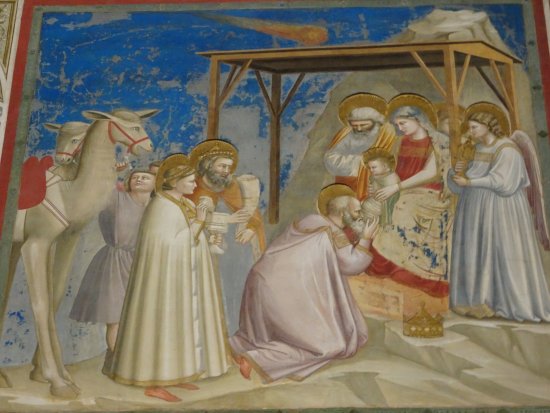
The English thought that the comet was an omen for war in 1066. William the Conqueror was much more optimistic he called it a “wonderful sign from Heaven” but then he’d taken the precaution of giving a daughter to the Church and persuading the Pope to call his invasion of England a crusade.
As luck would have it I am also in the midst of the seventeenth century at the moment so was mildly delighted when I came across Samuel Pepys account of a comet in 1664 seen above London.
So to the Coffeehouse, where great talke of the Comet seen in several places; and among our men at sea, and by my Lord Sandwic, to whom I intend to write about it to-night.
Sir Isaac Newton, a student at the time, searched the skies for the comet and Pepys hoped to see it for himself, not least because it had caused a plethora of prophesies – oddly none of them positive!
Mighty talke there of this Comet that is seen a ’night; and the King and the Queene did sit up last night to see it, and did, it seems. And to-night I thought to have done so too, but it is cloudy and so no stars appear. But I will endeavor it (December 17).
My lord Sandwich this day writes me word That he hath seen (at Portsmouth) the Comet, And says it is the most extraordinary thing that Ever he saw. (December 21)
Daniel Defoe mentions it as well in his Journal of a Plague Year – which despite appearances to the contrary is a secondary rather than a primary source.


It wasn’t long before the doom mongers were proven correct in both 1066 and 1664. In 1066 Harold Hardrada and William of Normandy both took the opportunity to launch an invasion of England. In 1664 people started dying rather unpleasantly from the plague and let’s not forget that there were two comets so that covers the Great Fire of London as well.


And just so we’re clear that fiery stars caused panic amongst the population here are a few more examples. In 1456 the Ottoman Empire invaded Hungary – their arrival pre-ordained by Halley’s Comet. Pope Callixtus III ordered prayers to be said in an effort to counter-act the comet.
Halley’s Comet turned up in 1910 – slightly early for World War One and even the sinking of the Titanic. Despite the fact that by the beginning of the twentieth century scientists had given the world a better understanding of what a comet was they could still cause chaos. In 1908 for example panic broke out in Chicago because people thought that the comet they saw (Moorhouse’s Comet) signalled the end of the world and in 1910 when Halley’s comet arrived you could purchase an umbrella to protect you from the comet – which was slightly optimistic as some scientists believed that the tail of the comet was filled with poison gas that would kill everyone when the Earth passed through it.
Obviously Halley’s comet didn’t kill everyone – that would be silly. No, it was just a sign that Edward VII was going to pop his clogs on 6th May in Buckingham Palace – not from comet miasma but from bronchitis. He was a man in his seventies who had over indulged for most of his adult life and who smoked heavily. It probably didn’t require a comet to predict his death.
And finally Giotto managed to paint Halley’s Comet as the Star of Bethlehem in 1305 – always nice to see a more positive construction of its appearance. The painting can be seen at the Scovegni Chapel in Padua.