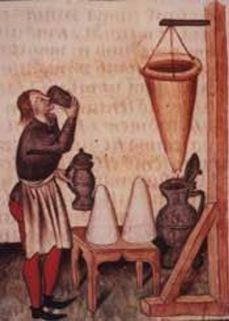
Image from Eliza Acton’s Cookery Book 1845 – smoking bishop
This is not a post about the demise of Thomas Cranmer during the reign of Mary Tudor – rather it’s another festive drink. This particular beverage retained its popularity into the Victorian period and gets a mention in The Christmas Carol.
It is effectively a mulled port. You will require a bottle of ruby port, an orange stuck with six cloves, sugar to taste and about 1/2 pint of water but that’s optional. Cut the orange in half and place it in the pan with the port and a little sugar. Bring it to simmering point and then set it alight. Allow it to burn for a few seconds. Pour into a punch bowl and dilute with water if you wish.
Apparently in earlier times the fruit might have been roasted to caramelise it and there might also have been red wine as well as the port. A smoking cardinal was made with champagne which seems like a waste of good champagne but that’s only my opinion. The recipe comes from the National Trust Book of Christmas and Festive Recipes.
And why the name? It has been suggested that it was served in Oxford and Cambridge Universities and medieval guilds in a bowl that resembled an upended mitre.
Ebeneezer Scrooge and Bob Cratchit sharing a bowl of smoking bishop.
Hannah Glasse The art of cookery made plain and easy published in 1747.
Sounds lovely – and it is the forerunner of Christmas pudding but it was served by way of an appetiser and was more of a broth than a pudding. In fact it contained meat, vegetables and raisins. Essentially this is an upmarket version of a pottage and could be boiled in a cauldron. Why do I get the feeling that I’m not particularly selling it to you?
As time passed more in the way of bread crumb was added as well as egg to thicken the whole concoction. Eventually the meat would be replaced by suet and it progressed from an introduction to the festive meal to the pudding.
Day 4: Throughout the medieval period the boar’s head was regarded as a key part of the Christmas festivities – unfortunately by the time of Henry VIII there weren’t any left so Henry was reduced to wild boar pate sent as a gift by the king of France.
The Boar’s Head Carol dates back to the fifteenth century and references the “rarest dish all the land.” The actual serving of pigs at this time of year dates back much earlier to Neolithic times. Archeologists at Durrington Walls have discovered pits of pig bones that tell a story of midwinter feasting. The Anglo-Saxons referred to November as “blood month” because animals that couldn’t be kept over winter were slaughtered and many medieval books of hours depict November with a pig about to meet his end. Even the Vikings get in on the pig eating act with sagas recounting feasting upon wild boar.
In wealthy medieval households the boar required much preparation. The head itself was stuffed with forcemeat and often gilded and decorated – it’s tusks may have been retained to make it look more lifelike and it might be given eyes created from sugar paste. It was carried to the table amidst much fanfare.
These days there are once again wild boar in England – follow the link for more information. I think I’ll stick to pigs in blankets and sausage rolls though.
Jumballs can be found in many different sixteenth and seventeenth century recipe books. They were a popular biscuit at the time. They could be flavoured with caraway seeds, rosewater or almonds depending on personal preference and what was in the cupboard.
25g (1oz) soft butter)
2tsp rosewater
70g (3oz) caster sugar
1 egg beaten
15g (2oz) caraway seeds
160g (6oz) plain flour
Preheat the oven to 180c. Line two baking sheets with greaseproof paper. Beat the butter and rosewater well together, then cream in the sugar.
Mix in the beaten eggs. Then add the caraway seeds and flour. Work the mixture into a dough. It should be possible to handle. If too wet, add some more flour. Separate the dough into balls the size of a walnut, then form them into rolls about 5mm in diameter and 15cm long. Shape into rings, knots and plaits.
Bake for 15 to 20 minutes. (knots and plaits will take longer than rings).
Tudor jumballs
This recipe comes from A Taste of Townend and were written by Elizabeth Burkett in 1699. Along with Christmas treats her recipe books contains cures and charms. Other recipes are available including one from the BBCGood Food magazine:
So why small biscuits in a festive count down to Christmas? – the spices and sugar would be expensive so these little biscuits represent a treat. They are also representative of the fact that society became more affluent because more people could afford the spices and sugars which were now becoming more readily available because of trade and the growth of Empire -which draws us on to the less pleasant fact that the sugar was becoming cheaper because it was being grown by slaves.
Sugar was taxed until the Nineteenth Century. If you couldn’t afford sugar then sweetness was provided by the use of honey. From medieval times until the Victorian period sugar was sold in cones or loafs. For more about sugar cones/loafs follow this link: https://livesandlegaciesblog.org/2018/12/13/all-about-sugar-cones/
Day two of the History Jar advent calendar of festive food and drink. Cristesmæsse is first recorded as a word in 1038. The Venerable Bede was not impressed with the Anglo-Saxon winter festivities:
They began the year with December 25, the day we now celebrate as Christmas; and the very night to which we attach special sanctity they designated by the heathen mothers’ night — a name bestowed, I suspect, on account of the ceremonies they performed while watching this night through.
Least said soonest mended I think! I don’t think we need linger on Bede’s disdain for the primitive behaviour of the locals. And rather unfortunately he did not think so far ahead as to ask for some recipes so we’ll just have to move on to the booze.
Wassail is a traditional Christmas and New Year toast. It comes from the Anglo-Saxon words for “to your health” – “waes hael”.
A wassail cup often involves quite a lot of cider but not always. It would be offered to guests throughout the festive period. In some cases a large wassail cup was taken from door to door (not appropriate in these socially distanced times.) The other kind of wassailing involves gathering in orchards to pour the wassail over the roots of the trees to encourage a good return on the next year’s harvest. This kind of wassail can involve singing to bees as well. It often takes place on twelfth night.
This recipe dates from 1722 from a book entitled Food in England by Dorothy Squires:
Take 1 lb. of brown sugar, 1 pint of hot beer, a grated nutmeg, and a large lump of preserved ginger root cut up. Add 4 glasses of sherry, and stir well. When cold, dilute with 5 pints of cold beer, spread suspicion of yeast on to hot slices of toasted bread, and let it stand covered for several hours. Bottle off and seal down, and in a few days it should be bursting the corks, when it should be poured out into the wassail bowl, and served with hot, roasted apples floating in it.
I’m not sure what “suspicious yeast” looks like but I think after that lot no one would particularly care. The National Trust has a rather more palatable looking recipe which could be served as an alternative to mulled wine. The are lots of modern versions available.
And the non- alcoholic version courtesy of Saga magazine:
Serves: 6-8
Ingredients
6 small cooking apples, cored
125g (4½oz) demerara sugar
1.5 litres (3 x 500ml bottles) of rich, fruity ale (I used a mix of Abbot Ale and Old Speckled Hen)
½ grated nutmeg
1 tsp freshly grated or ground ginger
Cinnamon sticks, to serve
Method
Preheat the oven to 120C/250F/gas mark ½. Bake the cored apples on a lightly greased baking tray for about 1 hour, until soft and easy to peel.
Meanwhile, put the sugar into a large heavy-based saucepan and cover with a small amount of ale. Heat this gently, stirring until the sugar dissolves.
Add the grated nutmeg, ginger and the rest of the ale. Stir and keep at a gentle simmer.
Cool the baked apples for about 10 minutes, then peel, reserving a few strips, and blend to a soft purée. Add this to the simmering ale and whisk thoroughly.
Leave to gently simmer for about 30 minutes. The frothy apples should rise to the surface. Ladle into sturdy glasses and serve with cinnamon-stick stirrers and a strip of peel.
Time for the History Jar Advent calendar and this year it’s festive foods and beverages.
In Ancient Rome dormice were kept in large terracotta pots called gliaria. And then they were fed hazelnuts, walnuts, cheese and pine nuts. Pliny says that they liked beechnuts as well. Erm – and then having been lovingly fattened up they were cooked. “There were also dormice rolled in honey and poppy-seed,” notes Petronius on one occasion. And I wouldn’t worry about the Roman rodent pots having an exercise wheel or not, apparently the glisglis sleeps for seven months of the year.
A glirarium exhibited at the National Archaeological Museum in Chiusi.
And before we all get carried away with the idea of Romans eating tiny dormouse at Saturnalia – their midwinter festival- it should be remembered that these dormice, the edible dormouse, are substantially larger than our native species.
glisglis- the edible dormouse- which is not native to the UK arrived in Tring in 1902 as part of Lord Rothschild’s wildlife collection…it escaped and can now be found in parts of the South East. They are protected by the Wildlife and Countryside Act 1981, so no giving them away to your guests to be fattened up.
The Roman cookbook entitled Apicius has the following recipe:
Stuff the dormice with minced pork as well as the flesh from all of the dormouse’s limbs, together with ground pepper, pine nuts, laser and liquamen and place them sewn up on a clay tile in the oven or cook them in a roasting pan.
Martial identifies dormice as a potential gift for guests but the Emperor Claudius banned this item from Martial’s list of 223 possible Saturnalia guest gifts as being too extravagant.
From the Lewis Carroll memorial window All Saints Church, Daresbury, Cheshire.
The dormouse being stuffed into the teapot is not an edible dormouse and thus not a suitable midwinter gift for an Ancient Roman or indeed anyone else for that matter.