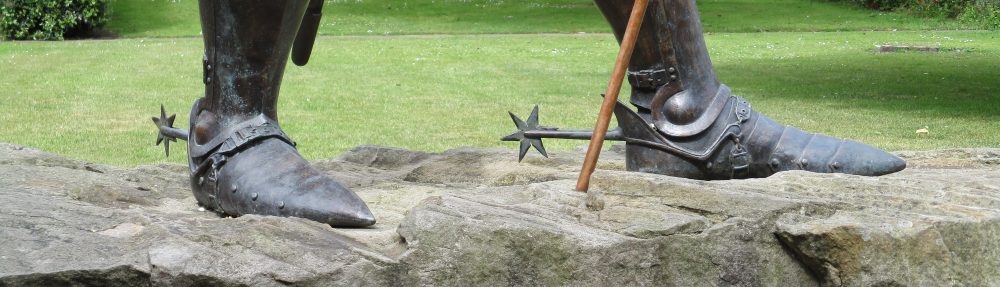
Getting a decent picture of the Earl of Derbys motte and Bailey castle is proving difficult- this is the result of the second attempt via Sheen!
It was built to protect, it is thought, the salt route from Cheshire into Derbyshire and so that the earl could levy taxes as the pack ponies carrying the salt entered the manor of Hartington. It also meant that any boundary disputes with the neighbours could be dealt with. Today though the place was deserted and I’m using an app on my phone to see if I can become more efficient at posting!
So much for posting every week – once again it’s been something of a summer! However, I’ve submitted the Dark History of Colchester to Amberley Press; discovered that collecting postcards is called deltiology; and nearly completed a Dark History of the Peak District. I’m collating images at the moment. And this is what led to today’s topic – a short round trip to gather photographs. And for those of you of a delicate disposition you may wish to turn away now.
The Magpie Mine near Sheldon first began mining for lead in 1740. Today it defines itself as the best preserved 19th century lead mine in the country. However, what its really famous for is the deaths of 1833. Rival groups of miners followed the Great Redsoil Vein of lead ore and rather unfortunately came to blows over who held the rights to it. Each group lit fires underground to force their rivals out. Three miners from the Maypitt Mine suffocated underground.
In all twenty-four Magpie Miners were arrested but when the case came before the judge at Derby it was decided that the Maypitt Miners should not have gone below ground in the circumstances nor did any one miner admit to having lit the fatal fire. Locally the legend of the ‘widows’ curse’ suggests that justice was served by other means.
The Magpie Mine’s Cornish engine house dates to 1869 – it was built at a time when the main shaft was deepened to 208 metres.
From there it was a hop and a skip to Ashford in the Water where you would have thought I’d have photographed the sheep wash bridge in the sunshine. I didn’t – I had a very lovely breakfast at the Ashford Arms before journeying via Monsal Head to the northern end of Cressbrook Dale and Peter’s Stone – or Gibbet Rock. In 1815 the toll house keeper at nearby Wardlow Mires was killed for her red leather shoes. Her murderer, Anthony Lingard from Tideswell was found guilty of the crime and executed at Derby. His body was transported back to the Peak District and suspended in the gibbet at Peter’s Stone as a warning to others – apparently it was the last gibbeting in Derbyshire. The view is rather cheerier these days.
From there it was a short journey to Tideswell, a quick look at the church and a hunt for the house of correction on Commercial Street – sadly it wasn’t very photographic because of the number of cars parked out front but I did have a look in the wool shop! Inevitably as we began the leg of the journey back to Buxton we paused at Litton Mill where poor apprentices died in their droves. Robert Blincoe, who was sent there from the St Pancras Workhouse, recounted his experiences and became the inspiration for Charles Dickens when he wrote Oliver Twist. Blincoe was initially apprenticed to a cotton mill in Nottinghamshire – without any payment until he reached adulthood – when the mill closed in 1802, Blincoe was sent to Litton. He detailed the horrors of a fourteen hour working day, savage beatings, starvation and abuse. Children who died at the mill were buried at Tideswell and Taddington.
From there it was on to Buxton and a nice cup of coffee in the Poole’s Cavern cafe. I had hoped to find some old postcards of the Peak District in town but there was no luck. It’s perhaps not surprising as deltiology is the third most popular hobby in the country after stamp and coin collecting.
Now I’m conscious that if I was currently receiving a mark for the frequency of my posts I’d receive something like ‘could do better.’ Fingers crossed!
It was said that the coming of the London and North Western Railway in 1863 from Stockport to Buxton was impacted by a supernatural skull, known as Dicky, when during the building work a railway embankment near Tunstead Farm when the line crossed the Coombs valley to Chapel-en-le-Frith slipped and the foundations of a bridge sank on several occasions. Eventually the company had to relocate the bridge. Local writers blamed Dicky for the expense and embellished the story with details of buried tools rather than consider that geology might have had its part to play.
The skull and the beleaguered inhabitants of Tunstead Farm was one of the most famous of the Peak District’s folk tales. In 1809, when John Hutchinson’s tour through the High Peak of Derbyshire was first published. Hutchinson met the owner of the farmhouse, Adam Fox, who claimed that the skull had been a feature of the property for the previous 200 years. There are several stories about the skull that used to be found at Tunstead Farm, near Chapel-en-le-Frith before its removal during the twentieth century to St James’ Church, Taxal, including the version that Ned Dixon was murdered by his cousin when he returned home after lengthy service as a soldier in Europe during the sixteenth century. Dixon’s murderous cousin was troubled by the appearance of the skull which remained at the farm despite attempts to remove it. By 1895, another story had sprouted: the skull belonged to a woman who was killed by her own sister during a quarrel over a man they both loved.
In reality, how the farm came to be home to the skull is a matter for conjecture. William Bunting, a historian writing in 1940, claimed that it was an archaeological find dating from the Iron Age.
Railway owners who developed lines and opened stations inside the Peak District discovered that passenger traffic was larger than they anticipated. By the 1840s it accounted for two thirds of their revenue. The Midland Railway opened at station at Buxton on 1 June 1863 from Derby while the London and North Western Railway opened its own, identical, station a fortnight later. Affordable travel drew day trippers from the middle and working classes who lived in the industrial towns that surrounded the Peak District. The new arrivals wanted more than hills and dry-stone walls. Dicky’s skull became part of the Peak District’s lore offering entertainment that appealed to the visitors and a method of boosting the local economy. It was even possible to buy postcards featuring the farm and the skull.
Inevitably, Dicky is not the UK’s only haunted skull. There are several purportedly screaming skulls. At Burton Agnes, in the East Riding of Yorkshire, Anne Griffiths was attacked and died soon afterwards having extracted a promise that her head would remain in the hall. Unsurprisingly her family did not comply with the request but soon wished that they had. To avoid continued disturbance Anne’s head was buried somewhere in the walls of the newly built house.
While history relies on recorded evidence – folk lore fills the gaps and there’s nothing like a spot of embellishment to improve a story in its telling!
There’re a variety of reasons why villages and settlements might have been deserted in the past. The obvious reason relates to the Black Death of 1348. Other reasons include landlords deciding to use an area for a new purpose. For instance, at Nether Haddon in the Peak District, the settlement was moved so that a new deer park could be created, Other settlements were relocated or abandoned due to an increase in wool production, enclosure and even the end of the monasteries which saw former monastic land end up in the hands of private landowners.
Climate change has its own story to tell – and at places like Hungry Bentley – also in Derbyshire which can’t have been particularly prosperous in the first place given its name – a couple of bad years would be enough to see a village deserted. Of course, living close to the coast could bring its own problems. Dunwich was once a thriving port but now its a ruin thanks to storms and coastal erosion.
In all there are about 3,000 deserted or vanished settlements in England – from across the centuries. The number of deserted medieval settlements in 1968 stood at 2,263 which was updated in 1977. Derbyshire had gained five lost settlements by that time rising from 33 to 37; the West Riding held steady at 75 settlements while Nottinghamshire had actually lost a settlement dropping from 67 to 66. The county with the biggest number of lost settlements is the North Riding of Yorkshire with 176 missing settlements. The University of Hull maintains a database of more than 2,200 sites.
Once upon a time Conksbury, which is on private property and not accessible, was part of the royal manor of Bakewell which William the Conqueror granted to William Peverel. He in turn granted land near Conksbury to Lenton Priory which he founded in Nottinghamshire while Conksbury was later given to St Mary de Pratis Abbey, Leicester by William Avenal – where it remained until the dissolution of the monasteries.
Henry VI hung on to it for a while as did the later Tudors but by 1610 it was part of the Cavendish family land holdings and as such remains part of the Devonshire estate. Magna Britannia states that Meadow Place Grange was given to Sir William Cavendish in 1552. The packhorse bridge at Conksbury was rebuilt in the 18th century to carry traffic and there were tolls for its upkeep from 1758 onwards.
After the Romans departed from Britain’s shores the towns and roads that they established began to decay. Even so, the roads continued to be used as did earlier prehistoric trackways. A road running between Buxton and Wirksworth, known as The Street, was still being used in the eighteenth century and lets not forget that King Alfred used Watling Street to mark the boundary between his own realm and Danelaw. The addition of the name ‘Gate’ to any road was originally the Norse ‘gata’ meaning road while street, meaning a paved road, originated from Latin but which was adopted by Anglo-Saxon road users.
It wasn’t until 1285 that the Statute of Winchester required individual manors to maintain highways that passed across them. It also required tracks and bridleways to be maintained. At Norbury, Sir Henry FitzHerbert was required to obtain a licence in 1305 to divert the old road which rather inconveniently passed through the courtyard of his house.
More people began to travel as markets were established and monastic houses founded. The Earl’s Way, heading east, from Leek was established by the Norman earls of Chester using some preexisting tracks. In addition to the earl using the route to travel to various parts of his estates in meant that his tax gatherers could also access the area more easily. Other routes from Leek to Macclesfield permitted monks to send wool towards Chester for export.
Long distance packhorse routes including Portway and Doctor’s Gate near Glossop carried goods from Manchester to Nottingham. It is thought that some of the way originated during the Bronze Age. Pack horse routes, often in the form of hollow ways, caused by the erosion of countless feet, carried salt, wool, lead and any other merchandise that required transport. Hartington which had its own market from 1203 onwards was at the hub of a number of pack horse routes including a route passing Minninglow in the direction of Wirksworth.
One of the paths running eastwards is called Gallowlow Lane. The low refers to a Bronze Age bowl barrow, long since robbed out. Its name is suggestive of a place of execution but there’s no extant evidence for a gallows there other than the name and its position in a prominent place in the landscape. More cheerily there’s also a Jaggers Gate heading from Buxton in the direction of Macclesfield. A jagger was another name for a carrier or packhorse man while a jag was the load that a mule carried. In Derbyshire the term began as a name for the packhorse trains that carried lead ore. Meanwhile, Doctor’s Gate was named after Dr John Talbot who is recorded as improving a section of the old road during the late fifteenth century. Black Harry Gate is an eighteenth century addition to the names of Derbyshire’s roads. He was a highwayman – which possibly explains why there are so many references to gallows and gibbets scattered across the area. Daniel Defoe would call the region a ‘howling wilderness’ when he visited, so it’s safe to assume that it wasn’t necessarily always particularly law abiding.
There are also coffin roads that enabled isolated communities to carry the coffins of their loved ones to the nearest church. The best known one runs from Edale to Castleton. Hollins Cross marked the point where funeral parties might stop for a rest and to offer prayers. The Peak District has nowhere near as many of this kind of path as Yorkshire and Cumbria.
Dodd, A.E. and Dodd, E.M. Peakland Roads and Trackways
I’ve written about the Augustinians of Dunstable before but I’m trying to decide whether I want to keep Medieval Dunstable (edited by Yates, Jean ) or not. It was one of five houses founded by King Henry I. By the time he died there were nearly two hundred Augustinian monastic houses in England which just goes to show how keen his nobility were to get into his good books. Apparently The Augustinians were not an enclosed order. The canons were all ordained priests who chose to live as a monastic community; they served the neighbourhoods where they lived as priests and offered hospitality. And that’s one of the reasons why Dunstable ended up with lands in Derbyshire. Situated on Watling Street, it was one of the busiest medieval roads in the kingdom but unlike the hotel chain which advertises a good night’s sleep the canons were unable to charge for the food and lodgings they offered. Instead, they were given gifts by grateful travellers.
Much of the monastic land was in the Dunstable environs as were the churches to which the canons held the advowson – or the right to appoint the priest. They also held land and churches in Buckinghamshire and, this is where I become interested, Derbyshire. Bradbourne Manor which was part of the Honour of Tutbury lay in the hands of the Cauceis family. Sir Godfrey de Cauceis granted the chapels at Ballidon, Brassington, Tissington and Atlow to the canons as well as the tithes at Aldwark and Lee Hall. (Yates, Jean, (Ed.), ‘Churches and Lands: Buckinghamshire, Derbyshire, Hertfordshire, Leicestershire, Northamptonshire & Oxfordshire’, in Medieval Dunstable, p.231.)
Unfortunately Godfrey died the following year and although the gift was confirmed, by the Archbishop of Canterbury, the Bishop of Coventry kept episcopal and parish rights for himself. With so many fingers in the pie it is perhaps not surprising that the prior at Dunstable took matters further. In 1215 the case went to Rome and three judges were appointed to take a closer look at the Peak District churches. The rector at Bradbourne, Robert, was the son of the previous incumbent and yes, Henry the vicar at Ballidon was also the progeny of the previous cleric. Both men were described as being incontinent – which has nothing to do with the modern meaning and more to do with the keeping of mistresses. I suppose that it’s only fair that William who was the chaplain at Tissington kept moth mistresses and hunting dogs. As a result of these discoveries, which all three men denied, the canons at Dunstable were allowed to appoint new vicars.
And just when it seems you’ve got a handle on these things in 1230, Pope Gregory extracted a tenth tax on the income from Dunstable’s Peak District churches. In 1242 the canons required a new charter for the church at Bradbourne because the old one was nibbled by mice. In the decades that followed the canons made an annual visit to the Peak District to inspect the books – and possibly to enjoy the countryside. Not that it was always plain sailing. Sheep, as any hill farmer will tell you, are quite keen on finding innovative ways to die and there were several years when disease took its toll but in general the wool trade was a profitable one at this time.
And it turns out that the canons held church rights along Watling Street while at Pattishall, the lord of the manor came to an agreement with the prior for him to stay three times a year depending on the number of horses he had with him (Yates, p.240.). The Augustinians already owned land in Northamptonshire – think of it as joining the dots. And there was the Augustinian Priory at Repton, virtually on the doorstep.
Dunstable’s ownership of various Peak District lands and churches came to an end in 1540 with its dissolution. However, Medieval Dunstable is going back to its place on the bookshelf – the section about Derbyshire is small but extremely useful and I have been reminded that I need to retake photos of the various churches that Dunstable held but possibly not on a day when the rain is coming in horizontally.
Well this is very exciting – I’m in the window of Waterstones in Derby! The History Press publication The Little History of Derbyshire is in the window…yes I did a little dance of happiness and have been photographed standing next to it.
Someone asked me how much I enjoyed writing it – and the answer is that I absolutely loved it the research process. I guess one of the things we’re all slightly guilty of is not visiting places on our own doorsteps, so it was a real pleasure to revisit locations I hadn’t been to for years and others that I’d never seen. I also became fascinated by the importance of geology and the development of infrastructure which impact on the prosperity of different locations as well as their evolution as settlements. Derbyshire is quite unusual in that there was no dominant noble family for many centuries after the de Ferrers earls of Derby blotted their copy books and Henry III ordered that Duffield Castle should be demolished, thus removing the county’s largest and most significant keep. Instead, more middling families assumed roles and responsibilities within the county working for the Dukes of Lancaster and, in due course, Lancastrian monarchs. By the fifteenth century Derbyshire’s gentry, of which there were about 30 families, were both prosperous and influential.
And the other thing I really enjoyed was turning my hand to some pen and ink drawings to illustrate the book. This pair didn’t make it into the book. It’s a quick sketch of the Thomas Cokayne and his wife Dorothy in St Oswald’s Church, Ashbourne. The Cokaynes were one of the gentry families who played a significant role in Medieval Derbyshire. Thomas was in the household of the 5th Earl of Shrewsbury, he took part in Henry VIII’s Rough Wooing in 1544 and was knighted by Edward Seymour for his part in it – notably the burning of Edinburgh. In 1587, he was one of the gentleman warders of Mary Queen of Scots on the orders of the 6th Earl of Shrewsbury. The following year, again on the orders of Shrewsbury, he joined other members of the Derbyshire gentry, as justices of the peace, recruiting men and arming them in preparation for the Spanish Armada.
My starting point for this post is Ralph FitzHubert who was one of Wiliam the Conqueror’s tenants in Derbyshire. He made his home at Crich even though the majority of his Derbyshire manors were closer to Chesterfield and he held other estates in Nottinghamshire – Crich was perhaps convenient to access his manors. Crich, with its woodland pasture, was home to the king’s deer – which all belonged to the Crown. So far so good. Ralph is sometimes called Hubert of Ryes because he was the eldest son of the lord of Ryes near Bayeux and in Derbyshire he had six under tenants and was required to put a total of 30 knights in the field in return for all his land holdings.
Rather unexpectedly I found his younger brother was someone I’ve written about before. Ralph’s brother Eudo, who along with his three other brothers and father, arrived in England after 1066. Eudo held extensive lands in ten counties and by 1072 he was the steward or dapifer to the royal household. He was with William the Conqueror in Rouen when he died and he accompanied William II or William Rufus as he’s better known back to England. He continued as dapifer. Basically, he was a very powerful man and he married into a powerful family – his wife was Rohese de Clare.
He is also part of the group of men suspected of having William Rufus assassinated in August 1100. As conspiracy theories go the idea that the de Clares and their extended kinship network gave William’s little brother Henry a helping hand to the throne is not a new one and like all good theories there’s not a lot of evidence kicking around. Nor should it be added that he was ‘heaped with rewards’ if he did play a part in William’s demise (Frank Barlow, p.172).
Dapifer held extensive estates in East Anglia and played an intrinsic part in the building of Colchester Castle. His only child, a daughter called Margaret, was married to William de Mandeville. Eudo was the grandfather of Geoffrey de Mandeville, Earl of Essex. After Eudo’s death his estates largely reverted to the Crown – which led to a disagreement between the king and Geoffrey in the matter of who owned Saffron Walden, Sawbridgeworth and Great Waltham. The case was only resolved during the Anarchy when King Stephen granted Geoffrey the estates that he claimed the Crown had taken unlawfully.
All in all, I’m a long way from brother Ralph in Crich. His descendants took on the name FitzRalph and his son Odo FitzRalph of Bunny in Nottinghamshire inherited the lot. However, the estates were broken up by female inheritance. And as a final aside, the place name has nothing to do with bunny rabbits – I was always taught that the Normans introduced rabbits to Britain but it turns out from archaeological finds at Fishbourne Roman palace that it was the Romans and even more amazing it wasn’t lunch – it seems to have been someone’s pet lepus.
Barlow, Frank, William Rufus, (2008)
Warren Hollister, C, ‘The Strange Death of William Rufus’, Speculum, Vol 48. no.4 (Oct 1973), pp.637-653
Here we are for the History jar advent calendar 2022 – where did the year go? It’s going to be a bit random this year but I will attempt to sneak something festive into each post – ok very tenuously- which is why we’re starting 800,000 years ago during the Ice Age which is well outside the History Jar’s usual remit.
For much of the ice Age, ice sheets several meters thick covered Derbyshire so people could not live in the area. These ice sheets covered much of the northern hemisphere – further south the conditions were more akin to the tundra of Siberia. However, as the ice sheets retreated the conditions became sub-Artic or if you want to call it by the right name periglacial. This resulted in very cold winters but milder summers. Occasional finds of flint hand axes show that people hunted in the area.
Thor’s Cave in the Manifold Valley – which is in Staffordshire rather than Derbyshire yielded stone tools, pots and amber beads when it was excavated by the Victorians and again during the 1920s. These finds are thought to come from the end of the Palaeolithic Period.
Even more spectacular are the limestone caves at Creswell Crags on the Derbyshire/Nottinghamshire border which is believed to be among the most northerly of dwelling places during the last Ice Age. Finds included stone arrowheads, woolly mammoth bones, woolly rhinoceros and giant deer bones – yup- all this for giant deer –
Evidence suggests that hunters moved into the caves before the ice sheets advanced south and that the people who lived there were forced south themselves along with the rhinoceros, horse and bison that they hunted. They returned when the ice sheets retreated. Eventually the woolly mammoth and rhinoceros disappeared as the climate grew milder. Hunters relied on deer for their meat and the tools that archeologists have discovered changed as well.
The earliest British art comes from Cresswell Crags – the British Museum is home to a bone discovered here engraved with a drawing of a horse. The walls of Church Hole Cave contain marks that are deer and bison.