Godiva, Eustace and a fracas in Dover

eustace.jpgBoulogne had once been a vassal state of Flanders but when Baldwin IV of Flanders was a minor Boulogne took the opportunity to declare its independence.  As the eleventh century progressed the relationship between the Flemish and the people of Boulogne evolved from one of animosity to alliance and back again.  However, Boulogne ensured its borders by making alliances with the up and coming power house – i.e. Normandy.

Eustace I arranged for his son, also handily named Eustace to marry Duke Richard of Normandy’s niece. Goda or Godiva and her brothers Edward and Alfred had been sent to Normandy for safety in 1016 when the Danes invaded England.  In due course their mother Emma had married King Cnut, her first husband Aethelred the Unready having died.

Goda had been married off first of all to Drogo of Mantes who was the Count of the Vexin – an area that would be increasing contested between the dukes of Normandy and the kIngs of France. Her first marriage was in 1024 and there were three children including Walter who would become Count of Vexin in his turn.  He died in 1063 along with his wife having been captured by William of Normandy – make of that what you will.

By 1035 Goda had been widowed so Duke Richard married her off to Eustace of Boulogne making him the brother-in-law of Edward the Confessor.  Eustace and Edward remained on good terms even after Goda’s death.  Eustace visited Edward in 1051 which was unfortunate as Edward’s most powerful earl – Godwin had recently married his son Tostig to Judith of Flanders.  If you recall back to the start of this post Boulogne and Flanders did not always exhibit warm and friendly feelings to one another!

Eustace and his retinue left England via Dover where they got into a fight with the people of the town. About twenty of Eustace’s retinue were killed. Edward the Confessor was not impressed and ordered Godwin to punish Dover – which was part of his earldom.  Godwin refused. It led to a furious argument that resulted in Godwin being given his marching orders and Edward the Confessor’s wife being packed off to a nunnery.

Eustace would return to England in 1066 as part of William of Normandy’s army is featured on the Bayeux Tapestry as seen at the start of this post- so he can’t have been too perturbed about his step-son’s death in 1063.


Viking rulers in England- the late tenth and early eleventh centuries

Harald_Blåtand_(Roskilde_Domkirke)

Harold Bluetooth -Roskilde Cathedral

Having completed a run through of the Anglo-Saxon kings in the run up to the Norman Conquest I thought it would be useful to cover similar ground for the Vikings.  I’m prone to describing them as freebooters – in order to demonstrate Æthelred’s lack of common sense in trying to pay them off.

During the reign of Edgar the Peaceful  who ruled from 959 until 975 it seemed as though England had got itself sorted.  It was effectively one kingdom and there was political stability. Edgar applied taxes and also reformed the coinage – which helped him to finance a naval force to deter would be raiders.

After Edgar died the Vikings returned. Æthelred was unable to repel them and all that lovely new coinage found its way into Viking hoards.  35,000 English coins from his reign has e been found in Scandinavia to date.  Martin and Hannah Whittock explain that it was Edgar’s reformed coinage with its high silver content that was the lure to the Vikings.  It turns out that the silver mines that the Islamic world had relied on until this point were exhausted.  Countries to the east were beginning to establish themselves and repel Viking raiders who had found easy pickings in the past.  These twin causes had the effect of the Vikings looking elsewhere to maintain their wealth.  By chance Western Europe had a new supply of silver – from the Hare mountains.

Part of Æthelred’s problem was that in Denmark King Gorm had managed to establish a more unified state.  This was followed up by Harold Bluetooth, Gorm’s son, who extended the range of his influence to Norway.  His first achievement is usually listed as uniting Denmark under a single ruler. Bluetooth constructed forts and united resources based on his expanding wealth – this meant he had a larger force of men to command and they were more organised.  Secondly he became a Christian and converted all the Danes and Norwegians – part of the reason for this was not just because Harold had been tolerant of Christians but because Otto the Great, the Holy Roman Emperor of the time had taken the opportunity to interfere in Danish affairs there was a war.  The outcome was a Christian nation. It’s a bit unclear as to whether it was Harold’s way of keeping Otto at arm’s length or that Otto won the war and insisted on Christianity.  in either event it had the effect of further unifying the Danes.

Meanwhile in Norway a similar story can also be told.  Harold Finehair dominated Norway following a sea battle in 872.  This unity fractured with his death and this was what allowed the Danes to dominate Norway through local earls.  However for a short while Olaf Tryggvason, who was apparently Harold Finehair’s great grandson if you believe the sagas,  was able to rule independently from the Danes.  He was an active raider prior to becoming King of Norway.

sweyn-forkbeard-invade-england

Sweyn from a 13th century illustration held by the University of Cambridge.

Sweyn Forkbeard was Bluetooth’s son. He ruled Denmark from 985 until his death in 1014.  He invaded England and dethroned Æthelred the Unready in 1014.   We know about Sweyn from the Anglo Saxon Chronicle and from the later Icelandic Sagas that drew on the oral tradition.  According to the sagas Sweyn was a mercenary who deposed his father and started raiding England.  Bluetooth died in exile shortly after  Sweyn booted him off the throne.  At the beginning of Sweyn’s reign he formed a loose alliance with Olaf Tryggvason of Norway although this alliance would fracture in due course.

The Anglo Saxon Chronicle records the rise in number of Viking attacks throughout the 980s. In 993 the Earl of Essex – Byrhtnoth- wrought his own defeat by allowing the Viking army that he confronted at Maldon to access land on the same level as that as his own army – honourable but not tactically terribly helpful. Æthelred paid £10,000 to the Vikings so that they would go away.  The Vikings in question were Norwegians led by Olaf Tryggvason.

The following year Sweyn  Forkbeard of Denmark joined in the attack on England – a different confederation of Vikings who were looking to cash in on Æthelred’s inability to repel them.    In 994 it appears that Olaf was baptised at Andover.  He stopped raiding England.  It may have been part of a Danegeld treaty.  There was also the small matter of his move to become king of Norway and the imposition of unity upon the country – although admittedly this declined the further north he got.

swen_smrt-2Sweyn continued his campaign.  In 1002 Æthelred ordered the murder of all Danes on English soil on St Brice’s day – hardly a move designed to pour oil on a troubled situation.  It didn’t help that Sweyn’s sister Gunhilda may have been one of the victims.

Various annals record the raids which culminated in a successful invasion of England in 1013.  Forkbeard died five weeks after his conquest at the beginning of 1014.  Some sources indicate he fell from his horse at Gainsborough but the thirteenth century illustration along side this paragraph depicts the other version of his demise – at the hands of the ghost of St Edmund.

Edmund of course is the East Anglian king after whom Bury St Edmunds is named.  He died in 869 having been shot to death with arrows by an earlier wave of Vikings.  He was rather popular  during the reign of Æthelred as people prayed to the martyred king for salvation for the current crop of Vikings – which would account for Sweyn being skewered by a ghost.

Sweyn was succeeded by his son Cnut who married Æthelred’s widow, Emma of Normandy in 1016 on the understanding that any son that they had together would inherit the Crown upon Cnut’s demise.  Cnut was in his turn succeeded by  Harold Harefoot in 1035 and then Emma’s son Harthacnut in 1040.  Harthacnut, Emma’s son, had become king of Denmark upon his father’s death.


https://www.telegraph.co.uk/comment/11831753/The-oppressive-Danish-king-impaled-by-St-Edmund-of-the-East-Angles.html

Whittock, Martyn & Hannah. (2016) 1016 & 1066: Why the Vikings Caused the Norman Conquest. Marlborough: Robert Hale


What happened to the Cerdic line in 1016

sweyn-forkbeard-invade-england

Sweyn from a 13th century illustration held by the University of Cambridge.

From now until Christmas I shall be focusing on the eleventh and twelfth centuries – so its the Norman Conquest; William’s sons who ruled for another 48 years after their father’s death; followed by the Conqueror’s grandchildren Stephen and Matilda and the so-called Anarchy.

The key date is, of course, 14th October 1066, the date of the Battle of Hastings.  At the beginning of the century Sweyn Forkbeard’s invasion of England had caused Æthelred the Unready to flee to the Isle of White.  By April 1016 Æthelred  was dead.

Edmund_Ironside_-_MS_Royal_14_B_VI-2His son Edmund Ironside came to an accommodation with Forkbeard’s son Cnut following Edmund’s victory over Cnut at the Battle of Assandun on October 18th 1016 but by November 1016 he was dead as well.

Emma of Normandy
The problem for the Witan was that the Cerdic line of Saxon kings had heirs but they were not seasoned warriors. Edmund’s sons Edmund and Edward, were babies whilst Ironside’s brother was eighteen and with few supporters.  Ironside’s half brothers by Æthelred’s second wife Emma of Normandy were twelve and thirteen respectively.  Emma sent them for safety to Normandy as depicted in the illustration to the right of this paragraph. The Witan, having few options available, voted that Cnut should be king of England.King-Cnut-stowe_ms_944_f006r

Ironside’s brother Ædwig was swiftly dealt with probably because he was stirring up rebellion in the south of England.  He had initially fled the country but then returned to England.  Cnut could not be seen to have him executed so it’s thought that Ædwig’s murder was on Cnut’s orders.

Ironside’s sons Edmund and Edward were packed off to Sweden and King Olaf who was either a half-brother or foster brother to Cnut.  Cnut appears to have sent a note suggesting that if the infants had a very nasty accident he wouldn’t be unduly perturbed.  Olaf ignored the hint  and sent the two boys to safety in Hungary where they were raised as princes.  Emma of Normandy’s sons Edward and Alfred had already been sent off to Normandy on the understanding that when Emma married Cnut any son she might have with Cnut would be the heir to the throne – so for the time being they were also discounted.

Cnut used the Saxon system of administration that had raised the Danegeld that Æthelred paid to ensure that he had sufficient taxes to pay for a fleet and a standing army of professional soldiers. These men were initially Danish but it wasn’t long before Saxons were included in their number. The shires and hundreds that remain on the maps even today remained in situ with Cnut’s earls or thegns administering their land holdings on a semi-independent basis but remembering to remain loyal to Cnut.

During this time Cnut favoured Godwin who he made Earl of Wessex.  Earl Godwin was a Saxon demonstrating that Cnut quickly amalgamated his following and that the Saxons were pragmatic about their new situation.  Godwin went on to marry Cnut’s sister-in-law Gytha.

Chambers, James. The Norman Kings

Eadburgh – royal poisoner

Beorhtric_of_Wessex

King Beorhtric of Wessex – 13th Century Geneological Roll

Elfrida, mother of Æthelred the Unready has had a bad press historically .  She’s usually cited as the reason why the Saxons didn’t really do queens.  There was the small matter of her first husband’s death in a hunting accident and the assassination of her step-son Edward the Martyr at Corfe Castle. However the writers who were busily turning her into an assassin usually had their own particular axe to grind.

Eadburgh was a similarly dangerous high status woman.  Her father was King Offa of Mercia who lived at the end of the eighth century.  She turns up in Asser’s life of King Alfred on account of the fact that she accidentally poisoned her husband.  The error wasn’t that it was an accidental poisoning. It was an accident that the wrong person drank the poison, she had been attempting to get rid of one of her husband’s nobles and managed to kill them both if you believe the story.

It should be noted that Asser liked a moral fable so the handsome queen ended her days as an impoverished beggar having had a run in with Charlemagne and a bit of an exciting time in a nunnery before ending up on the streets of Pavia.

Asser included the tale of Eadburgh because the unfortunate spouse was King Beorhtric of Wessex who became king in 787.  Offa’s plan was to build political alliances between Mercia and Wessex through the marriage with him as the dominant partner. Offa and Beorhtric worked together to drive another Cerdic claimant, Egbert, into exile. Egbert was Alfred’s grandfather.  Egbert took himself off to the court of Charlemagne.

Meanwhile Eadburgh became a little bit over possessive of her husband.  She poisoned Beorhtric’s favourites so that she would always be the person most important to his counsels – thus ensuring the Mercian position would always be dominant.

egbert_-_ms_royal_14_b_v

King Egbert

Having accidentally poisoned Beorhtric in 802 Egbert returned from his extended European holiday and Eadburgh found herself without a home.  She couldn’t return to Merica as Offa had also died so she packed up her belongings and went off to Charlemagne bearing gifts.

Charlemagne must have liked the look of her because he asked her who she would rather marry – him or his son. Eadburgh opted for the son and was told that had she chosen Charlemagne she might have been the mother of a prince – as it was she wouldn’t get either of them!  Charlemagne packer her off to a nunnery as an abbess.

Old habits die hard and she took a lover.  When she was discovered she was evicted from the nunnery – thus ending up as a beggar.  Asser says this is why the Kings of Wessex were not terribly keen on anointed queens. Elfrida who was the wife of King Alfred’s great-grandson became the first anointed queen of England.

Elfrida received bad press on account of a falling out with Dunstan and later writers blackened her name with each new retelling.  In Eadburgh’s case the story is also dubious but Asser in blackening Eadburgh’s name was creating propaganda against Mercia which  began the period in a more dominant role to that of Wessex. Asser paints Eadburgh as an unnatural sort of woman being more dominant than her spouse.  He also paints her as a poisoner – not a very noble method dispatching your enemies. In reality Egbert was probably not sitting around waiting to be summoned back to Wessex.

Eadburh, Queen of the West Saxons” by Susan Abernethy, The Freelance History Writer

More on Saxon kings and their wives

king edgar

King Edgar from Edgar’s position in the genealogical roll of the Kings of England © The British Library Board, Royal 14 B. VI. Accessed from https://www.royal.uk/edgar-r-959-975.

Alfred’s son Edward the Elder was a much married man.  Unfortunately we have to rely on later writers for much of our information.

For example Edward’s children by his first marriage to Egwina are described by William of Malmesbury in the twelfth century as illegitimate.  This is probably unlikely as one of his sons with Edwina was Althelstan whose rule was not contended when he became king after Edward the Elder died.  It is reasonable to assume that had there been a question mark over his legitimacy one of Edward’s other sons would have stood a better chance of becoming king – having said that legitimacy wasn’t necessarily the issue that it became later on.

Edward’s eldest son by his second marriage to Elfleda was called Edwin and he died in 933.  Weir notes that he may have been murdered on his half-brother’s orders. Two sons of Edward’s third marriage to  Edgiva would wear the crown in their turn.

Rather conveniently for us Athelstan never married.  He was succeeded by his brother Edmund who added the tag “the Magnificent” to his name and managed to marry himself to a saint in the first instance and then to an Ethelfleda who became a nun in the second.    Edmund was murdered in his own dining hall in 946 and succeeded by his brother Ædred or Edred depending on which spelling you happen to prefer. Between the Danes and assorted assassinations it was clearly not a good time to become a monarch no matter how magnificent you might have been.

By the time Edred died Edmund’s sons were considered old enough to inherit so first Ædwig (or Edwy) became king and he in his turn was succeeded by his brother Edgar.   If you recall from the previous post Edwy who was only a young teenager allegedly had a fall out with St Dunstan.  Edgar on the other hand came to rely upon Dunstan who encouraged the king to found abbeys and ensure that papal taxes were paid – resulting in Edgar being known as “the Peaceable” and being made a saint.

Having offered you a saint and a murder or two it’s now time to introduce Edgar’s lady wives.  Firstly Edgar married Ethelfelda – a popular name- so the sobriquet “the fair” is usually added to differentiate from all the other Ethelfledas. Sometime between 962 and 964 Ethelfleda died or if you prefer the scandalous version Edgar divorced her and sent her off to a nunnery so that he could marry wife number two with whom he was said to be conducting an adulterous affair.

Wife number two is  Elfrida – which isn’t entirely helpful as the names of the two women are alarmingly easy to swap around. Elfrida had been married firstly to Ethelwald, the Ealdorman of Devon. There is a question mark over the ealdorman’s somewhat convenient death.   When she was crowned in Bath Abbey on 11th May 973 alongside Edgar she became the first recorded instance of a coronation for a queen of England – she did not set a particularly good example thereafter.

When Edgar died in 975 he was buried at Glastonbury Abbey and his son by Ethelfleda (wife number one) became King Edward…the Martyr.

Alison Weir Britain’s Royal Families

From greatness to disaster. Alfred to Athelred

Ethelred_the_Unready

Æthelred the Unready from a thirteenth century copy of the Abingdon Chronicle.

Alfred was succeeded by his son, Edward the Elder who ruled until 924. Edward had campaigned against the Danes during his father’s life time just as Alfred had been his brother’s lieutenant before he in his turn became king.

Edward didn’t automatically become king.  Applicants for the Crown were required to present themselves to the Witan.  Although Edward was the son of Alfred his cousins who had been bypassed when Alfred became king because of their youth were now men. Eadweard and Ethelwald both wanted to become the next king of Wessex.

Ethelwald fermented rebellion and seized Crown lands but was swiftly kicked into touch.  He reacted by taking himself off to Norse ruled Northumbria before returning at the head of an army in 905 when he was killed. Unfortunately for Edward the Elder the battle was actually won by the Danes so he had to negotiate a settlement.  Borders and boundaries became rather fluid after that.

Edward was able to work with his sister Æthelflæd, The Lady of the Mercians to secure territory from the Danes.  Howel the Good of Wales eventually accepted Edward’s overlordship as did the Kings of the Scots and Strathclyde when they met Edward at Bakewell in 920.  Edward died in 924 following a Mercian uprising.

Edward certainly extended the Cerdic line.  He had somewhere in the region of  eighteen children including his son Æthelstan who succeeded his father and ruled until his own death in 939. Unlike his father who the Mercians regarded as a king of Wessex, Æthelstan who had been reared in Mercia was accepted there before he was made king of Wessex.  In 927 he was victorious over the Vikings in York making him effectively the ruler of England (remember Scotland was somewhat larger at that time extending down through Cumbria into Lancashire.) In 934 he invaded Scotland.

Æthelstan wished to extend law and order.  He built on the legal reforms of his grandfather Alfred which is understandable as he had a rather larger kingdom than his predecessors.  When he died rather than being buried in Winchester he was interred in Malmesbury Abbey and succeeded by his brother Edmund.

It was not a peaceful time and Edmund was eventually murdered.  He was succeeded by his brother Ædred who was king from 946 to 955.  In 954 Ædred effected the removal of Eric Bloodaxe from the Kingdom of Northumbria.  When he died the following he was succeeded by his nephew, Æthelstan’s son, Ædwig.  He was only fifteen.  Four years later he was dead. Poor Ædwig had a bit of a reputation allegedly having been caught by St Dunstan consorting with two ladies of ill repute on the night of his coronation. More likely the tale arose out of the feud between the secular and clerical world for the control of the king’s ear.

After Ædwig’s death his brother Edgar became king.  Edgar is known as Edgar the Peaceful. He ruled from 959 (he was sixteen at the time) until 975. He relied upon St Dunstan for advice. He honed the laws and set about standardising currency.  He wasn’t without scandal though.  He allegedly killed a rival in love and when he was crowned in Bath had his wife crowned alongside him – a first for the kings of Wessex. The coronation took place in 973 – rather than at the start of his reign. We will be returning to Edgar’s problematic love life in due course.

Edgar was succeeded by his son Edward in 975.  Edward was murdered in 978 where upon he became known to history as Edward the Martyr and modern historians are increasingly keen to point the finger of blame at his step-mother Ælfthryth who was Edgar’s second or third wife.   Edward had been virtually of age when he became king and had the support of the Church.  The death of Edward at Corfe left the way clear for Ælfthryth’s son Æthelred to become king even though he was still a child.

Æthelred was king from 978 until 1013. Initially his mother was his regent. Æthelred the Unready or ill-advised had Viking problems.  He’s the chap who paid vast sums of Dane-geld to the marauding Norse not understanding the free lance relationship they had with their leaders or the fact that handing over great wages of coin was actually somewhat counter productive.

In 1013 King Sweyn Forkbeard invaded England and Æthelred fled to Normandy. Sweyn died the following year. Æthelred returned and ruled until he died in 1016.

He was succeeded by his son Edmund Ironside. It was a short reign from April to November 1016.  The summer of 1016 was a summer of battles.


Wessex’s kings from Ine to Alfred

Æthelred_-_MS_Royal_14_B_VI.jpgBede’s history identifies the most important kings of England’s Saxon world along with plenty of skulduggery, murder and back stabbing. Northumbria, Mercia and Wessex began to emerge from the melee as the dominant kingdoms.  Unfortunately for the first two kingdoms on the list the Danes turned up.  In 865 a major invasion occurred upsetting the see-saw of power between Northumbria, Mercia and Wessex.

Asser listed King Alfred’s ancestors back to Adam demonstrating that if you wanted to be a king of England you needed to be good in a fight (or know someone who was); have a genetic claim to the Crown and be able to demonstrate a link to a) mythical heroes, b) Biblical personages and saints or c) a god of some description.  It’s interesting to note that the Cerdic line had moved its claim from Woden to the Garden of Eden.  It’s also interesting to note that Henry Tudor used exactly the same techniques to assert his right to rule.

685-688 Caedwalla – ruled for three years, went to Rome was baptised and died.  Written about extensively in Bede’s History.

688 – 726  Ine wrote the first surviving English legal code.  Like his predecessor he went to Rome.

726-740 Æthelheard is supposed to have been Ine’s brother-in-law but there isn’t much in the way of evidence.  His Cerdic claim was not something that ought to be examined too closely.  His crown may have come about because of the support of the kingdom of Mercia reflecting that Wessex was still a little kingdom whilst Mercia had become much more politically significant.

740-756  Cuthred might have been Æthelheard’s brother but again history isn’t absolutely sure.  Certainly the kingdom of Mercia was dominant during this period as Cuthred joined the Mercians fighting against the Welsh.  In 745 Cuthred’s son attempted to depose him and there was a rebellion against him.  In between all of that Cuthred fought off Mercian overlordship that had compelled him to go to war against the Welsh.

756-757 Sigeberht became king of an independent Wessex but was promptly deposed by Cynewulf who ruled until 786 when Sigeberht’s brother murdered Cynewulf in his turn.

786-802 Beorhtric ruled Wessex.

786-802 Egbert became king. His father was king of Kent, a descendant of Ine’s brother so the Cerdic claim was back on the cv.  The power struggle with Mercia continued, ultimately resulting in the defeat of Mercia followed by the king of Northumbria who submitted to Egbert at Dore (just outside Sheffield).  Egbert had become Bretwalda.  This was only temporary.

839-858 Æthelwulf was Egbert’s son. Æthelwulf had six children including a daughter Æthelswith who was married into Mercia as part of a political agreement between the two kingdoms.  By this time the Danes were making their presence felt but he still felt able to go on pilgrimage to Rome. He was succeeded in turn by three of his sons; Æthelbald, Æthelbert and Æthelred (pictured at the start of the post.) The eldest of Æthelwulf’s sons died before his father.

Æthelred died in 871 and was succeeded by his brother Alfred who ruled until 899. Æthelred had sons but they were too young to rule which was an important factor at this time as the war between the Saxons of Wessex and various Vikings had not been settled by a Saxon victory at Ashdown.  Alfred who had seen various battles was far more experienced in the art of warfare.  The results of the warfare were inconclusive but gradually Alfred found himself losing territory to the Danes.  He must have wondered whether he would eventually be driven into exile like his brother-in-law of Mercia.  After all, he had started his campaign against the Vikings helping to defend Mercia and was now watching Wessex gradually shrinking.

In 878 the Viking army made a surprise attack in the middle of winter and if you believe such things Alfred found himself in Somerset contemplating his future and burning cakes.  It looked as though Wessex had gone the way of Mercia and Northumbria.  However disaster was averted and his descendants continued to rule in succession until 1016. Alfred, is of curse, the only English monarch to be afforded the title – The Great.


Brooke, Christopher.  The Saxon and Norman Kings.

Small kingdoms – a start

illustration-Cerdic-edition-John-Speed-The-Theatre.jpgI was interested to read that most English shires took a form that we would recognise today by the end of the tenth century – excepting those northern counties permanently unable to decide whether they were Scottish or not, oh and Rutland.

Kent, Sussex and Essex were once been kingdoms in their own right rather than counties.  Sussex was established in the fifth century by  Ælle who founded the South Saxon kingdom.  Meanwhile the “South folk” and the “North folk” found themselves being ruled by Rædwald who joined the people of Suffolk and Norfolk in to the kingdom of the East Angles – and so, at a stroke, we have a modern region identified.  In fact Brooke describes the county, regional and town names of England as being like a palimpsest leaving bits and pieces of history littering the landscape.

For the purpose of this post it also demonstrates that history does not happen in a vacuum.  Things evolve gradually over time.  Thus the starting date of 1066 for the History Jar is somewhat arbitrary as Duke William of Normandy, Edward the Confessor and Earl Harold did not spring fully formed from thin air on the 1st January that year.

Our story begins, if family is important, with Cerdic who was an Earldorman and war leader.  In 495 he conquered, if the Anglo Saxon Chronicle is to be believed, parts of the south coast and the Isle of Wight.  Just for context this is the time that the historical King Arthur was supposed to be doing battle on behalf of the Romano-British against the raping, looting, pillaging Saxons and Angles.

Cerdic’s family, which were in all probability Celtic in origin (hence the name), hung on to the land that Cerdic took and by the time of his grandson the Gewissæ as Cerdic’s people had became known dominated their little portion of land.  They didn’t do quite so well in the seventh century when the kingdom of Mercia spread down into the top end of the Thames Valley but that was okay because the Gewissæ relocated into the southwest as well as holding their original southern territories. The most important “petty” king of the Gewissæ  of this period was Cædwalla.  Under his rule the Gewissæ became known as the West Saxons – Wessex.

Cædwalla ruled from 685-688 and was succeeded by Ine who ruled until 726. Wessex was basically Dorset, Wiltshire and Hampshire.  Cædwalla justified his right to rule not from the fact that he was handy in a fight but because he claimed descent from Cerdic – Brooke notes that its impossible to prove that particular fact.  More important even than that so far as posterity was concerned Cædwalla took himself off to Rome got himself baptised by the pope and then promptly died – ensuring that he got into Bede’s history as a shining example of a Christian life.  Poor Ine ruled for thirty-seven years and created a written code that establish clear laws- the earliest one to survive (probably thanks to King Alfred) but Bede spent more time writing about Cædwalla.

Neither of the two Cerdic leaders identified in the previous paragraph were counted as great kings.  There were plenty of little kingdoms. A single kingdom could even be ruled by several warlords.  However from time to time a great warrior would arise who would be acknowledged as a sort of senior king amongst the others – the title given to such a man would be Bretwalda. 

In 1066 when Edward the Confessor died anyone claiming a descent from Cerdic could apply to become king.  Today some historians aren’t even sure that Cerdic existed – even though the Anglo Saxon Chronicle traces his descent back to Woden.

Whilst William Duke of Normandy wasn’t a Cerdic descendant all kings since Henry II have been.  Henry II’s grandmother, the wife of Henry I (Edith, Normanised to Matilda) was the daughter of Margaret of Wessex – better known as St Margaret.

The next couple of posts will explore how Cerdic’s descendants came to dominate the   Anglo-Saxon kingdoms in England…or whether they ever did.  There will also be a family tree at some point.

Brooke, Christopher. The Saxon and Norman Kings.  


Comets in English history and beyond -harbingers of disaster, disease and death

Bayeux_Tapestry_scene32_Halley_comet_closeup.jpgHalley’s Comet made an appearance in 1066.  Chinese scholars had been noting its appearance since 240BC so Western Europe was a bit late to the party.  The Babylonians were in on the act as well.

The English thought that the comet was an omen for war in 1066.  William the Conqueror was much more optimistic he called it a “wonderful sign from Heaven” but then he’d taken the precaution of giving a daughter to the Church and persuading the Pope to call his invasion of England a crusade.

As luck would have it I am also in the midst of the seventeenth century at the moment so was mildly delighted when I came across Samuel Pepys account of a comet in 1664 seen above London.

So to the Coffeehouse, where great talke of the Comet seen in several places; and among our men at sea, and by my Lord Sandwic, to whom I intend to write about it to-night.

Sir Isaac Newton, a student at the time, searched the skies for the comet and Pepys hoped to see it for himself, not least because it had caused a plethora of prophesies – oddly none of them positive!

Mighty talke there of this Comet that is seen a ’night; and the King and the Queene did sit up last night to see it, and did, it seems. And to-night I thought to have done so too, but it is cloudy and so no stars appear. But I will endeavor it (December 17).

My lord Sandwich this day writes me word That he hath seen (at Portsmouth) the Comet, And says it is the most extraordinary thing that Ever he saw. (December 21)

Daniel Defoe mentions it as well in his Journal of a Plague Year – which despite appearances to the contrary is a secondary rather than a primary source.

120px-Tiger_Tail_Star_1665-01-10Essentially the Normans and the Londoners who saw the comets in 1066, 1664 and 1665 (there were two rather than one prior to the plague and Great Fire of London) believed that they were fiery messengers of the heavens – a direct line from God.  They were an indication of his irritation with humanity and a heavy hint that something extremely unpleasant was bound to follow.  If it wasn’t fire, war and plague then someone important was bound to die.

It wasn’t long before the doom mongers were proven correct in both 1066 and 1664.  In 1066 Harold Hardrada and William of Normandy both took the opportunity to launch an invasion of England.  In 1664 people started dying rather unpleasantly from the plague and let’s not forget that there were two comets so that covers the Great Fire of London as well.

Bill+Of+Mortality+From+1665+London.jpegThe plague began in Yarmouth in the winter of 1664.  By Christmas the disease had spread to London.  The weekly Bills of Mortality were about to become extremely depressing. Not that it was a surprise.  In 1065 the plague was endemic in England.  On average it put in an appearance every couple of decades.  There had been an outbreak in 1603 which rather quelled James I’s coronation celebrations.  In 1625 – the year James had died approximately twenty percent of London’s population had succumbed to the disease. The first official mortality of the 1665 outbreak was in St Giles in the Fields – plague and typhus started to take their toll the numbers recorded on the Bills of Mortality began to rise.  The Great Comet prophecy had been fulfilled – plague had arrived.

And just so we’re clear that fiery stars caused panic amongst the population here are a few more examples.  In 1456 the Ottoman Empire invaded Hungary –  their arrival pre-ordained by Halley’s Comet.  Pope Callixtus III ordered prayers to be said in an effort to counter-act the comet.

Halley’s Comet turned up in 1910 – slightly early for World War One and even the sinking of the Titanic.  Despite the fact that by the beginning of the twentieth century scientists had given the world a better understanding of what a comet was they could still cause chaos.  In 1908 for example panic broke out in Chicago because people thought that the comet they saw (Moorhouse’s Comet) signalled the end of the world and in 1910 when Halley’s comet arrived you could purchase an umbrella to protect you from the comet – which was slightly optimistic as some scientists believed that the tail of the comet was filled with poison gas that would kill everyone when the Earth passed through it.

Obviously Halley’s comet didn’t kill everyone – that would be silly.  No, it was just a sign that Edward VII was going to pop his clogs on 6th May in Buckingham Palace – not from comet miasma but from bronchitis.  He was a man in his seventies  who had over indulged for most of his adult life and who smoked heavily.  It probably didn’t require a comet to predict his death.

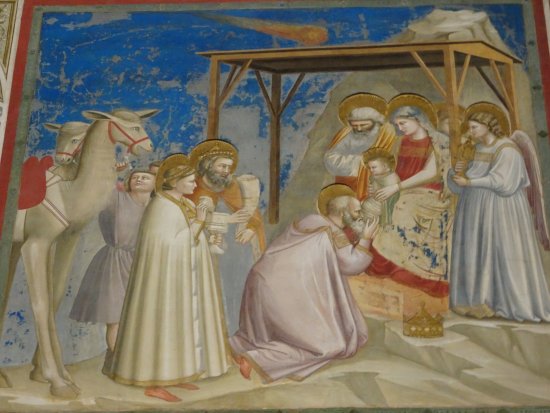
And finally Giotto managed to paint Halley’s Comet as the Star of Bethlehem in 1305 – always nice to see a more positive construction of its appearance. The painting can be seen at the Scovegni Chapel in Padua.

halley-comet-as-nativity.jpg

Danish and Saxon Kings of England before the Norman conquest – an eleventh century game of thrones

Ethelred_the_UnreadyWe think of England before 1066, if we think of it at all,  as being Anglo Saxon with a large Danish contingent in the north.  Simple perhaps,  that’s the story most of us learn as children in primary school.  Unfortunately for the Anglo-Saxons and their Norse descended neighbours things were not that straight forward. England was a wealthy country and its inhabitants might have been forgiven for thinking that they were a tasty bone being pulled first one way and then the other by  opposing forces.

Æthelred the Unready, pictured at the start of this post,  ruled England from 996.  His predecessor was Edward the Martyr.  Edward died in uncertain circumstances in Corfe Castle- Suffice it to say that Edward’s death didn’t enhance the reputation of Æthelred’s mother. Æthelred was the three times great grandson of King Alfred.  He ruled until 1013.  During that time his biggest problem were the Danes.  Thanks to bad advice Æthelred’s response was to pay them to go away and when they kept coming back he ordered the massacre of all Danes in England in 1002.

The event is known as the St Brice’s Day Massacre. It wasn’t an unmitigated success Æthelred could only really expect the order to be carried out in the southern parts of England.  In addition to which Swein, or Sweyn, Forkbeard’s sister was amongst the victims of the massacre along with her husband and child,

sweyn-forkbeard-invade-englandSwein seeking revenge and revenue committed himself to invading England. The Chroniclers do not have much good to say about Swein.  Suffice it to say he became the first Dane who could claim to be king of all England in 1013.  The following year he fell off his horse and died.

There were now two possible contenders for the crown. Æthelred who had made himself scarce on the Isle of Wight during Swein’s period in power and Swein’s son Cnut (yup – the one who allegedly demonstrated that he couldn’t hold back the tide.) Æthelred now promised the nobility all sorts of things so that Cnut found that he didn’t have as many allies as he previously thought meaning that Cnut’s territory dwindled quite rapidly.

Edmund_Ironside_-_MS_Royal_14_B_VI.jpg

If this seems straight forward Æthelred’s son Edmund known as Ironside because of his warrior like tendencies now decided to revolt against his father.  It was only when Cnut came back to England in 1016 that Edmund returned to his father’s side.  By then Æthelred’s chief ally a Norwegian called Olaf Haroldson had taken himself off for a spot of light raiding in Europe. Æthelred died in April 1016.  The battle for England continued between Edmund and Cnut.  Cnut won a decisive battle in October 1016 and Edmund Ironside died at the end of November.

cnutCnut was now king of England.  He married Æthelred’s widow Emma.  Cnut the Great ruled England for the better part of two decades.  He died on 12th November 1035.  In Denmark he was replaced by his son with Emma – Harthacnut.

England was a less straight forward proposition.  Cnut had two sons by two different women – Harold Harefoot and Harthacnut.  The former found support in the north of the country – by which I mean north of the Thames- whilst the latter had more support in Wessex.  Eventually Harefoot was acknowledged king but not until 1037.  He died in 1040.

harold harefoot.jpg


Harthacnut_-_MS_Royal_14_B_VIHarthacnut then returned to England and became king without any difficulty.  Harthacnut celebrated his arrival by having Harefoot dug up, beheaded and dumped in a handy marsh.  He ruled until 8th June 1042 when he died having celebrated the wedding of Cnut’s standard bearer Tovi the Proud at Lambeth.  Harthacnut stood to drink a toast to the bride and promptly died.


England had been under Danish rule since 1016.  The House of Wessex now regained the upper hand.  Emma’s sons by Æthelred, Edward and Alfred, had grown up in Normandy.  They had attempted to regain the Crown in 1036 when Harold Harefoot and Harthacnut were at a standoff after their father’s death.  Edward had arrived at Southampton and then taken himself back to Normandy.  His brother Alfred had landed in Dover, been greeted by Earl Godwin, tricked into believing that Godwin sided with Æthelred’s sons, captured, blinded and left to died from his injuries at Ely.

Edward the confessor drawn

Now, in 1042, Godwin the most powerful of the earls supported Edward’s claim to the throne. It wasn’t long before Godwin’s family began to benefit from their father’s decision. Then in 1045 Godwin’s daughter Edith married Edward.  When Edward died on 5th January 1066 he had not children of his own.

Anyone with the blood of the Royal House of Wessex could have been king if they had sufficient support. Edward Ætheling, the son of Edmund Ironside, had returned to England from Hungary in 1057 but died, somewhat suspiciously, almost as soon as he arrived back in England with his three children.  Edward is also known in history as Edward the Exile.

Edward’s son Edgar was an Ætheling – i.e. throne worthy but he was not really old enough when Edward the Confessor died in 1066 to become king. The man who wielded the most political power in the country was Godwin’s son Harold, although Harold’s brother Tostig also fancied his chances.

There was also the small matter of a promise made to Duke William of Normandy by Edward the Confessor possibly in the winter of 1051-52 when he had been able to rid himself, albeit briefly, of the Godwin clan.  In 1064 Harold Godwinson had made a trip to Normandy and had not been allowed to return home until he had sworn to support Duke William’s claim to the throne.

And then there was the claim of  King Magnus I of Norway who said that Harthcnut had left the throne to him not to Edward the Confessor. He had been crowned king of Denmark in 1042 after Harthacnut’s death honouring the agreement made between the two men that which ever one of them who outlived the other would inherit the dead man’s kingdom.  Magnus had not pursued his claim to England but in 1066 his son Harold Hardrada in alliance with Harold Godwinson’s brother, Tostig, would make an attempt to secure the throne.