The formation of the northern borders -part deux.

Carlisle Castle

The kingdom of Northumbria did not enter Norman rule placidly but Gospatric, who was related to Malcolm Canmore was eventually stripped of his power and died in Scotland. The Scottish king had given him Dunbar Castle and his eldest son became the Earl of Dunbar. Another, Dolphin, ruled Carlisle on Malcolm’s behalf.

We had arrived at the Treaty of Abernethy in 1072.

1079 The Normans invade Scotland to remind Malcolm not to keep raiding Northumbria and to reinforce the Treaty of Abernethy.

1092 William II, better known as William Rufus, drives Dolphin out of Carlisle. Malcolm doesn’t immediately respond to this.

13 November 1093 Malcom III killed with his eldest son by Margaret of Wessex at the Battle of Alnwick on his way home from a spot of light raiding. It is said that Margaret died from a broken heart three days later. Malcolm’s brother Donald Bane took the throne as Donald III but was driven from it six months later by Duncan – who had been handed to William the Conqueror as a hostage at the signing of the Treaty of Abernethy. Rufus accepted Duncan II’s homage – however, despite the political expedient, it wasn’t long before Donald regained the throne. The turmoil in Scotland was matched by the dispute in England between William Rufus and his elder brother Robert Curthose who was Duke of Normandy but who wanted his brother’s crown as well.

1095 Duncan II murdered.

1097 Edgar, the fourth son of Malcolm, takes the Scottish throne. He has received English support.

1100 William Rufus killed in a hunting accident in the New Forest. His brother Henry ascends the throne as Henry I and marries Edith of Scotland – the daughter of Malcolm III and Margaret of Wessex. As well as helping to secure his northern border, it also helps to stabilise his throne. Edith changes her name to Maud when she marries.

1107 Edgar dies and his younger brother, Alexander the Fierce, became king in his stead – with the approval of King Henry I. This accord was cemented by Alexander’s marriage to Sybilla of Normandy who was one of Henry’s illegitimate daughters.

Henry is able to cement his control of the north and establish lordships to rule Cumbria and the borders on his behalf – e.g the de Hottons of Hutton.

1124 Alexander died without children and was succeeded by his brother David who becomes King David I.

King Henry I died on 1 December 1135. He had wanted his only legitimate child, the Empress Matilda, to rule after him but despite having made his barons agree to the plan, its actually his nephew Stephen of Blois who nabs the crown. In 1138 a civil war known as the Anarchy erupts between supporters of Stephen and Matilda.

King David I had already seized the opportunity to extend his kingdom south once more on the pretext of supporting Matilda’s claim. The local militia and baronial retinues of Yorkshire and the North Midlands  fight back against the Scottish incursion to the West and south. In Northumbria the castles at Bamburgh and Wark  hold out against the Scots

January 1136 Treaty of Durham – King Stephen cedes Cumberland to the Scots – Carlisle is part of Scotland once more. The earldom of Huntingdon and its associated land is transferred to David’s son Henry.

22 August 1138 •The Battle of the Standard on the Great North Road – north of Northallerton. The Scots are defeated but retreat in good order they regrouped in Carlisle. There is another meeting and another treaty at Durham. Cumberland would remain part of Scotland for the next 20 years and Northumberland was ceded to Earl of Huntingdon as a fief.

It was King David I who built the first stone castle at Carlisle and where he died on 24 May 1153. He had extended his rule to both the north and the south and through the Second Treaty of Durham he was an independent king who did not have to take oaths of vassalage to the English… which brings us to the end of the Norman period.

The Plantagenets in the form of King Henry II, son of Empress Matilda and Geoffrey of Anjou, ascended the throne in 1154. Obviously Henry had other plans for the north but for the time being Scotland held the upper hand in the matter of the borders.

The evolution of border reiving

By Forman Armorial (produced for Mary, Queen of Scots) – This image is available from the National Library of Scotland under the sequence number or Shelfmark ID Adv.MS.31.4.2, fol.5r., Public Domain, https://commons.wikimedia.org/w/index.php?curid=1409450

Given the borders gave us the words blackmail and bereaved it’s perhaps not surprising that the culture of the borders was on occasion lawless or that people who lived in the marches may not have regarded themselves either as Scottish or English – ties of kinship were much more important than nationality.

Let’s begin with the geography of the post-Roman world. The kingdom of Benicia was established by 547AD. When it unted with Deira in 603AD – ok, I’m underplaying it – there’s a marriage followed by a series of assassinations – the kingdom of Northumbria was formed.

By the ninth century Northumbria was one of England’s dominant kingdoms while the concept of Cumberland only really appeared as a political entity from the tenth century onwards. Saxons, Vikings, various wars, rebellions and the incorporation of Cumberland into the kingdom of Strathclyde by Malcolm I are all recorded in the Anglo Saxon Chronicle and bring me to the start of my chronology. I am not tackling King Edwin or the various political manoeuvrings of the heptarchy in this post. Let’s just stick with the borders for the time being.

1005 Malcolm II crowned king of Alba. He allied himself to Owain Foel of Strathclyde.

1006 Siege of Durham – results in the defeat of Malcolm by Uhtred of Bamburgh who later became both the earl of Bamburgh and York.

1018 Battle of Carham – the Northumbrians defeated and an eastern border between England and Scotland created.

1031 King Cnut invades Alba.

1034 Malcolm II dies. His grandson Duncan inherits the throne. At this time Scotland – which holds Cumbria on the west side of the country, possibly now extends so far south as the River Lune in Lancashire.

27 July 1054 The Battle of Dunsinane Wood also called the Battle of the Seven Sleepers. This was fought between the forces of King Macbeth, who is another of Malcom II’s grandsons, and Siward, Earl of Northumbria and his nephew, Malcolm Canmore, the son of King Duncan. Macbeth, who killed Duncan in 1040, was defeated. Malcolm remains in Scotland continuing his war with Macbeth. Siward returned to Northumbria…and as an aside Siward was rather hoping for a Scottish monarch on the throne who would support his claim to the kingdom of Cumbria.

1055 Siward, Earl of Northumbria died. He had gained control of Northumbria through judicious marriage and political manoeuvring. He supported Cnut, Harthacnut and then Edward the Confessor. He is replaced by Tostig Godwinson, a brother of Harold Godwinson (he of arrow in the eye fame). It was not a popular choice.

1058 Malcolm III (Canmore) began raiding Northumberland. Peace is eventually agreed but there are a successive series of raids resulting in the taking of slaves, cattle and tribute.

1065 Tostig booted out of Northumbria by its people who are fed up with his heavy-handedness. Morcar, the younger brother of the Earl of Mercia, is appointed in his place. It does not sweeten Tostig’s relationship with his brother Harold. Malcolm III welcomed Tostig into Scotland.

1066 Tostig returns from exile with the army of Harold Hardrada, King of Norway who is making his claim to the throne of England.

25 September 1066. Hardrada and Tostig are killed at the Battle of Stamford Bridge outside York.

So far so good but in 1067, Copsi, who was Tostig’s man, submits to William the Conqueror and is sent to York as the new Earl of Northumbria. It’s a promotion which lasts five weeks before the Northumbrians murder him. Osulf, son of Eadulf, and a member of one of the region’s leading families – chase Copsi to a church near Ouseburn. Osulf sets the church on fire. Fleeing once more, Copsi was captured and beheaded. Osulf becomes earl but is murdered in his turn.

1068 Gospatric who is a relative of Uhtred of Bamburgh and Malcolm Canmore pays William the Conqueror to become Earl of Benicia He then joined in with a rebellion against the king fermented by Edwin, Earl of Mercia and his brother Morcar. Gospatric fled to Scotland and the north endured a harrying.

1069 Malcolm III takes his army south as far as Wearmouth. Gospatric submits to William the Conqueror and is sent to make was in Cumbria which is part of Malcolm’s kingdom.

Malcolm welcomes Saxon refugees from the Royal House of Wessex, including Margaret – who he married- which improves his claim to territory in the south, especially as he gave his sons English rather than Scottish names. Malcolm recognised that the Conqueror’s grasp on Northumberland was weak and was making a political play for the territory.

1072 Treaty of Abernethy. Terms agreed between Malcolm and William the Conqueror who had an army as well as a network of fortifications at Warwick, Nottingham and York which secured the south and the Midlands. According to the Anglo Saxon Chronicle, Canmore became William’s man and gave him his son, Duncan, as surety. It wasn’t long before Malcolm was raiding again and Northumbrians revolting against Norman rule.

1080 another Norman army heads north, this time under the command of Robert Curthose, William’s eldest son. A new accord is reached and things went quiet for ten years or so.

Which is a good place to stop, because although it doesn’t take me to the end of the Norman period there have been a fair few dates in this post, several murders and some very dodgy dealings.

History Jar Challenge 6 – Northern Castles

All I can say is that there are a lot of castles in this country and I’m sure I haven’t got them all. I have tried to remember some of the differences between a tower house or pele tower and a castle when I’ve made my list. A pele tower was not designed to be lived in the whole time – it was more of a refuge when reivers and clan enemies arrived on your doorstep. Aydon Castle is actually a fortified manor house rather than a castle but it’s on the list because it’s such a lovely example. The list is in no particular order and I have missed a particular favourite of yours I can only apologise. Please add it to the comments section. I have written about rather a lot of castles over the years. If you select “castles” from categories on the right hand side of the blog you will be able to find them.

Cumberia and Westmorland:

Naworth Castle is actually a pele or peel tower depending on how you would like to spell it. https://thehistoryjar.com/2017/05/11/naworth-castle-and-the-dacres/ Highead Castle and Thistlewood Tower, both in Cumbria are also peel towers. Thistlewood was in the possession of the Dacre family as was Naworth. https://thehistoryjar.com/2017/05/16/highead-castle-and-thistlewood-tower/

Naworth Castle

Carlisle Castle – first built in 1092 by William Rufus. I don’t think I’ve ever written specifically about the castle although it has turned up in quite a few posts including about Andrew de Harcla who was besieged by the Scots.

Askerton Castle – a fortified manor house rather than a castle. Now a farm.

Dacre Castle – it’s actually a tower house rather than a castle but it looks remarkable like a castle from the exterior.

Rose Castle – the home of the Bishops of Carisle https://thehistoryjar.com/2017/05/22/rose-castle/

Greystoke Castle I know I’ve visited Greystoke but I think that I posted about the church at the time.

Egremont Castle https://thehistoryjar.com/2017/05/15/egremont-castle-the-de-lucys-and-the-de-multons/

Corby Castle

Cockermouth Castle

Penrith Castle

Brougham Castle

Newcastle Castle

Armathwaite Castle

Appleby Castle

Brough Castle

Pendragon Castle https://thehistoryjar.com/2016/06/28/pendragon-castle/

Kendal Castle

Muncaster Castle

Egremont Castle https://thehistoryjar.com/2017/05/15/egremont-castle-the-de-lucys-and-the-de-multons/

Dalton Castle

Piel Castle

Lowther Castle isn’t a medieval castle its a much later build as is Wray Castle.

Sizergh Castle

Lancashire: Lancaster Castle and Clitheroe Castle spring immediately to mind. Then, Hornby Castle due to the Wars of the Roses – I think.

Yorkshire – north of Pontefract Castle which was often described as the “Key to the North.

Spofforth Castle

Skipton Castle

Knaresborough Castle

Clifford’s Tower

Helmsley Castle

Pickering Castle

Scarborough Castle

Middleham Castle

Bolton Castle

Richmond Castle First built by Alan the Red after the Norman Conquest.

County Durham and Northumbria

Castles, peel towers and fortified manors sprout like mushrooms in the NorthEast and I suspect this is one of the reasons why I love visiting the area.

Thirlwall Castle – built close to Hadrian’s Wall from dressed stones quarried from the wall. It’s also a tower house rather than a castle proper.

Aukland Castle

Barnard Castle https://thehistoryjar.com/2015/10/31/barnard-castle-anne-beauchamp-and-oriel-windows/

Raby Castle

Walworth Castle

Bowes Castle

Durham Castle

Hylton Castle

Newcastle Keep

Aydon Castle

Lumley Castle

Tynemouth Castle

Belsay Castle

Bothal Castle

Bywell Castle

Mitford Castle

Warkworth Castle https://thehistoryjar.com/2018/07/15/warkworth-castle-hotspur-and-rebellion-against-henry-iv/

Edlingham Castle

Preston Tower – looks like a keep but is actually a peel tower.

Alnwick Castle https://thehistoryjar.com/2018/07/05/alnwick-castle/

Dunstanburgh Castle

Chillingham Castle

Bamburgh Castle

Etal Castle

Lindisfarne Castle

Norham Castle

Berwick Castle

Featherstone Castle

And that is, as they say, that! If this has wetted your appetite to visit a few castles when we’re all allowed out then I would recommend the Collins English Castles from its Little Books series. Others of you may have your Observers Book of Castles on your bookshelves. It has been very pleasant thinking of all the castles that I have visited – less pleasant trying to identify my photographs!

Preston Tower and it’s builder – from murderer to warden of the east march

preston towerIn 1415 there were about 78 peel or pele towers in Northumberland.  These towers were essentially private fortifications for protection in the event of Scottish raids – or neighbours you  didn’t necessarily agree with.  The idea was that you could secure your family and portable valuables until it was safe to emerge or help arrived – beacons were kept on the top of the towers which could be lit to summon help and to worn the surrounding countryside of danger. Preston tower 1
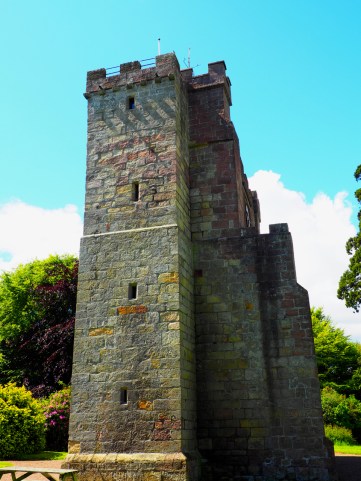
Peel towers were an architecture that resulted from the Scottish Wars of Independence.  Some of the peel towers were not ordinarily used as dwellings – rather they should be considered refuges in times of trouble whilst at the other end of the spectrum places like Aydon Castle near Hexham resemble castles.

Preston Tower was built by Sir Robert Harbottle at the end of the fourteenth century.  Sir Robert was a man of his time.  He was part of the affinity of Sir Mathew Radmayne of Levens and rose in Redmayne’s service.  When Harbottle murdered a man in Methley in Yorkshire in 1392 it was Redmayne and his successor who secured Harbottle’s pardon.

You’d have thought that Harbottle would have kept his head down but it wasn’t long before he came to the attention of the law once again when he took part in a raid on the Yorkshire property of Isabel Fauconberg stealing her property as well as the property of her tenants.   A commission was set up to investigate but somehow or other Harbottle escaped the consequence of his crimes once more.

Henry IV,  having taken the crown from his cousin Richard II, made him constable of Dunstanburgh Castle in 1399 – clearly not having read his cv beforehand.  He even managed to acquire one of the wardenship of the east march – essentially turning Harbottle into the law.  Perhaps it’s not surprising that since he did so well from the Red Rose monarchs that Harbottle was loyal to both Henry IV and Henry V even when the Percy family rebelled against them.  Having bagged himself an heiress in the form of Isabel Monbourcher,  Harbottle had risen from henchman to man of wealth and influence.  When Hotspur rebelled against Henry IV, Harbottle was able to claim a better share of his wife’s inheritance  – so it would appear that luck was on his side as well.

In between times Harbottle had served in Henry IV’s army in 1400 against the Scots and became a member for parliament.  In short he had become part of the gentry in the north and had a good stout peel tower to prove it.

Preston Tower has walls which are over two metres thick, is three storeys high and has rooms off the main chamber at each level.  It was described by Pevsner as one of the best bits of medieval architecture in the country.


https://www.historyofparliamentonline.org/volume/1386-1421/member/harbottle-robert-1419

Warkworth Castle, Hotspur and Rebellion against Henry IV

DSC_0030.jpgWarkworth Castle was not always in the hands of the Percy family.  It was presented to them in 1332 by Edward III.  Our interest today is in the 1st earl of Northumberland who was so created at the coronation of Richard II.  The earl’s mother was Mary of Lancaster, a great granddaughter of Henry III.  Ultimately the 1st earl sided with his cousin Henry Bolingbroke and helped to topple Richard II from power in 1399.  Henry, who had been exiled by Richard II returned to Ravenspur after his father’s death ostensibly to claim the Duchy of Lancaster which Richard had decided to confiscate upon John of Gaunt’s death.  Richard II was in Ireland at the time of Henry’s arrival at Ravenspur.  Richard returned to England via Wales.  He found himself in Conway Castle having a discussion with the Earl of Northumberland and the Archbishop of Canterbury.  From there he found himself in the Tower of London, deposed by Parliament on an assortment of charges agains this realm and from there sent to Pontefract where he died- either because he was starved, forgotten about or refused to eat.   Henry IV did not see himself as a usurper because legally the throne became vacant when Richard was deposed by Parliament. He had merely stepped up to take the role.

As is the way of these things relations soured between the Earl of Northumberland and Henry IV. Given that there were family links as well as ties of affinity and education it is perhaps unexpected. However, this is where the story becomes more complicated and not just in terms of the politics of power.  Hotspur was married to Elizabeth Mortimer.  The Mortimers were descended from Lionel of Antwerp who was John of Gaunt’s older brother – thus even though the throne may have been legally vacant Henry Bolingbroke really and truly shouldn’t have become king. The title should have gone to the earl of March – Edmund Mortimer- who was the son of Elizabeth Mortimer’s brother Roger who had been killed by the Irish in 1398.  Edmund who was a rather youthful eight at the time. Realpolitik must have noted that Richard II’s minority hadn’t been without its issues. Better a grown man than a youth.

DSC_0042.jpgNow in 1403 the initially pro-Lancastrian Percies needed a reason to turn against Henry IV as they discovered that their courses were not running in parallel.  They had initially supported Henry Bolingbroke to regain what was rightfully his but he had then taken matters further and toppled Richard II from the throne – or so they said- demonstrating the History is about stories and that one person’s story is another person’s work of fiction.  Having been badly disappointed in Henry IV who had taken what was not his, the Percies now decided that it was only right and proper that they help put Mortimer on the throne.

It should be noted that Henry IV had not treated Mortimer or his younger brother badly. They were in receipt of a good education and were, for part of the time raised with the king’s own children.  Matters became complicated when Hotspur’s brother-in-law, Sir Edmund Mortimer, managed to get himself captured by Owen Glyndwr and then changed sides – or was at least accused of changing sides by Henry IV.  It probably didn’t help when Glyndwr married his daughter to Sir Edmund and that Sir Edmund wrote that his nephew, young Edmund Mortimer was actually the correct king of England rather than Henry IV.

The truth is that it was during the fourteenth century that the North of England saw the Percy family expand their territory and their power. The accession of Henry IV saw Percy being made Constable of England. This bred much resentment both nationally and locally. The start of the fifteenth century was a time when the monarch wished to curtail the Percy power base.  Meanwhile there were the local politics to contend with  – the Nevilles of Raby were snapping at Percy heels. The Percies became increasingly aggrieved. They were irritated because they had not been properly paid for their protection of the Scottish borders, Henry IV had confiscated their Scottish captives after the Battle of Homildon Hill and thus deprived them of rich ransoms, Henry IV was offering favour to men like Neville and also to George Dunbar who had sought exile in England after a slight to his family honour in Scotland. Sir Edmund had been captured in 1402 and had not been ransomed. It could be argued that Sir Edmund had taken steps to gain his freedom when he reached an understanding with Glyndwr.

It was at Warkworth that the earl plotted the rebellion that led to the death of his son Henry “Hotspur” at the Battle of Shrewsbury in 1403 and his own exile and loss of title and lands. The key conspirators were related to the Mortimers by marriage: Elizabeth Mortimer was married to Hotspur.  Sir Edmund Mortimer was married to Glyndwr’s daughter Catherine.  They decided to divide the kingdom in three – Mortimer would rule the south, Glyndwr would rule Wales and the Percies would take control of the North.  The earl sent his son Henry and his brother Thomas (the earl of Worcester) on ahead of the earl. They raised their standard at Chester.

Dunbar, loyal to Henry IV raised an army as he marched after his Percy adversaries. Hotspur was killed at the battle of Shrewsbury whilst Thomas was executed two days later. Hotspur was initially buried in Whitchurch but when Henry IV heard rumours that Hotspur was still alive he had the body disinterred and then placed between millstones so that it could be viewed.  He then had the head displayed on the Micklegate in York. Eventually Hotspur’s remains were entombed in York Minster.

Dunbar was created the Earl of the March of Scotland  and given Thomas Percy’s estates as a reward by Henry IV.

DSC_0047.jpgThe grief-stricken earl of Northumberland made his peace with Henry IV on that occasion but it was not long before he rebelled once again, fled to Scotland with his grandson and finally returned to die at Bramham Moor.

Warkworth did not immediately hand itself over to the Crown.  It was briefly besieged although just seven canon shots were required to bring its surrender and then handed into the custody of Henry IV’s younger son John who history would best know as the Duke of Bedford.  Eventually when Henry IV died the earl’s grandson who had lived in exile in Scotland was restored to his property although a marriage to Eleanor Neville, the daughter of Ralph Neville and Joan Beaufort was negotiated first – in part to keep Ralph sweet as he had acquired much of the Percy lands and offices in the intervening time.

For more information on Warkworth follow this link: http://www.gatehouse-gazetteer.info/English%20sites/2879.html

Alnwick Castle

Alnwick CastleAlnwick, like most of the great castles, has had a succession of owners  beginning with Ivo de Vesci who married the granddaughter of Gilbert Tyson, a Saxon killed at Hastings in 1066. The zigzag moulding on the arch in the arch that leads to the inner courtyard reminds visitors that Alnwick has been a fortification for the better part of a thousand years.  The barony of Alnwick and its castle continued in the de Vesci hands until the fourteenth century with intermittent lapses into the hands of David of Scotland and William the Lion although it should be noted that during the reign of Henry I Eustace FizJohn was the castle’s owner.  He married the de Vesci heiress of the period and their son William assumed his mother’s name.

IMG_0237Ivo built a motte and bailey castle from timber – by which we can suppose some hapless Saxons found themselves moving soil and digging ditches. There were two baileys – one to the east and one to the west.  Over the years fortifications were added to the central shell keep and to de Vesci’s two baileys. By 1135 it was one of the strongest castles in Northumberland. In actual fact when William the Lion besieged the castle in 1172 he was unable to capture the castle from William de Vesci. In 1174 the Lion had another go at it and was captured by the English.  Part of the reason why William spent so much time hammering on Alnwick’s doors was that he had originally been the Earl of Northumberland but Henry II had removed it from him some twenty years earlier. Perhaps that was why William joined in the revolt by Henry II’s sons and his queen against Henry II in 1173.  William found himself bundled off to Newcastle and from there to Normandy.  William was forced to recognise Henry II as his feudal overlord and in so doing sewed the seeds of the Scottish Wars of Independence when Edward I insisted on the right to naming the Scottish king and to being the feudal overlord of Scotland.

The de Vescis who did not get on terribly well with King John.  It was only luck that the castle wasn’t razed in 1213.  William de Vesci died at the Battle of Bannockburn the following century without heirs so the king sold it to Anthony Bek, Bishop of Durham who sold it to Henry de Percy.  De Vesci did have an illegitimate son and was able to hand his Yorkshire lands to his natural son.

IMG_0211


The Percys did rather a lot of rebuilding based on the income from the Scottish wars; either loot or ransoms.  The two huge octagon towers that tower above the inner gateway were built sometime around 1350  and this phase of rebuilding included the rebuilding of the keep with seven U shaped towers.  The castle had been successively strengthened by all its owners but this was the time when the Percy family were most wealthy and the reality of having a bellicose neighbour meant that fortifications were a good investment.

IMG_0215The outer wall, around those two baileys encloses something like five acres of ground.  The wall contains several towers and turrets.  One of them houses a water tower and very sensibly it was here that the castle’s laundry was done.  There is also a rather fine well in the inner court yard near the entrance to the keep.  The Constable’s Tower is open to the public

IMG_0224The fortunes of the Percys declined with the Wars of the Roses and the accession of the Tudors.  Margaret of Anjou had garrisoned Alnwick with three hundred french troops in the aftermath of Town in a bid to retain a toehold on her husband’s kingdom. It was a Scot who rode to the garrison’s rescue on that particular occasion so that Margaret’s troops could make good their escape from the forces of the Earl of Warwick.

Put simply they were the over mighty subjects that a strong monarch needed to keep firmly in check. They continued to fulfil their role  on the borders however.  The Alnwick Muster Roll dating from 1513 identifies the men who fought under the Percy colours at Flodden and survived the encounter with the Scots.  When not at war with Scotland there was intermittent raiding.  In 1528, for example fourteen Scottish reivers were hanged in Alnwick.  However, not even their hereditary role of warden was secure any longer nor were the earls necessarily cut out for border warfare.

The Percy family were not as wealthy as they had once been and in 1567 when George Clarkson was commissioned to assess the castle it was deemed unfit for purpose.  Perhaps lack of cash was something that the earl should have considered before conspiring with the Earl of Cumberland and Leonard Dacre to raise the north in rebellion against Elizabeth I.

In 1569 matters came to a head with the Earl of Northumberland revolted along with the Earl of Cumberland in a bid to return England to Catholicism.  The people of Alnwick were caught up in the rebellion.  Although numbers of rebels dwindled rapidly after the initial success of capturing Durham and celebrating the Mass there before marching into Percy’s Yorkshire estates Alnwick Castle did prepare to withstand the Queen’s forces.  Hartlepool was also captured by the rebels with the intention of providing a safe harbour for the Duke of Alva to land Spanish troops. The Spanish Ambassador it should be noted had already told the conspirators that they had not chance of succeeding in their venture.

The arrival of Sir John Forrester  (or Forster depending on the source) the Warden of the English Middle March on the East side of the country was sufficient for earl’s tenants to hand over the castle and hurry to their own homes.  Forrester also blocked the passes so that men who might have joined the rebels could not join with the earls whose thoughts swiftly turned to flight.

There was much rebuilding during the eighteenth and nineteenth centuries to transform the medieval fortress into a stately home. It was in the 1750s that it became the main residence for the Duke of Northumberland who commissioned Robert Adam to make the castle more habitable not to mention fashionable.   In the Nineteenth Century Salvin was appointed to create more modifications – the fourth duke liked his castle with a romantic tinge.  It remains the second largest inhabited castle in England and reflects a gothic Italian styles admired by the family at that time.

92e66707bdd190a278c16b6a13d82001.jpg