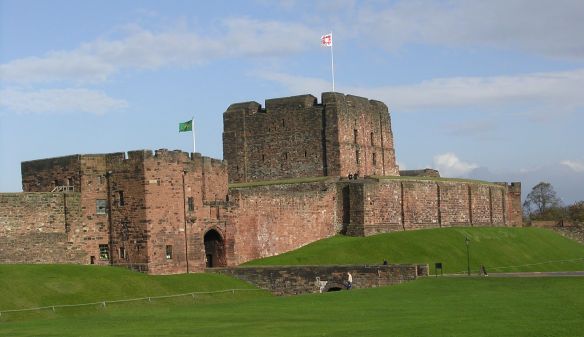
 At the onset of the English Civil War the inhabitants of Cumberland and Westmorland can’t be described as being very enthusiastic for war – although they were largely nominally Royalist. In the North East, the Earl of Newcastle levied a force and roused some stronger feeling although his tenants did, on occasion, simply ignore his warrant.
The Earl, no doubt feeling that the west of the country should be more proactive, appointed Sir Philip as commander-in-chief of the two counties. Sir Philip Musgrave of Edenhall was already a militia colonel and based on the content of a letter in his correspondence had taken steps to act against known parliamentarians in the area – Sir Patrick Curwen of Workington found it expedient for his friends to intercede with Musgrave on his behalf for instance. He was not very active but the musters he did insist upon were sufficient to irritate Sir John Lowther – who didn’t want Sir Philip to do anything at all. Essentially he felt undertaking the minimum would increase the likelihood of drawing Parliament’s attention on the northwest while Sir Philip hoped that doing very little would ensure that Newcastle would stay on the opposite side of the Pennines. Somewhat bizarrely Musgrave and Lowther engaged on a long drawn out feud over who had the right of the matter which involved several of Cumberland’s leading families including the Dacres who resisted Musgrave’s command.
 Sir Philip was the son of Sir Richard Musgrave, the 1st baronet of Hartley Castle. Sir Richard died in 1615 when his son was just eight. His career trajectory followed that of many of other gentleman of the period. He was educated at Trinity College Oxford and then was found a suitable wife- Julia Hutton- from within his own county. He became the Deputy Lieutenant for both Westmorland and Cumberland. In 1642 he was made a commissioner for array – that is to say he was responsible for raising Cumberland’s levy of soldiers for the king. There were problems over the exact nature of his commission from Newcastle and assorted feuds to contend with. However, by 1644 he was able to supply a force to join with Prince Rupert’s army.
Things changed in 1644 because of the intervention of the Scots. On one hand York was captured by Parliament thus causing royalists to come north and secondly Carlisle now stood in danger of capture. When the city finally fell to Parliament Edenhall had been damaged and Sir Philip had to ride south with a royalist troop to join with the king. At the battle of Rowton heath in September 1645 Sir Philip was injured and subsequently captured. Records indicate he was sent to York and from there to Pontefract. Meanwhile his lands were sequestrated.
Sequestration was a means by which that Parliament was able to fine Royalists and confiscate their goods. Sir Philip’s belonging were valued at £308 in the spring of 1643. Not only were his cattle and sheep assessed but a figure was also attached to the bees in the hives on his land.
Musgrave was released at the end of 1645 and he went to Newcastle. From there he finally made his way home the following year. Suffice it to say, Musgrave was loyal to the Stewarts and became involved in the 1648 rising in Scotland which resulted in Musgrave capturing Carlisle on the 29th April. Musgrave before seeking to capture Appleby. Unfortunately for Musgrave Parliament gained the upper hand before the Duke of Hamilton and his army could take advantage of the way into England.
Rather than face General Lambert Musgrave sued for parliamentary protection which he gained, not that this prevented him from fleeing to France in 1649. As a direct result of this involvement with the so-called Scottish engagers Musgrave’s lands were confiscated in 1651. His wife was required to sue for maintenance, Sir Philip having been excluded from any act of amnesty by the Treason Act which confiscated his land.
Sir Philip did not remain quietly in France. He negotiated with the Scots, travelled to England and was even offered Governorship of the Isle of Man by the Countess of Derby. In part his apparent freedom to travel around the realm which had declared him traitor resulted from his friendship with Lord Wharton who even lent his son the money to buy the sequestrated estates back. It was however, one step too far when Sir Philip turned up at his newly repurchased estates. He was arrested and sent to London where he was charged with various conspiracies against parliament. If he himself was not involved it is probable that one or more of his sons was. Ultimately Sir Philip was released but not until £2000 bail had been paid and even then Parliament was keen for him to remain outside his home county.
Musgrave returned to Cumberland in 1660 with the Restoration. He returned to doing what gentry do – being a JP and member of parliament. He was also the mayor of Carlisle in 1666 having also been its governor and the captain of the castle.
He died in 1678 having fought at the Battle of Marston Moor and the Battle of Worcester. In between times he had fathered seven children, been granted a peerage by Charles II which he never took up and acquired the right to take tolls on cattle passing through Cumberland (of which he did avail himself).
It would have to be said Sir Philip is one of those figures in history that the more you dig around the more that you find – although sadly not a portrait.
Robinson, Gavin. Horses, People and Parliament in the English Civil War: Extracting Resources
https://archive.org/stream/lifeofsirphilipm00burt/lifeofsirphilipm00burt_djvu.txt
http://www.historyofparliamentonline.org/volume/1660-1690/member/musgrave-sir-philip-1607-78

 Initially Brereton tried to take hold of Chester for Parliament but was unable to capture it. Instead having taken Nantwich for the Parliamentarian cause in 1642 he made that his headquarters. From there he ranged along the Welsh marches on Parliament’s behalf and down through Cheshire to Stafford. He came with Sir John Gell of Hopton in Derbyshire to the siege of Lichfield and was concerned at the later siege of Tutbury that his colleague was far too lenient on the Royalist defenders. Across the region Brereton was only defeated once at the Battle of Middlewich on December 26 1643 but he swiftly recovered from this as he had to return with Sir Thomas Fairfax to Nantwich when Sir George Booth managed to get himself besieged by Lord Byron and Cheshire was more or less completely in the hands of the Royalists not that this stopped Brereton from establishing an impressive network of spies loyal to Parliament.
 In January 1644 Sir Thomas Fairfax crossed the Pennines with men from the Eastern Association Army. On the 25th January his men were met by a Royalist army headed by Byron who was defeated. The place where the two armies collided was Necton but the disaster for the royalists has become known in history as the Battle of Nantwich. It meant that the king could not hold the NorthWest. Even worse Royalist artillery and senior commanders were captured along with the baggage train. None of this did any harm to Sir Thomas Fairfax’s reputation nor to Brereton who had command of the Parliamentarian vanguard.
 From there Brereton became involved in the siege of Chester – at Nantwich Byron had been outside the town whilst at Chester he was inside the walls. In September 1645 Bristol in the command of Prince Rupert surrendered. The only remaining safe harbour to land troops loyal to the king was Chester. Lord Byron had withdrawn there following his defeat at Nantwich and Brereton had followed him. Byron held the river crossing and in so doing was denying the Parliamentarians a way into North Wales which was Royalist.
 Let us return today to the Royalist summer of victories in 1643. It was really only in the east of the country that events did not go all Charles I’s way. On 20 July 1643, Lord Willoughby captured Gainsborough in Lincolnshire for Parliament. This meant that the Earl of Newcastle could not now communicate so easily with the royalists at Newark and he could not simply march south expanding royalist territory. The Committee of Safety scratched their various heads and then sent Oliver Cromwell and Sir John Meldrum from the Eastern Association Army to back up Lord Willoughby as he was being threatened by the Royalist military commander – Colonel Charles Cavendish – who was the nephew of the Earl of Newcastle.
 As with all civil wars some people change their minds. Having described the Hothams (father and son) shutting the city gates of Hull in Charles I’s face in 1642 it comes as something of a surprise to discover that John Hotham (junior) was executed for treason on 1st January 1645 for conspiring to let the royalists in! John Hotham senior was executed the next day. Unfortunately for them their coat turning tendencies had been proved by the capture of the Earl of Newcastle’s correspondence after the Battle of Marston Moor.
 1644 was a year where no one gained the upper hand and the casualties of war grew. The arrival of the Scots in the Civil War ultimately tipped the balance of power in Parliament’s favour but as a result of amateur approaches to warfare the Second Battle of Newbury failed to end matters once and for all. This had the knock on effect of ensuring the rise of the New Model Army and Cromwell’s Ironsides.
 Meanwhile two of the Parliamentarian generals were at loggerheads with one another. Robert Devereux, 3rd Earl of Essex felt that Edward Montagu, Earl of Manchester (pictured above) was getting the better part of the deal from Parliament. Montagu, married to a cousin of George Villiers in the first instance married for a second time to Ann Rich, the daughter of the Earl of Warwick – the Parliamentarian Lord Admiral. He turned from Court towards a more Puritan way of thinking and did not support the king in the Bishop’s War. He was also the peer who supported John Pym at the opening of the Long Parliament and was the one member of the House of Lords who Charles I wanted to arrest at the same time as the five members of the House of Commons. In 1642 he was on his third wife (another member of the Rich family) and had become the Earl of Manchester upon his father’s death. Manchester had been at the Battle of Edgehill but his was one of the regiments that had fled the battlefield. After that he was eventually appointed to the command of the Eastern Association Army – regiments covering Hertfordshire, Suffolk, Norfolk, Essex and Cambridge. By the end of 1643 East Anglia was very firmly in Parliamentarian hands and Manchester’s men had broken out into Lincolnshire and Yorkshire. This should be contrasted with Essex and the Western Association Army performance. It is perhaps not surprising that Parliament effectively allowed Manchester to by pass Essex and to liaise with the Scots and with the Fairfaxs.
 Fairfax opposed Goring on the right wing: Goring 1 – Fairfax O. Goring and his men got side tracked by the baggage wagons. Crowell was on the left wing facing Lord John Byron (pictured right): Ironsides 1 – Royalists 0. Prince Rupert turned the fleeing royalists round and sent them back into battle. Rupert and his men were evenly matched with the Ironsides. Essentially they hacked one another to a standstill at which point the Scottish cavalry charged in on the Royalist flank and scattered them.
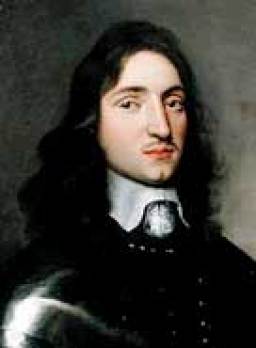 Essentially we have covered the fact that during 1643 the Earl of Essex’s parliamentarian Western Association army did not have a great deal to shout about. Meanwhile in Yorkshire the same Commissions of Array were delivered and like their counterparts in the SouthWest the gentlemen of Yorkshire and the Midlands were forced to decide where their loyalties lay. Hull and Leeds were important towns. Both declared for Parliament, Hull rather noticeably by refusing to let the king into the town in 1642.
 By contrast the Parliamentarians had men whose names reverberate through history. Sir John Hotham was the governor of Hull; Sir Hugh Cholmley led the garrison at Scarborough and then in the West Riding there was Ferdinando Fairfax (pictured right) and his son Thomas (pictured at the start of this post). The only difficulty was that Hotham didn’t appreciate Fairfax being the senior commander. The Fairfaxes controlled the West Riding and extended their hold from there to Tadcaster. Their main opponent in the West Riding was Sir William Savile.
 Gloucester is one of the key locations for Parliamentarian and Royalist confrontation. It is the victory that Parliament desperately needed in 1643 and it is perhaps also written about by historians as much as it is on account of the fact that there’s so much primary source material to support the story. The Earl of Stamford arrived in Gloucester in about November 1642 and left a regiment there for its defence.
 It’s interesting that in January 1643 the king was still receiving petitions asking him to return to London and his parliament. A Parliamentary committee even visited Oxford where the king was based in order to promise him his safety if he returned to London.
 The royalist command in Cornwall was held by Ralph Hopton featured at the start of this post with his wife Elizabeth. In 1642 he and his men had driven the Parliamentarians from Launceston. Whilst Hopton was unable to secure Devon at this time, Cornwall was firmly royalist. This position was confirmed on the 19th January 1643 when Hopton won the Battle of Braddock Down and from there went on to besiege Plymouth which was in Parliamentarian hands. In early 1643 there were a number of skirmishes between both sides but places like Parliamentarian Exeter continued to petition and negotiate for peace between the warring factions. In London, Parliament urged the Devon Committee to raise more money and troops.
 t that point the Royalists realise that they could control the whole of the southwest. On the 24th July Prince Rupert (pictured above) and his men rock up outside Bristol (England’s second city at this time) and suggest very nicely that its Parliamentarian Governor Colonel Nathaniel Fiennes might like to surrender. Fiennes declines the invitation and on the 26th Rupert and his forces storm Bristol. By nightfall Fiennes asks for terms and at the beginning of August King Charles visits. Fiennes will ask for a parliamentary investigation into the fall of Bristol as he is widely castigated on account of the fact that Waller has far more success with Gloucester than he has with Bristol – Gloucester requires its own post and besides which is just outside the region I am covering today.
 I am currently feeling slightly out of kilter time wise as I have classes running on topics ranging from Kathryn Swynford to the English Civil War with a side interest in the names on my local war memorial – the research for which in the hundredth anniversary is proving fascinating. I almost feel that I should do more blogs to give every area of History an airing!
 Aside from the fact that spelling remonstrance is not straight forward its an interlude that heads me off in the direction of the English Civil War.