 I had thought three parts to this little series but having written today’s post which is largely about the fourteenth and fifteenth centuries I shall be extending it to four parts.
Generation 10 of Topcliffe/2 of Alnwick:
Henry Percy Junior was only sixteen when his father died in 1314. Initially John de Felton held his lands in ward but by the time he was twenty Edward II had granted Henry more lands in Northumbria than his father held. These had been part of Patrick Earl of March’s territory. Patrick was Scottish and the land offer reflects the way in which northern territories fluctuated between Scotland and England during troubled times. Henry was no more impressed with Edward II’s choice of male favourite than his father had been nor with the foreign policy and military prowess that saw the Scots raiding deep into Yorkshire.
In no particular order, Percy conspired against the Despensers and was made governor of both Pickering and Scarborough Castle. The northern Percy powerhouse was further built upon when he married into the Clifford family and Edward III granted him Warkwarth Castle. In 1346 he was one of the English commanders at the Battle of Neville’s Cross near Durham against the Scots which must have been a bit irritating given that he had gone to Scotland in 1327 to help negotiate a peace treaty with them.
Generation 3 of Alnwick:
The next generation Henry Percy was at the Battle of Crecy – so should probably be regarded as the Hundred Years War Percy. His correct title was the 3rdBaron Percy of Alnwick. His first wife was Mary of Lancaster – the best way of thinking of her is as Blanche of Lancaster’s aunt. Blanche was the first wife of John of Gaunt who is commemorated in the Book of the Duchess by Chaucer and whose land ensured that Gaunt was the wealthiest man in the country. Mary was a daughter of Henry III. With each marriage the Percy family made the wealth and the prestige of the family rose, as did the amount of land that they held and their proximity to the throne.
Generation 4 of Alnwick – 1st Earl of Northumberland:
The Percy family now found itself elevated to the earldom of Northumberland – after all Mary of Lancaster was a Plantagenet princess so it is only reasonable to suppose that her first born son should have a sufficiently impressive title. The first earl, yet another Henry Percy, was born in 1341. He supported Edward III and then he supported Richard II in his various official capacities on the borders. It was Richard who created him an earl at his coronation in 1377. Unfortunately despite being having been married to Margaret Neville, Percy was distinctly un-amused when his power base was eroded by Richard II who created his rival (and nephew-in-law) Ralph Neville the earl of Westmorland. The First Earl of Northumberland now had a hissy fit because of the creation of the First Earl of Westmorland. He swapped sides. Instead of backing Richard II against his enemies he supported Henry of Bolingbroke, John of Gaunt’s son, against Richard II. Bolingbroke duly became Henry IV and Percy found himself swaggering around with the title Constable of England.
Unfortunately in 1403 the earl swapped sides once more. He was slightly irritated by the outcome of the Battle of Homildon Hill in 1402. It was an English-Scots match that the English won. Percy stood to make rather a lot of cash from ransoming his Scottish prisoners. Unfortunately Henry IV was feeling the financial pinch and besides which felt that the Percys had too much power in the north. So he demanded all the hostages and gave Percy a fraction of their value. The earl was underwhelmed but didn’t immediately voice his irritation.
Having been given the task of subduing the Welsh in 1403, Percy and his son Harry Hotspur now joined with Owain Glyndwr. Hotspur died at the Battle of Shrewsbury in 1403 but Henry IV couldn’t pin anything on the earl who hadn’t taken part in the battle. The most that Henry IV could do was remove the office of constable from Percy who didn’t learn the lesson and continued to conspire against Henry IV. In 1405 Percy decided to take a long holiday in Scotland for the sake of his health. He took Hotspur’s son with him. The earl returned to England in 1408 where he managed to get himself killed at the Battle of Bramham Moor near Tadcaster. This was the final battle in the Percy family rebellion against cousin Henry IV.
2nd Earl of Northumberland:
 Hotspur’s son another Henry had spent most of his childhood in Scotland because both his father and grandfather were at loggerheads with the monarch. Very sensibly after his grandfather was killed the second earl remained safely in Scotland. It was only when Henry IV died that Henry Percy took the opportunity to be reconciled with the Crown. He was officially recognised as the 2ndearl in 1413.
He arrived back in England and settled down to a spot of feuding with his Neville relations. The Nevilles, particularly Richard Neville (aka the Kingmaker) and his father the Earl of Salisbury were associated with Richard of York so naturally the Percy family supported Henry VI and the Duke of Somerset. Ironically the 2ndearl’s mother was Elizabeth Mortimer, the grand-daughter of Lionel of Antwerp, so you would have thought that he would have been more sympathetic to Richard of York who based his claims on his descent from Lionel. Not only that but his return to the earldom had been smoothed by Joan Beaufort, Countess of Westmorland. She also arranged his marriage to Eleanor Neville – her second daughter with the Earl of Westmorland – making the Earl of Salisbury Percy’s brother-in-law and the Kingmaker his nephew. Talk about a tangled family web.
I’ve blogged about Eleanor Neville and the Battle of Heworth Moor before so there is no need to write about it again. Enough to say that it demonstrates the depths to which the feud had sunk. And things were about to get worse. The earl was born in 1393 and died on 22 May 1455 at the First Battle of St Albans. It was a comprehensive victory for the Yorkists and according to the chronicles of the time an opportunity for Richard Neville, Earl of Warwick, to settle some personal scores – the death of the Earl of Northumberland being on his “to do” list. Obviously it didn’t help the relations between the Percy and Neville families as the Wars of the Roses spiralled towards the bloodiest battle in English history.
3rd Earl of Northumberland:
Another Henry Percy, swearing vengeance for his father’s death was one of the commanders of the army that surrounded Richard of York and the Earl of Salisbury at Wakefield. The deaths of Richard, his son Edmund and the Earl of Salisbury on the 30 December 1460 were part of the continuing vendetta.
The victors of Wakefield were now joined by Margaret of Anjou’s army. They marched south and won the Second Battle of St Albans but stopped short of taking London. Various armies marched back and forth but for the purposes of this post the next time we need to focus is at the Battle of Ferrybridge – 27 March 1461. Northumberland was supposed to stop the Yorkists from crossing the River Aire at Castleford whilst Lord Clifford held Ferrybridge for the Lancastrians. Lets just say that Northumberland arrived at Castleford late allowing Lord Fauconberg and his men to cross the river and come around behind the Lancastrians who retreated to Dintingdale (28th March) where Lord Clifford was killed by an arrow.
On the 29thMarch 1461, blinded by a snowstorm the 3rdEarl commanded the van of the Lancastrian army. Closing with the enemy he was killed.
Edward IV was now the only king in England and issued an act of attainder against all the Lancastrian nobility who had fought at Towton. Edward now rewarded the Nevilles who supported the House of York and punished the Percys who supported the house of Lancaster.
John Neville, Earl of Northumberland.
John was the Kingmaker’s younger brother. He was created Earl of Northumberland in 1464 after he had spent three years finishing off the Lancastrian threat in the north. Unfortunately for John, the Kingmaker became increasingly dissatisfied with Edward IV who, in return, became increasingly suspicious of his cousin. In 1470 Edward removed John from post and gave him the tile the Marquis of Montagu and assorted lands to compensate for the loss of the earldom of Northumberland. It did not go down well with the Neville family who did not see any need for the balance of power in the North to be restored by the return of the Percy family.
Edward was forced to flee his realm in October 1470 but returned in 1471. John had not regained his title to Northumberland despite his brother effectively ruling England with a puppet king in the form of Henry VI on the throne. Rather than attack Edward when he landed at Ravenspur, Neville simply shadowed the returned Yorkist king. Ulitmately Neville would died at the Battle of Barnet along with his brother.
4th Earl of Northumberland:
Henry Percy (what a surprise) was imprisoned in the Fleet Prison in the aftermath of Towton (he was about 12 at the time) and from there he was sent to the Tower in 1464. In 1469 after swearing fealty to Edward IV he was released. He then set about trying to get his estates returned. He petitioned for the reversal of his father’s attainder though this was not granted by Parliament until 1473.
Interestingly his wife was Maud Herbert, the girl who Henry Tudor should have married had events not unfolded as they did in 1470. They had eleven children.
Henry Percy went back to doing what the Earls of Northumberland had been doing for a very long time – i.e. ruling vast tracts of land and skirmishing with the Scots. He held many of the important government posts in the north of England which were traditional in his family including from 10 May 1483, as protector, Richard, Duke of Gloucester, confirmed the fourth earl of Northumberland’s appointment as warden-general of the east and middle marches ‘during the space and time of a whole year’, after which it was renewed for five months but perhaps it would appear not as much power from Richard III as he had hoped. Naturally enough he fought at Bosworth where he commanded the right wing of Richard III’s army. The Percys were naturally Lancastrian by inclination. Percy’s father and grandfather had died for Henry VI. Some historians says that Percy betrayed Richard III by holding his forces back from action. Percy’s northern levies weren’t committed to the battle.
If Northumberland had been a metaphorical spoke in Richard’s wheel he wasn’t very well rewarded by Henry Tudor who now became Henry VII. Northumberland, along with the earls of Westmoreland and Surrey was taken into custody and kept in prison for several months, being released only under strict conditions of good behaviour. He was restored to his position as warden but with curtailed powers. Henry may not have trusted him but Percy knew how to protect England’s northern border. He was also at hand to help defeat the Yorkist forces that gathered during the Lambert Simnel rebellion in 1487.
In 1489 Northumberland was part of the king’s administration gathering £100,000 of tax. This led to the Yorkshire Rebellion. Northumberland had to deal with the resistance of Yorkshiremen to the tenth of incomes demanded for Henry’s Breton war and for the raising of a force against the Scots. Things can’t have gone well for the Earl as his own tenants were up in arms. He was so alarmed that on Saturday, 24 April, he wrote to Sir Robert Plumpton from Seamer, close to Scarborough, ordering him to secretly bring as many armed men as he could to Thirsk by the following Monday. It didn’t do him much good.
On Wednesday, 28 April, having gathered a force estimated at eight hundred men, he came into conflict with the commons, whose ringleader was one John a Chamber, near Thirsk, at a place variously called Cockledge or Blackmoor Edge, and was killed. Popular history claims it wasn’t so much the tax collection that irritated the locals as the fact that as good Yorkshire men their loyalty lay with Richard III.

 Thomas Beresford died some ten years after his wife, Agnes. They were buried in St Edmund’s Church, Fenny Bentley opposite their home in Fenny Bentley Old Hall. Their tomb tells us quite a bit about the couple – they had sixteen sons and five daughters – all of them in their shrouds, as indeed are Thomas and Agnes.
 The Babington family of Dethick arrived in Derbyshire in 1420 when Sir Thomas Babington, who was born in the mid 1370s, married Isabel Dethick the daughter of Robert Dethick, heiress to the Manor of Dethick. Prior to that time the Babingtons were a Nottinghamshire family who had moved south sometime before from Babington in Northumberland. There are records of thirteenth century Babingtons in Northumberland during the reign of Henry III. By the reign of Edward III there are records of Babingtons in East Bridgeford.
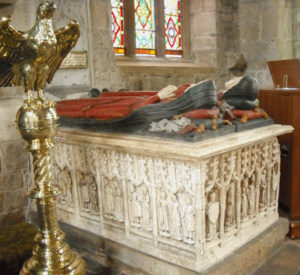 Thomas died in 1518 and was buried in Ashover where his grandparents were buried. It was the first thing he identified in his will. His wife had already died and the monument already built. The figures around the tomb included members of his family. He did not want it broken so that he could be interred. He stipulated where he wished to be interred, that candles were to be burned around his body and alms given to the poor. He asked that his debts be paid and that if he had offended anyone that they should have restitution. He asked for masses and prayers to be said. In short it was a good pre-Reformation will with attention being paid for departing purgatory for Heaven as soon as possible.
 Yesterday’s post covered all of points 1-3 and most of 4:
 He and Elizabeth of Lancaster had three sons. The eldest and youngest died without heirs whilst the middle son, conveniently called John regained the dukedom from Henry V following the victory at Agincourt. John, the second Duke of Exeter, married the widow of Edmund Mortimer and had two children. The boy was called Henry and he was born in 1430 so we have now arrived at the Wars of the Roses generations.
 Edmund Cokayne or Cockayne, depending on the source and your own preference, is buried in St Oswald’s Church, Ashbourne but he lived near Alport at Harthill Hall. His parents were Sir John Cokayne and Cecilia Vernon. Sir John Cokayne was John of Gaunt’s steward for the duke’s estates north of the Trent – so very much part of the Lancaster Affinity. As might be expected the family including Edmund were MPs for Derbyshire.
 I tend to think of Lady Margaret Beaufort looking rather austere in a wimple and black gown as pictured left. Melanie Taylor, art historian (
 A quick check on the National Portrait Gallery website revealed eighteen images associated with Henry Tudor’s mother in their collection. They all picture her dressed as a widow. There are other portraits dotted around the countryside including the one at Hever Castle pictured left which features an expensive cloth of state, trademark widow’s wimple, black frock and prayer book. We tend to think that the black dress she is most commonly associated with is akin to a monastic habit but in actual fact the fabrics and dyes made her clothing some of the most expensive available. The robes she wore were the same quality as those worn by Henry VII’s queen and during one Christmas celebration they wore identical garments.
 It turns out that there is only one original known likeness of the redoubtable matriarch of the Tudor family – her funeral effigy cast by Italian Master Pietro Torrigiano. He also created the wonderful sculpture of Henry VIII as a little boy and the bust of Henry VII. The face was probably taken from her death mask – so not one of her better days. Interestingly as well as the Beaufort arms the Stafford knot features in the imagery around her effigy.
 The portrait that I’m particularly fond of is purported to be Margaret Beaufort in her youth but unfortunately the headdress doesn’t match to the correct period but to a time closer to the beginning of the sixteenth century. The National Portrait Gallery identifies it as an Unknown Lady. Despite that you can see how the folded hands, the rings on her fingers, and headdress would lead to the idea that it was Margaret Beaufort. The portrait has been in the National Portrait Gallery since 1908.
 Henry Stafford was the second son of Humphrey Stafford, First Duke of Buckingham. I’ve posted about him before. The post can be found
  King Henry V of England or Henry of Monmouth if you’ve been reading Shakespeare became king in 1413. He resumed the Hundred Years War that his great grandfather Edward III had pursued and in 1415 won the Battle of Agincourt. So far so good. As part of the Treaty of Troyes between England and France that followed – recognising Henry as Charles VI’s heir he married Katherine of Valois – the French king’s daughter. All the dominoes had been lined up for a union between England and France. He had done, in short order, what medieval kings were required to do – he’d been victorious in war and landed a bona fide princess to boot and his first child was a boy – what more could you want?
 Bamburgh Castle perched on the edge of Budle Bay is another of the Percy castles but its history is much longer than that. It was home to Gospatrick Earl of Northumbria at the time of the Norman Conquest. He was eventually forced to submit to the Conqueror. Bamburgh was handed over to the Bishop of Durham. Sources differ as to whether it was William the Conqueror who built the first castle on the site or the bishop. Suffice it to say that by the reign of Henry II after several changes of ownership it was in Crown hands – Henry II funded the great keep and it became a venue for a number of Plantagenet visitors.
 Warkworth Castle was not always in the hands of the Percy family. It was presented to them in 1332 by Edward III. Our interest today is in the 1st earl of Northumberland who was so created at the coronation of Richard II. The earl’s mother was Mary of Lancaster, a great granddaughter of Henry III. Ultimately the 1st earl sided with his cousin Henry Bolingbroke and helped to topple Richard II from power in 1399. Henry, who had been exiled by Richard II returned to Ravenspur after his father’s death ostensibly to claim the Duchy of Lancaster which Richard had decided to confiscate upon John of Gaunt’s death. Richard II was in Ireland at the time of Henry’s arrival at Ravenspur. Richard returned to England via Wales. He found himself in Conway Castle having a discussion with the Earl of Northumberland and the Archbishop of Canterbury. From there he found himself in the Tower of London, deposed by Parliament on an assortment of charges agains this realm and from there sent to Pontefract where he died- either because he was starved, forgotten about or refused to eat. Henry IV did not see himself as a usurper because legally the throne became vacant when Richard was deposed by Parliament. He had merely stepped up to take the role.
 Now in 1403 the initially pro-Lancastrian Percies needed a reason to turn against Henry IV as they discovered that their courses were not running in parallel. They had initially supported Henry Bolingbroke to regain what was rightfully his but he had then taken matters further and toppled Richard II from the throne – or so they said- demonstrating the History is about stories and that one person’s story is another person’s work of fiction. Having been badly disappointed in Henry IV who had taken what was not his, the Percies now decided that it was only right and proper that they help put Mortimer on the throne.
 The grief-stricken earl of Northumberland made his peace with Henry IV on that occasion but it was not long before he rebelled once again, fled to Scotland with his grandson and finally returned to die at Bramham Moor.