Edward II and his favourites

edwardiiPiers Gaveston was the son of a Gascon lord. When Edward I chose suitable persons for his eldest surviving son’s household young Piers was selected on account of his father’s loyalty and the fact that Edward thought he’d make a good role model – Piers was apparently a bit of a charmer.

The Prince of Wales and Piers were both about 16 when they met. They certainly took to one another though how close their friendship was is a matter of speculation. After all, Edward went on to have four children with his wife Isabella. Many at the time thought Edward and Piers were having a homosexual relationship (it explained why Edward could refuse Piers nothing), but some modern historians see it as more like close brotherly love. Edward referred to Gaveston as ‘my brother Piers’. Whatever the exact nature of the relationship, it was a disaster for the kingdom.

In 1307 Edward I banished Gaveston from England, though he was to be paid an allowance. The king asked the men gathered round his death-bed to ensure that Gaveston did not return (one of them was Robert Clifford) unfortunately for England all the men gathered around Edward at the time appear to have had their fingers crossed when they promised Edward that Gaveston wouldn’t be allowed back.

The new king, Edward II, immediately brought Gaveston back to his side, made him Earl of Cornwall and bestowed on him an aristocratic wife, land  and money. Edward II was not like his father – medieval kings were supposed to be successful warriors. Edward II was more interested in digging ditches and chatting to ordinary men – preferably burly ones with a good set of biceps if some accounts are to be credited. He was also prone to doing slightly silly things such as burning Wetheral Priory on an evening out (well it saved the Scots a job) and it was swiftly becoming clear to all around him that he was not a good judge of men.


In 1308 Edward allowed Gaveston a prominent role in his coronation and later at his wedding banquet, at which he paid so much attention to the favourite that Queen Isabella’s French relatives walked out. It probably didn’t help that Gaveston had ordered tapestries for the occasion – they depicted the king’s arms quartered with his own. There was also the matter of Piers wearing the queen’s jewelry ‘for safe keeping.’

The king was forced to send Gaveston away to Ireland later that year, but he was back in 1309 and resumed his position at court as Edward’s principal adviser. This effectively meant that if you wanted to get the king you had to go through Piers. He controlled royal patronage and used his position to get rich.

By March 1310 opposition had mounted to such a point that the king had to agree to the appointment of the Lords Ordainers, a committee of 21 earls, barons and bishops who were to draw up rules for the management of the royal household and the realm. At the forefront of this drive to curtail Edward’s power was his cousin Thomas of Lancaster.

Gaveston was exiled by the Lord Ordinancers in November 1311. He returned without permission in January 1312 and was captured. He was effectively kidnapped on his journey south by Thomas of Lancaster at Warwick. He sentenced Gaveston to death and had the sentence carried out as soon as possible. The problem was that the execution wasn’t entirely legal. Lancaster had exceeded his authority. This caused a rift between some of the Lord Ordainers and although Edward II couldn’t act against them immediately he stored up his anger and took his revenge at a later date when he felt that he was in a position of strength.


Meanwhile the king led a military campaign in Scotland that failed to subdue Robert the Bruce. It would eventually culminate with a crushing defeat for the English in 1314 at the Battle of Bannockburn. Edward had no idea of strategy or good positioning for an army.   He thought that it was enough to turn up with lots of men.  The north of England found itself open to wave after wave of Scottish invaders and raiders. Skipton Castle came under attack in 1317, 1318, 1399 and 1322. It was partly because of this that Sir Roger Clifford, second Lord of Westmorland joined with the king’s enemies.


It didn’t help either that the harvest failed in 1315. The famine was not the king’s fault but it was symptomatic of the problems besetting his realm. The country was descending into chaos and just to make matters worse Edward found himself a new best friend. Hugh Despenser and his dear old dad also called Hugh Despenser. Hugh Despenser the Younger was married to Edward II’s niece so he was already part of the family.

Edward was clearly attracted to arrogant and greedy men. The Despensers made Gaveston look positively mild in comparison. They seized castles that didn’t belong to them, bullied women (by which I mean breaking their legs) and were probably unkind to small animals.  Things came to a head when they took possession of land in the Welsh marches that definitely didn’t belong to them. It was at this point that court politics erupted into open rebellion. Parliament caused the two men to be banished in 1321 but Edward called them home the following year.


At first Edward was victorious. His army quelled the Mortimers and then another army loyal to him was victorious at the Battle of Boroughbridge. The army was led by Sir Andrew de Harcla who knew that Thomas of Lancaster had called upon the Scots for support. Lancaster is supposed to have said that Sir Andrew would find himself in a position similar to that of Lancaster before the year was out. It turned out to be true. Roger Mortimer found himself in the Tower of London and Thomas of Lancaster found himself without a head. The following year Sir Andrew de Harcla, who had lost confidence in his king’s ability to protect the people of the north following the Battle of Byland in 1322, was found guilty of treating with the Scots. He was hanged, drawn and quartered in Carlisle. Ironically Edward was forced to make terms with the Scots shortly afterwards because he’d had his best warriors executed.


It was just after this in 1325 that Queen Isabella took the opportunity to go home to France for a holiday along with her son where she wreaked havoc upon her family as well as meeting and falling in love with Roger Mortimer who had managed to escape from the Tower.


Isabella and Mortimer invaded England from the Continent in 1326 with only 1500 men. Such was the unpopularity of the king and his favourites that people flocked to join them. The Despensers suffered unpleasant deaths. Hugh Despenser the younger was taken to the market place in Hereford covered in tattoos outlining his many sins which included rape (Alison Weir has a theory that Despenser raped the queen) before being hanged, drawn and quartered.


Edward was forced to abdicate in January 1327, in favour of his son another Edward. Edward II was murdered at Berkeley Castle. He is the king purported to have been killed with a red-hot poker shoved somewhere unmentionable. However Dr Ian Mortimer presents an intriguing theory that the king’s death was feigned.


Roger de Clifford – the Second Lord Clifford.

IMG_3982Roger Clifford, the 2nd Baron Clifford born in 1299 at Appleby Castle inherited the title, estates and inherited role of Sheriff of Westmorland upon the death of his father at the Battle of Bannockburn in 1314 at the age of fourteen. It was never a good idea to inherit as a minor as it could play havoc with estate income but 1314 was a particularly bad time to inherit property in the North of England. The Scots took advantage in the military ineptitude of Edward II to raid the borders, into Durham and on into Yorkshire. Skipton Castle was soon withstanding Scottish marauders.


Little wonder then that Roger, when he attained his majority, found himself drawn towards Thomas of Lancaster, Edward II’s cousin (His father was Edmund Crouchback, Edward I’s brother) a man of sound military experience. Through a complicated series of manoeuvres King Edward II was forced to form a council with Thomas of Lancaster at its head. The goal was to try to make some sense out of the chaos that followed Edward’s policies and reliance upon his favourites – Piers Gaveston and then Hugh Despencer.


Not that the council’s policies did much good. Berwick was lost to the English in 1318 and Edward’s favourite, the avaricious Hugh Despencer, so successfully irritated the nobility (who were already a tad tetchy about Edward II’s whole management style) that they revolted. The flames were first fanned into open revolt on the Welsh Marches where nobles including the Earl of Hereford and Sir Roger Mortimer found that their land was prey to Despencer and his father.


The Earl of Hereford was, according to the Lannercost Chronicle, Roger Clifford’s father-in-law so it was almost inevitable that he should have been drawn in to the conflict. As is always the case, history is not necessarily clear-cut. Another source states that Roger Clifford was unmarried at the time of his death, his marriage having been annulled but more of that shortly. It should also be added that Despencer had helped himself to some land belonging to Roger’s mother the heiress Maud de Clare giving Clifford more than enough reason to take up arms.


Edward realizing that he was on the verge of loosing his kingdom exiled Despenser and called on his loyal subjects to tackle Thomas of Lancaster and his cronies. Mortimer and the Welsh marches were subdued in January 1322. A northern army led by Thomas of Lancaster posed more of a threat.


Of key importance to Edward II’s victory over his subjects in 1322 was Sir Andrew de Harcla, the hero of the Siege of Carlisle, who marched south with an army of borderers upon hearing that Lancaster had turned to the Scots for support. The Lannercost Chronicle contains an account of the Battle of Boroughbridge:


On Tuesday, then, after the third Sunday in Lent, being the seventeenth of the kalends of April [16 March 1322], the aforesaid Earls arrived in force, and perceiving that Sir Andrew had anticipated them by occupying the north end of the bridge, they arranged that the Earl of Hereford and Sir Roger de Clifford (a man of great strength who had married his daughter) should advance with their company and seize the bridge from the pikemen stationed there, while the Earl of Lancaster with the rest of the cavalry should attack the ford and seize the water and ford from the pikemen, putting them to flight and killing all who resisted; but matters took a different turn.  For when the Earl of Hereford (with his standard‑bearer leading the advance, to wit, Sir Ralf de Applinsdene) and Sir Roger de Clifford and some other knights, had entered upon the bridge before the others as bold as lions, charging fiercely upon the enemy, pikes were thrust at the Earl from all sides; he fell immediately and was killed with his standard‑bearer and the knights aforesaid, to wit, Sir W de Sule and Sir Roger de Berefield; but Sir Roger de Clifford, though grievously wounded with pikes and arrows, and driven back, escaped with difficulty along with the others.


The Chronicle records the overnight armistice between Lancaster and de Harcla, who had once served Lancaster. It continues:


But during that night the Earl of Hereford’s men deserted and fled, because their lord had been killed, also many of the Earl of Lancaster’s men and those of my Lord de Clifford and others deserted from them.  When morning came, therefore, the Earl of Lancaster, my Lord de Clifford, my Lord de Mowbray and all who had remained with them, surrendered to Sir Andrew, who himself took them to York as captives, where they were confined in the castle to await there the pleasure of my lord the King.


Roger had been seriously wounded but it didn’t save him from Edward II’s wrath. In March 1322 the motte and bailey castle at York gained a new name when Roger Clifford was hanged in chains from its walls. Clifford may have given his name to Clifford’s Tower but his lands from Hartlepool to Westmorland were confiscated by the crown.


A man found guilty of treason not only forfeited his life but also the wealth of his family.  In this case the third lord was Roger’s brother, Robert (the good news is that everything was restored in 1327). The king played fast and loose with the laws of the land when he confiscated many of the Clifford estates. There were rules about dower lands and entails which should have resulted in Robert, who was a minor, keeping more than he did but wars cost money and besides, Edward II had favourites to please. Two thirds of the Clifford estates were bagged by the crown. The third that remained had come into the family along with Maud de Clare.


Roger died without legitimate heirs although folklore, as recorded by William Wordsworth (yes – the William Wordsworth) notes that Roger had a mistress by whom he had a number of children (allegedly). Julian of the Bower (yes I know it’s a boy’s name) is supposed to have been so beloved of Roger that he had a house built for her near Penrith in the Whinfell Forest. Julian’s Bower is not without controversy. The name is given to turf mazes across the country and Julian’s Bower near Penrith may or may not be the remnants of a medieval love nest given that Nicholson and Burn in their county history identify its origins as Roman.  There is no reason given for Roger’s marriage being annulled but then much of Roger’s personal life seems to be as nebulous as will o’ the wisp.

My next post will take an overview of Edward II’s reign which is convenient as I have just started a book called ‘The Cup of Ghosts’ by Paul Doherty about Matilda of Westminster, a fictional confidante of Isabella of France – Edward II’s wife and personal ‘She-wolf.’


Robert, First Lord Clifford

IMG_4008Robert Clifford was born in 1274. He was the son of Isabella de Vieuxpont and Roger Clifford. The Cliffords were an old Norman family who took their name from their main seat in Herefordshire meaning that the Lords of Skipton were distantly related to Rosamond Clifford (Fair Rosamond) who was Henry I’s mistress. On his mother’s side – Isabella and her sister Idonea were coheirs to the lordship of Westmorland which, together with Edward I’s campaign to subdue Scotland, would ultimately change the marches upon which the Cliffords prowled.


Young Robert lost his father early so the vast lands (including Brough, Brougham and Appleby) that would one day be his passed into other hands for the time being. When he reached his majority Robert would spend years trying to regain property which had been stolen during his minority.  He ultimately grew to maturity under the care of Edward I from whom he learned the art of warfare in North Wales before making a name for himself in Scotland. By 1297 he was responsible for Edward’s castles in Cumberland as well as taking part in the perennial border warfare of the period. The following year, according to Summerson, he became Keeper of Nottingham Castle and the justice in the royal forests north of the River Trent. That same year Edward I gave Robert Clifford Caerlaverock Castle and all the lands that belonged to Sir William Douglas as a reward for his work. On one hand this was very nice for Robert on the other hand the Douglas family were not best pleased. Edward’s grant triggered a feud between the Douglasses and the Cliffords that lasted for the next hundred years.  It probably didn’t help that Robert’s actions in Dumfries and Annan were recorded in the Song of Caerlaverock. Clifford was undoubtedly a capable as well as loyal officer to the crown – it certainly helped him to build an extensive power base on which to build his family’s fortunes.

He attended Edward I until his death and from his appointment as Marshall of England by Edward II whom Clifford had served during the Prince of Wales’ time on campaign in Scotland. He didn’t hold the job for long. He also gave up his role of Justice and Keeper of Nottingham Castle.  In October 1309 he was appointed keeper of the English West March with Carlisle as its headquarters, and was ordered to act as Warden of Scotland, with a force of 100 men-at-arms and 300 foot soldiers – so he probably didn’t have much time to sit around in Nottingham.


It was at about this time Robert came to an accommodation with his childless aunt (Idonea) which ultimately resulted in the Lordship of Westmorland being granted to him. Robert Clifford already held Brough Castle and Appleby and now he was granted Skipton Castle making him a force to be reckoned with in the north.


Unfortunately the business of the Scottish Wars of Independence were somewhat sidelined by Edward II’s relationship with Piers Gaveston. The King’s favourite was greedy for wealth and power. In October 1310, just as Clifford was building a substantial power base for himself in the north-west the king granted the Honour of Penrith to Gaveston – a bit of a fly in the ointment so far as Clifford was concerned but not sufficient to make him join with many of the other English barons who formed a commission against Edward II to reform the way in which Edward governed his household and the realm.  The barons issued ordinances from which they gained the name Lords Ordainers.  One of the ordinances made Edward II take back into royal custody all the land which he’d given away.  This meant that Robert having gained Skipton was forced to return it to the crown.  A bizarre game of pass the castle then followed in which Skipton was then handed back to Clifford.  The reason behind this probably lies in the fact that Clifford had given his lands in Monmouth in exchange for the Honour of Skipton – so he wasn’t depriving the crown of its revenue. Clifford resumed his building work on the outer defences of the castle.


This uncertainty and his previous record for loyalty didn’t mean that Clifford wasn’t sympathetic to the demands of the Lords Ordainers. In 1312 he prevented Gaveston from receiving Scottish help, besieged him in Scarborough Castle and recovered royal jewels from Newcastle when they were abandoned by the king and his favourite. Later he acted as a go-between for the Earls of Lancaster and Warwick who sought a pardon when Edward II regained control of his realm. The earls received a pardon and so did Robert Clifford.


The pardons signaled a resumption of the Scottish War of Independence. In June 1314 Clifford was summoned to Berwick and the start of the campaign that ended in disaster for the English at Bannockburn. Clifford was killed in action. His body was taken to Carlisle and from there to Shap Abbey where he was buried.

Skipton Castle was about to face Scottish invasion and be plunged into civil war – life wasn’t going to be very restful for the Clifford family either.

A tale of Alice two Earls, kidnap, murder and the Elland by-pass

sirjohn ellandThomas, Earl of Lancaster is  most often known in history as the earl who was executed at Pontefract Castle for treason in 1322. He was led to a hill outside the castle, turned to face Scotland because his treachery came not only from his rebellion against his cousin Edward II but also from the fact that he had made a pact with the Scots.


His wife was Alice de Lacy. She was the daughter of the Earl of Lincoln and was espoused to Thomas when she was just twelve years old. The marriage was not a happy one. She spent much of her time at Pickering Castle. In 1317 she was kidnapped by John de Warren, Earl of Surrey. There is no evidence as to Alice’s view of the matter but historians speculate that she was agreeable to the idea – hardly surprising given Lancaster’s reputation as a womaniser. Lancaster did eventually divorce her but Alice did not find happiness with Surrey who already had a wife. Alice later married Eubolo Lestrange but not before she’d had an unpleasant encounter with Edward II’s favourite Hugh Despencer, who like the other powerful men in her life were more interested in her estates than in her.


So far so good – or not, as the case may be. The conflict rapidly escalated beyond Alice’s marital relations and into West Yorkshire. Lancaster and de Warren were sworn enemies; hence the kidnap. The ensuing fisticuffs was not something that was readily resolved and it involved many households who owed their allegiance to one or other of the parties. In Elland, tragic events unfolded and were even recorded in a ballad running to one hundred and twenty four verses  first written down in the Tudor period but which, it is agreed by some historians, date from much earlier.  As with the way of these things while some historians regard the ballad as authentic others have their doubts.

Sir John Eland of Eland was de Warren’s steward for the Manor of Wakefield and Sheriff of Yorkshire. He wanted vengeance from Robert Beaumont who was held accountable for the death of another of Warren’s men – possibly Sir John’s nephew. Beaumont owed his fealty to Lancaster. Robert Beaumont was shielding the real culprit of the murder, a man called Exley. As was the way of the time it also appears that compensation was paid for the death of Sir John’s kinsman. The matter should have ended there. The blood money having paid the debt.


However, Sir John was in no mood for forgiveness.  There was also much unrest in the county as a result of Edward II’s incapacity to rule and the greed of his favourites – the Despencers.  Sir John and his henchmen took the opportunity to kill Robert Beaumont in his own home, Crossland Hall near Huddersfield, then sat down to breakfast in the dead man’s stead. He forced Robert’s sons to partake of the meal. The eldest boy, Adam, refused and was threatened by Sir John.


Sir John had good reason to be hungry. He’d been up most of the night committing murder. On the way to Crosland Hall he’d stopped off at Quarmby Hall where he’d killed Sir Hugh de Quarmby before detouring to Lockwood Hall where he’d finished off John de Lockwood. Lockwood is recorded in the Wakefield Court Rolls as being found guilty of evicting an innocent man from his home.


The Beaumont family and the sons of Lockwood and de Quarmby fled to Lancashire but returned fifteen years later to exact their revenge. They stayed with a branch of the Lacy family while they plotted and awaited their opportunity. They killed John Eland on his way home from court in Brighouse in 1354.  Again, that might have been the end of the matter but for the fact that Sir John Eland’s son, another Sir John petitioned the king to pursue his father’s killers. Quarmby, Beaumont and Lockwood decided that their safety rested upon the end of Eland’s plans. The following year they killed Sir John’s son and grandson.   Only Isabel Eland remained and she married Sir John Savile. Eland’s home, Eland Hall overlooking Eland Bridge remained until 1976 when it was torn down to make way for the Elland By-pass according to the Halifax Courier.


The three vengeful sons fled the scene. They were followed and there was a fight in Ainley Wood. Quarmby was killed. Adam de Beaumont was able to flee the country. He reached Rhodes where he joined the Knights Hospitaller. Lockwood remained in the area because he was in love. His location was betrayed and he was killed by the under sheriff. According to the ballad he was betrayed by the lady he loved.

Sir John Eland’s home, Elland Hall overlooking Elland Bridge remained until 1976 when it was demolished to make way for Elland By-pass.


Click on the picture to open the Midgley Webpage to find out more about the Elland Feud.


A Little Bit of Luck

Luck of Edenhall

Luck of Edenhall

When I was a child we used to refer to a bird splattering the car window screen  with its guano as leaving ‘luck’.  As an adult responsible for washing my own car I fail to see what luck has to do with it.  However, back to matters in hand, the lucks of today’s post as rather prettier and infinitely more historic – although once again in some instances ‘luck’ seems to be missing from the equation.

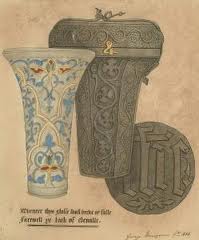
The first luck is the ‘Luck of Edenhall’ which used to be in possession of the Musgrave family of Edenhall. The ‘luck’ is a beautiful gilded and enamelled glass beaker (it looks like a vase to me but what do I know).  It was made in Syria so the chances are that it made its way home in the trunk of a Musgrave crusader.  Remarkably it survived the joys of reiver warfare, heavy handed drinkers and the washing up bowl.  Though to be fair it must always have been prized because when not in use it was kept in a leather container that had been made in the Fourteenth Century. The case bears the letters IHS suggesting that it was once used as a communion challice.

The luck was still in one piece at the beginning of the Eighteenth Century when the current owner decided it would be a good idea to drink the health of the entire family from the priceless heirloom.  Luck must indeed have been on the side of the Musgraves because it survived and went on to feature in a ballad.

Border ballads had been popularised by Sir Walter Scott and James Hogg at this time and “The Drinking Match” was a modern contrivance which featured the medieval glassware.

If this cup should break or fall,

Farewell the Luck of Edenhall.

From there it was one small step to the fairies – quite literally at the bottom of the garden – who were supposed to have given the luck to the Musgraves after water was drawn for them at a well.

The Musgraves aren’t the only family to have a ‘concrete’ luck that they need to guard against disaster.  The Lamb Family of Great Salkeld had a brass dish allegedly given by hobgoblins at a wedding feast.  A girl from the wedding family went to a nearby well to fetch water where she was accosted by a hungry hobgoblin – or gaggle of hungry hobgoblins depending on the account- who said that they would bless the bride and groom in exchange for food and drink.

Sir John Pennington was the Lord of Muncaster Castle during a portion of the Wars of the Roses.  In the aftermath of the Battle of Hexham (15 May 1464) King Henry VI was found wandering over the fell.  He was taken to Muncaster where Sir John and his wife cared for the broken monarch for the next nine days.  When he left the monarch – who could have done with a bit more luck himself- gave the family a glass cup telling them that they would prosper so long as it remained unbroken.  It is still on display in Muncaster Castle.

View across fells from Muncaster Castle

View across fells from Muncaster Castle

The final luck in this post brings us to the Luck of Workington.  Mary Queen of Scots fled across the Solway Firth in a fishing boat with sixteen companions.  When she arrived she had very few possessions and needed shelter.  Lord Herries, a Scottish Lowland laird who’d remained loyal to his queen sent a message to Sir Henry Curwen of Workington with whom he had a friendship.  Sir Henry sheltered Mary until she could be escorted to Carlisle Castle.  When she left she gave the family a small agate cup as a token of her gratitude.  It became known as the Workington Luck.

Fortified Churches in Cumbria

DSC_0065There are officially three fortified churches in Cumbria.  Two of them lie on the Solway Firth and the third, the first picture in this post, lies in the Eden Valley at Great Salkeld a few miles north of Penrith.

St Cuthbert’s Church in Great Salkeld was a brief resting place for the body of St Cuthbert when the monks spent seven years wandering through the north in fear of the Danes.  These days it is more noticeable for its tower.  The thick walls, narrow doorway and staircase as well as the ironbound door indicate that it was a place of safe haven from marauding Scots.

At Newton Arlosh they say that the door is so narrow that the bride and groom have to decide who is leaving the church first.  The spouse who sees daylight first will be the one in charge of the partnership so the locals say…I couldn’t possibly comment.

The third church is at Burgh-By-Sands and it is probably the oldest of the fortified towers which is not surprising given that it lays so very close to Scotland.  Its stones once formed part of the Roman fort of Aballava; a Celtic carved head reminds visitors that people have lived here for thousands of years.  The church lay in the domain of one of the knights who killed Thomas Becket and in 1307 Edward I was laid here in state after dying on his way to war with the Scots.  The tower caused the Bishop of Carlisle some distress because when the villagers built it they managed to undermine the foundations of the church.  One thing is for sure the builders meant business.  The tower is heavily buttressed and several feet thick as well as the narrow entrance, the iron yet is still in place with its three great bolts and there is a huge slot in the masonry for a bar to be slid into place.  There are narrow windows through which arrows could be fired and there is evidence of archers having sharpened the tips of the arrows on the walls of the tower.  When gunpowder became more readily available someone cut a gun loop in the lower room and a height that would leave attackers facing kneecapping at best.  The tower is vaulted and there is a narrow spiral staircase just the same as in Great Salkeld.DSC_0128

Of course there are a number of other churches in the area where villages- and certainly the priest- sought sanctuary in time of trouble.  The tower on the church at Edenhall (another St Cuthbert’s and another resting location for the saint’s mortal remains) has a funny little tower that includes a ‘mini’ steeple.  It was built in the fourteenth century and was probably used in much the same way as the three fortified churches already described but unlike the towers at Newton Arlosh, Burgh by Sands and Great Salkeld the tower in Edenhall lacks the narrow doorway and the iron bound door.

Other strategies were devised elsewhere. In Corbridge the vicar came up with an alternative means of self-preservation.  There is a peel tower in the churchyard where the vicar could flee in the event of trouble and the wall around the churchyard is fairly stout too.  At Kirkby Stephen the church tower is a handy vantage point that enabled two Westmorland’s Pilgrimage of Grace ringleaders to evade capture by Henry VIII’s men and is also part of a more general defense strategy whereby the streets narrow so that the townsfolk could defend their property more easily against border reivers.

The Mad Priest of Kent

John-ball-rebel-1John Ball was an English priest and one of the leaders of the Peasants Revolt of 1381. The revolt started in Essex at Brentwood.  It was only when the revolt spread to Kent that John Ball became involved but he quickly, according to folk-lore and the chroniclers of the period, became one of the revolt’s leaders.  He was certainly one of the most eloquent representatives of the Peasants Revolt.

Ball probably began his career in St Mary’s Abbey, York where he was ordained as a priest.  He next appears in Colchester in 1366 when he was arrested for heretical preaching and forbidden from preaching.  John Ball was not deterred. He attacked the wealth of the church and preached for equality between social classes. In 1376, he was arrested by the new archbishop of Canterbury, Simon of Sudbury because he preached that people need not pay their tithes to unworthy priests.  Even more inflammatory he said that all property should be shared in common among all people.

He was in prison at the outbreak of the Peasants’ Revolt in June of 1381. He wrote many letters from prison to his supporters continuing to urge them to break free from social injustice. When the revolt reached Maidstone one of the first things that Wat Tyler did was to free Ball.

Ball gave a sermon at Blackheath saying “When Adam delved and Eve span, who was then the gentleman?”  The peasants were so inflamed by his words that they demanded the heads of King Richard II’s bad advisors— Richard returned to the Tower with the men who the commons wanted to kill and the next day the commons rampaged through London.

Ball survived the death of Wat Tyler, there is no further reference to him after the famous sermon speech at Blackheath “When Adam delved and Eve span – who then was then the gentleman?” He escaped London and went into hiding.  He got as far as Coventry where he was discovered, captured and dragged back to face the king.

He was hanged, drawn and quartered on July 15 1381 at St Albans after judgment by Richard II.  His head ended up on a spike on London Bridge.  In the city itself people began to rebuild their homes and their lives where they could.  Many Flemings and Lombards had been killed during the unrest and now the King and his council ordered Englishmen to leave London if there had not lived there for a year and a day.

It was said by chroniclers of the period that Ball was a supporter of Wycliff and the Lollards but it is thought that this was an attempt by the authorities to implicate them in the events of the revolt.

Princess Joan of Kent

Joan of Kent was the daughter of Prince Edmund of Woodstock, 1st Earl of Kent and his wife Margaret Wake; wife of the Black Prince and mother to King Richard II.  She is unusual in that on the death of her brother, the 3rd Earl of Kent and 4th Baron Wake, Joan inherited the titles in her own right.

She may well be named after her maternal grandmother who was Princess Joan, King John’s illegitimate daughter who married Llewelyn the Great of Gwynedd.  Just to add to the family tangle, Princess Joan was also cousin to Roger Mortimer, Earl of March.  And Roger Mortimer was the man who was Queen Isabella’s lover and the man responsible for the judicial execution of Joan of Kent’s father who had continued to be loyal to the deposed Edward II (Kent’s half brother).  Once the usurping Earl of March had been done away with and Edward III assumed control of the throne he arranged for Joan and her sister to come to court.  The two girls were raised alongside his own children.  So Joan grew up with the Black Prince.  Eventually Joan became Edward III’s ward.

Clearly Joan was an important member of the royal family.  Whoever won her hand in marriage would gain many points in the medieval power game.  Joan had other ideas.  She fell in love with Sir Thomas Holland.  She was twelve.  He was twenty-six. His grandmother was Ela Longespee whose grandfather was the Fist Earl of Salisbury and the illegitimate son of Henry II which puts a whole new meaning on the saying ‘keep it in the family.’  Suffice it to say Thomas Holland wasn’t someone of the make.  His ancestry was as illustrious as that of Joan.

The problem was that because the pair had run away to get married it wasn’t strictly legal though very romantic.  Joan, and indeed Thomas, required the king’s consent to get married.  Her guardians at the time wanted Joan to marry their son, Sir William Montague, who was the second Earl of Salisbury.  They didn’t see Joan’s marriage to Thomas as a problem.  They simply waited for him to leave the country to go on crusade and then forced Joan to marry their son. In 1341 Holland returned home and wasn’t terribly pleased to discover that his wife was married to another man.  Undeterred he set about winning fame in France in what was to become the Hundred Years War as a military commander and then set about regaining Joan.  Salisbury put up a fight but in the end Pope Clement VI annulled Joan’s marriage to Salisbury.

Joan’s firstborn son Thomas Holland who became the Earl of Kent was an ancestor of Katherine Parr which is definitely an unexpected connection – though given the medieval penchant for familial marriages it probably shouldn’t be quite such a surprise. Another son married one of John of Gaunt’s daughters. And yet another child was an ancestor of Lady Jane Grey.  Sir Thomas died in 1360 leaving Joan a rich widow.  She was eventually buried beside her first husband.

As well as being wealthy and well-connected with the royal family Joan was also one of the beauties of her age.  She was known as ‘the fair maid of Kent’. Many offers of marriage were made.  Joan turned them all down.  According to one version of events, one of the Black Prince’s men asked  Edward to intercede with Joan on his behalf.  Edward found himself falling in love with his childhood companion.  They were cousins within the degree prohibited by the church so before they could marry a papal dispensation was required.  On her marriage she became the first Princess of Wales.

When she became the Queen Mother her life continued to be the stuff of historical novels and mini-series.  She was so loved by the people of England that when she encountered Wat Tyler and his men at Blackheath they let her pass unharmed with an escort (you can’t help wondering who let such an important personage as the king’s mother meander into the path of revolting peasants?).  In any event the tale demonstrates that as well as being regarded in the light of national treasure she was also conventionally religious.  She was returning from pilgrimage to Canterbury when her path crossed with that of Wat Tyler.

Richard II – who do you think you are? Or meet the family.

tumblr_m94jocf45j1qeu6ilo1_500Richard II is one of those monarchs in history who is remembered for coming to a rather nasty end.  Incidentally he is also the first English monarch for whom we have a realistic portrait.

So who was the unfortunate king who lost his throne and starved to death in Pontefract Castle.  Richard’s grandparents were Edward III and Philippa of Hainhault.  His father was Prince Edward known as the Black Prince on account of the colour of his armour but only from the sixteenth century.  The prince died a year before his father of an illness that he’d contracted in Europe.  He is best remembered for his military importance at the Battle of Crecy and later on for capturing the french king.  He campaigned in Spain and made himself unpopular with the people of Aquitaine when he taxed them for his Spanish campaigns – for that and for the massacre of some 3000 inhabitants of a town that rose up in revolt against him.

Edward was married to Joan who was the daughter of the Earl of Kent.  He was the son of Edward I and Margaret of France.  So, he was the chap who supported his brother (Edward II) and was executed on the orders of Mortimer and Isabella – so not exactly a peaceful childhood.  As if that weren’t enough she’d been married before – twice.  Unfortunately the second marriage was bigamous and it took papal decree to sort the tangled matrimonial web out.  She produced five children before her legitimate husband Sir Thomas Holland died.  She then married the Black Prince and bore two sons.  The first child, a boy called Edward, died age six or seven.  Her second son, Richard, was born in 1367 in Gascony.  He succeeded his grandfather as king, the year after the Black Prince died.

Richard was a minor with lots of half-siblings on his mother’s side of the family and plenty of cousins and uncles on his father’s side of the family – the most notable one being John of Gaunt.  The stage was set for a familiar family saga of murder and mayhem.

A warrior-bishop who collected taxes.

precinctsJohn Halton, or de Halton, was an Augustinian Canon in Carlisle.  He was elected the ninth Bishop of Carlisle on 23 April 1292 making him bishop during the reigns of Edward I and then Edward II – and putting him on the front line for the First Scottish War of Independence.


As well as caring for the spiritual concerns of his flock- his Register of the incumbents of the diocese still exists- he was also a busy diplomat and entertainer of royalty. The Magna  Britannia records him entertaining the king at Rose Castle (the principle residence until recently of the Bishops of Carlisle) in 1306 from 28 August until 10 September.

He was sent to Scotland in 1294 by the king and was a papal tax collector in Scotland (which possibly didn’t enhance his popularity with the locals and may account for why the Scots burned Rose Castle down at the first available opportunity – though obviously that’s my own personal spin on events).  On a more factual level, he was Governor of Carlisle Castle at one point, so had custody of Scottish prisoners and hostages – little did he realise that five hundred years later there would be so many Scottish Jacobite captives in Carlisle that the cathedral would have to be used as a prison.


It was Halton together with the Archbishop of York who excommunicated Robert Bruce in 1305 after the killing of John Comyn  and in 1306 he absolved everyone of their offences against the King’s enemies in Scotland which must have pleased the English borderers no end as they could then steal and kill with neither fear of hellfire and damnation nor, at the very least, a long time in Purgatory.  For his pains he was involved in the Seige of Carlisle in 1314 when Edward Bruce attempted to take the city.  He fled the border for large chunks of time enjoying the peace and quiet of Lincolnshire.  He was one of the king’s representatives in the treaty signed between England and Scotland in 1320.


The following year he turned up at a meeting held by Thomas of Lancaster which was the first indication of the barons uprising against Edward II.  There’s no evidence that Halton was involved any further but trouble and the bishop seemed to have gone hand in hand.  He died in 1324 having lived through some turbulent times on the border.