Talbots were medieval hunting dogs, apparently something like a beagle – short legs, long ears and a curling tail. Oh, and they were white. They may have been quite heavy and slow but no one is quite sure how they worked within a hunting situation because the breed no longer exists. Given the number of monarchs who seemed to have spent their time crashing around in the undergrowth for one reason or another it is not unreasonable to blog about them at this time. There is even a theory that William the Conqueror arrived with the breed of dog.
The Talbot Earls of Shrewsbury took over the title from the Montgomery family. Henry I removed the earldom from his rebellious subjects. The title was given by Henry VI to John Talbot who fought during the Hundred Years War in 1442. Talbots feature on the Shrewsbury Coat of arms as charges and as supporters.
I’m changing tack slightly this evening having skipped through bestiaries and peered into menageries it’s now time to take a look at medieval royal animals in heraldic terms. Supporters usually appear in pairs holding a shield up. Charges are depicted on the shield and a sigil is the symbol that appears on a seal. Livery badges were personal devices. Hope this isn’t too boaring…
Yup – tonight its the turn of the white boar which was used by Richard, Duke of Gloucester who ascended the throne as King Richard III. It’s not entirely certain why Richard used a boar by preference. It is often suggested that it was a play on Ebor or York. Richard’s wife, Anne Neville, used a white boar as well but her livery badge was chained and muzzled and was in fact associated with the earldom of Warwick. It has even been suggested that Richard chose this symbol when he was little more than a child based on the carvings at St Mary and All Saints at Fotheringhay.
A quick search of the Internet reveals plenty of white boar related posts – so I’ll keep this one short. Richard’s boar turns up on his standard, as supporters in the York Minster, as a badge and on livery collars. It even turns up as graffiti (Carlisle Castle).
Matthew Paris, British Library (CCCC MS 16, f. ivr)
It’s neither medieval nor an elephant but Cardinal Wolsey owned a pet cat. Just thought I’d throw it in. Anyway, King Louis IX of France gave Henry III, his brother-in-law, an African elephant – as you do. Inevitably it was packed off to the Tower where Matthew Paris saw and drew it. The poor elephant did not survive long in medieval London. It arrived in 1255 but was deadly 1257.
Apparently the elephant arrived at its destination having been traded during the Crusades. Louis led a crusade to Egypt. Louis was presented with the elephant as part of peace negotiations. The elephant was sent to France, et voila.In 1254, Henry III who was in Gascony at the time met up with Louis and the elephant was hastily passed on. As Louis gave Henry the elephant whilst in France it was Henry who had to transport the beast home – it gave the Sheriff of Dover a bit of a problem as Henry delegated the task,
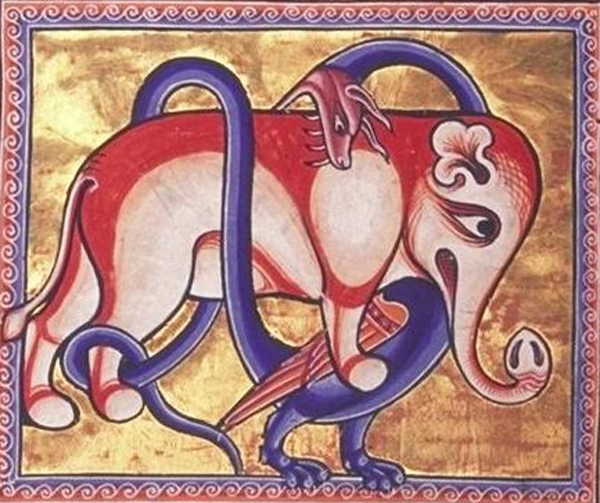
Meanwhile monastic writers described the elephant as a symbol of Christ and hope of redemption. The writers of bestiaries listening to tales from travellers convinced themselves that elephants lacked knee joints and that if they fell over they couldn’t get up again. Apparently dragons were fond of baby elephants …as a light snack and elephants were also afraid of mice.
The Aberdeen Bestiary – elephant and dragon in combat.
Matthew Paris and Henry III’s elephant Richard Cassidy and Michael Clasby
Henry I had quite a collection of exotic animals including a porcupine and some hyaenas which he kept at Woodstock. Thankfully he built a large wall around it. The local population may initially have thought that he was establishing a deer park – so it may have come as something as a shock when the hyaenas arrived with the lions, leopards and camels. Henry arranged for fodder to be strewn for his non carnivorous pets by Henry de La Wade of Stanton Harcourt who also came to have responsibility for the royal falcons.
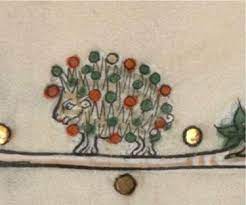
Which leaves us with the porcupine. It was a gift from William V of Montpellier who had gone on the First Crusade. Medieval bestiaries describe porcupines using their quills to spear fruit. They were also symbolic of sin -the fleshly ones apparently so an eminently suitable pet for womanising King Henry I. If you don’t fancy that particular sin othe bestiaries pinned avarice and covetousness on the porcupine and hedgehog – all those spikes collecting up everything around it.
Henry III would develop the menagerie Woodstock to form the basis of his own menagerie at the Tower of London which was initially founded by King John.
Grigson, Caroline, Menagerie: The History of Exotic Animals in England, 1100-1837, (Oxford University Press, Oxford 2016)
Poole, Austin Lane, From Domesday book to Magna Carta, 1087-1216 (Oxford University Press, Oxford, 1951)
What do you give a Plantagenet monarch in 1251/52? Well if you are the king of Norway (Haakon IV) you send a large white bear – possibly a polar bear although such a thing would not have been recognised by writers at the time – hence the reference to white bear. The bear, whose name is unknown, was duly ensconced in the Tower which must have come as a surprise to the lions and before long the bear was catching his own fish in the Thames. In addition to fishing rights, Henry III ordered that London’s sheriffs contribute 6d a day to support the bear and a strong rope for the handler who had to muzzle the creature before leading him down to the river to allow the bear to swim- presumably the bear and the handler got on well as there are no references to the need for regular replacement handlers.
It’s possible that a local tavern took up the name the White Bear’ because of Henry III’s pet – but that’s only speculation.
Alright – I know that the seventeenth century is not medieval by anyone’s stretch of the imagination – however, I just couldn’t resist.
Samuel Martin, a consul in Algiers and husband of one of Samuel’s old flames, sent Pepys a ‘tame’ lion as a gift in 1674. Sam decided that the lion would be best accommodated in his admiralty office in much the same manner as any other moggy. He wrote with his thanks and the information that ‘as tame as you sent him, and as good company.’ The cub eventually grew too big to be accommodated in Sam’s office at Derby House and he joined the menagerie in the Tower of London. Samuel had written about visits to the zoo in 1660 to see a lion named Crowly who was very tame.
Should you happen to be wandering near Seething Lane Garden where Pepys had his home you can find a carving of a lion.
The Tower of London has had a menagerie since the 1200s – which is definitely medieval. In medieval times, in order to get into the Tower visitors would have to cross a drawbridge to the lion tower built by King Edward I in about 1275 before entering. The tower was demolished during the Victorian period . In addition to lions the barbican also housed leopards.
Eventually it came to be believed, so it is said, that if a lion died someone in the royal family was about to die. The rumour was given credibility when a lioness died in 1603 shortly followed by Queen Elizabeth I.
It’s the beginning of December and I’m starting the annual advent count down to Christmas with a fabled creature from medieval bestiaries that gained more recent recognition thanks to a certain boy wizard. These creatures were allegedly hatched from the egg of a toad which had been incubated by a cockerel. As with most things scientific the medieval world took their cue from the Greeks. Pliny the Elder described basilisks killing with a single stare, being venomous and breathing fire. The Venerable Bede attested to the basilisk and Geoffrey Chaucer made mention of them.
In the event of coming across a basilisk the advice is to throw a weasel down its hole or burrow. Apparently, according to Pliny, who described the basilisk has having a deadly effect on everything in its vicinity including the vegetation, the weasel would become a fatality but the basilisk would succumb to the weasel’s smell. The weasel in this particular image from The British Library seems to be having a staring competition with the basilisk which has a resplendently serpentine tail attached to the body of a cockerel. An image of a basilisk held by the Bodleian Library shows the weasel being decidedly more aggressive and considerably larger that your average weasel. If you do encounter a basilisk but don’t have a handy weasel to lob at it, medieval writers professed the power of prayer. After all, the basilisk was an embodiment of evil. By the Renaissance, writers urged people to defend themselves with axes – presumably whilst avoiding the creature’s gaze.
A Weasel Combating a Basilisk, Folio 79, Bestiary of the Second Family, also known as The Ashmole Beastiary, Peterborough Abbey or Canterbury Abbey, c. 1200–10. BODLEIAN LIBRARY, OXFORD, MS ASHMOLE 1511
It has been suggested that Pliny was actually writing about a cobra – which hisses, spits and is deadly. Greek descriptions were used widely in bestiaries from the ninth century onwards. By 1100 they were becoming incorporated in alchemy. By the Renaissance writers were tripping over basilisks on a regular basis and inevitably charlatans were faking taxidermic examples. Francesco I de Medici had a particularly fine example on display in Florence.
I found this little chap on Pinterest. He originates in the bestiary of Anne Walshe dating from the early fifteenth century. Anne was a child and annotated several of the drawings. It can be found in the Royal Library of Copenhagen and can be viewed digitally online by following the link at the end of the post before the references.
R. McN. Alexander. “The Evolution of the Basilisk.” Greece & Rome, vol. 10, no. 2, [Classical Association, Cambridge University Press], 1963, pp. 170–81, http://www.jstor.org/stable/642817.
This post is by way of a Christmas warm up. Many of England’s medieval kings had exotic animals given to them, stories about animals abounded as new lands were explored and in Christian Europe, it was believed that the natural world was ordered by God to instruct people on a good life, proper behaviour and to reinforce Biblical knowledge – all anyone needed to do was to interpret the behaviour. Essentially the whole of creation was viewed as an allegory. Inevitably the idea was pinched from the greeks. But what the medieval world ended up with was a set of texts that combined zoology with religion – with a spot of mythology…unicorns for instance feature in many medieval bestiaries but in reality an elephant was as strange as a unicorn or a dragon. And just for good measure there was almost a game of Chinese whispers played between explorers, writers and illustrators of the bestiary – resulting in some very strange looking creatures including an ostrich with hooves.
So – lets make a start – eagles are the kings of the birds in the same way that the lion is the king of the beasts (natural order – you need to know your place) Eagles look to the sun to renew their youthfulness. People should look to God for their restoration. Equally sea eagles take dramatic plunges in search of food – they’re just like Adam and Eve falling from grace. I rather like these three eagles as they seem to be smiling.
More in December including Pope Leo X’s white elephant, King John’s zoo and King Henry I’s porcupine…
Sir Andrew Murray’s father, also named Andrew, fought with William Wallace. Our Sir Andrew was married to Christina Bruce the sister of King Robert I although his two sons were the issue of a previous marriage. He came to prominence during the Second Scottish War of Independence which started when Edward Balliol, one of the so-called ‘Disinherited’ made his claim to the kingdom of Scotland during the minority of King David II. Having won the battle of Dupplin Moor near Perth, Edward was crowned king.
However, supporters of David continued to fight on. Amongst them was Sir Andrew. In December 1332 he won the Battle of Annan which sent Edward packing to Carlisle, dressed it was reported only in his underclothes – where he presumably spent a miserable Christmas trying to drum up local support as well as some new togs. Having promised Edward III all of Lothian the king marched north with an army and besieged Berwick – not quite breaking the Treaty of Edinburgh-Northampton as I don’t think he crossed the Tweed.
Rather than taking Edward and his army on and lifting the siege, the Scots tried to draw the king away by raiding England. Sir Andrew got himself caught and imprisoned in Durham in April 1333. His replacement Guardian was Sir Archibald Douglas who rather unfortunately lost the Battle of Halidon Hill in July. Rather bizarrely, and in what can only be described as an own goal, the English ransomed Murray and allowed him to return to Scotland in 1334 – where he proceeded to besiege Balliol’s ally Henry de Beaumont (both names betraying their Anglo-Norman ancestry.)
Edward III was unable to bring Murray to battle, as the wily knight recognised that this was a sure fire way to lose any advantage. Instead, Murray harried the English with guerrilla tactics. When Edward and his army left Scotland he resumed the capture of castles fallen to supporters of Balliol. It was March 1337 before he recaptured his own castle of Bothwell.
The way into England was now clear and the burghers of Carlisle were faced with a Scottish army.
Having made his point, Murray retired in 1338 to Avoch Castle where he died. By that time King Edward III of England had turned his attention to France but Murray’s actions turned the tide in David II’s and Scotland’s favour. Meanwhile in Bute, Robert the Stewart was also taking action to secure the revival of the Bruce cause.
After 1341 the Second Scottish War of Independence reached a stalemate and the seventeen-year old king returned from France where he had been sent for his own safety after Dupplin Moor. The Auld Alliance would see David invading England with disastrous consequences for his rule.
The death of Isabel Marshal – daughter of Isabel de Clare, one of Isabel and William’s ten children.
The daughter of Earl Richard ‘Strongbow’ Earl of Pembroke and Striguil and Lord of Leinster and Aoife of Leinster, Isabel grew up as part of the powerful de Clare family and following her brother Gilbert’s death became one of the wealthiest heiresses in the kingdom. She was placed by King Henry II, who did not trust Strongbow, in the care of Ranulf de Glanville, justiciar of England.
In 1189 her marriage was arranged by Richard the Lionheart to William Marshal. The couple were happily married despite a twenty-six year age gap and never having met before their wedding in August that year. Isabel travelled by her husband’s side, took part in the management of their estates and issued writs. They went to Ireland in 1200 and she may have ruled Leinster in his absence. She continued to demonstrate her capacities when, Marshal was placed under arrest in 1207, she led a campaign against the province’s rebel barons. She was pregnant at the time. She gave William ten children, five boys and five girls. Marshal recognised that his power and his wealth came from his wife, honoured, loved and respected her intelligence. In Leinster her presence in Marshal’s life gave his rule legitimacy – she was after all the grand daughter of the last king of Leinster.
Isabel managed her husband’s affairs in his absence and following his death she took control of her own inheritance corresponding with the justiciar of England, with the papal legate and with King Philip II of France. After thirty years of marriage, William died. One of the last things he did was to join the Templars – forgoing the company of his wife and daughters in his final days. Isabel was devastated by Marshal’s death but she worked closely with her family to preserve her inheritance. She died ten months after her beloved husband. Her earldom did not survive her children. All five of the couples’ sons died without heirs.
Isabel was buried in Tintern Abbey next to her mother.