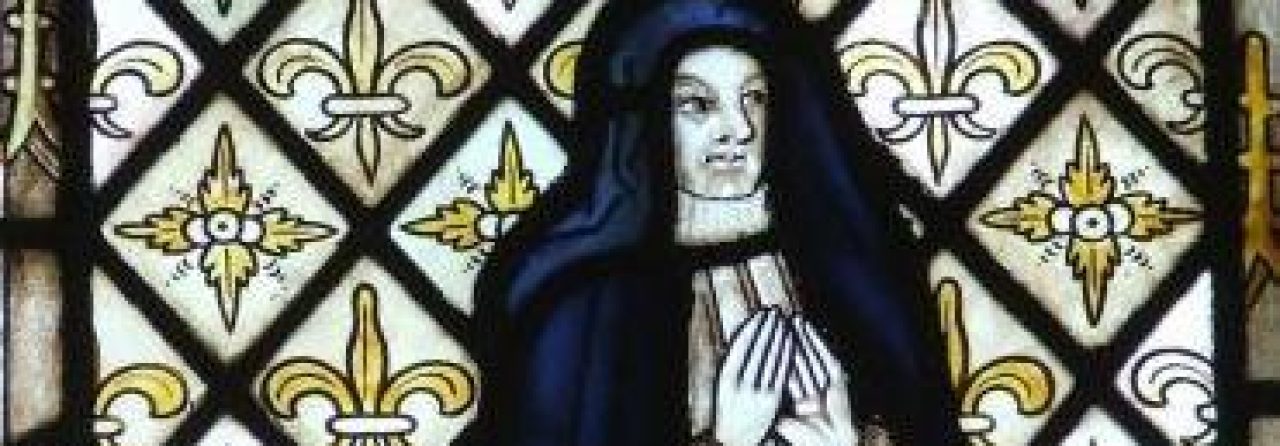
The Gilbertine Order was founded by Gilbert of Sempringham in 1130. Most of the priories associated with the order are in Lincolnshire and on the eastern side of the country.
Eleven of the twenty-six houses were double houses, in that they accommodated both men and women but there were strict rules about segregation. The priory at Ravenstonedale does not appear to have been a double house.
It was founded circa 1200 when the manor was granted to Watton which was a double house with some 150 women and 70 men. It seems that Ravenstonedale never grew large – there were three canons and some lay brothers. The men followed the Augustinians and were all canons whilst the women were Benedictine.
There was a fish pond and a rabbit warren to feed the canons at Ravenstonedale. Effectively the canons were the Lords of the Manor so had to fulfil that role including dispensing justice.
Gilbert of Sempringham founded the Gilbertine Order. It was the only English founded order and it was also the only one with double houses. Gilbertine nuns followed the Benedictine pattern whilst the monks followed the Augustinian pattern of canons. Not all houses were double but the one at Watton in East Yorkshire was.
The story was recorded by Ailred of Rievaulx in the early 1160s. Essentially the nun in question was an oblate in that she had been in the priory since she was four years old. Interestingly, the Gilbertines had an age requirement for entry to their order – 24 for men and 20 for women. However, our nun gained admittance as a child at the request of the Bishop of York.
The nun became enamoured of either a lay brother or one of the canons. The attraction was reciprocated. They arranged to meet. The inevitable happened. The nun was found to be pregnant. The nun was beaten and imprisoned and when her lover captured she was forced to castrate him herself. He was returned to the male side of the house at Watton and disappears from the story.
However, the nun returned to her prison, was visited by the now deceased archbishop and two women who took the baby leaving the teenage nun in her original state of virtue. At which point she was allowed out of prison – a miracle having occurred.
It would have to be said that the Gilbertines had strict rules about segregating the canons from the nuns. Nonetheless the priory at Watton which was one of the most important Gilbertine Foundations was said to have many secret passages.
Watton was where Marjory Bruce, the eleven year old daughter of Robert the Bruce, was imprisoned by Edward I in 1306. She regained her freedom after the Battle of Bannockburn.
G. Constable, ‘Aelred of Rievaulx and the Nun of Watton: an episode in the early history of the Gilbertine order’, Medieval women, ed. D. Baker, SCH, subsidia, 1 (1978), 205–26
Armathwaite can be found in the Eden Valley near Croglin. It’s said to have been founded by William Rufus in 1089. Unfortunately Rufus wa snot known for his links with the Church and it’s now generally thought that the charter was a forgery. The nuns of Armathwaite weren’t the only ones to make their founding patron or history seem more important or to gain more definite legal ownership of property so let’s not hold a spot of light forgery against them.
Edward IV accepted their documents which included freedom from toll throughout England and there was also a claim for sanctuary. Someone claiming sanctuary had to be inside the boundary of the nunnery – there’s a pillar near the nunnery to bolster this.
Detective work finds the nunnery in 1200 mentioned in the St Bees charter when Roger de Beauchamp gives the monks lank near that belonging to the nuns of Armathwaite.
The Scottish Wars of Independence were not kind to the nuns which was why Edward II gave them leave to pasture their cattle in Inglewood Forest and excused them a debt for food purchased because their lands and income had been virtually destroyed by marauding Scots.
It’s generally accepted that nunneries weren’t so well supported as their male counterparts. Although there were some foundations and patronage by royalty and the nobility the bulk of funds seem to have come from local gentry often in the form of will bequests:
“From the fourteenth century wills on record in the diocesan registers, we learn that this nunnery had some friends and received bequests as well as the other religious institutions in the county. In 1356 Dame Agnes, the consort of Sir Richard de Denton, bequeathed 10s. and in 1358 John de Salkeld 40s. to the prioress and her sisters of ‘Hermythwayt.’ Richard de Ulnesby, rector of Ousby or Ulnesby, was good enough in 1362 to bequeath them a cow which he had in that parish, while a citizen of Carlisle, William de London, in 1376, and a country gentleman, Roger de Salkeld, in 1379, made them bequests of money.”
‘Houses of Benedictine nuns: The nunnery of Armathwaite’, in A History of the County of Cumberland: Volume 2, ed. J Wilson (London, 1905), pp. 189-192. British History Onlinehttp://www.british-history.ac.uk/vch/cumb/vol2/pp189-192 [accessed 22 February 2021].
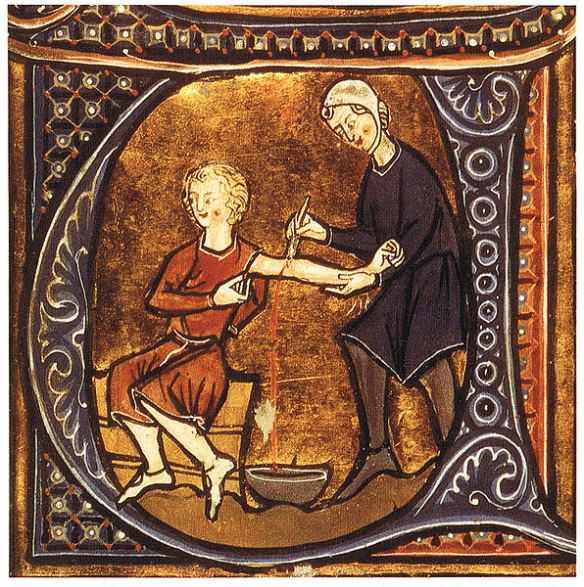
Today I’m combining February’s calendar page information (yes, I know its the middle fo the month) with monasticism. Bloodletting was an important part of medieval health. If you were a monk you would pop along to the warming-house/room, usually in the late morning or early afternoon having had a snack in the refectory first. Monastic blood letting seems to have been akin to letting a vampire do his worst because accounts suggest that monks might lose up to four pints of blood during a letting. In fact monks were so weakened by the experience that they needed to spend time recuperating without the requirement for labour and with a relaxed dietary regime. On the third day after the bloodletting, the monk joined the rest of the community for some of the offices and might start doing a spot of light reading. Â
Monks, certainly Cistercians, were bled four times a year including February. Basically the idea was that blood letting was a restorative that sharpened the mind and quenched the kind of urges that might get monks into trouble. If the truth was told the quarterly blood letting probably meant that the monks had more blood taken than they had baths each year.
The ‘vein man’ – a guide to blood letting. Wellcome Images L0020781
Candlemas on the 2nd of February ended the Medieval Christmas cycle. It was also often depicted as a time to rest – there are many images of agricultural labourers toasting their feet and warming their hands in front of a roaring fire in February.
The astronomical signs for the month began with Aquarius and ended the month with Pisces. Books of hours contained the astrological symbol for each month because it helped decide on medical practices – so letting blood from mid January to mid February was good because it is good to do things that last only a short while under Aquarius. But once the star sign changed it wasn’t a good idea to have anything medical done to your feet- not sure where you stand on clipping your toe nails as my medieval medical understanding isn’t that well defined.
In fact whilst we’re on the subject of blood letting – it depended on the month as to where blood should be taken and also what condition it was good for.
An example of the ‘theory’ of melothesia in which a particular parts of the body are associated with zodiac symbols. WI no. L0047652
There is a name for the way in which parts of the body are associated with different zodiac symbols – melothesia – if you please. It had a Babylonian background so we are back to the transference of knowledge via the Arab world.
Beauvale Priory was a Carthusian Priory. It’s remains are situated in Greasley, Nottinghamshire. Today it is a farm and very scrumptious tearoom.
It was built in 1343 by Sir Nicholas de Cantilupe, Lord of Ilkeston, with the approval of King Edward III. Nicholas was given permission for twelve monks and a prior to build a priory on his land and he provided them with £100 a year in rent as well. They also received the advowsons of Greasley and Selstone – so it was their right to appoint the vicars there. Other members of Debryshire’s gentry also patronised the abbey giving land and money, none the less there were occasions when the priory struggled financially.
This record of a grant records the importance of monks saying masses for the souls of the departed.
“Sir William de Aldburgh, for the soul of his lord Edward Baliol, King of Scotland, and for the soul of Elizabeth his wife, and for others his near kinsfolk, did in 1362 grant to the priory of Beauvale the hay of Willey in Sherwood. In the succeeding reign (18 Richard II) a chantry was founded in the conventual church for two of the monks to say mass for the souls of William de Aldburgh and Edward Baliol.”
The Carthusians, renowned for their scholastic understanding, were unanimous in rejecting Henry VIII’s “Great Matter.” In refusing to consider an annulment of the marriage between Henry VIII and Katherine of Aragon they were required to pay a particularly heavy price.
1535, Robert Lawrence, the Prior of Beauvale, travelled to London, as did the Prior of Axholme another Carthusian priory to discuss matters with the monks at the London Charterhouse. Lawrence had been a member of the London house, and had been transferred to Beauvale as its prior five years previously whilst John Houghton who had been Prior of Beauvale was sent to take charge of the mother house in London. The three priors decided to talk about the matter with Cromwell but he refused to discuss the matter sending them to the Tower instead. They refused to take the Oath of Supremacy and were executed.
Beauvale Priory
‘House of Carthusian monks: The priory of Beauvale’, in A History of the County of Nottingham: Volume 2, ed. William Page (London, 1910), pp. 105-109. British History Onlinehttp://www.british-history.ac.uk/vch/notts/vol2/pp105-109 [accessed 7 February 2021].
Croxden in Staffordshire was a Cistercian foundation. The Cistercians or “white monks” wanted to live a more austere life than their Benedictine or Cluniac brothers. This was symbolised by the undid wool habits that gave them their name.
Croxden Abbey was founded by Bertram de Verdun in 1176, Monks from Aunay in Normandy were sent to live in the new foundation. Initially the abbey began its life at Cotton but by 1179, the monks had moved to Croxden. The first abbey was built by 1254 but the precincts were expanded during the 13th and 14th centuries. The ground plan of the monastery at Croxden is modelled on Aunay.
When Croxden Abbey was dissolved in 1538 the property was leased to Francis Bassett, a member of the local gentry and rather conveniently a servant of Archbishop Crammer.
A road which dates from the 18th century runs diagonally across the site of the nave and the south transept.Â
The Augustinian Canons, “black canons” or Austin canons depending on your preference arrived in England during the Twelfth Century. They were all priests and rather than living in enclosed orders they sought to work within the community.
John was born at Twing just outside Bridlington in 1320. By the time he was twelve he had taken vows of chastity.
His education had begun locally but he went to Oxford from about 1336 to 1339. In 1340 he became a monk in Bridlington Priory. He gradually rose within the priory carrying out different roles: novice master, almsgiver, preacher and sub-prior. Then in 1346 he became a canon. Ten years later he was elected prior.
 He served as prior for 17 years before dying October 10, 1379.
Pope Boniface IX canonised him in 1401 – which is unusual I don’t think that there are that many Augustinian saints, unless we include Thomas Becket who was a secular canon rather than a regular canon. Ie John followed the monastic rule. Essentially he miraculously saved fishermen from drowning and on another about to get into trouble for giving the priory bread away as alms to the poor he opened his bag to reveal stones for road mending. His saint’s day should you need to turn bread into stones is October 10th.
He can be found dressed in his Augustinian black cloak in the Beaufort Book of Hours which includes a prayer to him. The Beaufort Book of Hours is in The British Library.
There is another Yorkshire saint – St John of Beverley who gets mentioned by Henry V at Agincourt.
Duke William of Aquitaine founded Cluny Abbey in 910. It was exempt for visitations from it’s local bishop answering, instead, directly to the Pope. Like all monastics the monks at Cluny followed the rule of St Benedict but it placed a new emphasis on the liturgy. Ceremony, prayer, mass and psalms became the focus of the day.
William the Conqueror wanted the Cluniacs in England but the first one was founded at Lewes by William de Warenne. Lewes was not an abbey, it was priory. All Cluniac houses remained dependent upon their mother house at Cluny for direction. Bermondsey followed and William Rufus who did not have a reputation for piety gave it rich endowments. In total there would be some 35 Cluniac foundations in medieval England.
Faversham was founded by King Stephen and his wife Matilda in 1147 when Stephen donated his manor as the location of a new abbey – to be called St Saviour’s. A group of monks from Bermondsey, under licence and with permission from the mother house at Cluny to build the new priory – or rather abbey. It was understood that the new foundation was to be as free and independent as Reading Abbey, another Cluniac foundation. Reading Abbey was founded by King Henry I and is where he is buried. This was to be the place where the House of Blois would be buried. Stephen, his wife and son Eustace were buried there.
Henry II confirmed the grants and charters that Stephen made and it was still a Cluniac foundation. It remained Cluniac in the reign of his grandson Henry III but it was independent and ultimately not so important as Reading Abbey, the House of Blois lasting precisely one generation. It’s status as an abbey was contrary to Cluniac identity. Thus in the reign of Henry III, although it was founded by Cluniacs Faversham became a Benedictine Abbey.
At the dissolution the bones of Stephen and his family were disinterred. Their empty graves were discovered during archeological survey in 1965 but it is thought that they might have been moved to St Mary’s Church rather than dumped in Faversham Creek
In Benedictine abbeys abbots were responsible for the running of an abbey and its material wellbeing as well as the spiritual health of the monks in their charge. They were lords of the manor, so important on a local political and social level as well as often being prominent figures in secular government. They were also patrons of art and architecture.
Abbots were selected from within the abbey. The result had to be confirmed by an ecclesiastical superior and, under the terms of many charters, by the patron. During the reign of William Rufus this was problem as he kept a number of posts vacant in order to draw the income from the land, based on the principle that when the land was vacant of its tenant ( a role fulfilled by the post of abbot) that the Crown, which was the owner, took the profit. And clearly elections were not always as straight forward as the basic description suggests. There were all sorts of internal and external political shenanigans that didn’t necessarily have a great deal to do with piety.
Originally the abbot filled the role of father figure but as time passed many abbots were taken to task for not eating in the refectory with the rest of the monks or living away from the cloister. As well as not having oversight of the monastic foundation which they were supposed to be running they were also effectively invisible in terms of the example they were supposed to be setting. And if they were present the example was not necessarily positive – one of the abbots of Selby was taken to task for being drunk most of the time and for womanising.
As the medieval period progressed abbots were celebrated not for their piety but for their administrative capacities and control of the finances. This in its turn led to some interesting, not to mention creative, accounting in terms of pasturing their sheep on common land or pocketing the proceeds for themselves rather than the chapter.
All who arrive as guests are to be welcomed like Christ, for he is going to say, ‘I was a stranger and you welcomed me. (Rule of Saint Benedict 53:1)
Monastic hospitality was of key importance during the medieval period for travellers, pilgrims and rulers. For the monastery it was an opportunity to fulfil its spiritual obligations, find out what was going on in the outside world and also to gain patronage. Reputation for hospitality was an important thing – abbots wished to be seen as generous to their guests.
Houses in York and London could find themselves swamped with guests – the Cluniac priory at Bermondsey being an excellent example of how its location just off the London-Dover road did it’s finances no good at all because it was such a popular stopping off place. In Reading the number of guests resulted in the abbey finding itself in debt. The result of this being that rich guests continued to be welcome but the poorer ones were turned away. Eventually a new hospice was built for poorer travellers outside the abbey gates.
It was also possible for guests to outstay their welcome. It was expected that visitors at larger houses would leave on the third day unless they were ill or travel was made difficult by bad weather. Visiting monks would be permitted to stay longer and of course it’s hard to tell a monarch or a bishop to go away.
The abbot would be expected to dine with guests and on those occasions he didn’t have to stick to the monastic diet – which didn’t help monastic reputation for clerical abuses. By the end of the twelfth century most abbots had their own lodgings and ate separately from the rest of the brethren. I have posted about the abbot’s lodge on a previous occasion: https://thehistoryjar.com/2015/07/28/the-abbots-lodging/
It was the responsibility of the guest master and the cellarer to accommodate and supply the guests. They would be housed according to their rank. Those with fourteen or more horses in their retinue would find themselves in the abbot’s house whilst those on foot would be provided with a space in the communal hall. Guests were provided with candles and given tours of the monastery where appropriate. There were restrictions of females entering monastic cloisters and on monks interacting with female guests. There were rules about when male visitors could enter different parts of the monastery as well so that the monastic day was not interrupted.
At Kirkstall near Leeds (A Cistercian foundation) there was a separate guesthouse and kitchens and even piped water, elsewhere the guest chambers were within the abbey precincts. Guest quarters would also have fires in them, unlike the monastery itself where a warming room was provided for use by elderly and infirm monks at given times of the year.
Burton, Janet. (1994) Monastic and Religious Orders in Britain 1000 – 1300, Cambridge, 1994
Kerr, Julie. Monastic Hospitality: The Benedictines in England, C.1070-c.1250 (Studies in the History of Medieval Religion)