Andrew de Harcla

Andrew de Harcla or Harclay was knighted in 1303 by Thomas of Lancaster.  As the fourth of six sons he would have to make his own way in the world and by 1312 he was on his journey to success.  He was sent to Parliament as a knight for Cumberland.  It wasn’t long before he became the ‘custos’ for Carlisle and the castle.  He started to hold other castles for the king, including Pendragon Castle.  Following the death of Robert de Clifford in 1314 at the Battle of Bannockburn he also found himself responsible for Appleby and Brougham Castle while Roger de Clifford was deemed too young to hold the castles in his own name.

images-18De Harcla found himself responsible for the security of the north at a difficult time.  Robert Bruce seeing the difficulties that Edward II managed to get himself into with his assorted favourites and bolshy barons (the Lord Ordainers) decided to snaffle some territory.  The lifestyle of raiding and warfare was on its way to being endemic by the end of the period. Prior to Bannockburn in the year 1313 Edward Bruce raided the land around Carlisle and following Bannockburn de Harcla found himself besieged for some ten or elven days in 1315 by the Scots with siege engines.  Only the rumour that the Earl of Pembroke was on his way with a relieving army and that Edward Bruce had been killed in Ireland sent the Scots on their merry way once more.   This initial letter from the Carlisle Charter shows Sir Andrew defending the castle.

King Edward II initially recognised the importance of de Harcla as a stabilising force in the north of the country.  In 1320 he gave de Harcla the right to help conserve a recently made truce with the Scots.  This meant that there was a degree of interchange between the two sides to ensure that justice was met according to the treaty.  This was reinforced in 1322 when Edward gave Sir Andrew power to treat with the Scots – again, initially this seemed to be of benefit to the King.  Letters from Thomas of Lancaster to the Scots revealed that the king’s cousin was fermenting rebellion.

In 1322 de Harcla found himself taking the field against Thomas of Lancaster at the Battle of Boroughbridge.  Thomas knew that he had to cross the river but when he arrived at the bridge it was held by the king’s men.  After a ferocious battle the two leaders made terms.  Lancaster tried to remind de Harcla that he owed his knighthood to him and that if he joined the rebellion against Edward II he would be further rewarded.  Andrew said no and the two armies settled down for a sleepless night – although unusually it was de Harcla who spent the night out in the cold guarding the bridge while Lancaster and his men were billeted in Boroughbridge.  Lancaster is said to have cursed de Harcla saying he would die a traitor’s death within the year.

At first this seemed unlikely, Edward loaded Sir Andrew with rewards for his service including making him the first Earl of Carlisle.  Unfortunately de Harcla was not left in peace to enjoy his new title.  Before long the Scots were on the march.  They laid siege to Norham Castle in the East and pushed south to Byland where an English army were soundly beaten.  Edward II did what he did best – he ran away.  The Scots plundered Ripon and did nasty things to Beverley.

It was the final straw for de Harcla, despite the fact that his permission to make treaties with the Scots had probably expired by that point he had a cosy little chat in Lochmaben Castle about the possibility of recognising King Robert Bruce and bringing the war to an end.  The Lanercost Chronicle roundly denounces de Harcla as a traitor- as indeed did the king- but at least the Chronicle makes the point that the ordinary people would have been very grateful for a bit of law and order and the chance to grow things without the Scots coming along and causing chaos.

Edward had de Harcla arrested in the great hall of Carlisle Castle by Sir Anthony de Lucy.  De Lucy was probably quite gleeful about this as he’d had a bit of a land dispute with de Harcla and now got all the property that he wanted…think Monopoly but a bit more dangerous.  Sir Andrew was stripped of his earldom and his knighthood and then he was taken out to the gallows at Harraby Hill where he was hung, drawn and quartered and all without the benefit of a trial beforehand.  His decapitated head was, apparently, taken to Knaresborough Castle for Edward to inspect before it was placed on a spike with a nice view over London Bridge.

Eventually de Harcla’s sister was allowed to collect up the scattered body parts from their various locations – Carlisle, Newcastle and London to name but three and his remains were interred in the church at Kirkby Stephen.

Ironically Edward was eventually forced to recognise King Robert of Scotland – in part because he’d had his best commander in the north executed for trying to protect Edward’s subjects.

Thomas of Lancaster, Second Earl of Lancaster


Thomas_Earl_of_Lancaster_kneels_before_the_executioner_who_has_his_sword_raisedThomas of Lancaster was the son of Edmund Crouchback who was the second surviving son of King  Henry III.  Crouchback refers to the fact that he fought in the ninth crusade so was entitled to wear a cross stitched onto the back of his clothes – no Richard III tendencies.  But I digress, Thomas of Lancaster is the grandson of Henry III, just as Edward II is the grandson of Henry III – making them cousins; though they clearly weren’t the kissing variety by the end of Thomas’s life as this rather graphic image from the Luttrell Psalter demonstrates.


He was one of the richest and most powerful men in the country.  He held five earldoms, was the Sheriff of Lancashire, the Steward of England and held several key strategic castles in the North including Pontefract. He fought in Scotland during Edward I’s wars and when Edward II was crowned he carried Edward the Confessor’s sword during the coronation ceremony.


The main problem was that Thomas and Piers Gaveston, the king’s favourite could not stand one another.  It didn’t help that the upstart Gaveston was given a more important role during the coronation or that he referred to Thomas as ‘the churl’ or ‘the fiddler’. Despite this Thomas was initially loyal to his cousin. But as time went by it became apparent that Edward was blind where his favourite was concerned.  Thomas was part of the group of barons who saw Gaveston banished- for the third time it might be added- but when the royal favourite returned to England in 1311 to spend Christmas at court despite Edward II agreeing to his banishment hostility was almost bound to break out into violence.

In Spring 1312 Edward and Piers were forced to flee York when they heard that Thomas of Lancaster was leading an army in their direction.  They fled to Newcastle, leaving the pregnant Queen Isabella to deal with the irate earl as best she could.  Unfortunately for the king and his friend, Thomas of Lancaster swiftly changed direction and surprised the monarch in Newcastle.  Apparently the king and Piers fled with little more than they wore.  It took Lancaster four days to catalogue everything that had been left behind while the king and his crony found a ship to take them south to Scarborough.


Edward demanded his fortress of Scarborough back from the control of the Percy family which they obligingly handed over and Edward left Piers Gaveston in charge.  Once Thomas ascertained that the king wasn’t in residence, he besieged the castle and Piers surrendered being more of a courtier than a warrior.  Thomas took Piers south for trial but the Earl of Warwick – nicknamed the ‘Black dog of Arden’ by Gaveston  (and who definitely wasn’t one of Gaveston’s admirers) took the royal favourite out of Thomas’s hands, tried and executed him.


Following the disaster of Bannockburn in 1314 Edward was forced to submit to his cousin and it was Thomas who tried to rule for the next four years.   It would have to be said that Thomas was a bit of a thorn in Edward’s flesh prior to this period.  He refused to attend parliament and there is some evidence that he didn’t send enough men to aid his cousin against the Scots.  It was during this time that Scottish raiding along the borders became prevalent and in 1318 Thomas fell from power.  In 1321 Thomas was at the head of a rebellion once more.  He met with forces loyal to the king at the Battle of Boroughbridge where he was taken prisoner, tried and finally executed at Pontefract Castle – for treason and rudeness towards Edward…which certainly puts a whole new meaning on the naughty step…oh yes, and for plotting with Scotland.


He was buried in Pontefract Priory (a Cluniac monastery).  All that remains of the Priory is the name Monk Hill.


Alphonso, Earl of Chester

Prince Alfonso is one of history’s ‘what ifs?’  He is a son of King Edward I and Eleanor of Castile.  The couple had fourteen children though many did not survive infancy.  Alfonso was born on the 24 November 1273 in Bayonne (Gascony) as his parents journeyed home from crusade upon receiving the news that King Henry III was dead.  This made Alfonso the third male child of the couple to have survived into infancy and then childhood.

6a00d8341c464853ef014e8904d8ed970d-800wi

Sadly when his parents arrived home they discovered that his older brother Prince John had died in August 1271.  He was just six years old.  A year after Alfonso’s birth his remaining brother Henry also died.  Like John, he was six years old. Both died from unspecified illness.

So, Alfonso, named after Eleanor’s family, was heir to the throne.  Apparently he was lively, quick and intelligent.  His father created him Earl of Chester and planned a marriage that would enhance an English alliance against the French.  The illuminated page in this blog comes from the so-called Alphonso Psalter which was commissioned when Alphonso was to have been married to Margaret, daughter of Florent V, Count of Holland.  The coats of arms at the bottom of the page show the union of the two families.

The psalter is beautiful. It contains fantastical creatures such as griffins and mermaids as well as scenes from everyday life and biblical characters – like this letter depicting King David playing his harp.  Work soon came to a halt though.

On August 19 1284 the ten-year-old heir to the throne died at Windsor Castle.  He was buried in Westminster Abbey.

The psalter is in the British Library.  It was eventually completed thirteen years later when Alfonso’s sister Elizabeth married John I of Holland and Zealand – the brother of the girl Alphonso was to have married.

And as for the English crown?  Well, Edward I had only one more male heir – Edward of Caernarfon who is known in popular history as the king murdered with a red-hot poker.


Marguerite of France

200px-Marguerite_of_franceUsually when we think of Edward I’s queen we think of Eleanor of Castile.  However the grief-stricken widower married again.  Initially he planned to marry Philip III’s daughter Blanche but she was married elsewhere to the Duke of Austria in fact.  In her place, Philip IV offered the king his young half-sister Marguerite.  Edward was so disgruntled about the loss of his potential bride that he went to war, or so the story goes.  Five years later, following negotiations the sixty year old king married Marguerite.  It’s more likely that the protracted negotiations had to do with who would hold Gascony.  It was all that remained of the Angevin empire and Edward wished to keep hold of it but the French had other ideas.

However, the couple finally tied the knot in 1299.  There was a forty-year age difference.  They were married in Canterbury and then Edward hurried back to Scotland to pursue his military campaign but not before Marguerite became pregnant.  Her first child, Thomas, was born a year after her marriage in Brotherton in Yorkshire.

Marguerite – presumably fed up of being deserted in London by her groom- hastened north to join the king.  It was the start of a mutually loving relationship.  When her sister Blanche died, Edward tried to lighten her distress by having the whole court go into mourning.  There are also letters which show his concern for his young wife’s health. They had three children, one of whom was called Eleanor after Edward’s first queen which just goes to show how understanding Marguerite must have been.  She even attended masses and memorial services for Edward’s first wife.  She also became friends with her step-children and interceded with the king on more than one occasion on behalf of folk who’d irritated him. She even managed to soothe Edward’s anger against the man who hid the crown used by Robert Bruce.  No wonder her English subjects called her ‘The Pearl of France.”

Her desire to be loved and liked may have had some negative side effects though.  The king gave her wardships worth £4000 so that she could pay her debts, a quarter of which seems to have been with an Italian cloth merchant….so a well-dressed lady.  Whatever her methods she and her husband had a genuinely loving relationship and she steered a delicate course across the treacherous waters of Anglo-French relations which remained difficult during this period.

When Edward died, Marguerite proclaimed “When Edward died, all men died for me.”  She retreated to Marlborough Castle after the coronation of her step-son which was unfortunate.  Her niece Isabella – to be known in history as the ‘she-wolf of France’ arrived in England as Edward III’s new bride and at that time the barely adolescent Isabella could have done with a bit of loving help from her diplomatic and much-loved aunt.

Marguerite died just ten years after her king.

Richard de Clare- Strongbow

Richard was born sometime around 1130.  He inherited his father’s estates in 1149 becoming Earl of Pembroke and Strigul but was rather extravagant and fell out of favour with King Henry II.  So he had to go and seek his fortune.  He did this when he went to Ireland to help Dermot MacMurrough make his claim to the kingdom of Leinster.

clare2

Dermot showered Richard with lands and the hand of his daughter Eva which rang alarm bells with King Henry as Richard was looking increasingly powerful and ordered that there should be no further campaigning in Ireland until he was present but de Clare had his army and went to Normandy to gain the approval of Henry II which was given albeit reluctantly. It was a gamble but one which paid dividends for de Clare. He went on to capture Dublin and on Dermot’s death, Strongbow took the throne of Leinster and began a campaign against the Irish with the assistance of Raymond le Gros who eventually became Strongbow’s brother-in-law.  Henry, as might be expected, was not terribly amused by Richard de Clare’s elevation and Richard hurried to England to offer his homage and protestations of loyalty to the king.  Henry II accepted Richard’s oath and also Dublin as well as the other seaports that Richard had captured during his campaign.

Strongbow may have had a reputation but the Irish continued to make life difficult for him  even when Henry II recognised his role in Ireland and gave him an official title. By 1177 he was dead as a result of an on-going illness having established himself as a man of power.  His son Gilbert died eight years later without attaining his majority. Strongbow’s daughter, Isabel, became the wife of William Marshall.

When history becomes mystery – or perhaps its the other way round. A brief look at Robin Hood.

P2101335So much for a catchy title!  Before we begin I need to admit that Robin Hood is my all time hero.  My father used to read me the tale of Robin Hood, at my request, again and again.  I visited Nottingham when I was seven and was disappointed with the castle in the way that only a seven-year-old can be.  I was expecting Hollywood turrets, battlements and assorted drawbridges.  Even worse, so far as fair Nottingham was concerned, what the bombing raids of Luftwaffe didn’t destroy, the city planners had mangled.  I can still remember my Dad going round the one way system getting progressively more irritated.  Things only really got better when we arrived in Sherwood Forest and we went in search of the Major Oak.  But enough of my personal history – just be aware that I have a not altogether unbiased viewpoint as to whether Robin existed or not.

Legend, film versions at any rate, places  Robin Hood and his merry band firmly in the reign of Good King Richard and Bad King John.  Other versions place him in the reign of Henry III, possibly dying with Simon de Montfort at the Battle of Evesham.

In some respects it doesn’t really matter.  The fact is that The Lyttell Geste of Robin Hood was set in print by William Caxton.  This is a version of an oral tradition that must have been handed down over the generations. And here its worth a moment’s digression. If we look at the ballads of the border reivers such as the tale of Kinmont Willie it is possible to see where history has become embroidered by the needs of a good story and the formula of the  ballad.  There’s also a little bit of a hint that Sir Walter Scott may have tidied the whole thing up somewhat.  It is possible to see a sixteenth century historical event turning into a story.  The same, perhaps, can be said for Robin Hood excepting the fact that there isn’t anywhere near as much paper based evidence for Robin Hood as there is for William Armstrong of Kinmont who took for himself rather than anyone else irrelevant of the wealth of his victims but still seems to have managed to stay one step ahead of the law.  And yes, Sir Walter Scott did embroider the Robin Hood story – who could forget Ivanhoe?

There is, however, a faint trace of a historical paper trail for the man in green.  The Court Rolls of the Manor of Wakefield; the Contrarient Rolls of King Edward II and the Household Expenses Account of Edward II reveal an archer by the name of Robin Hood. The key thing is though, not whether he existed or was fabricated by disgruntled over-taxed peasants, but that he became a national hero – and was sung about in English.  Robin reflects the fact that during the Plantagenet period the English were beginning to get a sense of themselves as a nation.  In part, this was because King John lost his continental empire and was forced to concentrate on England – not that the barons were terribly grateful for the favour. The accession of Henry III, the first child monarch in English history, saw a time of some weakness for the monarchy and the reissue of Magna Carta; the concept of shared power (well shared if you were a baron); a rising group of free men and a somewhat fairer legal system.  It is perhaps not surprising then that Robin’s story should be associated with a period in history when the English were beginning to evolve as a nation.

Of course, the Black Death killing one-third of the British population between 1349-50 helped matters along rather nicely as the English-speaking hoi-poloi suddenly found that they had more economic clout than previously but the fact that  English was reinstated in schools that same year, although the universities of Oxford and Cambridge continued to use Latin, reflects the growing importance of the English language and the changing perspectives of the ruling classes.  They were beginning to see themselves as English rather than Norman.  In 1362 English replaced French as the language of law by the Statutes of Pleading but records continued to be kept in Latin and English was used in Parliament for the first time.

Now if you don’t mind, I’m off to re-watch Errol Flynn being heroic in the green wood. If you want to find out more about the history of Edwinstowe where Robin Hood is supposed to have married Maid Marian, click on the image at the beginning.  It will take you to an article I wrote and had published a couple of years ago.  You might be surprised to discover that even Henry II gets in on the act as well.

King John and St Wolstan

king john1According to Roger of Wendover, as King John lay dying he commended his body and soul to God and St Wolstan. Wolstan was the Saxon Archbishop of Worcester, consecrated in 1062, who remained in post after the Norman Conquest.  Legend says he was called upon to resign his bishopric but lay his crozier upon the shrine Edward the Confessor in Westminster from whom he’d gained his bishopric.  No one could move the crozier except for Wolstan.  This was taken as a sign that the devoted, but not especially learned priest, should retain his see. king john It is hard to find a rationale for King John’s appreciation of Wolstan – who incidentally was canonised during John’s reign. Certainly chroniclers do not record a lifetime of prayer on John’s lips.  Perhaps John admired a man who overcame his temptations and turned aside from ambition but who still ended his life as a bishop.  Whatever the reasons, John was drawn to St Wolstan.  He visited Wolstan’s shrine at Worcester twice – once in 1207 and again in 1214.  He may have visited more often.  He came to Worcester to negotiate with the Welsh and also to hunt in nearby forests. John asked to be buried next to his favourite saint which is why he lies in Worcester Cathedral, as does Prince Arthur (Henry VIII’s elder brother).  The cathedral library contains John’s will and one of his thumb bone’s in its collection.
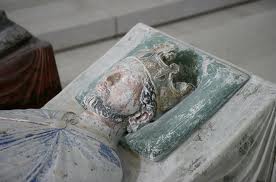
Geoffrey of Brittany

Geoffrey2Gerald of Wales described Geoffrey as a “deceiver and a dissembler.”  Roger of Howden described him as a “son of perdition”. However, given that none of Henry II’s legitimate surviving sons could be described as loyal to their father it is perhaps not surprising that Geoffrey as son number three should have been untrustworthy.  He joined the Young King and Prince Richard in their rebellion against their father in 1173.

Nor is it surprising that Henry II used Geoffrey as a political pawn in his empire building strategies.  Henry had supported the subjects of Conan IV of Brittany when they rebelled against him.   Finally Henry was victorious, peace required that Conan was forced to abdicate and his daughter Constance was betrothed to Geoffrey – Geoffrey taking on the title Duke of Brittany (in 1166) which Henry ruled personally, in theory, until Geoffrey came of age.  Geoffrey was required to give homage to the French king, just as Richard was required to give homage for Aquitaine.  It was a neat device that allowed Henry to continue to build his empire without public recognition that Henry was the French king’s vassal.

Part of the problem between father and son in later years was Henry’s inability to relinquish power from his own hands.  In response to the rebellion of 1173 Henry did concede that Geoffrey should marry Constance and have half of the revenues of the duchy, along with the task of quelling the rebellion that he had stirred in Brittany. In November 1179 Geoffrey was in Paris to witness the coronation of King Philip. Geoffrey and Constance married in 1181.

By 1184 unrest stirred again.  The Young King’s death during his rebellion against Henry in 1183 elevated Richard to the role of Henry’s heir.  Henry envisioned a land redistribution with Richard’s duchy of Aquitaine being handed to Prince John.  Richard having been raised in Eleanor’s court and having subdued the region by force was not prepared to hand his territory over so easily.   In the end Richard was obliged to hand the duchy back to his mother who was removed from prison in England and bought to France for the occasion.  In effect this meant that once again Aquitaine was in Henry’s hands.  Geoffrey and Richard remained at loggerheads  about land and position as Henry did not establish any of his sons as heir apparent.

Geoffrey, perhaps recognising the importance of strong allies, became friends with the French King Philip Augustus (Louis VII’s son).  Philip made him a senschal of France.  He died on the 19th August in Paris as the result of an accident that occurred during a tournament.  Chroniclers record that Philip was so distressed that he attempted to climb into Geoffrey’s grave.

Geoffrey’s son, Arthur, was born the following year in 1187.  He also left two young daughters; Eleanor, who was born in 1184 and Matilda, born 1184. Matilda died before she reached her fifth birthday while Eleanor and young Arthur faced uncertain futures in the hands of their Uncle John.


Richard the Lionheart – King of England- preparing for crusade.

On the 3rd September 1189 King Richard was crowned in Westminster Abbey.  That autumn he began to gather the resources he required for his crusade and put into places measures that would keep his kingdom secure, he hoped, in his absence.  At home he needed to decide who would be the de facto regents in his absence, secure the Welsh Marches, keep the Scots quiet and his brother John and his half-brother Geoffrey and resolve the ongoing dispute between Church and State as to issues such as benefit of the clergy.  He also needed cash to buy ships, weapons, men and food.


With those ends in mind he levied taxes, sold off royal estates and castles.  He is supposed to have said that he would have sold London if he could have found someone to buy it.

He appointed four new bishops including his brother Geoffrey who was already Bishop of Lincoln but who had not been ordained.  Richard made him Archbishop of York and ensured that he was priested. Geoffrey had to be carried protesting to the ordination.  Henry II’s illegitimate son was the only one who’d remained loyal to Henry throughout his life and rumour speculated that he saw no reason why illegitimacy should prevent him from seizing the crown.  Whatever the truth Richard’s swift actions ensured that Geoffrey was no longer a contender for the throne.  Prince John was Lackland no longer.  Richard showered him with lands and titles as well as the rich heiress Isabella of Gloucester in an attempt to keep John content.  Just before he set off on crusade, Richard required both his brothers to swear a solemn oath that they would not set foot on English soil for the next three years.  As a further disincentive to John he also named his young nephew Arthur of Brittany as his heir.

Arthur was the son of Richard and John’s legitimate brother Geoffrey who had been made Count of Brittany by their father but who had died during one of the sons intermittent rebellions at the court King Philip of France during a jousting tournament.

Richard also ensured that there were strong regents in place.  He appointed Hugh, Bishop of Durham and following the death of the Earl of Essex his chancellor William Longchamp who was also the Bishop of Ely.  Richard had barely set sail for Sicily on the 4th July 1190 en route to Outremer and the Third Crusade when John, disgruntled by Richard’s choice of regents, started to plot against him.

One thing Richard did not do was to marry the Princess Alys to whom he’d been engaged since 1169.  This fact was one of many that caused the relationship between Richard and King Philip of France to deteriorate.  The atmosphere between the two kings soured even further upon Richard’s arrival in Sicily.

Richard the Lionheart, Duke of Aquitaine

imagesRichard was born in Oxfordshire at Beaumont Palace in September 1157.  Records reveal that the cost of Queen Eleanor’s laying in was accounted at 20 shillings.

Though born in England, the second of four surviving sons, he was destined to inherit Queen Eleanor’s duchy of Aquitaine. He grew up in an atmosphere of courtly love, speaking the langue d’oc.  Today we think of him as a warrior but he was an accomplished musician thanks to his early years in Eleanor’s court.  Ralph of Coggleshall, records the fact that he ‘conducted’ the clerks of the Royal Chapel in song.

By the time Richard was ten his father (Henry II) had betrothed Richard to the daughter of Count Richmond of Barcelona.  Nothing came of this engagement but in 1168 when Richard was formally invested with the Duchy of Aquitaine he was betrothed to Princess Alys of France, the daughter of King Louis VII – his mother’s ex-husband- by his second wife. Presumably the laws of consanguinity did not account for such things.  What they did account for though was a father ‘knowing’ his son’s bride.  Alys came to Henry II’s court and eventually Henry made her his mistress which goes some way towards explaining Richard’s reticence when it came to honouring the engagement.

By 1173 Henry II’s relationships with all his sons had reached breaking point.  Henry expended huge amounts of energy creating an empire that stretched from the Welsh Marches to the Pyrenees.  He did not wish to do homage to King Louis VII so he gave his European lands into the keeping of his sons Henry, Geoffrey and Richard.  He even went so far as to have Henry crowned king of England while he was still living.  However, they were rulers in name only.  Henry retained the power.  His sons rebelled.  Queen Eleanor, perhaps tiring of Henry’s infidelities, her own lack of power and a mother’s need to protect her sons joined in the rebellion. Fortunately for Henry, Eleanor was swiftly captured and then subjected to fifteen years of captivity. Monarchs on the edge of his kingdom added their armies to the fray.

Young Prince Richard battled on, attempting to besiege La Rochelle despite the fact that King Louis unable to capture Rouen had sued for peace.  King William of Scotland had been roundly beaten at Alnwick.  Was it stubbornness?  Was it anger at his mother’s treatment?  Or was it simply because his father excluded him from the peace that he negotiated with King Louis?  In any event, it was 23 September 1174 before he threw himself on his father’s mercy.

In 1175 Henry set his son the task of quelling the Aquitanian nobles who had risen with Richard two years earlier.  Richard set about subduing nobles and towns one by one.  Limoges fell having been besieged for only two days.  He was accused, in Aquitaine, of being ‘evil to all men.’ Yet he succeeded where his father could not.  He went on to make the road through to the Pyrenees safe for travellers, thus furthering his father’s diplomatic allegiances with Spain.  In 1179 Richard sided with his father when his brothers Henry (the Young King) and Geoffrey (Count of Brittany) rebelled once more. Four years later Henry was dead of dysentery and Richard was heir to the English throne.

King Henry ordered Richard to hand over Aquitaine to Prince John.  Richard refused.  He held an ostentatious Christmas court at Talmont where he gave generous New Year gifts to his nobles.  He’d fought long and hard for the kingdom that was his mother’s and he had no intention of handing it over to his little brother despite the fact that allocating inheritances between sons in this manner was a normal procedure.  He showed no sign of backing down even when Henry openly toyed with the idea of marrying Princess Alys off to John and bypassing Richard altogether. Roger of Hoveden’s account shows that King Philip of France (Louis VII’s much long for son) would not agree to this. Eventually King Henry informed John that he could have Aquitaine if he could take it.

Inevitably these family tensions led to Richard coming to terms with the King of France.  It was this coming to terms that has given history pause for thought about Henry’s sexual orientation despite the existence of two illegitimate sons.  It was reported that Philip and Richard shared the same bed following a day of negotiations.  It was not regarded with the raised eyebrows of today and suggests instead a symbolic sealing of an agreement.

Richard was not the callow youth he’d been last time he’d rebelled against his father, nor was his father a well man.  Neither for that matter was Philip much like his father in matters of warfare.  Eventually the city of Le Mans was captured and Henry was forced to flee.

The king sued for peace.  He came to terms with the french king and Richard during a thunder-storm.  He was so shattered that his men had to hold him upright on his horse.  Some accounts describe a tear in Henry’s back passage that bled so much during the hours of negotiation that the blood streamed down his horse’s flanks.   Henry, vanquished and in pain, returned to Chinon a broken man having learned that John, the son for whom he’d gone to war, had betrayed him.  Henry died on the 6th July 1189.

Prince Richard, Duke of Aquitaine was now King  Richard I.  One of the first things he did was to give orders setting Eleanor free from her captivity.

tal3

Talmont

Resources:

For a full account of Henry II’s final campaign and encounter with his son visit: http://www.fordham.edu/halsall/source/1189hoveden.asp

Jones, Dan. (2012). The Plantagenents. London: Harper Press