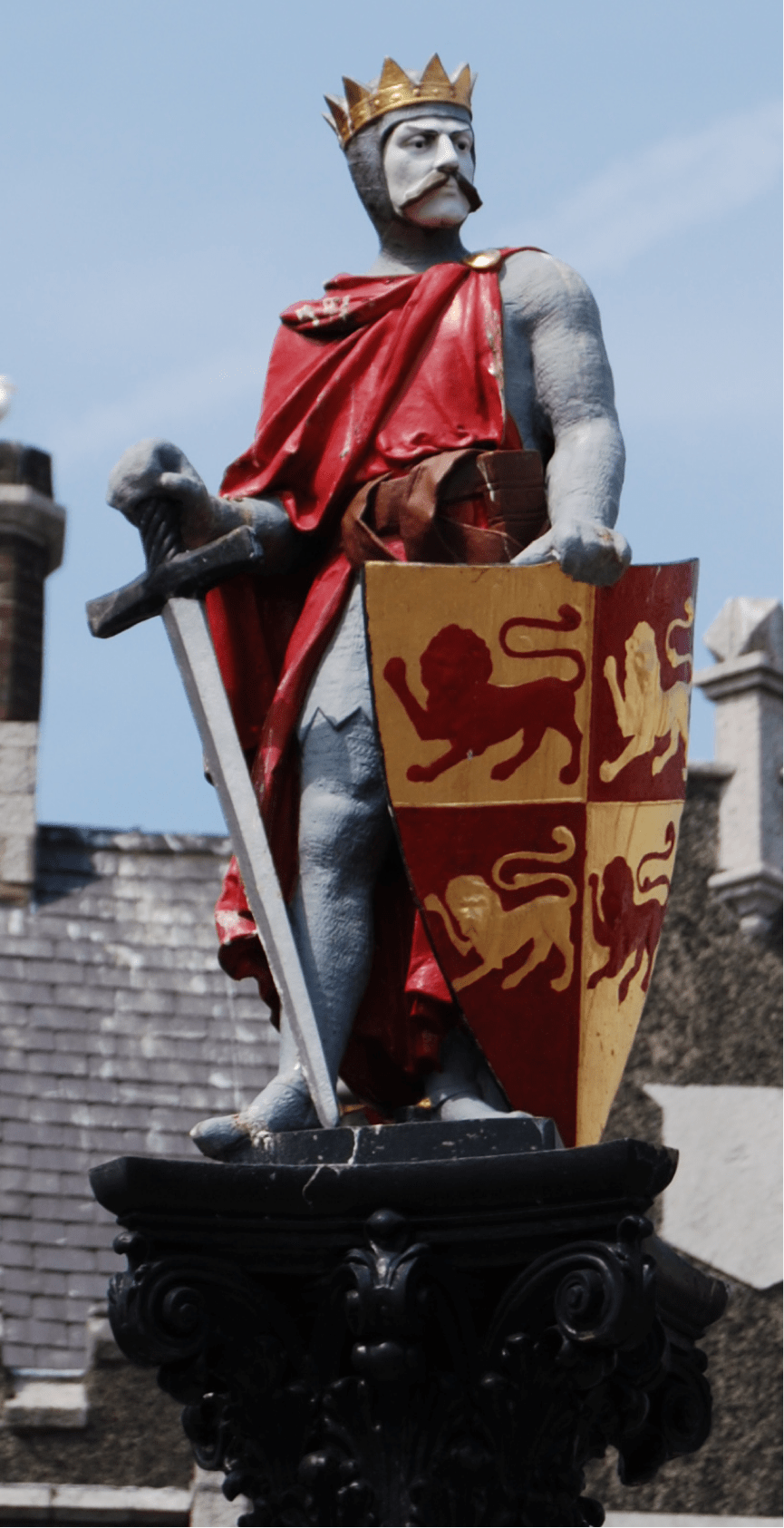
Robert, First Lord Clifford

IMG_4008Robert Clifford was born in 1274. He was the son of Isabella de Vieuxpont and Roger Clifford. The Cliffords were an old Norman family who took their name from their main seat in Herefordshire meaning that the Lords of Skipton were distantly related to Rosamond Clifford (Fair Rosamond) who was Henry I’s mistress. On his mother’s side – Isabella and her sister Idonea were coheirs to the lordship of Westmorland which, together with Edward I’s campaign to subdue Scotland, would ultimately change the marches upon which the Cliffords prowled.


Young Robert lost his father early so the vast lands (including Brough, Brougham and Appleby) that would one day be his passed into other hands for the time being. When he reached his majority Robert would spend years trying to regain property which had been stolen during his minority.  He ultimately grew to maturity under the care of Edward I from whom he learned the art of warfare in North Wales before making a name for himself in Scotland. By 1297 he was responsible for Edward’s castles in Cumberland as well as taking part in the perennial border warfare of the period. The following year, according to Summerson, he became Keeper of Nottingham Castle and the justice in the royal forests north of the River Trent. That same year Edward I gave Robert Clifford Caerlaverock Castle and all the lands that belonged to Sir William Douglas as a reward for his work. On one hand this was very nice for Robert on the other hand the Douglas family were not best pleased. Edward’s grant triggered a feud between the Douglasses and the Cliffords that lasted for the next hundred years.  It probably didn’t help that Robert’s actions in Dumfries and Annan were recorded in the Song of Caerlaverock. Clifford was undoubtedly a capable as well as loyal officer to the crown – it certainly helped him to build an extensive power base on which to build his family’s fortunes.

He attended Edward I until his death and from his appointment as Marshall of England by Edward II whom Clifford had served during the Prince of Wales’ time on campaign in Scotland. He didn’t hold the job for long. He also gave up his role of Justice and Keeper of Nottingham Castle.  In October 1309 he was appointed keeper of the English West March with Carlisle as its headquarters, and was ordered to act as Warden of Scotland, with a force of 100 men-at-arms and 300 foot soldiers – so he probably didn’t have much time to sit around in Nottingham.


It was at about this time Robert came to an accommodation with his childless aunt (Idonea) which ultimately resulted in the Lordship of Westmorland being granted to him. Robert Clifford already held Brough Castle and Appleby and now he was granted Skipton Castle making him a force to be reckoned with in the north.


Unfortunately the business of the Scottish Wars of Independence were somewhat sidelined by Edward II’s relationship with Piers Gaveston. The King’s favourite was greedy for wealth and power. In October 1310, just as Clifford was building a substantial power base for himself in the north-west the king granted the Honour of Penrith to Gaveston – a bit of a fly in the ointment so far as Clifford was concerned but not sufficient to make him join with many of the other English barons who formed a commission against Edward II to reform the way in which Edward governed his household and the realm.  The barons issued ordinances from which they gained the name Lords Ordainers.  One of the ordinances made Edward II take back into royal custody all the land which he’d given away.  This meant that Robert having gained Skipton was forced to return it to the crown.  A bizarre game of pass the castle then followed in which Skipton was then handed back to Clifford.  The reason behind this probably lies in the fact that Clifford had given his lands in Monmouth in exchange for the Honour of Skipton – so he wasn’t depriving the crown of its revenue. Clifford resumed his building work on the outer defences of the castle.


This uncertainty and his previous record for loyalty didn’t mean that Clifford wasn’t sympathetic to the demands of the Lords Ordainers. In 1312 he prevented Gaveston from receiving Scottish help, besieged him in Scarborough Castle and recovered royal jewels from Newcastle when they were abandoned by the king and his favourite. Later he acted as a go-between for the Earls of Lancaster and Warwick who sought a pardon when Edward II regained control of his realm. The earls received a pardon and so did Robert Clifford.


The pardons signaled a resumption of the Scottish War of Independence. In June 1314 Clifford was summoned to Berwick and the start of the campaign that ended in disaster for the English at Bannockburn. Clifford was killed in action. His body was taken to Carlisle and from there to Shap Abbey where he was buried.

Skipton Castle was about to face Scottish invasion and be plunged into civil war – life wasn’t going to be very restful for the Clifford family either.

Capital

Wells capitalsI’m sitting here feeling slightly dazed – and perhaps it’s not surprising.  I’ve just spent five hours in Wells Cathedral taking photographs (okay there was a pause for a very moorish ginger and chocolate tray bake which contained absolutely no calories what-so-ever and a cup of tea.)  Aside from the scissor arch, the medieval crazy patchwork stained glass and the cathedral cat – a glorious and imperious ginger called Louis I spent an awful lot of time craning my neck for some capital shots.

A capital coming from the Latin capitulum meaning of the head refers to the top bit of a column – so it’s load bearing.  A very nice guide even talked me through the different parts of a capital this morning.  The very top of the capital is flat – that’s called the abacus.  The abacus tends to be plain – though by the late Gothic masons were decorating them as well.  Then comes the necking which thins to join the shaft of the column beneath it.  Sometimes the necking runs straight into the column but more often than not there’s a thin moulding to separate the column from its capital.

It’s possible to tell the age of a capital in an English church by the kind of decoration on the necking.  Norman capitals are solid and largely undecorated – those are the Romanesque ones.  Having said that the Normans do decorate their capitals often with symmetrical patterning and rather chunky looking people if my memory serves me correctly.

In any event  the next stage  in the evolution of the capital involved foliage – in some cases foliage that looks rather like a tree drawn by a small child – one stem and one leaf in neat rows.   Somehow the Gothic evolved out of the Romanesque so that by the thirteenth century masons were running riot carving sinuous leaves, green men, strange birds, beasts and odd little figures.

In Wells there are doves, dragons and lions as well as a fox running off with a goose in its mouth.  The fox is being pursued around the capital by a very cross farmer.  There’s a spoonbill swallowing a rather plump frog; a devil who has caught a fish; a pedlar with his pack and a string of beads; a man with terrible toothache; a cobbler; a man removing a thorn from his foot; a thief; assorted Old Testament types; someone being martyred and rather a lot of different kinds of leaves as well as a bewildering collection of heads peering down from their hiding places.  The more you look the more that you see – English Gothic at its best – at least that’s what the very nice guide told me and I’m not going to disagree.

So next time you go to a church or cathedral if you’re not crawling around on your hands and knees attempting to photograph misericords  without moving them or crossing any barriers that have been erected to keep the public at a safe distance you can vary your posture by standing on tip-toe developing a crick in your neck while trying to hold your camera steady in order to capture capitals.


Thirteen Claimants to the Scottish Throne

alexiiiAlexander III of Scotland died on a wild midnight dash to be at his beautiful bride’s side in 1286.  His broken body was found the following morning. It presented Scotland with a problem.  The reason that the king had a beautiful bride was that his sons had died leaving no heir.  For a few months the Scots waited to see if Alexander III’s widow was pregnant.  Then they looked around for their new monarch.

The new Queen of Scotland was Margaret, the Maid of Norway, Alexander’s granddaughter.  She was three years old at the time.  The little girl died on her way to claim her crown in 1290 aged just seven.  In some ways the six Guardians of Scotland who had been appointed to protect the kingdom during her regency may have been relieved – child monarchs were a prelude to unrest and they had effectively married the lassie off to Edward I’s son in a bid to ensure security along their southern border.


On 1st May the Scots met Edward I  at Norham.  He claimed his right to be Lord Paramount- or the feudal overlord of the Scots.  The Scots were not impressed and said that they could make no such concession because only their King could make that decision.  Resistance grew when Edward sent garrisons of armed men to ensure his will was done.


The three best claimants to the Scottish throne were Robert Bruce, John Balliol and  John of Hastings who were descended from King David I of Scotland.  Both Bruce and Balliol held lands in England so already recognised Edward as their overlord – in England.


Then there were  Eric II of Norway who had been married to Alexander III’s daughter Margaret.  Margaret had died in childbirth.  He was the father of the Maid of Norway.  Floris V, Count of Holland who appears to have forged his claim to the throne; William de Vesci; John Comyn known as the Red Comyn; Patrick, Earl of Dunbar; William de Ros; Nicholas de Soules who was a border lord; Robert de Pinkeney; Roger de Mandeville; and Patrick Galithly.


Many of the lesser known claimants to the throne made their bid for power based on the fact they were descendants of illegitimate children of previous kings such as William the Lion.


In 1292 Edward I selected John Balliol.  Four years later the Scottish Wars of Independence were well under way and the Stone of Scone was on its way to London.

Dafydd ap Gruffydd

EdwardDafydd was the grandson of Llywelyn the Great.  He was also the first nobleman in Britain to be executed by being hanged, drawn and quartered for treason.

The story is a complicated one and begins with Llywelyn the Great.  Llywelyn married Joan, the natural daughter of King John.  They had one son who inherited his father’s kingdom.  He died without heirs so the kingdom was inherited by the heirs of Llywelyn’s other son Gruffydd who had been excluded from a share in the power because of his illegitimacy.  This had followed the English way of excluding all but the legitimate heirs.  Now though Gruffydd’s four sons all had an opportunity to make a bid for power.

In 1256 Llywelyn ap Gruffydd managed to wrest power from his brothers.  The early years of his reign were helped by the fact of the Baron’s War in England and the role of Simon de Montfort.  Dafydd formed an alliance with King Henry in 1263 and continued to fight against his brother alongside Edward I from 1274.

The alliance with King Edward served Dafydd well.  He married Lady Elizabeth Ferrers, the daughter of the Earl of Derby and widow of William Marshall (2nd Baron Marshall).  He gained land and prestige in England.  But then Dafydd thought better of his links with the English and returned to fight alongside his brother.  He attacked Hawarden Castle during Easter 1282.  Edward was unamused.

That same year Llywelyn was killed and Dafydd became the next Prince of Wales.  It probably wasn’t a very comfortable position as Edward was hot on Dafydd’s heels.  In fact he was captured once but managed to escape into the Snowdonian Mountains.  Finally he was cornered along with his younger brother Owain.  Also imprisoned were Dafydd’s wife, their seven daughters, two sons and one niece.

The Lanercost Chronicle takes up the story:

The King sent him forward to the Tower of London with wife and children….David’s children were condemned to perpetual imprisonment, but David himself was first drawn as a traitor, then hanged as a thief; thirdly, he was beheaded alive, and his entrails burnt as an incendiary and a homicide; fourthly his limbs were cut into four parts as the penalty of a rebel.


This all took place in Shrewsbury.  As for his wife and children.  Their fates are not completely known.  His wife is thought to be buried in the church at Caerwys.  One daughter, Gwladys, a child, was sent to the Gilbertine convent in Sixhills Lincolnshire where she spent the rest of her life along with her cousin.  Her brothers Llywelyn and Dafydd were imprisoned for the rest of their lives.  Llywelyn died in suspicious circumstances in 1287 in Bristol Castle.

A warrior-bishop who collected taxes.

precinctsJohn Halton, or de Halton, was an Augustinian Canon in Carlisle.  He was elected the ninth Bishop of Carlisle on 23 April 1292 making him bishop during the reigns of Edward I and then Edward II – and putting him on the front line for the First Scottish War of Independence.


As well as caring for the spiritual concerns of his flock- his Register of the incumbents of the diocese still exists- he was also a busy diplomat and entertainer of royalty. The Magna  Britannia records him entertaining the king at Rose Castle (the principle residence until recently of the Bishops of Carlisle) in 1306 from 28 August until 10 September.

He was sent to Scotland in 1294 by the king and was a papal tax collector in Scotland (which possibly didn’t enhance his popularity with the locals and may account for why the Scots burned Rose Castle down at the first available opportunity – though obviously that’s my own personal spin on events).  On a more factual level, he was Governor of Carlisle Castle at one point, so had custody of Scottish prisoners and hostages – little did he realise that five hundred years later there would be so many Scottish Jacobite captives in Carlisle that the cathedral would have to be used as a prison.


It was Halton together with the Archbishop of York who excommunicated Robert Bruce in 1305 after the killing of John Comyn  and in 1306 he absolved everyone of their offences against the King’s enemies in Scotland which must have pleased the English borderers no end as they could then steal and kill with neither fear of hellfire and damnation nor, at the very least, a long time in Purgatory.  For his pains he was involved in the Seige of Carlisle in 1314 when Edward Bruce attempted to take the city.  He fled the border for large chunks of time enjoying the peace and quiet of Lincolnshire.  He was one of the king’s representatives in the treaty signed between England and Scotland in 1320.


The following year he turned up at a meeting held by Thomas of Lancaster which was the first indication of the barons uprising against Edward II.  There’s no evidence that Halton was involved any further but trouble and the bishop seemed to have gone hand in hand.  He died in 1324 having lived through some turbulent times on the border.

Alphonso, Earl of Chester

Prince Alfonso is one of history’s ‘what ifs?’  He is a son of King Edward I and Eleanor of Castile.  The couple had fourteen children though many did not survive infancy.  Alfonso was born on the 24 November 1273 in Bayonne (Gascony) as his parents journeyed home from crusade upon receiving the news that King Henry III was dead.  This made Alfonso the third male child of the couple to have survived into infancy and then childhood.

6a00d8341c464853ef014e8904d8ed970d-800wi

Sadly when his parents arrived home they discovered that his older brother Prince John had died in August 1271.  He was just six years old.  A year after Alfonso’s birth his remaining brother Henry also died.  Like John, he was six years old. Both died from unspecified illness.

So, Alfonso, named after Eleanor’s family, was heir to the throne.  Apparently he was lively, quick and intelligent.  His father created him Earl of Chester and planned a marriage that would enhance an English alliance against the French.  The illuminated page in this blog comes from the so-called Alphonso Psalter which was commissioned when Alphonso was to have been married to Margaret, daughter of Florent V, Count of Holland.  The coats of arms at the bottom of the page show the union of the two families.

The psalter is beautiful. It contains fantastical creatures such as griffins and mermaids as well as scenes from everyday life and biblical characters – like this letter depicting King David playing his harp.  Work soon came to a halt though.

On August 19 1284 the ten-year-old heir to the throne died at Windsor Castle.  He was buried in Westminster Abbey.

The psalter is in the British Library.  It was eventually completed thirteen years later when Alfonso’s sister Elizabeth married John I of Holland and Zealand – the brother of the girl Alphonso was to have married.

And as for the English crown?  Well, Edward I had only one more male heir – Edward of Caernarfon who is known in popular history as the king murdered with a red-hot poker.


Marguerite of France

200px-Marguerite_of_franceUsually when we think of Edward I’s queen we think of Eleanor of Castile.  However the grief-stricken widower married again.  Initially he planned to marry Philip III’s daughter Blanche but she was married elsewhere to the Duke of Austria in fact.  In her place, Philip IV offered the king his young half-sister Marguerite.  Edward was so disgruntled about the loss of his potential bride that he went to war, or so the story goes.  Five years later, following negotiations the sixty year old king married Marguerite.  It’s more likely that the protracted negotiations had to do with who would hold Gascony.  It was all that remained of the Angevin empire and Edward wished to keep hold of it but the French had other ideas.

However, the couple finally tied the knot in 1299.  There was a forty-year age difference.  They were married in Canterbury and then Edward hurried back to Scotland to pursue his military campaign but not before Marguerite became pregnant.  Her first child, Thomas, was born a year after her marriage in Brotherton in Yorkshire.

Marguerite – presumably fed up of being deserted in London by her groom- hastened north to join the king.  It was the start of a mutually loving relationship.  When her sister Blanche died, Edward tried to lighten her distress by having the whole court go into mourning.  There are also letters which show his concern for his young wife’s health. They had three children, one of whom was called Eleanor after Edward’s first queen which just goes to show how understanding Marguerite must have been.  She even attended masses and memorial services for Edward’s first wife.  She also became friends with her step-children and interceded with the king on more than one occasion on behalf of folk who’d irritated him. She even managed to soothe Edward’s anger against the man who hid the crown used by Robert Bruce.  No wonder her English subjects called her ‘The Pearl of France.”

Her desire to be loved and liked may have had some negative side effects though.  The king gave her wardships worth £4000 so that she could pay her debts, a quarter of which seems to have been with an Italian cloth merchant….so a well-dressed lady.  Whatever her methods she and her husband had a genuinely loving relationship and she steered a delicate course across the treacherous waters of Anglo-French relations which remained difficult during this period.

When Edward died, Marguerite proclaimed “When Edward died, all men died for me.”  She retreated to Marlborough Castle after the coronation of her step-son which was unfortunate.  Her niece Isabella – to be known in history as the ‘she-wolf of France’ arrived in England as Edward III’s new bride and at that time the barely adolescent Isabella could have done with a bit of loving help from her diplomatic and much-loved aunt.

Marguerite died just ten years after her king.

King John and St Wolstan

king john1According to Roger of Wendover, as King John lay dying he commended his body and soul to God and St Wolstan. Wolstan was the Saxon Archbishop of Worcester, consecrated in 1062, who remained in post after the Norman Conquest.  Legend says he was called upon to resign his bishopric but lay his crozier upon the shrine Edward the Confessor in Westminster from whom he’d gained his bishopric.  No one could move the crozier except for Wolstan.  This was taken as a sign that the devoted, but not especially learned priest, should retain his see. king john It is hard to find a rationale for King John’s appreciation of Wolstan – who incidentally was canonised during John’s reign. Certainly chroniclers do not record a lifetime of prayer on John’s lips.  Perhaps John admired a man who overcame his temptations and turned aside from ambition but who still ended his life as a bishop.  Whatever the reasons, John was drawn to St Wolstan.  He visited Wolstan’s shrine at Worcester twice – once in 1207 and again in 1214.  He may have visited more often.  He came to Worcester to negotiate with the Welsh and also to hunt in nearby forests. John asked to be buried next to his favourite saint which is why he lies in Worcester Cathedral, as does Prince Arthur (Henry VIII’s elder brother).  The cathedral library contains John’s will and one of his thumb bone’s in its collection.

Berengaria of Navarre

berengaria_tombDaughter of Sancho the Wise of Navarre, Berengaria was related to the royalty of Spain, England and France.

She was brought from Navarre to Sicily by her future mother-in-law, Eleanor of Aquitaine, in 1190 to marry King Richard I of England.  She was in her twenties at the time.

Richard was in Sicily on his way to the Holy Land to join with the Third Crusade having taken the cross in 1187.  He had been prevented from fulfilling his vow because of a Plantagenet power struggle with his father King Henry II and younger brother Prince John over control of Aquitaine.  His ally in his rebellion against his father was the French King Philip but by the time Berengaria arrived on the scene relations were souring between the two monarchs, not least because Philip expected Richard to marry the french princess Alys, a bride-to-be of some twenty years.  Unfortunately, Philip’s half-sister was an unsuitable match in Richard’s eye – not least because she had been Henry II’s mistress, not that this stopped Philip from pocketing some 10,000 marks in compensation.

Berengaria accompanied Richard and Richard’s widowed sister Queen Joanna of Sicily to the Holy Land.  Before their ship could reach Outremer it was separated from the main fleet and the royal women were ship wrecked off Cyprus.  The ruler of Cyprus, Isaac Comnenus, whose only redeeming feature seems to have been the love he bore his daughter, attempted to take them hostage.  This resulted in Richard leading an attack on Cyprus and capturing the island in less than a month.  As well as demonstrating his prowess in battle, Richard also captured a useful staging post.  Berengaria and Richard were married in May 1191 at Limassol. Berengaria was also crowned at this time and Richard gave her dower rights to all territories in Gascony south of the River Garonne.  The marriage had been delayed thus far because of it being Lent.

Why marry Berengaria?  Richard was the Duke of Aquitaine before he became King of England.  An alliance with Navarre went some way to off setting the expanding power of Castille and Count Raymond of Toulouse who was undoubtedly a thorn in Richard’s side.  It could also be that Berengaria’s reputation was spotless, a direct contrast to Alys.  Chroniclers of the time were generous in their praise of a queen who never came to England.  William of Newburgh described her as prudent and beautiful.

Both royal women accompanied Richard to the Holy Land.  They were at the Siege of Acre and remained there while the crusaders pushed in land and it was from here that they sailed when Richard and Saladin agreed their truce in 1191.  Berengaria and Joanna sailed to Brindisi and from there they travelled to Rome while Richard travelled home a different route and found himself a captive of the Duke of Austria.

Following his release, Berengaria did not join her husband.  The estrangement between husband and wife was never fully reconciled.  Perhaps because Richard needed to secure his empire from the machinations of Philip of France or possibly because Berengaria’s father was now dead and her brother, Sancho VII, had succeeded to the throne.  The Navarre alliance served Richard well during his crusading years.  Certainly he’d never bothered to demand the two castles that were Berengaria’s dowry.  Now however, Richard set about gaining what the marriage treaty guaranteed.  He even involved Pope Innocent III. The couple remained childless and spent very little time in one another’s company.  As he lay dying he sent for his mother, not his wife. Berengaria did not attend Richard’s funeral and remained in a small castle near Angers -in effect a penniless princess having failed to provide Richard with an heir.

Berengaria now entered into a long struggle with King John for her dower lands which were all in France.  In addition to her own dower lands in Gascony she was supposed to receive Eleanor’s lands in England, Normandy and Poitou after Eleanor’s death.  John, once named Lackland, was not forthcoming.   Fortunately, her sister, Blanche of Champagne took in the widowed queen and later King Philip gave her the city of Le Mans to rule. It was only in 1214 that John said he would settle the claim. This was, in part, due to Magna Carta and the fact that the Pope had excommunicated him but he never did pay what was owed.  King Henry III settled Berengaria’s claim when he came to the throne.

Berengaria lived in Le Mans and ruled there from 1204 until her death in 1230.  She ruled well and with determination, even tackling corrupt clerics.  The Bishop of Le Man once closed the door of the cathedral in her face as she arrived for a Palm Sunday service.  She also founded the abbey of L’Epau