The Welles Uprising and subsequent brushes with royalty…

Lionel Lord Welles

In the Spring of 1470, England was facing a fresh round of the intermittent warfare that punctuated the Wars of the Roses. The Earl of Warwick’s relationship with King Edward IV had been strained to breaking point the previous year and although the Kingmaker had captured and imprisoned his cousin he had been forced to let him go. There had been an apparent reconciliation. In reality Warwick plotted to overthrow the king and replace him with his son-in-law, George Duke of Clarence. He method for bringing this about involved the Welles family and the men of Lincolnshire.

Lord Richard Welles was the seventh Lord Welles descended from a family of Lincolnshire magnates. He was the son of staunch Lancastrian, Lionel. The sixth Lord is best remembered for his second wife, Margaret Beauchamp, the mother of Lady Margaret Beaufort. Lionel was killed at the Battle of Towton.

Lionel was born in 1410 and was knighted in 1425 at Leicester by the Duke of Bedford who knighted King Henry VI at the same time. In 1446 he received a licence to marry Margaret Beauchamp, the Duke of Somerset’s widow. His loyalty to the Lancastrian cause was absolute. His heir, Richard and his sons-in-law were attainted by Parliament for their support of the Lancastrian cause but as the Yorkist king became reconciled to former Lancastrian supporters the Welles family land and titles were returned.

However by the ninth year of Edward’s reign relations between the Welles and the Yorkist king of England nose dived. Richard and his brother-in-law Sir Thomas Dymmock either became involved with a private feud with Sir Thomas Burgh who was the king’s Master of Horse or they were inveigled to rebellion by the Earl of Warwick who was also a kinsman ( Richard’s wife was a granddaughter of the 3rd Earl of Salisbury as well as being suo jure Lady Willoughby.) In either event, they attacked Gainsburgh Old Hall which was Burgh’s property and the Master of Horse was forced to flee the county whilst his property was looted or destroyed. King Edward summoned both men to London. Initially pleading illness, the pair then took sanctuary in Westminster Abbey only emerging with a royal promise of a pardon – which was granted on 3 March 1470. The pardon did not give them their freedom. Edward marched north and took the two men with him as collateral.

In Lincolnshire, Sir Richard’s son, Robert raised an army calling the men of Lincolnshire to defend themselves against the king, who is was said was determined to punish the county for supporting Robin of Redesdale’s rebellion the previous year (1469). If he had done this it would have meant that he intended to go back on the pardon he granted the rebels the previous year. Robin of Redesdale is a shadowy figure. Most historians believe that the rebellion was fermented by the Earl of Warwick for his own ends. In 1470, the Earl of Warwick was plotting the overthrow of the king who was marching north. The earl planned to trap Edward between Welles’ army and his own.

King Edward was not so easily outmanoeuvred. He marched out of London along the Great North Road in the direction of Lincolnshire but he threatened to have Robert’s father and uncle executed if Welles did not submit to the king’s will. By then Robert and his men were on course to render-vous with Warwick’s army. On hearing the king’s threat, Robert turned back, the king catching up with him just outside Stamford. The two armies drew up opposite one another on the 12th March 1470 at Empingham. Edward gave orders for Lord Welles and his brother-in-law to be summarily executed in the space between the two armies. Other sources state that Edward had the two men executed in Stamford.

The battle became a rout with rebels fleeing the field. Hoping to avoid capture and punishment they shed their jerkins which bore the insignia of Warwick and Clarence. This resulted in the battle being renamed Losecoat during the nineteenth century. As a direct consequence of Welles failure to win the battle the Earl of Warwick and the Duke of Clarence were forced to flee the country.

Sir Robert was captured and confessed the involvement of Warwick and the Duke of Clarence on the 14 March. Further incriminating evidence was found amongst Welles’ documents. It appeared that Warwick intended to make his son-in-law the King of England and Wales in Edward’s place. Sir Robert was executed on 19 March and his only surviving sibling Joan became heiress to her brother’s estates. Strictly Welles’ land was forfeit to the Crown, and it was confiscated a month after Sir Robert’s execution but it was returned to Joan in June that year. Joan died sometime in 1474/1475 and a formal act of attainder was passed against Lord Welles and his son in order to prevent Joan’s inheritance going back into the Welles family. Joan was married to Richard Hastings, the brother of Edward’s drinking buddy and Chamberlain of the Household circa 1470. Hastings ensured the king provided Joan, now suo jure 9th Baroness Willoughby de Eresby with her father and brother’s estates. After her death the regime ensured that Hastings didn’t lose out. It also meant that a large chunk of Lincolnshire was held by a loyal Yorkist.

It was only on the accession of King Henry VII that the attainder against the Welles family was reversed and John Welles, Joan and Robert’s uncle from their father’s second marriage inherited the titles and estates along with their cousin Christopher Willoughby. Even so, Sir Richard Hastings, who died in 1503 continued to be known as Lord Willoughby, a title which should have more properly belonged to Christopher Willoughby whose mother Cecily was a daughter of Lionel, 6th Lord Welles, who died at Towton.

Katherine Willoughby, Duchess of Suffolk by Hans Holbein

And before I finish… if the name Willoughby is ringing bells its because Christopher’s son married Katherine of Aragon’s loyal lady in waiting Maria de Salinas. The couple had only one child, Katherine, who was a sole heiress to the Willoughby title and estates. She was supposed to have married the Duke of Suffolk’s son but instead found herself married to the duke, Charles Brandon, who was significantly older than she was. In 1546, after she was widowed there were rumours that King Henry VIII wanted to make her wife number seven, even though wife number six was alive and well at the time.

Jean de Wavrin, Lord of Forestel

De Wavrin’s Chronicle – The British Library Board: Royal 15 E iv vol 1, f. 14

De Wavrin was born at the turn of the fifteenth century. Jean’s father was killed at Agincourt as was his brother. Jean having lost his family, and being an illegitimate descendent of the house of Artois, continued to fight alongside the French army until 1435 when he entered into the employment of the Duke of Burgundy who was an ally of the English. Eventually de Wavrin retired from a career as a professional soldier, married and settled down with a wife in Lille. It helped that she was a rich widow.

He was an avid book collector and amateur chronicler. In effect history was one of his hobbies. From 1445 onwards he began to write a chronicle of English history in four volumes which he finished in 1455 with the death of King Henry IV. Before long he commenced a fifth volume and continued writing about the history of England until 1471 by which time he was on his sixth volume.

Wavrin’s work was not undertaken for patronage and as such the work is not only extensive it is also uncritical. The period covering the Wars of the Roses is not so disinterested. It should be remembered that de Wavrin favoured the House of York because of his association with Burgundy and its alliance with the Yorkist kings. He even presented a copy of his history to Edward IV which can, today, be found in The British Library.

http://www.bl.uk/manuscripts/FullDisplay.aspx?ref=Royal_MS_15_E_IV

What makes the chronicle unique is that he knew the people that he was writing about and presents the Wars of the Roses from a European perspective. What’s not helpful is that he is not always accurate- perhaps in part because he was not a fan of the Lancastrians. My current interest comes from his description of the relationship between Edward IV, his brother George and the Earl of Warwick and the role played by the Woodville family in the breakdown of the family relationship.

Robin of Redesdale or Robin Mend-all

In April 1469 parts of the north rose in rebellion against Edward IV. John Neville, the Earl of Northumberland – the Percy family having been displaced for a time – put down the rebellion killing Robin, if Polydore Vergil is to be believed. A second leader took on Robin’s authority and name and the rebellion continued. it’s worth pointing out that John was the Kingmaker’s brother and that the Kingmaker, a.k.a the Earl of Warwick, orchestrated the uprising. Amongst the rebels demands was the removal of the Woodville family from power.

The real identity of Robin is unknown. He may have been Sir John Conyers or his brother William. Sir John was Middelham’s steward, related by marriage to the Nevilles and would fight alongside the kingmaker at the Battle of Edgecote in July 1469. Conyers was one of the casualties of the battle. Equally, it seems unlikely that Warwick’s brother would put down a rebellion fermented by the Kingmaker. An alternative source for the uprising might be the Percy family who had suffered a serious setback at Towton when their rivals the Nevilles emerged victorious and the Lancastrian king was toppled from power. The north became a Neville stronghold and in 1464 Neville became the Earl of Northumberland – which did not go down well with the locals. It should also be added that the rebels weren’t keen on the tax situation. None-the-Less the Warkwarth Chronicle places the blame for the rebellion squarely on the shoulders of Warwick.

Part of the problem in terms of understanding the rebellion, or even rebellions, and its participants is that the chronicles are often written at a later date and/or by writers living in the south. The Croyland Chronicler was not a fan of anyone who lived north of the River Trent – which isn’t even the north in He-who-is-occasionally-obeyed’s opinion but then he comes from Cumbria and most of the country is the south so far as he’s concerned. The other problem is that there’s no record of trials – there is a set of records sent to Calais (remember Warwick was the Captain of Calais)

Watch the lady!

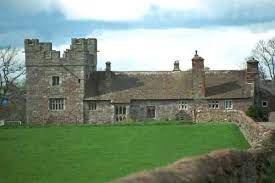
Yanwath Hall

It never does to forget that genealogical tables by their very nature are composed of women as well as men! Take Maud Clifford who was born sometime around 1442. Her parents were Thomas, 8th Baron Clifford and Elizabeth Percy , the daughter of Hotspur and Elizabeth Mortimer. It’s this Clifford who was killed at the First Battle of St Albans in 1455 – and as a consequence of his son’s desire for vengeance the new earl became one of Margaret of Anjou’s foremost supporters, the young Earl of Rutland was killed at the Battle of Wakefield and John Clifford gained the by-name “Black Face Clifford.” You can also see why the Cliffords would have joined in a feud against the Neville family thanks to their Percy mother.

Maud who was one of a large brood was married in the first instance to Sir John Harrington of Hornby – which was mildly unfortunate because the Harringtons supported the House of York. Sir Thomas, John’s father being a retainer of the Earl of Salisbury. Thomas and John were both at Wakefield and slain on the 30th December 1460. Maud’s daughters were just four and five but as co-heiresses they became wards of the Crown. In November 1461 Edward IV gave wardship to Thomas Lord Stanley but their uncle James refused to hand them or Hornby Castle over resulting in yet another regional fifteenth century feud.

Meanwhile Maud married Edmund Sutton in about 1465. He was the eldest son of John Sutton, Baron Dudley who changed sides after the Battle of Northampton from being a loyal supporter of Henry VI to being a loyal supporter of Edward IV. Edmund was at St Albans as a Lancastrian but at Towton as a Yorkist. The could had several children including Thomas, who did not become Baron Sutton of Dudley because Maud was a second wife and Edmund already had an heir. A suitable match was found with Grace Thelkeld who was one of three co-heiresses of Yanwath – and with that Thomas, effectively a younger son and confusing matters by taking the surname Dudley rather than Sutton as many of his kin chose to do, disappeared into the northern gentry when Yanwath Hall became his through right of his wife.

However, it always helps to maintain kinship ties and as it happens Thomas’s sons John and Thomas were able to find themselves a very powerful Tudor patron in the shape of their cousin Robert Dudley, Earl Leicester – which is of course why I have been reading about them. It’s also given me another challenge – to see if I can find my own photo of Yanwath Hall in the many out of sync files that I managed to retrieve.

The Berkeley feud and the last private battle in England

Berkeley Castle (https://www.berkeley-castle.com/visit)

On the 20th March 1470 the Battle of Nibley Green brought the so-called Berkeley Feud to a head. It was to become the last private battle on English soil.

Edward IV was in the north of England at the time tying up the loose ends of unrest there. The Earl of Warwick, increasingly unhappy with his cousin, had rebelled in 1469 and imprisoned Edward in Warwick Castle. In September Edward was released and in 1470 following the Battle of Losecoat which had been fought on the 12th March the Earl of Warwick had fled England for France along with Edward’s brother, George Duke of Clarence.

Meanwhile Thomas Talbot, Viscount Lisle and William, Lord Berkeley took the opportunity to get on with a spot of feuding. Both men believed that they were entitled to the Berkeley estate as well as title and castle. Margaret, Countess of Shrewsbury born Beauchamp was the granddaughter of Thomas, Lord Berkeley who died in 1417 (this is a long story). She and her sister were his co-heiresses via their mother Elizabeth. However, Berkeley’s estates and title passed to his brother’s son James, though it should be added that this wasn’t without dispute. In fact Thomas had enfeoffed Berkeley Castle and his lands to several trustees prior to his death because the line of inheritance was uncertain.

James died in 1463 and his son William inherited the title and the estates.

It wasn’t a straight forward sort of transfer across the family branches because Margaret was married to the Earl of Warwick – so one of the most powerful families in the land. Margaret had imprisoned James’ wife, Isabel, in 1452 when she attempted to appeal James’ claim to a council of Henry VI. Isabel died whilst still in captivity. Its probably didn’t help matters much.

In 1468 Margaret died and her claim was taken up by her eighteen year old grandson Thomas Talbot.

In 1470 William Berkeley attempted to conclude matters by issuing a personal challenge to Thomas. The pair’s heralds agreed a time and a place. The result was the Battle of Nibley Green. William had a substantial force of men which outnumbered Thomas’s. Thomas Talbot and some one hundred and fifty other men died. it probably didn’t help that Thomas forgot to lower his visor in the heat of the moment.

Thomas’s manor at Wotton was then sacked.

Margaret had occupied Wotton which was part of the Berkeley estate so William Wotton regarded it as his anyway. Lord Berkeley in one of his legal petitions accuses the Countess of unjustly keeping possession of his manors of Wotton, Symondshall, Cowley, and some others; of plotting and corrupting his servants to get possession of Berkeley Castle, and finally of compassing his death by means of a hired assassin.

Margaret denied the charge of intended murder but held fast to her claim to the Castle and manors of Berkeley. She believed that as Thomas Berkeley’s granddaughter by a direct line of inheritance that her various attempts to gain possession were justified and she petitioned to have her rights restored to her. The first petition and reply were referred by the king, (Edward IV) to the Lord Chancellor, to whom the subsequent pleas and counter-pleas were addressed, and in these proceedings, varied by predatory incursions upon each others’ manors and frequent fights between their servants and tenants, five years had passed without any decision being pronounced when Thomas Talbot inherited the feud.

William Berkeley was a Yorkist and Edward IV needed his support so he suffered little punishment being made a viscount in 1481. In 1483 he became the Earl of Nottingham. Berkeley didn’t have any legitimate children so his brother Maurice inherited the estate by which time William had done a Lord Stanley at Bosworth i.e. sat and waited to see what the outcome was going to be before joining the battle. Even worse he’d sent men to Richard III and money to Henry Tudor.

“A Sketch of the History of Berkeley Its Castle, Church, and the
Berkeley Family” by James Herbert Cooke,
Land Steward to the Right Hon. Lord Fitzhardinge.

Wagner, John A. The Encyclopaedia of the Wars of the Roses

History Jar Podcast

Episode 4 of the podcast is now available in the series No plan like yours to study history wisely. Having covered the Normans and Plantagenets in previous podcasts we have now arrived at the house of Lancaster, descended from John of Gaunt, the third surviving son of Edward III. This week we cover Henry IV, Henry IV, and Henry VI.

https://podcasts.apple.com/gb/podcast/the-history-jar-podcast/id1509714747

With many thanks to Andrew Durrant of This is Distorted

www.thisisdistorted.com

And the legal bit:

This podcast uses sounds from free sound which are licensed under creative commons:

Ambient battle sounds by pfranzen at https://freesound.org/people/pfranzen/sounds/192072/

Beheading SFX by Ajexk at https://freesound.org/s/271984/

History Jar Challenge week 9 answers. Battles of the Wars of the Roses

Map showing Wars of the Roses battles

22 May 1455. First Battle of St. Albans— York and his allies, the Neville earls of Salisbury and Warwick, win control of the king and kill their chief enemies: Somerset, Northumberland, and Clifford.

 23 September 1459. Battle of Blore Heath—Richard Neville, Earl of Salisbury, defeats a Lancastrian force trying to block his junction with York.

12-13 October 1459. Heavily outnumbered, the Yorkist lords abandon their men and flee from the royal army at Ludford Bridge; Richard of York goes to Ireland whilst the earls of Warwick, Salisbury, and Edward Earl of March go to Calais. The Battle of Ludford Bridge is virtually bloodless. The sack of Ludlow followed.

10 July 1460. Battle of Northampton— Warwick captures Henry VI and control of the government.

30 December1460 Battle of Wakefield— defeat and death of Richard of York, Earl of Salisbury, and York’s second son, Edmund Plantagenet, Earl of Rutland.

2 February 1461 Battle of Mortimer’s Cross—Yorkist victory in Wales.

17 February 1461. Second Battle of St. Albans—Margaret of Anjou defeats Warwick and reunites herself and her son with Henry VI.

27-28 March 1461. Battle of Ferrybridge—Lancastrian attempts to prevent a Yorkist crossing of the River Aire. 

29 March 1461. Battle of Towton— Edward IV wins throne and Henry VI and his family flee into Scotland.

16 October 1461. Battle of Twt Hill— Yorkist victory in Wales

 25 April 1464. Battle of Hedgeley Moor—Yorkist victory in the north.

15 May 1464. Battle of Hexham— Yorkist victory leads to the execution of Henry Beaufort, the Lancastrian duke of Somerset.

26 July 1469. Battle of Edgecote Moor—William Herbert, Earl of Pembroke, and other Yorkist lords are defeated and executed by the Earl of Warwick who turned against Edward IV.

12 March 1470. Battle of Losecote Field—Edward IV defeats rebels operating under the direction of the Earl of Warwick and George Duke of Clarence. Both men will now flee to France where Warwick will reach an agreement with Margaret of Anjou – fully turning his coat.

14 April 1471. Battle of Barnet—Warwick is defeated and killed; Margaret of Anjou and Prince Edward of Lancaster land in England at Weymouth.

4 May 1471. Battle of Tewkesbury— Prince Edward of Lancaster is killed on the field. Henry VI, a prisoner in the Tower, is murdered shortly afterwards.

22 August 1485. Battle of Bosworth Field—Richard III is defeated and killed; accession of Henry Tudor, Earl of Richmond, as Henry VII.

16 June 1487. Battle of Stoke—Henry VII defeats Yorkist supporters of Lambert Simnel.

How did you do?

Anne Plantagenet and the duke of Norfolk

princess anne plantagenet framlinghamAnne was the fifth daughter of Elizabeth Woodville and Edward IV, born in 1475 had her father not died in April 1483 she would have found herself married to Philip of Burgundy.  However, Edward IV died unexpectedly and the treaty with Burgundy was never ratified.  Had she married Philip she would have gone to live in the court of her aunt Margaret of Burgundy.

Instead, Anne’s uncle Richard arranged a betrothal to Thomas Howard who would one day become the 3rd Duke of Norfolk.  Once Richard III was overthrown in 1485 Howard petitioned for the betrothal to stand – meanwhile Anne served her sister Elizabeth of York as a lady-in-waiting. She featured during the baptism of both Arthur and Margaret.  The problem was that the Howards were not supporters of the house of Lancaster.

John Howard, Thomas’s grandfather, served Edward IV and was knighted by him. Richard ennobled John making him the Duke of Norfolk on 28th June 1483 with Thomas’s father another Thomas, becoming the Earl of Surrey at the same time thus ensuring their continued loyalty.  In fact John, the 1st Howard Duke of Norfolk was killed at the Battle of Bosworth as he commanded the vanguard of Richard’s army by an arrow which struck him in the face.  The Earl of Surrey spent the next three years in the Tower until he convinced Henry VII of his loyalty.

3rd duke of norfolk framlinghamMeanwhile Anne married Thomas junior on 3rd February 1495. She was never the Duchess of Norfolk  Anne died in 1510 or 11 depending on the source.  It was only in 1514 that the Earl of Surrey was allowed to inherit his father’s title which had been made forfeit by his attainder following Bosworth.

Hans_Holbein_the_Younger_-_Thomas_Howard,_3rd_Duke_of_Norfolk_(Royal_Collection)As for Anne’s widower depicted above -Thomas junior- he would remarry Lady Elizabeth Stafford but would go down in history as the rather brutal third Duke of Norfolk, uncle of Anne Boleyn and Katherine Howard and arch-Tudor politician.  Anne had a son who died young but the Howard heirs came from the third duke’s marriage to Elizabeth Stafford (the eldest daughter of the Duke of Buckingham who revolted against Richard III and Eleanor Percy the eldest daughter of the Duke of Northumberland – and thus having more sound Lancastrian credentials.)

Anne was buried originally in Thetford Priory but upon the Dissolution of the Monasteries she was reinterred in Framingham Church.  Thomas Howard 3rd Duke of Norfolk managed to survive both his nieces’ downfalls, topple Thomas Cromwell from power  and generally demonstrated more political wiliness than a cat with nine lives but he was ultimately charged with treason and was sent to the Tower to await his execution.  Henry VIII died the night before he was due to be executed.  He eventually died in 1554 having been freed by Mary Tudor.

His tomb is in Framingham next to Anne who lays on his righthand-side because she, as a princess, is more important than a mere duke.


The Church of St Michael Framingham guidebook


The Babingtons of Dethick before the reign of Elizabeth I

Babington, Thomas d.1519The Babington family of Dethick arrived in Derbyshire in 1420 when Sir Thomas Babington, who was born in the mid 1370s, married Isabel Dethick the daughter of Robert Dethick,  heiress to the Manor of Dethick. Prior to that time the Babingtons were a Nottinghamshire family who had moved south sometime before from Babington in Northumberland.  There are records of thirteenth century Babingtons in Northumberland during the reign of Henry III. By the reign of Edward III there are records of Babingtons in East Bridgeford.
It was from this family that the Babingtons of Dethick descended.  Sir John Babington of East Bridgeford had five sons and a daughter called Sidonia who was born in 1374. Thomas was John’s eldest son and therefore his heir. There were also Sir William Babington of Chilwell; Arnold Babington who moved to Norwich and became a Merchant of the Staple; Norman who remained in East Bridgeford and who can be found in the records as the Sheriff of Nottinghamshire and Derbyshire in 1428.  Norman did rather well for himself because he married a daughter of the Duke of Norfolk.The fifth son was called John and he settled in Devon.


Sir Thomas Babington who married Isabel should, of course, have inherited the East Bridgeford property but it appears that he sold his inheritance to William prior to going on campaign to France.  When Thomas returned from the Hundred Years War having fought at Agincourt in 1415, he purchased the manor of Kingston-on-Soar in Nottinghamshire. He did the things required of fifteenth century gentlemen.   He became a member of parliament, was appointed to administrative jobs and produced sons and married into the Derbyshire landed gentry.

He was also a pious man and spent money on the church at Ashover.  The tower was built to mark his safe return from the Hundred Years War.   He died in 1464 and he was buried at Ashover rather than Kingston.

Sir John Babington, Thomas’s son married Isabel Bradbourne, ensuring links with another local family.  He was the High Sheriff of Nottinghamshire, Derbyshire and the Royal Forests in 1480 – demonstrating that public roles were semi-inherited, in this case from his Uncle William.  He was a Yorkist supporter and had fought for Edward IV at the Battle of Barnet in 1471.  On 22ndAugust 1485 he fought for Richard III and died at Bosworth a the hands of Sir John Blount who was Henry Tudor’s Provost Marshal.  Isabel seems to have died the following year.


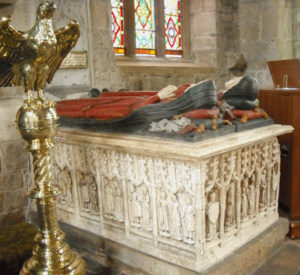
Evidently  Henry Tudor didn’t harbour a grudge against the Babingtons because the records show that Thomas’s grandson, another Thomas pictured at the start of this post, inherited the estates and the job of Sheriff despite the fact that in 1498 he married Editha or Edith Fitzherbert of Norbury.  One of the interesting things about the Norbury FitzHerberts’ is that their effigies bear the insignia of the white boar – Richard III’s personal symbol.

Thomas-Babington-of-Dethick-d-300x275.jpgThomas died in 1518 and was buried in Ashover where his grandparents were buried.  It was the first thing he identified in his will.  His wife had already died and the monument already built.  The figures around the tomb included members of his family. He did not want it broken so that he could be interred. He stipulated where he wished to be interred, that candles were to be burned around his body and alms given to the poor. He asked that his debts be paid and that if he had offended anyone that they should have restitution.  He asked for masses and prayers to be said.  In short it was a good pre-Reformation will with attention being paid for departing purgatory for Heaven as soon as possible.


He left behind him a family of nine sons and six daughters.  His oldest son was called Anthony.  His grandson was also called Anthony and whereas Sir Anthony Babington senior is remembered for building the church tower at Dethick, his grandson is remembered for the so-called Babington Plot which saw him attainted and executed for treason in 1586.

Antony Babington having been attainted a traitor and executed in 1586 didn’t lose the Babingtons all their property.  His brother Francis inherited Kingston-on-Soar but he sold it to Gilbert Talbot – the Earl of Shrewsbury and so the manor passed from the hands of the Babington family.  Anthony’s other brother George sold the Manor of Dethick into the hands of the Blackwall family.

Kerry, C. (1887) ‘Babington family (from Report of the Hon. Secretary).’ Derbyshire Archeological Journal :9. (pp. XXI-XXVIII).

Babington, T. (1897) ‘The will of Thomas Babington, of Dethick, Derbys.’ Derbyshire Archeological Journal :19. (pp. 080-093).


The Holland family -part 2

msharley1319f25Yesterday’s post covered all of points 1-3 and most of 4:

  1. Robert Holland who married Maud de Zouche and managed to get himself beheaded by some irate Thomas of Lancaster supporters in 1328.
  2. Sir Thomas Holland who married Edward I’s granddaughter Joan of Kent in a secret marriage.  He became the first  Holland Earl of Kent. He died in 1360.
  3.  Sir Thomas and Joan had two sons – Thomas and John. Thomas became the 2nd Holland earl of Kent after his mother’s death in 1385.  He was married to Alice FitzAlan the daughter of the Earl of Arundel. the 2nd earl died in 1394.  I’ll come back to John shortly.
  4. The 2nd earl and his wife Alice had two sons, another Thomas and Edmund.  Thomas, the elder of the two brothers became the 3rd earl but was elevated by his half-brother Richard II to the title 1st Duke of Surrey. He was demoted back to being an earl when Henry of Bolingbroke usurped the throne from his cousin Richard II.  In January 1400 Thomas plotted with his uncle John to overthrow Henry IV and return Richard II to power.  Both Thomas and John were executed.  Thomas did not have any heirs so the title of 4th earl went to Thomas’s brother Edmund.  Edmund was killed in 1408 during one of the intermittent skirmishes of the Hundred Years War.  The Holland Earldom of Kent was extinct as he had no heirs.holland1exeter

So let’s go back to John, the second son of Joan of Kent.  John benefited from the patronage of his step father the Black Prince.  He married Elizabeth of Lancaster, the daughter of John of Gaunt, was elevated to the earldom of Huntingdon and then to the title 1st Duke of Exeter.  When Henry IV gained the throne John was demoted back to his earldom, plotted to kill Henry and his sons and was promptly executed.

Effigy_John_Holland_died_1447He and Elizabeth of Lancaster had three sons.  The eldest and youngest died without heirs whilst the middle son, conveniently called John regained the dukedom from Henry V following the victory at Agincourt.  John, the second Duke of Exeter, married the widow of Edmund Mortimer and had two children.  The boy was called Henry and he was born in 1430 so we have now arrived at the Wars of the Roses generations.

Henry became the 3rd Duke of Exeter in 1447.  He was an important political figure.  So it is not surprising that he married Richard of York’s young daughter Anne. On December 30th 1460 he was one of the Lancastrian commanders at the Battle of Wakefield – where his father-in-law was killed.  He was at Towton and fled to Scotland to continue serving Margaret of Anjou.  He wasn’t caught by the Yorkist king Edward IV until he was injured at the Battle of Barnet on the 14th April 1471.  The following year his wife, who had already separated from him, sought a divorce.  In 1475 he was let out of the Tower having volunteered to go to France with Edward IV.  Henry Holland, 3rd Duke of Exeter and Joan of Kent’s great grandson.  On the way back from France Henry fell mysteriously overboard and drowned – probably on the orders of Edward IV.  I’ve posted about the 3rd duke before. Click on the link to open a new window: https://thehistoryjar.com/2017/02/07/duke-of-exeter-was-he-murdered-or-did-he-slip/ Henry’s only child, a daughter called Anne had predeceased him a year earlier.

And that’s the end of the Holland males.  There are, of course, assorted female Holland descendants – married as  you might expect into some of the most important families in the country.  I shall begin to look at the female line in part three of this series.