St Andrew’s Castle and Cardinal Beaton

David Beaton was James V’s ambassador to France and by 1528 was the Keeper of the Privy Seal. It was he who helped to arrange the king’s French matches, first to Madelaine of France and then, following her death in 1537, to Mary of Guise. His rise in the church had been just as rapid thanks to his kinship to the Archbishop of Glasgow but in 1358 he was creed a cardinal and following his uncle’s death in 1538 he became the Archbishop of St Andrews. By 1542 he was one of the king’s most trusted advisors, encouraging the king to affiliate himself ever more closely to the French. St Andrew’s Castle, Beaton’s principal residence, reflected his wealth and status.

When James died leaving his infant daughter, Mary, the crown. Beaton was swift to produce a document purporting to be the king’s will and making the cardinal the Regent of Scotland along with a group of his own supporters. Instead of getting what he wanted the Earl of Arran, who was Mary’s heir, became regent but in a gesture of good will, or at least of political expediency, Beaton became Chancellor. Beaton and the queen’s mother, Mary of Guise, wanted to keep Scottish foreign policy tied to the French but across the border, in England, Henry VIII wanted his son, Edward, to marry the young queen and unify the two nations. The Protestant lords of Scotland also looked more favourably on that match than one that might be made with Catholic France.

When Henry VIII gave orders for the Rough Wooing, some of Scotland’s nobility felt that it was the French faction who provoked it. Beaton was not popular with his peer group. he’d risen to power through nepotism and had more than 20 illegitimate children. He personified all that was wrong with the catholic church. To make matters worse, Beaton began to arrest reformers and imprison them in St Andrew’s Castle bottle dungeon at the bottom of the Sea Tower. He regarded them not only as a threat to his religious beliefs but also dangerous to his political power.

In 1545 Beaton arrested George Wishart, a Protestant preacher, and then had him burned at the stake for heresy. His initials mark the spot outside St Andrew’s Castle where he died. Scotland’s protestant Lords decided enough was enough and on 29 May 1546 Beaton was captured by a group of men pretending to be stone masons. They killed the cardinal and displayed his naked body from the parapet before throwing it in the castle’s bottle dungeon.

Mary of Guise sent troop to regain control of the castle from the protestants. The siege was commanded by the Earl of Arran who ordered a mine be dug beneath one the castle’s towers to undermine it. The garrison, after a couple of false starts, dug a countermine. They also hoped that assistance would be sent by the English – but instead, in July 1547, the French navy arrived and bombarded the castle causing the castle’s garrison to surrender. The men that were captured, including John Knox (who was doing a spot of light tutoring in St Andrews, was an admirer of Wishart, and had somehow ended up as the Protestant chaplain in the castle), ended up as prisoners in France or forced to row in French galleys. Knox, who spent 19 months chained to an oar, returned to St Andrews in 1559 following his return from a decade of exile. After he preached a particularly fiery sermon St Andrew’s Cathedral was stripped of its wealth in the aftermath of an orgy of destruction.

Stirling Castle, Argyl’s Lodging and Mar’s Wark

Stirling is perched on top of a hill and between the start of the twelfth century and the Union of the Crowns in 1603 every Scottish monarch lived here at one time or another. The oldest parts of the castle date from the time of Robert II and I am not lingering on the Scottish Wars of Independence in this post and besides which the castle as it can be viewed today was the work of James IV and James V. And like everywhere else I’ve been in the last week, it’s featured on Outlander.

I guess the start of my particular story is when James II arrives at the castle, aged 6, for safety after the murder of his father in 1437. It commences the tradition of young Scottish monarchs and heirs being both protected and educated here.

James II, who was known for his somewhat irascible temper, threw his enemy, William 8th Earl of Douglas, out of a window into the garden beneath in 1452 having first murdered the lord.

James IV saw himself as a Renaissance Prince and it was he who began the transformation of the medieval fortification into something more comfortable as well as encouraging scholars and artists to visit him. He was particularly interested in alchemy and instituted a research laboratory at the castle. His alchemist, John Damian, was something of a favourite with the king from about 1501 onwards. He was employed as the king’s doctor, tried to turn base metals into gold and wanted to fly. In September 1507 he made himself a pair of wings from bird’s feathers and announced that he would fly from Stirling to France. It was a short-lived project saved from total disaster by crash landing into a dung-hill at the foot of the castle’s walls. The laboratory and its experiments concluded in 1513 with the death of James IV and accession of James V, whose regent was his mother Margaret Tudor.

James V sent for French masons to continue his father’s work. Like his English brother-in-law he wanted to be seen as a Renaissance Prince. He might also have wanted to impress his French bride. There are six rooms dating from this period – three for the king and three for the queen and the most notable thing about them is the ceiling in the king’s audience chamber which contains the Stirling Heads carved from oak. The originals were taken down in 1777 and can be seen elsewhere in the castle. Throughout the fifteenth and sixteenth centuries there were various building projects which turned Stirling into a Renaissance Palace.

James VI was born at Edinburgh Castle but quickly moved for his own safety to Stirling where he was baptised in a ceremony costing £12,000. He would be crowned at the nearby Church of the Holy Rude. His mother, Mary Queen of Scots, was crowned in the chapel in the castle and she spent most of her Scottish childhood there, out of reach of the English. Her son would also spend his childhood at Stirling. Come to think of it James V, who was born at Linlithgow, was also crowned at Stirling after the death of his father at Flodden.

It was only when James’ wife, Anne of Denmark, became pregnant that James VI returned and gave orders for the castle to be modernised. James VI had the medieval chapel torn down and a new far grander chapel royal built for the baptism of his heir Prince Henry in 1594. The outline of the medieval building can be seen in the cobbles of the courtyard.

The feast celebrating Henry’s baptism, which took place in James IV’s Great Hall (completed in 1503) included a fish course served in a full size boat that came accompanied by cannons that fired and some mermaids. The Great Hall is, apparently, the largest medieval hall in Scotland and had five fireplaces. As well as providing fine dining for Scotland’s nobility and other honoured guests, parliament used to occasionally sit there. After James moved to England in 1603 the castle ceased to be so important.

In 1746 Bonnie Prince Charlie tried and failed to capture the castle. It was the last of the castle’s eight sieges and given that it is protected on three sides by steep drops it’s reputation for security is perhaps not surprising.

Castle Wynd leading up the hill to the castle from the town contains houses with their own links to the Stewart/Stuart dynasty. Argyll’s Lodging dates from the sixteenth century but was extended in the seventeenth century, and is best known as the Stirling home of the 1st Earl of Stirling. It was owned for a time by Adam Erskine the administrator for Cambuskenneth Abbey and one of the players in the life of the young James VI. He originally supported Morton, tried to win favour with the king and in 1578 gained the pos of keeper of Stirling Castle having persuaded his cousin, the 2nd Earl of Mar, that he had a hereditary right to be the king’s guardian. There was something of a dispute that caused the king much distress. Later Adam would support the Earl of Gowrie who held the king at Ruthven Castle. After the collapse of Gowrie’s regime, Adam was banished and his properties forfeited to the crown.

In 1629 – by which time the royal family were ensconced in England- the property was sold to Sir William Alexander who was one of Prince Henry Stuart’s tutors during his life time. He went with the royal household to London in 1603 and by 1626 was appointed Secretary for Scotland. In 1630 he became Earl of Stirling. Stirling had the house on Castle Wynd remodelled when Charles I was going to visit Stirling for his Scottish coronation. Below the castle garden, known as the King’s Knot and the Queen’s Knot, were created to celebrate the occasion and the Chapel Royal in the Castle was also given a new paint job. In the event the king and court only stayed a few days but the frieze painted by Valentine Jenkin in the chapel can still be seen.

The coat of arms above the courtyard doorway at Argyll’s Lodging shows a mermaid and an Indigenous American. Alexander is principally remembered of this settlement of Nova Scotia. And why is it called Argyll’s lodging I hear you ask? Well Stirling died deeply in debt in 1640 – the town fathers claimed the house and then, during the 1660s, sold it to the Duke of Argyll.

Mar’s Wark, on the opposite side of the road, was the townhouse of John Erskine who built the house during the 1560s/1570s when he was regent for James VI. When Anne of Denmark first arrived in Stirling she moved into Mar’s Wark while work on the castle was completed. The facade is all that remains today and both buildings are in the hands of workmen at present – so photos are littered with scaffolding and bright orange safety barriers. Oh well.

Tomorrow? The bookshops of St Andrews await along with the cathedral of course and some of the towns award winning fish and chips!

Dunfermline Abbey and Palace

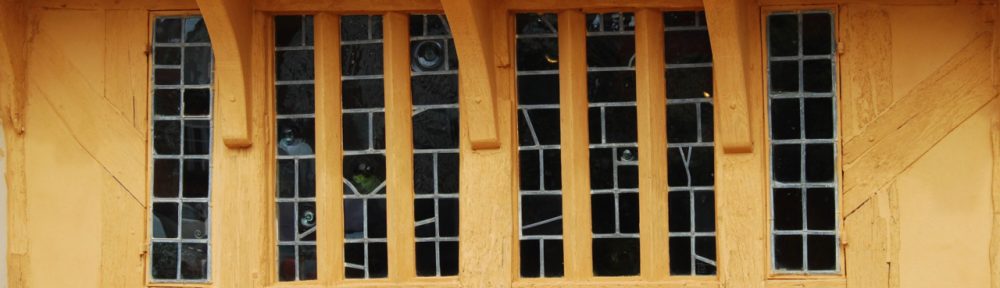
The sun shone! The sky was blue! The people we met at the abbey and palace were lovely and the almond croissants at the Abbot House (the very pink building) were delicious. I was also quietly amused by the addition of a spider to the window depicting Robert the Bruce. Last time we visited Dunfermline we had greater access to the ruins and in case you’re wondering my earlier photographs are all trapped on my misbehaving external hard drive.

The abbey became the burial place for Scottish royalty in the 1100s. St Margaret (the daughter of the Anglo-Saxon Edward the Exile) established the monastery in 1070, on the site where she married King Malcolm. It was enlarged by David I who was the youngest of Margaret’s six sons. David arranged for masons to come from England to complete the building work and appointed Geoffrey, who was Canterbury’s prior, as the first abbot. Even on the eve of the reformation, thanks to David’s devotion to the abbey, where his parents were buried, it was one of the wealthiest foundations in Scotland. It helped that across the centuries pilgrims had come to visit the shrine of Queen Margaret who was canonised in 1249.

Not that matters were always so trouble free. The Scottish Wars of Independence took their toll on the abbey and the town. Alexander III’s three children died before him as did his queen, Margaret, a daughter of King Henry III of England. In an attempt to secure his dynasty he remarried and was in such haste to spend the night with his beautiful young bride took a tumble off a cliff on his way to visit her in 1289 – he was buried at Dunfermline next to his first queen while his grand daughter the Maid of Norway was invited to wear Scotland’s crown. Her premature death in 1290 during her journey to Scotland was the trigger for the Scottish Wars of Independence.

Not far away from the abbey and palace, at Pittencrieff Park, visitors can find Wallace’s Well. William Wallace, he of Braveheart fame (and no he did not father Edward III…even if the Mel Gibson film of 1995 suggests that he did) is supposed to have taken refuge here in 1303 after the Battle of Falkirk. How true the story might be is another matter entirely (it’s the uninspiring mini stone shed with the littler on top of it in the gallery of images). Wallace’s mother is also said to be buried in the churchyard on the northern side of the building and after Wallace’s execution a bit of him made it back to Dunfermline where it was interred with his mother’s remains. Inevitably. Edward I and his court spent some time here as well. Having spent the winter of 1303 at the abbey when he left Dunfermline in May 1304 he gave ordered for the monastery to be burned. Perhaps he heard rumours that the abbot had helped Wallace or perhaps he was just as unpleasant as he can, on occasion, sound.

Robert I financed the rebuilding of Dunfermline’s abbey. The huge new building made an impressive statement as did the rest of Scotland’s programme of monastic construction. After his death, in 1329, Robert was buried there in front of the high altar. His heart is, of course, went on crusade and is interred at Melrose. The Stewarts/Stuarts stayed in the abbey guest house which doubled as a royal residence when they visited. It underwent several remodellings including that of James V at the beginning of the sixteenth century. James VI/I eventually gifted the abbey and its accommodation to his queen, Anne, in 1598 and she turned it into a palace. The queen’s daughter Elizabeth and her son Charles were born here. Her young son Robert was the last of the Stuarts to be buried here in 1602.

After the Stuart kings travelled south Dunfermline’s importance diminished and it gradually turned into a ruin. A new parish church was designed to take the place of the old one at the turn of the nineteenth century. It was in 1818 that Robert the Bruce’s remains were found during building work along with 19 fragments from his tomb.

This year, to celebrate his 750th birthday Historic Scotland commissioned a reconstruction of the famous king’s head based on a scan of the scull found in 1818- although it cannot determine whether the king had leprosy at the time of his death or not. The reconstruction shows him without the illness dressed as he would have been at Bannockburn, while a second digital model makes the same reconstruction but with the effects of leprosy evident. There are no accurate descriptions of the king and, in case you’re wondering, the leprosy accusation came from English sources – and let’s face it, the accusation is a pretty good way of insulting Robert as well as suggesting that God wasn’t happy with him.

Aberdour Castle

The sun came out- the sky was blue – briefly. Today we explored a little of the Fife coast and visited the home of James Douglas 4th Earl of Morton. He was instrumental in bumping off Mary Queen of Scots’ secretary, David Rizzio and encouraging her to abdicate while she was imprisoned in Loch Leven.

Which leads us to the reign of James VI. James Stewart, Earl of Moray was assassinated at Linlithgow in 1570. In 1571, the next regent, James’ grandfather Mathew Stewart, Lord Lennox was shot and died at Stirling. The third regent was the Earl of Mar…he died in 1572 and hey presto Morton, who was already one of the nation’s most influential men, became regent. He was forced to resign six years later much to the irritation of Elizabeth I.

In 1580 he was accused of playing a part in the murder of Lord Darnley. He was condemned and executed in Edinburgh. The consummate politician had finally gone the way of so many of his predecessors. Morton’s wife, Elizabeth, was incapable of managing her own affairs. It seems that she and her sisters Margaret and Beatrix suffered from an inherited mental illness. Morton’s three surviving legitimate daughters were also declared mentally incompetent in 1581. The older women were grand daughters of James IV, through their mother Katherine (an illegitimate daughter of the king) and all of them, incompetent or not, were married to powerful men. It was through Elizabeth that Morton inherited his earldom and Aberdour. Elizabeth spent most of her time in seclusion at Tantalon Castle. An inquest after Morton’s death declared her to be incapable of managing her affairs, as she was an “idiot and prodigal”. King James VI signed a warrant appointing a legal guardian called an “administrator and tutor” to supervise her dower. (Fraser, William, eds., Lennox Muniments, vol.2 (1874), 321-322).

The earldom of Morton passed to Sir William Douglas of Lochleven (Mary Queen of Scots’ gaoler). He was eventually succeeded by his grandson who was one of James VI’s gentlemen of the bedchamber. He made several alterations to Aberdour including the gallery and walled garden. But it was Regent Morton who began the castle’s terraced gardens, planted the orchard and gave orders for the dovecot to be built.

And that leads me down an interesting rabbit hole that really has nothing to do with Aberdour or Regent Morton – What exactly did James V die from at Falkland. Was it one of the many diseases that plagued armies at the time? I’ve also seen cause of death described as pulmonary tuberculosis. And did he suffer from depression – famously having heard that his wife, Mary of Guise, had given birth to a daughter he turned his face to the wall and stayed there until he died having declared that the crown came into the Stewart family with a girl and would go with one .

Mary Queen of Scots was not without her own maladies – hardly surprising under the circumstances. I don’t suppose 19 years of captivity is going to do anyone the world of good. In all honesty being a royal Stewart, or even Stuart, wasn’t necessarily good for your health for a variety of reasons setting aside melancholy – James I was assassinated; James II was killed by one of his own cannon; James III – either died on the battle field or was assassinated trying to leave it; James IV – killed at Flodden; James V – having lost the Battle of Solway Moss either died from disease or because he was extremely peeved about the birth of a daughter; Mary Queen of Scots – beheaded. James VI/I died of natural causes in his own bed (although the tall tale that he was poisoned by the Duke of Buckingham still occasionally surfaces). Charles I – followed in granny’s footsteps and lost his head.

Amazon Associate Link – Purchases made after following the Amazon link by clicking on the image help to keep the History Jar afloat.

Callendar House, Falkirk

Today the house looks like a very grand nineteenth century châteaux but it’s built around a fourteenth century tower (that’s the large square block on the right hand side of the main entrance). And there’s more history than that in the grounds. It lies on the line of the Antoine Wall that stretched from the Firth of Forth to the Firth of Clyde. By the 12th century a thane’s hall stood on the site. The Callendar family held the land until the Scottish Wars of Independence. Sir John Callender was a signatory of the Treaty of Salisbury which confirmed the Maid of Norway as queen of Scotland following the death of Alexander III when he died in March 1286. He also signed the Ragman Roll in 1296 that recognised Edward I as king of Scotland following the maid’s untimely end. He was captured by those fighting for Scottish independence at the Battle of Falkirk in 1299.

Sir Patrick Callendar had his own difficulties during the Scottish Wars of Independence but Callender House passed into the Livingston family with the marriage of his daughter to William Livingston. Unfortunately it was not that clear cut because Callender had elected to support Edward Balliol’s (the son of King John Balliol) claim to the Scottish throne when David II succeeded to the throne at the age of 4-years. Ball was crowned in 1332 after which there was rather a lot of crown swaps but essentially for our purposes when David II regained his throne the Calendars found themselves in some difficulty because of their affiliation with the Balliols.

In 1345 David II regularised matters with the grant of Callendar House to William Livingston. Livingston demonstrated his loyalty to the monarch and they were all set to rise. By the 1440s the Livingstone were the guardians of James II and Alexander, 5th Lord Livingston was one of Mary Queen of Scot’s guardians. By then the originally tower house had doubled in size but still had none of the turrets and additional wings of the modern building. The fifth lord was born at the turn of the sixteenth century and had a reputation as a military commander. When Mary travelled to France in 1548, Alexander travelled with her and remained there until his death. Alexander’s daughter Mary was one of the queen’s so-called Four Marys and his son William, who was a protestant, would fight for the queen at the Battle of Languid in 1568.

William accompanied the queen into exile. William’s wife, Agnes, travelled to Bolton Castle to serve the imprisoned queen. Like William she had known Mary all the queen’s life – Agnes was the daughter of Mary’s governess Janet Stewart, Lady Fleming (making Agnes the queen’s cousin as well). She shared several years of her mistress’s captivity. The Earl of Moray seized Callendar while William set about trying to negotiate the queen’s release. The couple’s eldest son Alexander, who would become the 1st Earl of Linlithgow, also supported the queen and was captured at Dumbarton in 1571. It was another three years before the family came to terms with James VI’s regent even though William returned to Scotland in 1573.

But by 1580 Alexander was a gentleman of the king’s bedchamber. In 1592 Alexander succeeded his father as Lord Livingston. He had worked his way into royal favour as a follower of Esme Lennox and by seizing Stirling Castle in 1584 after the Ruthven Raid. In 1594 he played a part in the baptism of James VI’s eldest son Prince Henry.

Two years later he and his wife Helenor (or Eleanor)Hay were entrusted with the care of James’ daughter Princess Elizabeth. The fact that Helenor was a Catholic did not make her unsuitable. As well as spending time at Linlithgow Palace, Alexander was its keeper, the princess also spent time at Callendar House. In 1600, at the time of Prince Charles’ baptism, Livingston became 1st Earl of Linlithgow. In 1603 the Livingstons’ took Princess Elizabeth to Windsor to return her to her father.

The couple’s eldest son, Alexander, became the 2nd Earl of Livingston while his brother James, who was a similar age to Elizabeth, became 1st Earl of Callendar in 1534. He had spent his formative years as a mercenary fighting in the Low Countries and in Germany. He served James VI (and 1) as well as Charles I but his support for the Covenanters led to difficulties. Ultimately though, he took the field on the side of the royalists. His estates were seized in 1654 and he was imprisoned by Parliament. By then Callendar House had also taken something of a battering. In 1651, following his victory at Dunbar, Cromwell had seized most of Lowland Scotland. That summer Callendar House was placed under siege. General Monck stormed the building with his men killing 62 of the garrison. The house’s governor was among the dead. Having buried the dead and demolished the gatehouse Monck departed, although not before Oliver Cromwell had arrived to survey the scene. Unsurprisingly given Livingston’s affinity, the estate was sequestered and it was General Monck who received the income from it.

The Restoration saw James Livingston return to Callendar and begin work on alterations and refurbishment to his home – a seventeenth century Manor House was added on to the tower. When he died in 1674 his title and estates were inherited by his nephew, another Alexander, who completed the building work that James’ began before his death. Unfortunately it wasn’t long before the house saw more soldiers – Alexander’s own views ran somewhat contrary to those of James VII of Scotland ( II of England) but he was dead before the Glorious Revolution of 1688. The third earl continued the policy of extending the house.

James, the 4th Earl of Calendar showed his ancestors’ loyalty to the Stuarts. He rose in support of the Jacobites in 1715 and was attainted for treason. His son-in-law, the Earl of Kilmarnock took possession of the property but in 1745 he supported Bonnie Prince Charlie (yup he stayed in the house which was looking a bit tatty again), was captured at Culloden and beheaded at the Tower of London.

In the latter half of the eighteenth century Callendar House was sold to the Forbes family. William Forbes was from Aberdeen and was known as Copperbottom from his business of coating the bottom of naval vessels. He was also a slave owner. He was very wealthy indeed, if not very popular with the people of Falkirk. It would be the Forbes’ family who turned Callendar House into a French Chateau.

You will notice that once again the sun did not shine! Good job I just need black and white photographs for Raising the Stuarts. The parking at Callendar House, which is owned by Falkirk Council, is free as is entry to the grounds and house. The history of the house was extremely well presented, as was the explanation of the location of the Antonoine Wall. Even better they did a very nice maple and pecan scone…

Falkland Palace – and me being grumpy about the no photography rule…

In 1458, on the orders of James II, Falkland became a royal burgh. The palace itself, really only the gatehouse remains today, was built in the twelfth century. It became crown property in 1424 after the death of David Stewart, Duke of Rothesay at the hands of his uncle, the then keeper of the castle. It was said that Rothesay died of a mysterious illness while quieter, but more persistent gossip, said that he died in chains in Falkland’s cellars. In any event it was James I, Rothesay’s little brother, who with the crown firmly on his head took possession of Falkland when their uncle, the Duke of Albany, fell from power.

In 1451, James II of Scotland gave the castle to his queen Mary of Guilders -and it was she who turned it into a palace with comfortable apartments and a pleasure garden. It was improved upon by successive kings. At the turn of the sixteenth century by James IV (the one killed at Flodden in 1513) improved the hunting on offer by importing wild boar from France and began work on a Renaissance palace. James V, who spent much of his minority in Falkland in captivity at the 6th Earl of Douglas, continued his father’s plan for a splendid summer palace by adding the gate house with its magnificent twin towers. It was he who added the tennis court in 1539. It was one of James V’s favourite retreats, despite the fact that he had been forced to escape from his step-father’s clutches at Falkland dressed as groom. He died at Falkland Palace in December 1542 following his defeat at the Battle of Solway Moss.

Later Falkland would hold the same appeal for his daughter Mary who could see the influence of France in its architecture and the chapel which retained its Catholic flavour in the newly Protestant realm. Her son, James VI, commissioned the famous Falkland Bed but by the time it was ready for him, he was James I of England and never slept in it. Charles I visited briefly. Charles II, who stayed in Falkland in 1650 when the Scots recognised him as their monarch was the last of the Stewarts to stay at the palace. In response, Oliver Cromwell, burnt the palace to the ground in 1654- although the fire could have been an accident.

Warning – the next two paragraphs contain evidence of a grumpy blogger at work!!

Unfortunately, despite the current entry fee of £17 per person, interior photography is not permitted. It’s a bit of a non sequitur I admit but it does make me feel that history is only for those who can afford it – which is just plain wrong on so many different levels. How can heritage belong to people if it’s made inaccessible to them? You’ll have to take my word that the painted ceilings and nineteenth century renovations including heraldic glass in the chapel are a treat – I could have an entire project on the way heraldic beasts are presented at Falkland beginning with the stencils of the red lions on the staircase at the entrance, to the wallpaper with its assorted stylised beasts, stained glass and, of course, various coats of arms. Falkland, still technically in the hands of the Crown even today, was purchased in 1887 by the 3rd Marquess of Bute who became the palace’s keeper. It was he who set about conserving and rebuilding what he was able of the palace. He even purchased the Falkland Bed when it came up for sale – and used it for the next three decades. It is indeed a bed fit for a king – complete with six royal swans, the virtues and a warning to remember that it is God rather than monarchs who are in charge! The wall paper and the decorative metalwork are pure Arts and Crafts and absolutely wonderful ( I loved the candle sconces in the chapel).

The hereditary keeper today is the great grandson of the Marquess of Bute but the deputy keepership resides with the National Trust for Scotland. And if anyone from that august body is reading this – I don’t make any money from the History Jar – so any photographs would be entirely non-commercial. The guides dressed in period costume are very informative and their costumes splendid – can’t photograph those either and I don’t think they’re going to stand still while I get a sketch pad out. Nor can I show you the 17th century stump work mirror frame with its rendition of Nonsuch Palace, the beautifully embroidered night cap or the modern examples of blackwork embroidery that are on display. And I shall not be recreating the blackwork motifs even if I wanted to (which I do) because there were no postcards available and there were certainly no images of the blackwork in the guide book or of the Jacobean bed hangings (in enough detail) in the event that I fancied creating a crewel work memento of my visit. Am I grumpy about this? Yes I am. But then, you’ve probably already gathered that fact. The Falkland Tapestries are old and their colour needs to be conserved – yes – but that doesn’t explain why everything is off limits. As a visitor, my experience is better when I’m looking closely at the detail and think about how I might use an image or design if I was going to turn it into a piece of needlework or even a sketch. And let’s not forget that I use images as a visual reminder of what I want to write about both for this blog and for anything else I might be writing. I think the sight of a woman scribbling manically into a notebook might be rather more off putting than one taking photos – and certainly more irritating for those members of her family who have to wait while she writes everything down and does neat little annotated sketches in the margins. In this day and age no one needs to use a flash to obtain a decent picture – so long as there is some natural light. And there weren’t that many people there so I don’t think it had much to do with crowd control. Oh well – rant over. I do think a book introducing the history of needlework through the embroideries of the Trust (Scotland or England) with some practical projects would sell a treat. I’d rather buy something like that than yet another tea towel. Come to think of it, I would love to be the one to write it. Perhaps I’ll add a new section to the History Jar- the meanderings of an embroiderer…

Falkland is a pretty little palace, or rather very large gatehouse, and it’s the first one off my Stuart odyssey. The spelling changed from Stewart to Stuart in about 1548 when Mary Queen of Scots married the French dauphin. The village has some quirky shops, friendly locals and a couple of excellent cafes. If you’re a fan of Outlander it will look very familiar. And now the sun has come out. Fingers crossed that’s it for the dreek greyness and my grumpiness for the rest of the visit.

When is Watling Street not Watling Street? – answer when you’re visiting Rome’s northern most town on Hadrian’s Wall

Vicar’s Pele, St Andrew’s Churchyard, Corbridge

I’m currently working on the Stuarts so am enjoying a break in sunny Scotland – a continuation, if you will, of the Mary Queen of Scots world tour upon which I intermittently indulge. So yesterday we joined some camels for breakfast off the A66 before heading in the direction of Hadrian’s Wall. There was a pause at Corbridge so that I can re-photo the Vicar’s Pele in the churchyard of St Andrew’s. Once upon a time, the vicar during time of trouble between England and Scotland the vicar would shut himself into the defensive building and hope for the best. It was built in the fourteenth century just at the point when the wars of independence were warming up. Its builders used dressed stone from Coriosopitum Roman camp known locally as Coria and by the modern world as Corbridge.

So far so good but I must admit to being slightly bewildered to seeing the street name Watling Street. For a moment I thought I’d got things very badly wrong over the years. I thought the famous Roman Road started in Kent made its way to St Albans and then cut across country towards Wroxeter. By the ninth century it was effectively the border between the Saxons and Scandinavian ruled Danelaw. So why does a short stretch of Watling Street suddenly turn up in Corbridge in Northumberland?

The answer is that the Romans did not build a small extension to the road in Northumberland. Dere Street Stretches from York north into Scotland (quite some way beyond Hadrian’s Wall) up to the Antonine Wall. Error arose because of the written record. The Antonine Itinerary which was created during the Roman period and which was reproduced by the Anglo-Saxons between the seventh and tenth centuries is a good example of the way confusion could arise. It was basically a road map of the Roman Empire with a British section. The second route listed in the British part of the itinerary misidentified a route between York and Carlisle as Watling Street. And by the Middle Ages short stretches of Roman Roads were being called Watling Street whether it was accurate or not. You can find a Watling Street from Catterick to York; from Knaresborough to Ilkley; there’s an example in Preston; and of course – the proudly named section of Dere Street in Corbridge.

And yes – we stopped off in a very misty and damp Corbridge Roman town to have a look at the Corbridge hoard which was buried during the second century AD and which was rediscovered in 1964. The Roman segmented armour is the star turn of the hoard which is thought to have been buried for safekeeping by a smith but there are also leather and textile artefacts. Until its discovery no one quite knew how the armour was manufactured. The museum also boasts a dodecahedron, an artefact that is something of a mystery because no one has yet established what its purpose was.

Then it was on to Otterburn, the site of the battle in 1388 between the Scots and the English – for an account look at Froissart but don’t expect to find a photograph of the site here. By the time we arrived it was like wondering around inside a very damp cloud and I fully expected to become lost. We stopped at the mill shop to see if I could find a waterproof that actually is waterproof and I was pleased to find a field full of tenterhooks so it wasn’t all in vain.

Tenterhooks at Otterburn Mill

Thankfully we made our way to our overnight accommodation without mishap and were shown to the ‘wobbly room’ which proved an apt description of the floor. Much to my delight I was staying in a pele tower – something I’ve always wanted to do. This particular one, at Clennell, was a bit like the little doll in the middle of a set of Russian dolls. Like the Vicar’s Pele it was built during the fourteenth century. It may have evolved into something slightly more comfortable by 1567 but the emphasis would still have been on defence. A new range was added in the seventeenth century around the original building and then more additions were made in the eighteenth and nineteenth centuries – actually perhaps I should have described the hall as being a bit like a many layered onion. In any event I was delighted by the whole thing.

Clennell Hall, pele tower.

The Chaloner family – an ambassador, a chemist, a governor and a regicide

AndyScott, CC BY-SA 4.0 https://creativecommons.org/licenses/by-sa/4.0, via Wikimedia Commons

Our story starts with Thomas Chaloner the Elder who was born in 1521. Thomas’s father, Roger, was an usher in the privy chamber of Henry VIII. Thomas was well educated and was sent off in 1540 as secretary to Sir Henry Knyvett to the court of Charles V and from there he was sent to Scotland where he was knighted after the Battle of Pinkie in 1547. He continued to serve Mary I in a diplomatic capacity before becoming Elizabeth I’s ambassador to Philip II at Brussels, although it is known that he was in England during 1560 and 1561. By then he was wealthy enough to build himself a house in Clerkenwell and he also had properties in Guisborough, St Bees and Steeple Clayton, a property in Buckinghamshire that he had been granted by Queen Mary.

From there he journeyed to Paris where he met Sir Nicholas Throckmorton, the English Ambassador to France. Unfortunately he arrived just as war broke out between the authorities and the French Huguenots. Chaloner, who despite his good relations with Mary was Protestant, was promptly arrested. When he was released, having met with Catherine de Medici and the Huguenot leaders, he made his way to Madrid, where he continued to serve Queen Elizabeth despite the fact that he hated the weather, the cost of living and the extremes of Catholic faith that he encountered. Nor did the fact that he was unmarried help with the management of his estates in England.

He had hoped to marry Elizabeth Sands who was one of the queen’s ladies but in his absence she married someone else. In 1563 he received a visit from Audrey Frodsham from Cheshire. She was 33 years old when she travelled to Spain. By the time she returned to England she was expecting Chaloner’s child. Chaloner’s brother Francis, who might reasonably have expected to inherit his brother’s wealth, would describe the boy as illegitimate. The problem was that the pair wished to marry as Protestants rather than in a Catholic Church but Chaloner was delayed by his duties, trying to negotiate the release of some English sailors, so it appears that the marriage took place after the birth of Chaoloner’s heir, which took place at the end of 1564.

Chaloner the elder’s health was not good, it seems that he may have had malaria, and he died in 1565 having made a new will ensuring that his belonging went to his son. In order to prevent his brother Francis Chaloner from contesting the will, Chaloner arranged for a group of his friends, including William Cecil, to become trustees of his estate having made provision for Audrey. he also arranged that Thomas Chaloner the Younger should be educated by Cecil.

Thomas Chaloner the Younger was tutor and friend to Robert Dudley the explorer. Like his young friend, Chaloner travelled extensively and after Dudley’s flight to Tuscany with his mistress in 1605 did his best to retrieve Dudley’s fortunes for him. He was well placed to do so, having gained a place in Queen Anne’s household. This happy circumstance derived from him having been an acknowledged part of the Earl of Essex’s circle. It was his task to manage the queen’s private estates. The king also appoint him governor of Prince Henry’s household at Oatlands. Chaloner’s reputation as a chemist and his interest in natural history were the ideal qualities in a man responsible for educating a renaissance prince. Chaloner was married twice and had eighteen children. In 1610, Chaloner became Henry’s chamberlain at St James’ Palace. As well as being a scholar, Chaloner like his father was also well informed on military and diplomatic matters.

He also identified the value of his Guisborough estates for its alum, having learned the process of its manufacture during his travels to Italy. Unfortunately his plans were ruined when the king seized the mines for the Crown. The seizure was one of the reasons that Chaloner was appointed to the role of Prince Henry’s governor – it was a sweetener for the loss of a fortune. Realistically Chaloner may have thought that his family would benefit more by their association and education alongside Henry. Unfortunately the prince died in 1612 – leaving the Chaloners out in the cold.

Two of Chaloner’s sons, James and yet another Thomas, would become regicides when, in 1649, they served on the commission that tried Charles I. James did not sign the death warrant but Thomas did. This meant that in 1660 Thomas, along with the other men who signed the document, was excluded from the act that pardoned other parliamentarians. James who was prominent in Yorkshire under the patronage of General Fairfax was arrested in 1655 for suspicion of involvement with the Sealed Knot and died prior to the Restoration. Thomas, the regicide, fled to the Low Countries, under the alias of George Saunders, where he died in 1661.

Chaloner the regicide had always had a difficult relationship with the Crown. The loss of the alum mines did not help matters, especially as Charles gave them to a syndicate of favoured courtiers. However, his religious beliefs, which were opposed to all formalised religions, and the publication of a treatise led to his arrest and subsequent flight from England in 1637. He returned home by 1644 and witnessed Laud’s trial. Nor was he a fan of the Scottish army in England during the First Civil War and he espoused the view that the king was bound by the laws created by Parliament – he was one step away from declaring the sovereignty of Parliament. He would be known for his opposition to the king and it was perhaps because of this that he retained his parliamentary seat (the Borough of Richmond) after Pride’s Purge. He was instrumental in the creation of the Commonwealth and was a key figure in the development of its trade and foreign policies. As a complete aside, the Chaloners were related by marriage to Oliver Cromwell. Thomas’s nephew Edward, was married to Anne Ingoldsby – who was one of the Protector’s cousins. Richard Ingoldsby, Chaloner’s brother-in-law, for those of you who might be interested, was another regicide but because he claimed that he was forced to sign the death warrant and because he supported General Monck, he was pardoned where other regicides were not.

Chaloner’s eldest brother William become Baronet of Guisborough in 1620. However, like his father and grandfather before him, William was well travelled and his died in Turkey the following year – meaning that the baronetcy was extinct almost before it began.

Amazon Associate – any purchase made after following this link, by clicking on the image to open a new tab, helps to keep the History Jar afloat.

Joseph Bampfield – womaniser, bigamist, spy – unlikely (very) short term guardian of a prince.

BOL93904 Portrait of James II (1633-1701) in Garter Robes (oil on canvas) by Lely, Peter (1618-80) (school of); 121.5×99.5 cm; © Bolton Museum and Art Gallery, Lancashire, UK; English, Wikipedia

Well this is embarrassing – what happened to an entire month! I hope that all History Jar readers have had a good summer with plenty of history to keep them entertained. I’ve been researching Colchester, Nottinghamshire and the Stuarts – which perhaps explains the prolonged pause. I’ve also been drawing a parish map for where I live which took a bit longer than I anticipated but which I’ve thoroughly enjoyed doing. For those of you who spotted that someone in the family was doing their GCSEs this year – I’m delighted to report that she passed with flying colours and is now poised to begin her A level history – the Luddites will be beckoning, and I’m quite looking forward to exploring the Pentrich Rebellion.

So today – where am I at? I’d like to introduce you to Joseph Bampfield – a man who was probably born in Devon and who had something of a shady employment history. He first appears in the Bishops’ War against the Scots in 1639 as an ensign when he was still only 17 years old. By September 1642 he was a major in the Royalist army – when he was captured by forces loyal to Parliament. In December he escaped custody and in January 1643, still only about 19 years old, was commissioned as a colonel by Charles I. He turns up in the southwest throughout the rest of the year but in December was at Arundel trying to capture the castle there. Unfortunately having been given command of the castle he was himself besieged and once again taken prisoner having surrendered in January 1644. After a spell in the Tower he was released on parole…which he promptly broke. He turned up in Oxford and rejoined the royal court.

In 1645 having had a somewhat colourful career he became one of Charles I’s couriers and intelligencers. Which is where he really enters my current field of interest. In April 1648 he was in London where on the night of 20 April Bampfield helped James Duke of York, who was 14 years old by then, to escape his custodians at St James’ Palace dressed in women’s clothes. James knew Bampfield by sight and was apparently trusted by the king to fulfil his task helped by Anne Murray. The pair landed in the Low Counties at Zealand on 22 April.

Bampfield returned to London would go on to have a bigamous relationship with Anne – he told her his wife, who he married when he was very young, was dead. In reality the pair had been estranged since almost the beginning of the First Civil War but whether Bampfield truly believed his wife to be dead or it was just a convenient lie is another matter entirely. Anne would eventually become Lady Halkett.

The spy continue to serve the royalist cause but fail to gain King Charles II’s – or more importantly Lord Clarendon’s trust- after he fled to Holland. He was also forced to fight a duel with Anne’s brother-in-law who was not amused by Bampfield’s deception. By 1652 he had returned to England but was politely asked to leave the country. He spent the next few years roaming Europe, including a spell in Vienna. He wrote an account of his career in 1685. By then he had lived his life as a professional spy and there were several versions of events to choose from as well as many variations of his name. In summing up he was something of a rogue who lived by his wits.

Amazon Associate link – click on the image to open a new page. Any purchase made after clicking on the link helps to keep the History Jar afloat.

Derbyshire’s memorials of the Wars of the Roses 1 of 8 – Ralph FitzHerbert, Norbury

Hurrah – that’s the indexing done – although bizarrely I actually rather like doing the final stages of the process. Think I need to have a better starting process though… Anyway, we took a trip because as those of you know me understand, I do like a list. And I have a lovely book entitled Memorials of the Wars of the Roses by W.E. Hampton. It’s also an opportunity to replace some of the images that disappeared when my external hard drive stopped working.

So today, it was a trip to Norbury and the wonderfully named church of St Mary and St Barlok near Ashbourne. I’ve posted about the location before (https://thehistoryjar.com/2015/07/17/nicholas-and-ralph-fitzherbert-a-glimpse-of-the-wars-of-the-roses/ – click on the link to open a new tab) as I have a fascination with the livery collar that Ralph is wearing.

The FitzHerbert name is a well known one in Derbyshire. Ralph Fitzherbert was lord of the manor at Norbury from 1473 onwards when he inherited the estate from his father, Nicholas Fitzherbert (whose effigy sports a livery collar with a lion pendent) Originally, during the 12th century, the holding was granted by the Abbot of Tutbury but by the 15th century the family owned the manor, having exchanged some land with the abbey, rather than renting their principle seat at Norbury. Inevitably he was caught up in the events of the Wars of the Roses, hence my interest. The gentry in Derbyshire principally supported the House of Lancaster who were their patrons from the medieval period onwards. Nicholas FitzHerbert made the transition from Lancaster to York and served in an administrative capacity with the county. He was associated with Walter Blount who got himself into difficulty with the rest of Derbyshire’s gentry because of his support for the House of York.

Ralph FitzHerbert owed his own loyalty to William, Lord Hastings who, you may recall, was one of Edward IV’s friends. It was he who was with the king when he was forced to flee his realm in 1470. The least said about his womanising the better. In return for supporting Hastings, Fitzherbert expected political advancement – this was the era of so-called ‘bastard feudalism’.

In 1475 FitzHerbert was part of the force which accompanied Hastings to France on military campaign. His place in Hastings’ retinue may have seen him at Picquigny where a peace deal was agreed. Fitzherbert’s association with Hastings so him rise to become a teller of the king’s money before becoming his remembrancer. A remembrancer essentially kept a list, or a roll, so that barons of the exchequer knew what business was pending.

We know that FitzHerbert married Elizabeth Marshall from Upton in Leicestershire. It was a good match as she was an heiress – and should not be surprising. After all, it was the way in which gentry families extended their land holdings and kinship networks to increase their power base within a particular region. Elizabeth who outlived her husband asked to be buried beside him.

Ralph made his will on 21 January 1484 and after his death, in March, was buried in the church with an effigy which recorded his loyalty to the house of York – in particular to Richard III. His livery collar is an unusual one as it depicts Richard’s white boar (I still think it’s the only extant one on an effigy.) Ralph, a pious medieval Christian, wished to ensure a smooth transition from purgatory to Heaven. His will details money to be given to the priests officiating at his funeral and well as to various abbeys so that prayers could be said for his soul.

His heir, John, was to receive the hall’s hangings, an iron grate, the best bed, armour, a flock of sheep with a ram as well as a wagon, 6 oxen and 6 cows. Another son, Thomas, was also in receipt of a bed as were two of Ralph’s daughters. They were also gifted a silver cup each.

John FitzHerbert had his own difficulties to contend with – aside from the effigy of his father sporting a noticeable link to Richard III at the start of the Tudor period. He was married to Benedicta Bradbourne (yet more kinship networks and alliances within the region – her mother was part of the Vernon family) but it didn’t work out quite as his family might have hoped. John’s will, written in 1517, records that the couple were no longer cohabiting because Benedicta had been unfaithful. He described her as ‘lewd and vile’ ( LRO, B/A/1/14, fol. 109v.) – so not a harmonious parting of the ways. His will goes on to ensure that she did not receive any dower rights. Under English law she would usually have been entitled to a third of her husband’s estates for her use during her life time. Sometimes it is quite frustrating to be provided with a fragment of a tale but not to be able to locate more information! And this is one of those occasions.

So in Derbyshire the other 7 ‘Wars of the Roses’ effigies are -At Ashover the effigies of Thomas Babington and his wife Edith FitzHerbert. John Babington, Thomas’s father, fought for Richard III at Bosworth and its possible that Thomas did as well but he made the transition to the Tudor regime.

Ashbourne – John Cokayne and his wife Anne Vernon. He was associated with the Duke of Buckingham and on one occasion Nicholas Fitzherbert was called upon to arrest him for being at feud with the Blount family. Like FitzHerbert he served Lord Hastings in France in 1475.

Barlow – Robert Eyre and his wife Margaret Delves.(Yorkist livery collar)

Hathersage Robert Eyre of Padley and his wife Elizabeth FitzWilliam. He also served Lord Hastings in 1475 and his ability to shift with the tide is reflected by his service as a justice of the peace under Edward IV, Richard III and Henry VII.

Kedleston John Curzon and his wife Elizabeth Eyre (SS collar)

Morley John Sacheverell and wife Joan Statham. Another Derbyshire member of the gentry indentured to serve Lord Hastings in 1474- so in France 1475.

Youlgrave Thomas Cokayne (York collar) – Served Lord Hastings in France in 1475.

I’ve posted about the Ashover and Ashbourne images before but will be revisiting them. Inevitably I will be looking at Nottinghamshire for research into The Little History of Nottinghamshire (a further eight). In Yorkshire – for those of you who are wondering,-there are a whopping 49 effigies with a link to the Wars of the Roses including the tomb chest at Beverley – which definitely doesn’t have an effigy- of Henry Percy, 4th Earl of Northumberland.

FitzHerbert, R. H C. (1897). Will of Ralph Fitzherbert, Esq. of Norbury, A.D. 1483.. The Derbyshire Archaeological Journal 19. Vol 19, pp. 94-100. https://doi.org/10.5284/1065424.