Henry Tudor arrives at Mill Bay

henryvii
The 7thAugust 1485 saw Henry and Jasper  Tudor land at Milford Haven  in Mill Bay.  four hundred or so years later in 1840 small boys were prohibited from climbing chimneys and in 1914 Lord Kitchener proclaimed that our country needed us for the first time of the 7th August.


Henry Tudor was twenty-eight in 1485.  He arrived with 2000 mercenaries in an area of Wales where Jasper Tudor was Earl of Pembroke with allies, one of whom was Sir Rhys ap Thomas of Carew Castle.  According to legend Thomas was waiting at Mill Bay to great the Lancastrian claimant and having said that Henry would enter Wales over his dead body according to the story he lay beneath a bridge whilst Henry walked over the bridge – but this seems to be an interesting embroidery.


What is apparent is that the previous year several letters had crossed the Channel garnering support for an invasion and rebellion. They were all signed  H.R. so it was quite clear that Henry wasn’t simply returning to claim his father’s earldom in the manner that Edward IV had returned to England or, more famously, Henry IV.  The last person to simply arrive by ship and claim that he had a better right to be king than the person on the throne was Richard of York  – it hadn’t ended well for Richard III’s father mainly because the concept of deposing the anointed king who had been on the throne since his infancy was repugnant to most magnates at the time.

This spate of letter writing also meant that Henry was reliant on his Beaufort claim, which was tenuous to put it mildly. Depending on viewpoint the Beaufort claim was an illegitimate one and besides which Margaret Beaufort, Henry’s mother, was alive and well.  It is not surprising that Henry swore to marry Elizabeth of York and equally it is not surprising that Richard III would have wished to have prevented that particular eventuality.

It is unlikely that Richard would have married his own niece – he wasn’t a Hapsburg but it is telling that he arranged the marriage of her sister, Cecily, to the brother of Lord Scrope, a man within his own affinity and of far lesser rank – appropriate for an illegitimate daughter of royalty.  Skidmore suggests that Richard planned to marry Elizabeth to a cousin of John II of Portugal.  In doing that Richard would have weakened Henry’s strategy for kingship at a stroke. As it was the plan came to nothing.

Thomas ap Rhys probably received a letter from Henry and also Henry Percy the Earl of Northumberland.  Percy had helped put Richard on the throne but his family were Lancastrian by inclination. The Stanley family were probably involved and Margaret Beaufort undoubtedly stirred the pot on behalf of her absent son with the aid of her agent, Reginald Bray.


England spent the summer of 1485 ready for war.  On June 21 Richard signed a proclamation against Henry in Nottingham Castle – it stated that Henry was in receipt of French backing and then it attacked Henry’s claim to the throne by attacking his bloodline and legitimacy.  It was effectively a call to arms.  Commissions of array followed soon after.  Commissions of Array were letters sent by the monarch to sheriffs and men of authority in each county commanding their presence on the field of battle with a group of armed men – the medieval equivalent of Lord Kitchener’s Poster but in this case rather less successful.

On 29 July Henry and his fleet left the safety of Harfleur.  At sunset on the 7thAugust Henry set foot in Wales.  His landing at Mill Bay meant that it escaped the attention, albeit briefly, of Richard III’s observers. The chronicler Robert Fabyan stated that Henry fell to his knees and gave thanks to God.  Then, once all Henry’s mercenaries were offloaded his fleet sailed away – it was do or die for Henry Tudor.

A fortnight later at the Battle of Bosworth Henry Tudor, with his very tenuous claim to the Crown, became Henry VII – the last English king to gain a crown on the battlefield.


Skidmore, Chris. (2013) The Rise of the Tudors. New York: St Martin’s Press


The coronation of Henry I

henry iiiUpon the death of William Rufus, Henry hastened to Winchester where the royal treasury happened to be located.  Henry was the fourth son of William the Conqueror and he had inherited no land from his father although under the terms of the Conqueror’s will he had been left money.

Under normal circumstances it would have been William and Henry’s older brother who inherited England.  Robert Curthose inherited Normandy from William the Conqueror and after some nastiness with William eventually came to terms with his younger sibling and took himself off on crusade.  When William died in the New Forest Robert was on his way home from the Holy Land.

Henry on the other hand was in England and able to seize the opportunity that presented itself.  Having taken control of the treasury he then ensured that some barons elected him as their king in a nod to the Anglo-Saxon practice of the Witan electing kings and arranged for his coronation to take place as soon as possible.  This took place in Westminster on 5th August 1100.

Henry I’s Coronation Charter is the earliest one to survive.  It is thought that the charter was part of the process by which a king came to the throne in Anglo-Saxon times.  The new king would essentially say to his barons this is what I’m giving you in return for your support of me. More than one copy of the charter exists suggesting that is was circulated in the shires. Basically he condemns William Rufus’ rule “the kingdom has been oppressed by unjust exactions” and then claims that by becoming king Henry has brought peace to the English Nation.  It is said that Henry I’s Coronation Charter is the basis for Magna Carta.  The charter is also called the Charter of Liberties in some sources.

Henry promises that he will not take property that belongs to the Church.  He also says that whilst he expects his barons to consult the monarch in the matter of their daughters’ marriages that he will not exact a tax for them being allowed to marry.  He also explains that if a baron dies with underage heirs that Henry will determine who those heirs will marry but that he will consult with the rest of his barons in the matter.  He also recognises that widows shouldn’t be required to remarry without their consent in the matter.

As well as dealing with feudal matters and wardship Henry also tackles the royal mint.  He makes it clear that it is the king who mints the coinage – no one else is permitted to do so.  He also makes sure that all the royal forests used by William the Conqueror remain in his own hands.  This is a rather clever wheeze of ensuring that if anything had been given away or sold by either William the Conqueror or William Rufus it now returned to the Crown – an veritable example of “having your cake and eating it.”

Essentially the charter places Henry and his successors under the rule of law.  Henry was aware that there had been recent rebellion and resentment of William Rufus.  There was also the small matter of the difficult relationship with the Church.  At a stroke Henry sets the clock back to zero and in so doing gives the barons president for Magna Carta and in turn for the Provisions of Oxford which Henry III was forced to accept by Simon de Montfort in 1264 and which Edward I was prudent enough to adapt in the Statute of Westminster.  It is perhaps not surprising then that Henry’s by-name is Beauclerk – or good scholar.

Henry I would reign for thirty-five years.  He set about bringing unity to his kingdom  not only with his barons but also with his Saxon commoners by marrying Edith of Scotland, the daughter of St Margaret of Scotland (i.e. niece of Edgar the Aethling and granddaughter of Edmund the Exile, the son of King Edmund Ironside, who arrived back in England on the invitation of Edward the Confessor only to die in unexpected circumstances.)  Edith was too Saxon a sounding name so it was promptly changed to Matilda but it was said of Henry that his court was too Saxon.  Certainly his son William who was born in 1103 was called the Atheling in an attempt to weave two cultures together.  So we can also see movement of a wise king towards the unification of his people.  Of course it wasn’t as straight forward as all that not least because William was his only legitimate male heir and he was drowned in 1120 when the White Ship sank.

After the death of his son, Henry remarried to Adela of Louvain who I have posted about before.

It was just as well that Henry had been so conciliatory to his barons and the wider population because in 1101 big brother Robert did invade England.  But, possession is nine tenths of the law and Henry gave him his properties in Normandy as well as an annuity to go away and leave England alone.  In 1106 Henry took advantage of the political turmoil in Normandy and beat Robert at the Battle of Tinchebrai – no more annuities and an entire duchy to add to the list of things that Henry owned although Robert’s son William Clito was unhappy about the outcome for obvious reasons.  Henry drew the line at killing his older brother but Robert would remain a prisoner for the rest of his life.

https://www.bl.uk/collection-items/coronation-charter-of-henry-i

http://www.arts.cornell.edu/prh3/MDVL%202130/Texts/1100charter.pdf

The Battle of Evesham

simon de montfortI am leaping around historically speaking at the moment. The Battle of Evesham was fought on the morning of the 4th August 1265.  Simon de Montfort, Earl of Leicester was in Evesham when news arrived that the royal army under the leadership of Prince Edward had been sighted – probably from the abbey.  Despite holding Henry III captive, De Montfort was outnumbered by as many as three to one which is why he started the battle with a cavalry charge which had it succeeded would have split Edward’s army and given de Montfort an opportunity to escape from Evesham with most of his men.  He had to charge uphill which was never going to be tactically satisfactory.  Unfortunately for de Montfort Prince Edward was going to turn into King Edward I – probably England’s most effective martial king. Edward learned much from de Montfort regarding tactics when he’d been at the receiving end of them at the Battle of Lewes. Now he employed them against de Montfort himself. The royal army swung in from both sides on de Montfort’s flanks and after several hours fighting it became a rout.  Henry III barely escaped with his life so eager was the royal army to let blood.


There was even a thunder storm to add  some atmosphere to an already bloody battle.  As many as 4000 of de Montfort’s 6000 men were killed. Many of the nobles that fought on his side were slaughtered including de Montfort and his son Henry.  Prince Edward did not offer any quarter regarding de Montfort as a rebel who needed to be extinguished. This was unusual at the time as it was generally accepted that quarter would be given and ransom obtained.  De Montfort was killed by Roger de Mortimer.  It proved to be the decisive battle of this particular Barons’ War –the Second one- but it would be another two years before peace was restored to the kingdom on account of many of the rebellious barons having well defended castles.


Almost inevitably the town and abbey of Evesham suffered in the aftermath of the battle.  Simon de Montfort, whose body was badly mutilated, was finally buried near the high altar in the abbey.  Only the bell tower remains today.

Our story actually began when Henry III tried to turn the clock back.  The Provisions of Oxford in 1258 had led to reforms from which many would argue parliamentary democracy had its foundation.  Henry III tried to undo the reforms and in 1264 had fought the Battle of Lewes.  In that battle de Montfort captured Henry III and Prince Edward, effectively allowing de Montfort to rule England for a year and to summon Parliaments thus drawing on Magna Carta which was about fifty years old at that point as well as the Provisions of Oxford.    De Montfort ensured that barons loyal to the Crown were fined or incarcerated – the Earl of Derby found himself in the Tower for instance.

However, things did not go all de Montfort’s way.  In May one of de Montfort’s supporters, the Earl of Gloucester (yup – that’s right he was a de Clare) suddenly changed sides.  The so-called Red Earl on account of his hair colouring and temper helped Prince Edward escape and put an army together.  He drew on his extended family and affinity – many of the Crown’s army came from the Welsh marches.  The outcome was the slaughter on the 4thAugust 1265 but ten years later in 1275 the Statute of Westminster accepted many of the Oxford provisions and there was reconciliation between Crown and barons.

A first hand account of the battle may be found at the National Archives. http://www.nationalarchives.gov.uk/education/resources/magna-carta/battle-of-evesham/


The De Clare family – royal relations.

clare1So who are the de Clare family from yesterday’s post who seemed to be loitering in the New Forest when William Rufus met his end? Complicated – that’s what rather than who. Richard son of Gilbert arrived with the Conquest.  Gilbert was a son of the Count of Brionne.  Gilbert was actually one of Duke William’s guardians during his childhood and was killed in a bid to control William.  Richard fled Normandy along with his brother only returning when Duke William was able to control the duchy. He was also one of Duke William’s extended family (Gilbert’s father was one of Duke Richard of Normandy’s illegitimate sons).


Richard Fitz Gilbert was with the Conqueror in 1066 and did rather nicely from the whole affair, acquiring more than 170 holdings including Tonbridge in Kent and Clare in Suffolk.  The Domesday Book identifies him as a very wealthy man indeed.  Not only rich but trusted by William who left him in England with the justicar role while he returned to Normandy in 1073. It was in this capacity that Richard helped to suppress the so-called Earls Rebellion in 1075.


Whilst more of Tonbridge Castle stands today than the castle at Clare in Suffolk, it was at Clare that the family chose to make their administrative seat- hence the de Clare element of the name.  All that remains today of the castle is the motte – the mound of earth on which the wooden keep once stood.  It must have been an impressive sight given that the motte is over 60ft tall today and can be something of a surprise to a casual visitor to the town.  In the thirteenth century the wooden keep was replaced with a stone  shell keep structure.


Rather interestingly, after William  the Conqueror died Richard Fitz Gilbert de Clare (to give him his full name) was one of the Norman lords who rebelled against William Rufus in favour of Rufus’s older brother Robert Curthose.  He died in 1090 having retired to the priory at St Neot’s in 1088. He and his wife had re-founded the priory in the years after the Conquest and it should be noted that the de Clares were important monastic patrons wherever they held land.

Despite his retirement from worldly affairs Richard de Clare left a tribe of powerful sons.  There were at least six of them as well as two daughters, not to mention a wife, Rohese Gifford, who owned land in her own right.  The de Clare family were well placed for power – they were related to the ruling house and were extremely wealthy. They were marriageable and therefore families sought alliances with the de Clares – which meant it wasn’t long before they were related to most of the other powerful Anglo-Norman families in the country adding to their political power.

Roger, the eldest son, inherited the Norman de Clare land. Gilbert who was the second of the de Clare sons inherited the English estates.  In 1088 Gilbert and his brother Roger rebelled against William Rufus at Tonbridge.  William promptly turned the motte and bailey castle into rubble – let’s not forget it was a wooden structure at the time. Gilbert and Roger were captured.   Interestingly the family despite having rebelled against the king; being suspected of being involved with Bishop Odo’s conspiracies in 1083; and were undoubtedly part of Robert de Mowbray’s conspiracies against William Rufus, kept hold of their lands.

Gilbert turns up in William Rufus’s army fighting the Scots.  The de Clare brothers appear at William’s side as part of the hunting party in August 1100 when he was killed.  Had it been an ordinary hunting party it would have been evidence that the de Clares were reconciled with William but since William suffered his rather nasty accident it is almost inevitable that historians point out the earlier hostility as circumstantial evidence of a conspiracy.   In 1101 Gilbert was at court with Henry I.  It could all be perfectly innocent but  there are rather a lot of coincidences – sadly all without the necessary documentary evidence to suggest conspiracy.


Gilbert remained hugely wealthy and influential.  He founded Cardigan Priory having been given the area around Cardigan by Henry I (no thought was given to what the local population might think- essential you have the land providing you can keep hold of it!).  Gilbert did secure Cardigan and Aberystwyth.  It is almost impossible to write about Welsh Castles without mentioning the de Clare family.


Brother Robert, another of the hunting party was the Baron of Little Dunmow and steward to Henry I. Walter de Clare would found Tintern Abbey.  He was a marcher lord in South Wales having been granted land by Henry I near Chepstow.

Between the brothers there were many children ensuring that de Clares married into important families, acquired land and a name for themselves but that’s an entirely different story which should include Richard de Clare, the Earl of Pembroke better known to History as “Strongbow.”  His daughter married William Marshal.  The two families would intermarry thereafter.  The Earls of Gloucester were de Clares and stood surety for the Magna Carta. Eventually the de Clares would marry back into the royal family with the 7thEarl of Gloucester – another Gilbert de Clare- marrying Joan of Acre, the daughter of Edward I ensuring that the family were knee deep in the Scottish Wars of Independence and Edward II’s familial difficulties over the Despensers.  This must have caused some head scratching as Hugh Despenser the Younger’s wife, Eleanor, was another member of the de Clare family.

Eleanor was the 8thearl’s sister.  She and her two other sisters became co-heiresses after the 8thearl died at Bannockburn. She was sent to the Tower when Isabella of France and Roger Mortimer deposed Edward II.  Three of her daughters were forced to become nuns at that time.  Eleanor’s story is a complicated and cruel one  – she escaped only by signing over most of her de Clare inheritance to the Crown.  It was only when Edward III took control of his throne that Eleanor was able to regain her lands (she’s going to get a longer post another day.)


Whilst we’re at it let’s not forget Walter Tyrel the man who is supposed to have shot William Rufus – he was Richard de Clare’s son-in-law. All of which brings us back to the starting point – was William Rufus’s death an accident? Yes – it still might have been but when you start to look at the de Clare family and their previous relationship with William you do have to wonder.

And before I forget Gilbert Fitz Richard’s son was also called Gilbert.  His wife was Isabel de Beaumont.  The Beaumont family had also fought at the Battle of Hastings but more important to this post is the co-incidence that Isabel was a mistress of Henry I – what a tangled web.


The death of William Rufus – accident or murder

king-william-rufus-william-ii-house-of-normandy-1087-1100-1351385894_bOn the 2nd August 1100 William Rufus or rather William II of England, who was born in 1056, had a nasty accident whilst hunting at Brockenhurst in the New Forest.  He’d been king since 1087 and demonstrated that being the eldest son of the previous monarch wasn’t the most necessary of qualifications for taking over the job at that time.

William was the third of William the Conqueror’s four sons. Robert Curthose, the eldest son inherited Normandy which was viewed as the greater part of William’s patrimony.  There were also the usual family relationships to be considered as well as fate. The second son Richard died in 1075 whilst, er, hunting in the New Forest.  William the Conqueror’s youngest son, named Henry, was left money.

William Rufus was not satisfied with England but then he’d never particularly liked his brother Robert either. There is an account of him emptying a chamberpot over Robert’s head for a joke in his youth.  Before long William Rufus and Robert were at war.  William the Conqueror’s nobility had a bit of a problem.  Many of them owned land in both Normandy and England.  It was difficult to decide which one of the brothers they should effectively rebel against.  Ultimately each man made his brother his heir – demonstrating that neither of them could gain the upper hand. Eventually Robert felt secure enough to go off on a crusade and leave William in charge of Normandy in his absence.

Meanwhile the Anglo Saxon Chronicle was not overly delighted with William Rufus.  The chronicler described him as “harsh and severe” though it seems unlikely that it would have been possible to rule in those times if one were approachable and cuddly.  The Anglo Saxon Chronicle suggested that William was advised by evil councillors when it came to extorting heavy taxes from his subjects.  One reason for William’s need for cash were his wars.  It was the Rufus who took on the Scots with regard to the ownership of Cumberland and he also made a less successful foray in Wales.  Then of course there was his war with his brother over Normandy.

So, back to 2nd August 1100.  The hunting party was composed of Gilbert and Roger de Clare.  There was also a man named Walter Tirel the would-be son-in-law of  Richard de Clare.  William Rufus’s little brother Henry was also on the scene.

The day hadn’t begun well.  A messenger had arrived from the Abbot of Gloucester with the news that a monk had dreamed that the king would be killed in the event of him going hunting that day.  William was not impressed.   He wasn’t terribly impressed with the Church full stop.  He was inclined to mock clerics. In another version of the same story it was a friend who arrived with news of an unsettling area,  The group split into two parties in order to better chase the deer.  William was with Tirel.  Apparently there were two deer; one for each man.

William of Malmsebury chronicled what happened next:

“The sun was now declining, when the king, drawing his bow and letting fly an arrow, slightly wounded a stag which passed before him… The stag was still running… The king, followed it a long time with his eyes, holding up his hand to keep off the power of the sun’s rays. At this instant Walter decided to kill another stag. …Walter immediately ran up, but as he found him senseless, he leapt upon his horse, and escaped with the utmost speed. Indeed there were none to pursue him: some helped his flight…”

Instead of shooting a deer Tirel had shot the king through the chest and to make matters worse William tried to remove the arrow, thus hastening his death.  To all intents and purposes it looked very much like a tragic accident, although clearly there were those who had their doubts.  The Orderic Vitalis also contains an account of events.  It said that the sharpest arrows go to the man who knows how to inflict the deadliest shots.  Aside, rather understandably from Tirel fleeing the scene, instead of collecting up his brother’s body, Prince Henry dashed off to the treasury at Winchester and having secured it, declared himself to be the new king of England becoming Henry I on 5th August.  The de Clare’s were his key supporters and were handsomely rewarded by the new king.

Various historians have argued that the descriptions make it unlikely for Tirel to have been the murderer.  They talk about trajectory, distance and the account of the arrow that killed William glancing off the deer meaning that the arrow was more likely to have lost its power.  Mason’s biography of William Rufus, published in 2005 suggests that he was assassinated by a French agent. Mason puts forward the theory that William was planning to invade France and that Prince Louis effectively had him replaced with Henry who was not likely to be so bellicose. Mason pins the blame on Raoul d’ Equesnes who was in the household of Walter Tirel.

The evidence for it not being a genuine hunting accident nearly a thousand years down the line is circumstantial.  Usually it is pointed out that Tirel was not pursued, that Henry did rather well out of William’s untimely death and that the de Clare family didn’t do so badly either.

Tirel, having scarpered to one of his castles in France entertained Louis very shortly after William Rufus’s death.   Tirel never returned to England but not only was he not physically pursued he wasn’t pursued by the law either so his English estates were passed on to his children on his death.


The English forces which were gathered around the Solent ready for William Rufus  to invade France were sent home very shortly after Henry declared himself king.


William Rufus’s body was found by a charcoal burner and it was he who transported  the body back to Winchester.  The image of William from the Stowe Chronicle shows him clutching an arrow.

Mason, Emma. (2005)  William II: Rufus the Red King.

Poison and murder – a Boleyn conspiracy?

fisherI recently purchased James Moore’s The Tudor Murder Files.  It’s published by Pen and Sword.  It turns out that under Henry VIII there were something in the region of 72,000 executions – which is a rather eye watering figure.  Clearly there were assorted bigwigs including as Sir Thomas More, Thomas Cromwell, Anne Boleyn and Katherine Howard  but there were also thousands of nameless men and women such as those who were executed by the Duke of Norfolk during the period of martial law following on form the Pilgrimage of Grace in 1536-which has just reminded me of another victim of Henry VIII’s famous Tudor tantrums – Robert Aske. Which brings as neatly to today’s post having mentioned beheading and hanging it’s time to move on to being boiled alive.

In Europe the practise of boiling people either in water, oil or tar (anything that got hot and unpleasant basically) continued into much more recent times.  In 1531 the Act of Poisoning was enshrined in English law.  It came about because a cook called Richard Roose or Rouse was found guilty of murdering two people with broth.  Roose is mentioned by name in the act.  The act made the crime of poisoning that of petty treason. Petty treason, just in case you were wondering, is when a subordinate (wife or servant) kills or betrays their superior (husband or master).  After Roose met his unfortunate end a maid servant was boiled in King’s Lynn for poisoning her mistress  and in March 1542 Margaret Davie was boiled at Smithfield for poisoning three households.


Richard Roose was a cook for the Bishop of Rochester – John Fisher (pictured at the start of this post)- the man who had been Margaret Beaufort’s confessor and who wrote her biography.  In 1509 he had led the funeral of Henry VII and had tutored Henry VIII in theology. He was regarded as one of the most learned theologians in the Western world which was fine whilst he and Henry VIII were in agreement.  In short, he was a very important person until he sided with Katherine of Aragon against Henry in Henry’s Great Matter. In 1527 Henry told Fisher that his conscience was tormented by concerns over Leviticus and  Deuteronomy as to whether he was legally married to Katherine.  Fisher, not taking the hint, went off and had a conflab with assorted theologians and got back to Henry with the “good news” that he had nothing to worry about. Henry presumably took a deep breath then went off to consult with theologians that Fisher hadn’t thought to ask.

1529, Fisher expressed his views very clearly at the Legatine Court about marriage and Anne Boleyn. He was Katherine’s advocate.  This was not at all what Henry wanted.

Fisher found himself briefly imprisoned for resisting the reformation of the clergy and the legal strategy that Cromwell was using to exert pressure on Rome.   It didn’t stop him from writing several books in support of Katherine of Aragon. By 1531 Bishop Fisher must have been feeling very uncomfortable indeed. Not only did he resist attempts to limit clerical power but Henry made it very clear that he would throw the bishop into the river if he didn’t start behaving himself.

On the 18th February 1531 the sixteen or so gentlemen who had shared Bishop Fisher’s meal became unwell.  One of them by the name of Curwen died. The beggars who gathered at Lambeth for alms – the leftovers- also became unwell. One, a widow called Alice Trypptt died.  The soup, or pottage as it was called, was dodgy.  The only man who didn’t succumb to food poisoning was Bishop Fisher who hadn’t fancied the soup.  Other sources suggest that Fisher wasn’t even present in Lambeth at the time.

The Venetian Archives contains a report about Richard Roose’s interrogation and confession.  He admitted having put a “powder” in the soup for a bit of fun.  He thought that the powder was a laxative (a man with a strange sense of humour).

At Henry’s insistence rather than being tried for murder in the usual fashion Roose was put on trial for treason as though Fisher was a member of the royal family.    What this meant was that there was no jury to hear the case, the verdict being a summary one. The Imperial Ambassador, Chapuys, noted that Roose did not say where the powder came from in the first place. Chapuys hesitated to blame Henry VIII himself for dishing out powders to get rid of troublesome priests but did suggest that the Boleyn family might have something to do with it – and let’s remember he wasn’t Anne’s greatest fan.  Thomas More reported the rumour that the Boleyn’s were involved to Henry VIII who was signally unamused by the suggestion.  It should be noted that neither Chapuys or More presented any evidence.  Henry is said to have commented that Anne Boleyn was blamed for everything.

It should be added that Fisher had another near miss involving a canon ball that landed in his study.  It appears that the canon which fired the aforementioned cannonball was sited in the home of Thomas Boleyn.  In October 1531 Anne Boleyn sent Fisher a message warning him not to attend parliament.  She noted that he would not get sick again.

On the 5th April The Chronicle of Greyfriars reported Roose’s end along with the mechanics of execution which as based on a rope and pulley system which lifted him in and out of the  water.  Another chronicle noted that there was a lot of yelling and that those people not sickened by the sight felt that the axeman was a more edifying sight.  Roose died without benefit of the clergy.

Hindsight is a wonderful thing but up until this point Henry wasn’t known for executing people willy-nilly  he hadn’t got to the point where he was lopping off heads to get the wife he wanted so either he had something to hide and was getting rid of the accomplice in plain sight or he really was deeply concerned about household staff with small bottles labelled with skulls and crossbones getting rid of their employers.  Let’s just remember the that the Tudors had a thing about anyone mentioning that they might die – so fear of being poisoned probably would produce alarm and brand new nasty punishments.

Poor Fisher found himself in ever increasing difficulties.  In 1534 he was imprisoned for not reporting everything about the Maid of Ken (Elizabeth Barton).  And then he refused to take the Oath of Supremacy.  On 22 June 1535 Fisher became one of the 72,000 execution victims of Henry VIII.  When he emerged from the Tower he was gaunt and badly nourished. This probably demonstrates more effectively than anything that Henry had no need to send henchmen to skulk down dark alleys with little bottles decorated by skulls and crossbones.   Henry and Cromwell knew how to use the law to intimidate and then silence Henry’s critics without legally getting their hands dirty.

Boiling people was removed from the statute books in 1547 during the reign of Edward VI although Moore dies note that there was at least one execution of this kind during the reign of Elizabeth I.

Moore, James. (2016) The Tudor Murder Files. Barnsley: Pen and Sword

Croxden Abbey, Staffordshire

DSC_0016In 1176 the Cistercians arrived in Cotton but three years later relocated to nearby Croxden.  The land was given by Bertram de Verdun, the lord of nearby Alton.  He was concerned not only for his own soul but also for those of his predecessors and also his descendants. Bits of Alton Castle (not open to the public) date to the twelfth century so are also part of Bertram’s building schemes.   Croxden is the oldest of Staffordshire’s Cistercian houses.  There were twelve monks and their abbot, an English man known as Thomas of Woodstock. They acquired endowments in Staffordshire, Leicestershire and in Hartshorne in Derbyshire amongst other locations from Bertram.  The land at Hartshorne was known as Lees and measured as a carucate. A carucate is of Norse origin and it signifies the amount of land that can be ploughed by one plough team of eight oxen in a season. Carucate is my word of the day! The monks also held Riston and Trusley in Derbyshire.

DSC_0015The choice of Croxden fits with the site selection that is almost uniform to Cistercian monasteries:

  1. by a river – River Churnet.  Usually the monks looked for a bend in the river where they had been granted land.  This method of siting the monastery meant that on most occasions the land was level and that there was agricultural land nearby as well as the opportunity for fish and the creation of fish ponds.
  2. in a valley (aren’t most rivers in a valley or on a plain?)
  3. remote – Staffordshire moorlands.

The Cistercians arrived in England in 1128 in Waverley.  Their foundations demonstrate a simplicity of design in harmony with the idea of obedience to their conformity to the Rule of St Benedict.  Most Cistercian churches for example have a “square” end of the kind that most medieval parish churches exemplify.  However, Croxden doesn’t.  It has an apse- not that much remains aside from the footprint and it has been separated from the main body of the church by the road that was driven through the village after the suppression of the monasteries.  I don’t think that any Cistercian Church survives in tact – possibly because of their habit of building in the middle of nowhere, thus there benign population in need of a parish church at the time of the dissolution – but I could be wrong.

DSC_0017The other feature of Croxden’s architecture to often appear in commentaries is the abbot’s lodging.  The first lodging appears between 1270 and 1290 but the following century Abbot Richard rebuilt a much more splendid dwelling – demonstrating the inevitable shift from poverty and simplicity.


In 1199 they  received lands in Ireland from King John  – the following year the abbot persuaded him to swap the lands for an annual annuity of £5.  In 1205 this was swapped again for land in Shropshire and in 1287 it was swapped for Caldon Grange near Leek.

DSC_0025.jpg

The thirteenth century saw Croxden at its most prosperous.  There may have been as many as forty monks at one time.  Revenues came from sheep and charcoal burning.  As a result there was extenisve building work as well as other purchases in William of Over purchased a house in London for £20.00.  However, the fourteenth century saw significant changes. As well as the Hundred Years War, Edward II and the Scottish levy there was also the fact that the abbey lost their key patrons.  The de Verdun family had supported them from the time of their foundation but in 1316 the last male of the family died so the title and estates were inherited by Joan de Verdun and her husband Thomas de Furnivalle.  He didn’t appear to understand the role of a patron and instead insisted on stabling his hoses and hounds at the abbey – not to mention the necessity of the abbey feeding seven of his bailiffs every Friday.  He also confiscated livestock and a cart.  Alton became a no go area resulting in the monks barricading themselves into Croxden for sixteen weeks beginning in March 1319. Eventually matters settled down – in 1334 Joan was buried at Croxden when she died in childbirth.  Stone coffins remain in the apse of the ruins.


In 1349 the plague arrived in Croxden.  It is recorded in the abbey’s chronicle but not how many of the monks succumbed.  Let us not forget famine and sheep moraine to add to the general joy of the fourteenth century.


Aside from the local bigwigs there was also the issue of dodgy royalty and the Scottish wars of independence. In 1310 the Crown required loans for a Scottish expedition and the abbey also had duties with respect to its landholdings.   In 1322 for example the abbot was taken to court for refusing to pay his share for the maintenance of  foot soldiers. By 1368 the abbey owed £165.  Nor did it help that the church roof had been releaded and the abbot’s house rebuilt (nice to know he got his priorities right.)  The following year the section of the abbey adjoining the church collapsed.  The list of problems facing the abbey continued to be chronicles.  There were also floods and storms.  By 1381 the abbot was in charge of six monks.


Somewhere along the line – the abbey was able to acquire more land on the Derbyshire/Staffordshire border. Hulton Abbey sold  90 acres of waste ground at Bradnop in the middle of the fourteenth century.  They also managed to acquire Sedsall. In 1402 they gained a house in Ashbourne from Henry Blore.  All these transactions are recorded in the form of royal licences.  Despite these new land acquisitions Croxden struggled to maintain its former wealth and it probably didn’t help that there were a series of law suits.


The visitation of 1535/36 valued them at less than £200 a year so they should have been suppressed with the smaller monasteries but the abbot paid a fine of £100 for a licence to continue.  Their income placed them as 67thout of  75 Cistercian houses according to Knowles and Hadcock cited in Klemperer. None the less in August 1538 Archbishop Cranmer wrote to Cromwell asking for a commission to be sent to Croxden, and on 17 September Dr. Thomas Legh and William Cavendish received the surrender of the abbey from the abbot and twelve other monks. One of the reasons that Cranmer was so interested in the fate of Croxden was because the much of the site of Croxden including the watermill was leased to his servant Francis Bassett (who assisted with the destruction of St Anne’s Well in Buxton.) In 1545 the estate was sold to the Foljambe family.


As for the monks, they all received their pensions. One of them became the vicar of Alton and he was still in receipt of his pension during the reign of Queen Mary.


Cromwell was always on the look out for tales of naughty monks but it seems that for much of Croxden’s history aside from the land deals and court cases that the abbots ran a tight ship. Tompkinson records that when in 1274 a lodger called Thomas Hoby was killed in a fight between grooms the entire household of the abbot’s servants were dismissed.

OLYMPUS DIGITAL CAMERA.


The Victoria County history details its landholdings:  the manor and grange of Oaken, Lee Grange in Crakemarsh, and granges at Musden, Caldon, and Trusley; lands and rents in Croxden, Combridge, Great Gate, Ellastone, Alton, ‘Whytley’ in Leek, Onecote, Cotton, Dog Cheadle, Uttoxeter, Denstone, Calton, Caldon, Stafford, Orberton (in St. Mary’s, Stafford), Walton (Staffs.), Ashbourne, Doveridge, Derby, Hartshorne, Thurvaston (in Longford), Langley (Derb.), Burton Overy, Tugby, Mountsorrel (in Barrow-upon-Soar and Rothley, Leics.), Casterton, Stamford, Misterton (? Leics.), London, and ‘Sutton Maney’; the appropriated churches of Croxden, Alton, and Tugby and the tithes of Oaken, Lee, Musden, Caldon, and Trusley Granges; and a ‘wichehouse’ in Middlewich and Hungarwall smithy in Dog Cheadle.   The list doesn’t include the mills and fish ponds nor the saltpan in Cheshire by which method the monks added to their self sufficiency.


G C Baugh, W L Cowie, J C Dickinson, Duggan A P, A K B Evans, R H Evans, Una C Hannam, P Heath, D A Johnston, Hilda Johnstone, Ann J Kettle, J L Kirby, R Mansfield and A Saltman, ‘Houses of Cistercian monks: The abbey of Croxden’, in A History of the County of Stafford: Volume 3, ed. M W Greenslade and R B Pugh (London, 1970), pp. 226-230. British History Onlinehttp://www.british-history.ac.uk/vch/staffs/vol3/pp226-230 [accessed 30 July 2018].


William D. Klemperer  Excavations at Hulton Abbey, Staffordshire 1987-1994

Tomlinson, John L. (2000). Monastic Staffordshire. Leek: Churnet Books


St John the Evangelist, Leeds.

DSCF0371St John the Evangelist in Leeds is a seventeenth century church built  between 1632-34.  To put that in context this is during the later part of the twelve years when Charles I ruled without Parliament.  In 1638  John Hampden was sent to trial for refusing to pay ship tax  (traditionally paid in coastal communities but not by the whole country) and John Lilburne was flogged for selling un-licensed Puritan books.  Between the Elizabethan religious settlement of 1559 and the onset of the English Civil War there were an increasing number of strands of protestant belief. Many of these branches of Puritanism did not want to be part of the Church of England because they saw it as too ritualistic and too hierarchical. In 1639 Charles I went to war with his Scottish subjects in the so-called Bishops War about the prescriptive content of the prayer book.  During this period of increasing religious turbulence, just prior to the English Civil War, very few new churches were built in England. During the Commonwealth period new churches harked back to the past – the Crown and to superstitious times.  To build a new church would have been an act of defiance against Parliament. Prior to the Commonwealth Period there were new chapels built during the reign of Charles I, notably by Inigo Jones in 1627 – the Queen’s Chapel at St James.  However, the queen in question was Henrietta Maria who was, of course, a Catholic. Consequentially if you had enough money for a new-fangled architect designed place of worship you ran the risk of being associated with European ideas, the Court, Laudianism and at worst Catholicism. In 1636 a new chapel was built in Somerset House – it was a Catholic Chapel.

Of course, that’s not to say that existing medieval churches didn’t have the occasional interior overhaul or extension in an era before the advent of the need for church faculties or conformity to planning regulations.

Yesterday’s post about Staunton Harold Church built during the Commonwealth period was a statement of Robert Shirley’s political and religious affiliations. John Harrison, who paid for St John’s building, was not a baron.  He was a wealthy wool merchant and local politician.  He was also one of Leeds’ benefactors. The building of St John’s was more about doing good for the people of Leeds as were Harrison’s other building ventures.  He helped pay for the Moot Hall and the market cross, a row of almshouses and the grammar school. Unfortunately the Jacobean architecture for which the church is famous (and yes I know the church was built ten years after the death  of James I) is beautifully decorated with angels and all sorts of other embellishments which are very decorative and thus not at all what Puritans approved. Nor would they have been very happy about the fact that the altar is against the East wall of the church and that there were screens to separate the congregation from the most Holy place within the church.

IMG_2987

The heavily carved pulpit makes the link to the importance of sermons for Puritans.  To hear and understand what the preacher had to say was an essential part of Puritan belief. Most pulpits dating from this time are plain, often of unpainted oak and usually octagonal.  This was the period of the triple-decker  pulpit.  If you’re curious about the tester or “roof” over some pulpits from this period it was so that the sound of the preacher’s voice didn’t disappear into the rafters of the church but so that it improved the acoustics for the congregation.

DSCF0380Parliament believed that Harrison was a Royalist and there is a tale that when the king was in Leeds as a prisoner that Harrison took him a lidded tankard of ale, except rather than ale the contents of the pot were gold coins – whether this was to support the king during his captivity or facilitate his escape is a matter for speculation. The moment is commemorated in the Harrison Memorial Window but this was not created until the nineteenth century.  And it would have to be said that Harrison didn’t get on with all of Leeds’ inhabitants.  There were a number of scurrilous songs about him – we know about this because there was a court case with Harrison taking twenty-two people to court for libel.


DSCF0384The problem for Harrison was that he lived in difficult times and despite his generosity he was insufficiently Puritan for some tastes.  In time he found himself being fined by Parliament – which must have been somewhat irritating given that he had loaned them money in 1642. As a result of his ultimate loyalty to Charles I and also as a result of his religious faith which although not described as Laudian was not as austere as Puritan taste demanded much of his wealth was confiscated and his is, described by an article from the Yorkshire Evening Post (29 Oct 2005), as spending his final years in comparative poverty.

IMG_2999

St John’s looks from the outside like a typically Gothic medieval church but the woodwork inside – the panelling, the pulpit and the screens inside are decidedly Jacobean. The coat of arms are those of James I (he died in 1625) before the church was built so it may have been that Harrison was trying not to make too public a statement in regard to his loyalty to the Crown.  The royal coat-of-arms are a feature of churches dating from the Act of Supremacy in 1534 which made the monarch the head of the Church of England.  These days the coats of arms can turn up any where within a church but during the sixteenth and seventeenth centuries they tended to be placed where the rood screen would have once stood. There is nothing subtle about Harrison’s screen.

It is a remarkable survival not least because there were some Victorian “improvements” which included the removal of the screen.  It was only by chance that it was rediscovered and returned to its correct location. The south porch actually was demolished and the tower rebuilt.

DSCF0408

At this point, you may like me, be wondering what other churches were built during this period. The seventeenth century is not exactly knee deep in new churches excluding all those Sir Christopher Wren creations in London built to replace medieval buildings destroyed by the Great Fire of 1666.  So here goes – the church at Berwick-Upon-Tweed was rebuilt in 1641 with money given by Charles I.  I think it was finished after the First English Civil War – though of course it wasn’t brand new – it was replacing a medieval church that had been rather badly knocked about. There is a church in Hargrave in Cheshire built by a former Lord Mayor of London – essentially a “local boy done good story” who then returned to his native Cheshire to create a church and school. There may be others but I have not yet stumbled across them.  St Charles the Martyr in Tonbridge Wells is Baroque and built during the 1670s but that is clearly post-Restoration as are the Wren builds and, like the Wren churches, the architecture has moved on from Jacobean to Baroque which is definitely a heavily ornamented period.

DSCF0399


Price’s Church Primer

Victoria County History

Sir Robert Shirley, Laudianism and an unusual protest against Cromwell’s Commonwealth

Staunton Harold ChurchStaunton Harold in Leicestershire, just a stone’s throw from Ashby de la Zouche.  It’s seventeenth century church reflects the principles of Laudianism.
Laudianism was the approach to religion and belief favoured by Archbishop of Canterbury William Laud.  On a superficial level Laud can simply be seen as wishing for a return to ritual, vestments and rich furnishings.  He also advocated the return of altars to the east wall of the chancel rather than a more central table.   It also placed an emphasis upon hierarchy. None of these things were particularly appealing to members of the church with a Calvinist mindset.

Even worse, Laud’s theology differed from those with more Puritanical leanings.  Calvinists believed in predestination.  Essentially you either were one of the elect or you weren’t – you could not save yourself from damnation by good works.  Laud was more optimistic in that he preferred to focus on God’s grace towards mankind and free will.

Unsurprisingly both groups believed they were right.  The Puritans saw church furniture such as the return of altar rails keeping God’s people at arm’s length so as to speak was rather too close to Rome for comfort. Meanwhile Laud was stressing that the altar was the “Greatest place of God’s residence upon earth.”  Salvation for puritans was through faith alone – there was not the need of the altar for communion and we are not even going to go down the route of transubstantiation.

Charles I favoured Laud.  When Laud was promoted from the bishopric of London to that of Canterbury he effectively became the spokesman for the Church of England which Puritans at the other end of the spectrum found somewhat alarming. Though as with all things painting in black and white does not do justice to the nuances of religious belief of the seventeenth century or the degree to which those in power tolerated the beliefs or not of their countrymen – and it certainly isn’t a topic for a brief post.

Into this increasingly complex world came Sir Robert Shirley.  He was just seventeen when he inherited Staunton Harold and the title Baron Ferrers (he was the 13th baron)  from his brother Charles in 1646 – the English Civil War seems not to have affected Staunton Harold or the Shirleys up until this point.

Unfortunately Robert Shirley was not like his brother who had done remarkably well to keep such a low profile in an area criss-crossed by assorted armies during the period.  Robert had been raised as a Protestant by his mother but the Shirley family were known for their Catholicism.  Perhaps for Shirley, Laudianism presented a middle ground where he felt comfortable. Robert was also a staunch royalist.

Robert now spent the next ten years irritating Cromwell and Parliament.  In 1648 he was caught up in the fighting for Ashby Castle. To be fair it was more of a drunken brawl that an attempt to take on the Parliamentarian garrison.  Shirley was packed off to Leicester where he was imprisoned and then accused of plotting with fellow Royalist goal-birds to ferment rebellion. He was also accused of stockpiling weapons at Staunton Harold. Shirley claimed he was the victim of some unfortunate confusion. He was also just nineteen years old.

In 1650 he found himself in the Tower having been set up by an agent provocateur and his estates were sequestrated. This particular episode began with a letter sent from some of the gentlemen of Staffordshire to the Rump Parliament denouncing the execution of Charles I.  Shirley added his signature along with some Leicestershire gentry.  Parliament responded by demanding that their various county committees investigate the men that they now styled “delinquents.” In Leicestershire this was backed up by confiscating all of Shirley’s rents and income. Shirley tried to untangle his finances from the Tower explaining that if Parliament sequestrated his estate rental then he would not be able to pay outstanding debts or care for his family.  Interestingly he didn’t attempt to naysay the notion that he was a delinquent although in his next missive he did take the authorities to task for their labelling of him. After six months of imprisonment he was freed. He did not receive a “get out of jail free card.”  He was required to offer a security of £10,000.

In December 1652 Shirley reappears in the official record on account of the fact that he was having to defend himself against the charge of being a “malignant Royalist landlord.”  Basically a couple of his Parliamentary supporting tenants had been on the receiving end of Shirley’s spite. Shirley needed to prove that the families who petitioned against him were not respectable Parliamentarians at all and that they were simply using his well known royalist credentials as a way of backsliding.  History does not know what the court decided.

In 1653 Shirley began to build an unusual architectural protest against the political and religious situation.  He also seems to have been part of the Sealed Knot – the underground Royalist organisation that plotted for the return to England of Charles II. It seems unwise to draw attention to yourself by building a new chapel kitted out with Laudian features at the same time as indulging in some serious plotting against authority but that is exactly what Robert Shirley did. By 1654 Shirley was purchasing arms, writing to royalists abroad and co-ordinating resistance to Parliament in the East Midlands.  In the prequel to the Royalist rising known as Penruddock’s Rising (March 1655) after John Penruddock who managed to get himself executed in Exeter, Shirley came to the notice of Cromwell’s intelligence network.

John Thurloe, Cromwell’s spymaster, now discovered that Shirley was planning to blow Cromwell up. But it didn’t really matter because Shirley had done something much more noticeable than concocting fantastical plots.  He had built Staunton Harold Church of the Holy Trinity – which was the private chapel of the Shirley family.  Staunton Harold boasts being one of the few churches built during the Commonwealth Period and it certainly didn’t meet with Cromwell’s approval.  The altar is aligned to the east wall of the chancel which is screened by rough iron gates.  The lavish silk velvet altar frontal yells Laudianism. And that’s before visitors to the Church even get so far as studying the painted ceiling in the nave.  It’s hues of grey depict the creation of the World by God.  Humankind are on the right hand side of the ceiling looking towards God whilst opposite them the head of a dog looks back in the direction of chaos – on one hand it might be the creation of animals on the other Shirley did liken Cromwell to a dog so it might be more of an oblique comment on Shirley’s views about the Protector’s religious beliefs.

Stunton Harold ceiling

Cromwell suggested that if Shirley could afford to build such a lavish chapel complete with box pews and a pulpit he could outfit one of Parliament’s ships.  Shirley declined and found himself back in the Tower where he spent his time considering how the Sealed Knot could best be reformed to be more effective.  Unfortunately he died whilst imprisoned aged twenty-seven.  Inevitably there were suggestions that he had been poisoned.  Robert never saw his completed church. His son’s guardians would complete the building and the message above the door which is Shirley’s legacy:

“In the year 1653 when all things Sacred were throughout ye nation, Either demolisht or profaned, Sir Robert Shirley, Baronet, Founded this church; Whose singular praise it is, to have done the best things in ye worst times, and hoped them in the most callamitous. The righteous shall be had in everlasting remembrance.”


And for those of you who like a moment of complication – the Earl of Essex who was Parliamentarian, perhaps  in part thanks to his humiliation over his divorce from Frances Howard so that she could marry James I’s favourite Robert Carr and become the Countess of Somerset, was Robert Shirley’s uncle.  Robert’s mother was Dorothy Devereaux – whose father managed to get himself executed for treason against Elizabeth I and whose mother was the daughter of Sir Francis Walsingham.  If one climbs a little further up the family tree Robert Shirley was descended from Catherine Knollys the unacknowledged daughter of Mary Boleyn and Henry VIII.


If you are in the West Riding and feel the urge to visit a seventeenth century church – St James in Leeds was built during the reign of Charles I and is resplendent in terms of its woodwork.  I shall be ferreting through my photographs and a post will follow!

Click to access 1982-3%20(58)%2025-35%20Lacy.pdf

Sir Philip Musgrave – A royalist commander in the North West

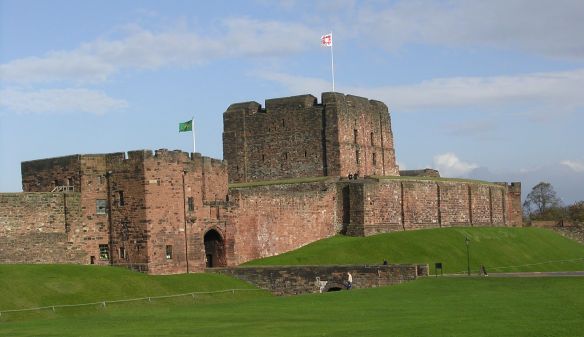
castleAt the onset of the English Civil War the inhabitants of Cumberland and Westmorland can’t be described as being very enthusiastic for war – although they were largely nominally Royalist.  In the North East, the Earl of Newcastle levied a force and roused some stronger feeling although his tenants did, on occasion, simply ignore his warrant.

The Earl, no doubt feeling that the west of the country should be more proactive, appointed Sir Philip as commander-in-chief of the two counties. Sir Philip Musgrave of Edenhall was already a militia colonel and based on the content of a letter in his correspondence had taken steps to act against known parliamentarians in the area – Sir Patrick Curwen of Workington found it expedient for his friends to intercede with Musgrave on his behalf for instance.   He was not very active but the musters he did insist upon were sufficient to irritate Sir John Lowther – who didn’t want Sir Philip to do anything at all. Essentially he felt undertaking the minimum would increase the likelihood of drawing Parliament’s attention on the northwest while Sir Philip hoped that doing very little would ensure that Newcastle  would stay on the opposite side of the Pennines.  Somewhat bizarrely Musgrave and Lowther engaged on a long drawn out feud over who had the right of the matter which involved several of Cumberland’s leading families including the Dacres who resisted Musgrave’s command.

julia musgraveSir Philip was the son of Sir Richard Musgrave, the 1st baronet of Hartley Castle. Sir Richard died in 1615 when his son was just eight.  His career trajectory followed that of many of other gentleman of the period.  He was educated at Trinity College Oxford and then was found a suitable wife- Julia Hutton- from within his own county.  He became the Deputy Lieutenant for both Westmorland and Cumberland.  In 1642 he was made a commissioner for array – that is to say he was responsible for raising Cumberland’s levy of soldiers for the king. There were problems over the exact nature of his commission from Newcastle and assorted feuds to contend with.  However, by 1644 he was able to supply a force to join with Prince Rupert’s army.

Things changed in 1644 because of the intervention of the Scots. On one hand York was captured by Parliament thus causing royalists to come north and secondly Carlisle now stood in danger of capture.  When the city finally fell to Parliament Edenhall had been damaged and Sir Philip had to ride south with a royalist troop to join with the king. At the battle of Rowton heath in September 1645 Sir Philip was injured and subsequently captured.  Records indicate he was sent to York and from there to Pontefract.  Meanwhile his lands were sequestrated.

Sequestration was a means by which that Parliament was able to fine Royalists and confiscate their goods.  Sir Philip’s belonging were valued at £308 in the spring of 1643.  Not only were his cattle and sheep assessed but a figure was also attached to the bees in the hives on his land.

Musgrave was released at the end of 1645 and he went to Newcastle. From there he finally made his way home the following year.  Suffice it to say, Musgrave was loyal to the Stewarts and became involved in the 1648 rising in Scotland which resulted in  Musgrave capturing Carlisle on the 29th April. Musgrave before seeking to capture Appleby. Unfortunately for Musgrave Parliament gained the upper hand  before the Duke of Hamilton and his army could take advantage of the way into England.

Rather than face General Lambert Musgrave sued for parliamentary protection which he gained, not that this prevented him from fleeing to France in 1649. As a direct result of this involvement with the so-called Scottish engagers Musgrave’s lands were confiscated in 1651. His wife was required to sue for maintenance, Sir Philip having been excluded from any act of amnesty by the Treason Act which confiscated his land.

Sir Philip did not remain quietly in France.  He negotiated with the Scots, travelled to England and was even offered Governorship of the Isle of Man by the Countess of Derby. In part his apparent freedom to travel around the realm which had declared him traitor resulted from his friendship with Lord Wharton who even lent his son the money to buy the sequestrated estates back. It was however, one step too far when Sir Philip turned up at his newly repurchased estates.  He was arrested  and sent to London where he was charged with various conspiracies against parliament. If he himself was not involved it is probable that one or more of his sons was.  Ultimately Sir Philip was released but not until £2000 bail had been paid and even then Parliament was keen for him to remain outside his home county.

Musgrave returned to Cumberland in 1660 with the Restoration.  He returned to doing what gentry do – being a JP and member of parliament.  He was also the mayor of Carlisle in 1666 having also been its governor and the captain of the castle.

He died in 1678 having fought at the Battle of Marston Moor and the Battle of Worcester. In between times he had fathered seven children, been granted a peerage by Charles II which he never took up and acquired the right to take tolls on cattle passing through Cumberland (of which he did avail himself).

It would have to be said Sir Philip is one of those figures in history that the more you dig around the more that you find – although sadly not a portrait.

Robinson, Gavin. Horses, People and Parliament in the English Civil War: Extracting Resources

https://archive.org/stream/lifeofsirphilipm00burt/lifeofsirphilipm00burt_djvu.txt

http://www.historyofparliamentonline.org/volume/1660-1690/member/musgrave-sir-philip-1607-78