Rather inconveniently I managed to bypass 1st December, and the death of King Henry I on 1 December 1135 – he’s the one who ate too many lampreys. He’d attempted to ensure his only legitimate child, Empress Matilda, would inherit his throne but in the event Matilda’s cousin Stephen nipped across the Channel, secured the treasury and claimed the throne, resulting in the so-called Anarchy.
On 2nd December 1804 there was another coronation. Napoleon crowned himself emperor of France. Pope Pius VII was apparently there to do the job but Napoleon preferred to do the job himself and make a statement about his relationship with the papacy. Most of the medieval crown jewels had been destroyed during the French Revolution including the Charlemagne’s coronation crown which was traditionally used. The monarchy had had several to choose from but they were all gone apart from the crown of Louis XV who ruled from 1643 to 1715. Napoleon had to have a crown made specially for the occasion. Napoleon called his new crown after the original and modelled it on a medieval style. The following year, Napoleon won the Battle of Austerlitz.
In 1546, Henry VIII, who was becoming old and increasingly paranoid about the future security of the Tudor throne, had Henry Howard, Earl of Surrey arrested and sent to the Tower. He had mentored Henry’s son, Henry FitzRoy, but was not a reformer or terribly keen on the new men who were promoted at court – in short he was something of a conservative as was his father the Duke of Norfolk. When Surrey quartered his own arms with those of Edward the Confessor it seemed to the king that Surrey intended to make a claim to the throne through his descent from King Edward I – and that, as they say, was that…Surrey was executed on 27 January 1547. The only reason that his father survived the whole experience was that Henry VIII died in the early hours of 28 January, saving the duke from the block.
Firstly, a very happy new year to everyone who enjoys the History Jar blog and thank you for your continued support. 2023 was something of a quiet year although the page underwent something of an overhaul towards the end of the year. I have further plans for 2024, although I am currently aware of a looming deadline for my fifth book with Pen and Sword! I have offered up the occasional ‘on this day in the past’ but this year it will make a more regular appearance.
On this day Pope Leo X excommunicated Martin Luther whose objections to some of the more corrupt practices of the Catholic Church at the time led to the Protestant Reformation in Europe. Luther’s 95 theses were nailed to the cathedral door at Wittenberg where the monk was a professor in October 1517 – he particularly objected to the sale of indulgences which meant people were able to buy a pardon from various sins. By the time he had refused to recant his views it was 1521.
In April 1521, Luther was called to the Diet of Worms to justify his views. The Holy Roman Emperor, Charles V, declared him an outlaw but Luther found protection from German princes.
King Henry VIII got in on the act when he wrote a paper defending the seven sacraments -known as the Assertio (Assertio Septum Sanctorum) resulting in Henry being given the title Defender of the Faith by the Pope. When Henry split with Rome following his failure to gain an annulment of his marriage from Katherine of Aragon, he kept the title. It should also be noted that Henry, who saw himself as something of a top notch Renaissance Prince on the academic front, may have had a helping hand from his friend Sir Thomas More – Tom found himself in dire trouble in 1534 when he refused to accept Henry as the supreme head of the Church of England or to recognise Henry’s divorce from Katherine granted by the Archbishop of Canterbury in 1533.
Henry’s defence of the papacy had been a best seller for ten years by then and Luther had taken the time in 1522 to write an attack on Henry mocking the Church for needing a defender and pointing out that the English king was totally unqualified at any level to write the riposte to Luther’s objections to the church – not that it ever stopped Henry. Nor did the Tudor monarch appear to notice the irony of leaning more towards Protestantism in 1527 when Pope Clement VII first refused the king his request to annul his marriage.
Elizabeth Denton or Elizabeth Jerningham as she was when she was born was appointed as Lady Governess to the infant Prince Henry in 1491. She also looked after his younger sister Mary until the queen appointed the child’s own lady governess. Elizabeth continued to be a part of Elizabeth of York’s household until the queen’s death on 11 February 1503.
King Henry VIII showed his affection for his former lady governess with gifts of a tun of Gascon wine each year and appointment as keeper, for life, his Coldharbour, one of Lady Margaret Beaufort’s homes, soon after he became king. In 1515 she was granted an annuity of £50 for her service to the Tudors. The gifts led to Philippa Gregory portraying Elizabeth as the first of Henry’s mistresses. It seems unlikely, but not impossible, that Henry would have wanted a former mistress looking after his own daughter! She next appears as Lady Governess in 1516 caring for Mary Tudor. Also, as Amy Licence observes, the suggestion rests wholly on the grants.
Elizabeth’s family was part of the Suffolk gentry but their service to the Tudors saw them rise during Elizabeth’s life time marrying into the Dacre and Stanhope families. She was distantly related by to Anne Stanhope, the wife of Edward Seymour, 1st Duke of Somerset. And her family served the king in other capacities. One of her brothers, Richard Jerningham, was a Gentleman of the Chamber and is recorded as being sent to Germany in 1511 to buy armour on Henry’s behalf.
So who was Elizabeth Denton?
She was the daughter of Sir John Jerningham of Somerleyton Hall near Lowestoft in Suffolk who died in 1474 and his wife Agnes Darell. (Image from https://www.somerleyton.co.uk) Her half-brother, Edward[i], inherited the bulk of his father’s estate but under the terms of Sir John’s will, upon the death of her brother Osberne, she was to inherit the manor of ‘Little Worlingham with all the commodities etc. within the towns of Little Worlingham, Cove, Ellough and Great Worlingham . . . and in default to Elizabeth Denton, my daughter, for life, and after to Walter Denton, her son for life, and after to be sold.’ The date indicates that she was significantly older than Henry – so unlikely to be mistress material for a man who was known to like a younger woman.
Elizabeth was married before she entered royal service, potentially to John Denton, but very little is known about her family except that she had a son called Walter. By 1515 she was a widow and was granted an annuity by Henry who continued to be fond of her. Elizabeth recognised that her time was running out. She had become a tenant at Blackfriar’s Priory and erected a tomb for herself there. Her will, dated April 26 1518 stipulated that she was to be buried near the staned glass window which featured St Thomas Aquinas. She ensured her last resting place with gifts to the monastic community:
To the Prior 20s. to the Sub-prior 10s. to Frier Simond 20s. to Frier De la hay, 10s. to every other Firer of the said Place, that is a Priest, and shall be within the said Place at the time of my burying, 2s. To every of the Novices of the same Place 12d. To the intent of the same Prior, etc, shall pray for the Soul of my late Husband, my Soul, and all Christen Souls. (John Strype’s Survey of London and Lady Elizabeth Denton’s will Guildhall Labrary S 9171/15 f/108v.)
The content of the will is conventional and it is perhaps not surprising that Elizabeth Denton was a pious woman given the piety of Lady Margaret Beaufort. Her eldest brother’s family continued in their Catholic beliefs after Elizabeth I ascended the throne and chose to emigrate to America rather than conform.
Licence, Amy, The Six Wives and Many Mistresses of Henry VIII. (p.XLII)
Suckling, Alfred, The History and Antiquities of the County of Suffolk, (London: John Weale, 1846), Vol. I,
Weir, Alison, Elizabeth of York
[i] Richardson, Douglas, Magna Carta Ancestry, 2nd ed., 2011, Vol. I, p. 512; Druery, John Henry, Historical Notices of Great Yarmouth, (London: Nicholas & Son, 1826), p. 17
Since we’ve tackled a roast peacock it makes sense to look at the roasted swan – which like the peacock would often be served in all it’s feathers along with a yellow pepper sauce and a side helping fo food poisoning as the skin, with the feathers attached wasn’t cooked. It appeared on the tables from medieval times and is listed in the accounts of Henry VIII’s and Elizabeth I’s feasts. They have, of course, been royal property since 1482.
Liber Cure Cocorum (or “The Art of Cookery” ) written in 1430 has a recipe for “Chaudron [Entrails] for wild ducks, swans, and pigs.” Please don’t try it at home given that bird flu is on the increase and all the swans belong to the Queen.
Take, wash the entrails of swans anon, And scour the guts with salt each one; Seethe all together and hew it small, The flesh and also the guts withal; Take galingale and good ginger And cinnamon, and grind them all together; And grated bread you take thereto, And mix it up with broth also; Color it with burned bread or with blood, Season it with vinegar, a little for good; Boil all together in a little pot; In service you shall set it forth.
If you must eat swan then could I suggest a meringue swan?
Edward Stafford the third Duke of Buckingham really should have known about the dangers of irritating monarchs. His father the second duke was executed by Richard III and Edward a mere child of five was forced to flee into hiding having been dressed by his mother Katherine Woodville as a girl.
The problem was that Edward was descended thrice over from Edward III despite the fact that his mother was Katherine Woodville. The Stafford family had been around for centuries whereas the Tudors were Johnny-Come-Late-lies. This was so much the case that after the death of Prince Arthur in 1502 it was suggested in some quarters that the Duke of Buckingham might make an appropriate monarch. Not only was Edward a Plantagenet with clear and legitimate lines of descent but he had also benefitted from a royal upbringing having been made a ward of Margaret Beaufort.
Seven years later when Edward discovered that his sister had become the king’s mistress he was absolutely furious. He believed that his family was far to important for Anne to be the mistress of a mere Tudor, a marked contrast to the Duke of Norfolk who would spend most of his political career from the 1520s onwards dangling Howard girls under Henry’s nose.
Buckingham knew how the court worked under Henry VII – a man not admired for his lack of mistresses and had failed to notice that whilst the Plantagenets were first amongst equals – in a country where rulers appointed men to effectively rule their own regions that the Tudors centralised and appointed administrators – that they were absolute rulers for want of a better description.
Henry VII sought to use Edward’s Plantagenet blood in the marriage market when he suggested a marriage with Anne of Brittany but avarice won out when the Earl Northumberland offered the king £4000 for Edward to marry his daughter Eleanor. By 1509 Edward Stafford had claimed the hereditary right of being Lord High Constable and was on Henry VIII’s newly appointed council having performed in a series of diplomatic and high status court roles.
Buckingham’s sense of self worth was probably reinforced when he received a licence to crenelate, i.e. to fortify a property. He was treading the path of the fifteenth century over mighty subject who ruled his own domain. He had failed to spot that his second cousin Henry VIII granted favours to his friends but woe betide them if they didn’t play by his rules.
Thus when Edward heard from Anne’s sister Elizabeth that Anne was conducting an affair with the king he thought that there would be no repercussions when he summoned his brother-in-law and removed Anne to a nunnery some sixty miles from court. Even worse the affair became common knowledge. Queen Katherine who was pregnant became very upset and Henry was embarrassed. Anne would return to court and the affair probably continued for another few years if Henry’s New Year’s gift list is anything to go by. However, the damage was done – Henry knew how to carry a grudge.
In 1520 Buckingham was suspected of treason. It had become clear that Katherine of Aragon was not as fertile as her mother. A child, Mary, had been born the pervious year but it was unthinkable that a girl might inherit – the Tudors were in danger of dying out. Edward Stafford was the man, so he said, to take up the Crown – Henry personally interviewed the witnesses. In April 1521 he was packed off to the Tower for imagining the death of the king and executed on the 17th May. The evidence was flimsy.
The History Jar’s previous post showed that James’ witchcraft trials were no respecter of rank, although it is telling that Francis Stuart survived the encounter. When James became king of England as well as Scotland he carried his interest in witches with him- not that trials were a new phenomena- between 1560 and 1701 there were 279 trials for witchcraft in Essex and those are only the ones that made it into the record books.
Like James, Henry VIII had thought that witches were plotting against him. And let’s not forget the rumour concerning Anne Boleyn. It was suggested that she carried the “devil’s mark” in the form of a mark on her neck and in the existence of a sixth finger on her right hand. Elizabeth introduced a law against witches in 1563. James was simply able to dust the law down and remind folk that practising witchcraft and consulting with them was an offence punishable by death.
Probably the most famous English case during the reign of James I was that, in 1612, of the Pendle Witches where three generations of one family found themselves on the wrong end of the swimming test (that’s the one where if you sink and drown you’re not a witch but if you bob to the top of the water having had your hands tied to your feet then you were a witch and having been hauled out and dried off could be burned.) To be honest it’s the case that springs to mind when thinking about Jacobean witch trials. Yet, in Scotland between 1603 and 1624 there were approximately 420 witchcraft trials a year which is a lot of elderly crones when all is said and done, even if only half of them were executed.
There were many fewer trials in England, Notestein suggests somewhere between forty and fifty, but they did tend to have a much higher profile and were mostly at the start of James’ reign. Take for example the scandalous affair of Francis Howard, Countess of Somerset and the murder of Sir Thomas Overbury in the Tower. Francis was said to have gained poisons from her friend Anne Turner who had a reputation for being a wise woman and it it was discovered had associated with Simon Forman who had predicted his own death. Even worse, if possible, Cunning Mary (a name with which to conjure) told the court that Francis had promised her a £1000. Anne was executed for her part in the murder whilst Francis who pleaded guilty was quietly pardoned and released.
Other notable cases were as follows:
1606
Royston in Hertfordshire, Joanna Harrison was found to have in her possession the bones of a man and a woman. Her property was searched after she made a man ill simply by looking at him.
1607
The Bakewell Witches demonstrates that it paid not to get on the wrong side of anyone. “A Scotchman staying at a lodging-house in Bakewell fell in debt to his landlady, who retained some of his clothes as security. He went to London, concealed himself in a cellar, and was there found by a watchman, who arrested him for being in an unoccupied house with felonious intent. He professed to be dazed and declared that he was at Bakewell in Derbyshire at three o’clock that morning. He explained it by the fact that he had repeated certain words which he had heard his lodging-house keeper and her sister say. The judge was amazed, the man’s depositions were taken down, and he was sent to the justices of Derby.” The writer (Wallace Notestein) added that there was little evidence for this but that a number of women were hanged in Bakewell on charges of witchcraft at this time.
1612
Witches discovered in Northamptonshire. Eight women were accused of torturing a man and his sister as well as causing lameness in the neighbourhood. One of them Agnes Brown had a wart that was taken to be the devil’s mark. She and her daughter already had a dubious reputation. Another was suspected because a child looked at her in church and when he got home went into convulsions.
Arthur Bill and his parents were accused of bewitching Martha Aspine.
The Pendle witch trials which was essentially two families at feud with one another. Sixteen women found themselves locked up in Lancaster Castle on witchcraft charges.
1613
In Bedford Mother Sutton and her daughter,Mary, fell foul of the local landowner who was called Enger. Enger claimed that on moonlit nights Mary was in the habit of manifesting herself at his side. She would sit and knit and tell him that if he agreed her terms that he would be restored to full health.
1616
The Leicester witch hangings. A boy had fits and claimed that they were caused by witches. As a result nine women were executed and six more were saved by James who was on progress and found that the boy was lying.
1618
The Earl of Rutland claimed that both his sons had been killed by witches. The Belvoir witches were tried in Lincoln. Joan Flower and her two daughters were dismissed from Belvoir Castle and when the second of the earl’s sons died it was realised that not only had he been killed by witchcraft but so had his sibling who had died several years earlier. It should be noted that Joan and her daughters had been dismissed some five years before the boy died. I’ve posted about the death of the earl’s sons earlier. https://thehistoryjar.com/2018/01/20/witchcraft-scandal-and-the-duke-of-buckingham/
1620
The saw called Bilston Boy case. Essentially thirteen year old William Perry craved attention and got it by having fits. He accused Jane Clarke of causing the fits and the case went to trial. It was only thanks to a very perceptive bishop that Jane didn’t hang.
1622
The Fairfax case in York saw six women accused on the testimony of children.
Notestein, Wallace (1909) A History of Witchcraft in England from 1558 to 1718.
If you’re thinking of coming to Gloriana a life in pictures there are still a few places available. Please let me know if you’re a regular and would like to attend.
Elizabeth is most usually depicted in costumes laden with symbolism but when she made her first appearance on the political stage in September 1533 shortly after her brith on the 7th of that month she was paraded as a naked babe in arms by her proud father for the benefit of Europe’s ambassadors.
Ann Boleyn had retired for her confinement in Greenwich Palace in August 1533. The room with its fastened windows and tapestry heavy walls must have seemed close and airless. Henry had been promised a son but the child who was born at 3pm on the 7th was a girl. Henry was swift to say that boys would follow – Elizabeth appeared to be a healthy infant and this particular father knew that many babies didn’t arrive safely in the world so he made the best of a bad bargain.
She was baptised when she was three days old at Greenwich in the Church of the Observant Friars. An account of the baptism may be found in Henry VIII’s letters and papers for 1533:
the Childe was brought to the hall, and then every man set forward: first, the Cittizens two and two; then Gentlemen, Esquires, and Chap-laines ; next after them the Aldermen, and the Maior alone; and next the Kinges Counsell; then the Kinges Chappel in coaps; then Barons, Bishops, Earles, the Earle of Essex bearing the covered basons gilt; after him the Marques of Excester with a taper of virgin wax; -next him the Marques Dorset bearing the salt; behind him the Lady Mary of Norfolke bearing the crisome, which was very rich of pearle and stone. The old Dutches of Norfolke bare the Childe in a mantle of purple velvet, with a long traine furred with ermine. The Duke of Norfoike with his marshal’s rod went on the right hand of the saide Dutchesse; and the Duke of Suffbike on the left hand ; and before them went Officers of Armes ; the Countesse of Kent bare the long traine of the Childes mantle; and meane betweene the Childe and the Countesse of Kent went the Earle of Wilshire and tlie Earle of Darby on either side, supporting the said traine in the middest: over the Childe was borne a rich canapie, by the Lord Rochford, the Lord Hussey, the Lord William Howard, and the Lord Thomas Howard the elder. After the Childe, followed many Ladies and Gentlewomen.
Lettice Knollys was the daughter of Catherine Carey – meaning that she was probably the granddaughter of Henry VIII as her grandmother was Mary Boleyn. She was born on the 8th November 1543. She married three times; first to Sir Walter Devereux who became the First Earl of Essex; second to Robert Dudley Earl of Leicester and thirdly to Sir Christopher Blount.
During the reign of Mary Tudor Lettice’s mother and father travelled to continental Europe because they were sincere protestants. Elizabeth sent her cousin Catherine a letter signed “broken hearted” when she learned of her departure. We do not know if Lettice travelled with her parents. Two years after Elizabeth became queen Lettice married Walter Devereux, then Viscount Hereford. They had five children:
Penelope was born in 1563 and Dorothy in 1564. Lettice went on to have three sons: Robert, Walter and Francis. Today’s post is about Dorothy and tomorrow I shall be posting about Penelope because of the portrait pictured at the start of the post which I love and is believed to be of Penelope and Dorothy. It can be found at Longleat House.
Dorothy was married first, in 1583, to Sir Thomas Perrot – which makes it all a bit family orientated as Sir Thomas’s father John claimed to be one of Henry VIII’s illegitimate children (click on the link to open a pervious post about Sir John Perrot in a new window.) Sir John was not one of Elizabeth I’s most favourite people even though he did claim close kinship with her. He found himself in the Tower on charges of treason during her reign. It is perhaps because of Sir John that Dorothy failed to ask Elizabeth I for permission to marry, which as one of her ladies-in-waiting she should have done and preferred, instead to elope with Penelope’s help. Alternatively it might perhaps of been that Dorothy’s hand was being settled by Robert Dudley who in 1582 had tried to arrange her marriage to his nephew Sir Philip Sidney. Either way, Elizabeth was not amused and probably even less so when she learned of the circumstances of the wedding.
The marriage took place at Sir Henry Coke’s house in Broxbourne. Coke was one of Dorothy’s guardians. He did not connive at the wedding. For most of the service Sir Henry’s servants were trying to break down the chapel door whilst the vicar was assaulted for arguing that the correct procedures had not been followed. He was eventually told that John Alymer the Bishop of London had granted a licence. This information would get him into trouble with Elizabeth. The historian Robert Lacey places the blame for this highly irregular marriage on the inadequacies of Lettice’s and Walter’s marriage rather than Dorothy accepting her allotted role of chattel being sold to the most powerful bidder.
Dorothy was banished from court and Thomas found himself in the Fleet Prison. There was also the small matter of William Cecil trying to have the marriage annulled. However, despite the chapel door being battered there were six witnesses and a proper priest on hand. In 1587 Dorothy’s brother Robert used his growing influence with the queen to try and return Dorothy to court during a visit by Elizabeth to one of Robert’s homes. This was not particularly successful as the queen was unamused to find Dorothy in residence. Dorothy had to stay in her room. Unfortunately Sir Walter Raleigh, who was also a guest, became involved and there was rather a loud argument resulting in Dorothy leaving in the middle of the night. It was only after Sir Thomas’s death that Dorothy was allowed back to court. By then she was the mother of four daughters: Penelope, Dorothy, Elizabeth and Ann
Dorothy then married the 9th Earl of Northumberland – Henry Percy- the so-called Wizard Earl. This particular earl would find himself involved in the Gun Powder Plot in 1605. He and his wife were not happily married despite the fact that Elizabeth I had approved of Dorothy’s second marriage. The pair separated in 1599. It is perhaps not totally surprising given that the earl had selected his wife based on her potential to have sons. Dorothy did have sons with the earl but they both died young. The couple had only one surviving child, a daughter called…Dorothy.
The separation was not permanent. Realistically the earl needed an heir and Dorothy could not really afford more scandal. Lucy Percy was born circa 1600 and the all important heir to the earldom of Northumberland followed in 1602. A second son arrived in 1604.
In 1605 when Northumberland was implicated in the Gunpowder Plot and sentenced to life in the Tower, Dorothy showed herself to be a loyal wife. She visited her spouse most days. For Dorothy the years of the earl’s imprisonment meant that she was responsible for running the earldom whilst Percy was in charge in name only. Like her first cousin twice removed (I think I’m right given that Catherine Carey and Elizabeth I were officially cousins; Elizabeth and Lettice were first cousins once removed thus Dorothy must have been twice removed) Dorothy was a woman with a brain. Unlike Elizabeth, Dorothy was not always able to act independently and much of her marital difficulty appears to have stemmed from this.
Dorothy died in 1619, two year’s before her husband’s eventual release from the Tower. She is buried in the Percy family vault at Petworth.
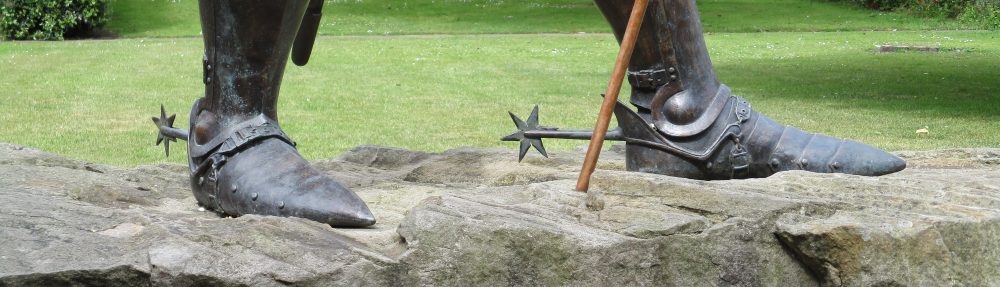
The Battle of the Spurs is also known as the Battle of Guinegate. It took place on August 16 in 1513.
Essentially Henry VIII had a full treasury and wanted to be a traditional monarch which meant going to war in Europe, preferably against the French. He was encouraged in this by the young men of his court who wanted fortune and glory. Polydore Vergil noted that the king was aware of his responsibility to seek military fame – and what better way to do it that to retrieve the Empire. All that remained of Henry V’s campaign victories and the early empire of the medieval kings was Calais and its Pale. This fitted nicely with his father-in-law Ferdinand of Aragon’s military plans.
0n 17 November 1511 Henry signed up to Treaty of Westminster and the Holy League which promised to protect the papacy. The only thing better than fighting the French was to fight the French as part of a holy war – you might describe it as a win-win situation so far as Henry was concerned.
The Holy League was formed by Julius II with the intention of removing the French from Italy – so really and truly it is part of the Italian Wars which began in 1495 and were concluded in 1559. Julius II realised the threat that the French posed and entered into an alliance with the Venetians in 1510. Let us leave the tooings and froings of the European powers aside – suffice it to say that in March 1512 Julius II withdrew the title “Most Christian King” from Louis XII and then gave France to Henry VIII of England. There was the small matter of the French not wanting to hand France over to Henry.
Thomas Grey, Marquess of Dorset arrived in the basque regions with 10,000 men. They marched to Fuenterrabia where the plan was that an Anglo-Spanish force would capture Aquitaine. Thomas Grey was the second marquess and the third son of Thomas Grey the eldest son of Elizabeth Woodville – meaning that our marquess was one of Henry’s half-cousins. The family had a bit of a colourful relationship with the Tudors but now he was sent off to acquire Aquitaine. This suited Ferdinand of Aragon’s (pictured at the start of this paragraph) desire to put the French off invading Northern Spain. He had his eyes on Navarre. The English stayed put until August 1512 during which time Ferdinand didn’t provide the support to capture Aquitaine that he had promised to his son-in-law (which didn’t help Katherine of Aragon’s relationship with her spouse) and also tried to persuade Grey to help him in his campaign in Navarre. Grey refused to deviate from his task.
Whilst all this was going on finances ran low as did food and all I can say is that troops turned to wine and became rather unwell due to lack of food, poor hygiene and bad weather. 3,000 of them caught the bloody flux. They blamed it on foreign food but generally speaking dysentery isn’t caused by garlic or wine. Sir Thomas Knyvet died at this time. Ultimately Grey’s army mutinied and when he arrived home Grey was in the doghouse. Henry considered trying him for dereliction of duty. It can’t have helped that Henry was hardly covered in glory at this point.
Somehow Grey managed to extricate himself and went with Henry the following year on campaign to France. He was at the Siege of Tournai and the Battle of the Spurs. In May 1513 English troops began to arrive in Calais. By then the Emperor Maximilian had joined the Holy Roman League and Louis XII of France was trying to persuade the Scots to attack the English – which ended disastrously for the Scots at Flodden. By the end of June Henry VIII was also in France having been outfitted by Thomas Wolsey who increasingly had the king’s ear at the expense of Katherine of Aragon – whose father had made something of a fool of Henry encouraging him to make an attempt on Aquitaine the previous year with the intent of using him as a distraction for his own ends. Despite that Henry left Katherine as regent during his French campaign and to ensure that there wasn’t any unrest had the Earl of Suffolk executed before he went – and let’s not forget that he was a cousin of sorts as well. Edmund de la Pole was the Yorkist heir. The Earl’s younger brother was in France so escaped Henry’s precautionary executions but it probably didn’t help that he called himself the White Rose.
On 24 July Henry and emperor Maximilian laid siege to Thérouanne. The Duc de Longueville was sent to relieve the town but when the English saw the French cavalry make an attempt to supply the town they chased after it. The French fled – hence the name Battle of the Spurs- suggesting that the French did more fleeing than fighting!
Part of the reason for the French confusion was because Henry Percy, the Fifth Earl of Northumberland appeared with English cavalry in front of the French forces whilst they were also potentially outflanked by English archers.
There was an undignified chase with the French trying to get their men to stop and fight. Henry and the Holy Roman Emperor captured six French standards and the Duc de Longueville. The duc, Louis d’Orleans, was packed off back to England where he was ensconced in the Tower. Whilst he was a prisoner he began a relationship with Jane Popincourt, a Frenchwoman who had been in the household of Elizabeth of York, who is also alleged to have been one of Henry VIII’s mistresses. Certainly when all the shouting was over and Henry’s sister Mary Tudor was married off to the aged Louis XII he struck Jane’s name from a list of women in Mary’s household. When Jane did eventually go to France to join Longueville, Henry gave her £100 which might have been for loyalty to Elizabeth of York, might have been for tutoring the Tudor children in French and it might have been for other things – unfortunately the accounts don’t give that kind of information.
Really and truly the Battle of the Spurs is not a battle in the truest sense of the word but it did bulk up Henry VIII’s martial reputation and answered what he’d arrived in France for in the first instance – i.e. glory and prestige on a European stage.
Thérouanne surrendered on the 22 August.
Hutchinson, Robert. (2012) Young Henry: The Rise of Henry VIII. London: Orion Books
Weir, Alison. (2001) Henry VIII: King and Court. London: Jonathan Cape
I recently purchased James Moore’s The Tudor Murder Files. It’s published by Pen and Sword. It turns out that under Henry VIII there were something in the region of 72,000 executions – which is a rather eye watering figure. Clearly there were assorted bigwigs including as Sir Thomas More, Thomas Cromwell, Anne Boleyn and Katherine Howard but there were also thousands of nameless men and women such as those who were executed by the Duke of Norfolk during the period of martial law following on form the Pilgrimage of Grace in 1536-which has just reminded me of another victim of Henry VIII’s famous Tudor tantrums – Robert Aske. Which brings as neatly to today’s post having mentioned beheading and hanging it’s time to move on to being boiled alive.
In Europe the practise of boiling people either in water, oil or tar (anything that got hot and unpleasant basically) continued into much more recent times. In 1531 the Act of Poisoning was enshrined in English law. It came about because a cook called Richard Roose or Rouse was found guilty of murdering two people with broth. Roose is mentioned by name in the act. The act made the crime of poisoning that of petty treason. Petty treason, just in case you were wondering, is when a subordinate (wife or servant) kills or betrays their superior (husband or master). After Roose met his unfortunate end a maid servant was boiled in King’s Lynn for poisoning her mistress and in March 1542 Margaret Davie was boiled at Smithfield for poisoning three households.
Richard Roose was a cook for the Bishop of Rochester – John Fisher (pictured at the start of this post)- the man who had been Margaret Beaufort’s confessor and who wrote her biography. In 1509 he had led the funeral of Henry VII and had tutored Henry VIII in theology. He was regarded as one of the most learned theologians in the Western world which was fine whilst he and Henry VIII were in agreement. In short, he was a very important person until he sided with Katherine of Aragon against Henry in Henry’s Great Matter. In 1527 Henry told Fisher that his conscience was tormented by concerns over Leviticus and Deuteronomy as to whether he was legally married to Katherine. Fisher, not taking the hint, went off and had a conflab with assorted theologians and got back to Henry with the “good news” that he had nothing to worry about. Henry presumably took a deep breath then went off to consult with theologians that Fisher hadn’t thought to ask.
1529, Fisher expressed his views very clearly at the Legatine Court about marriage and Anne Boleyn. He was Katherine’s advocate. This was not at all what Henry wanted.
Fisher found himself briefly imprisoned for resisting the reformation of the clergy and the legal strategy that Cromwell was using to exert pressure on Rome. It didn’t stop him from writing several books in support of Katherine of Aragon. By 1531 Bishop Fisher must have been feeling very uncomfortable indeed. Not only did he resist attempts to limit clerical power but Henry made it very clear that he would throw the bishop into the river if he didn’t start behaving himself.
On the 18th February 1531 the sixteen or so gentlemen who had shared Bishop Fisher’s meal became unwell. One of them by the name of Curwen died. The beggars who gathered at Lambeth for alms – the leftovers- also became unwell. One, a widow called Alice Trypptt died. The soup, or pottage as it was called, was dodgy. The only man who didn’t succumb to food poisoning was Bishop Fisher who hadn’t fancied the soup. Other sources suggest that Fisher wasn’t even present in Lambeth at the time.
The Venetian Archives contains a report about Richard Roose’s interrogation and confession. He admitted having put a “powder” in the soup for a bit of fun. He thought that the powder was a laxative (a man with a strange sense of humour).
At Henry’s insistence rather than being tried for murder in the usual fashion Roose was put on trial for treason as though Fisher was a member of the royal family. What this meant was that there was no jury to hear the case, the verdict being a summary one. The Imperial Ambassador, Chapuys, noted that Roose did not say where the powder came from in the first place. Chapuys hesitated to blame Henry VIII himself for dishing out powders to get rid of troublesome priests but did suggest that the Boleyn family might have something to do with it – and let’s remember he wasn’t Anne’s greatest fan. Thomas More reported the rumour that the Boleyn’s were involved to Henry VIII who was signally unamused by the suggestion. It should be noted that neither Chapuys or More presented any evidence. Henry is said to have commented that Anne Boleyn was blamed for everything.
It should be added that Fisher had another near miss involving a canon ball that landed in his study. It appears that the canon which fired the aforementioned cannonball was sited in the home of Thomas Boleyn. In October 1531 Anne Boleyn sent Fisher a message warning him not to attend parliament. She noted that he would not get sick again.
On the 5th April The Chronicle of Greyfriars reported Roose’s end along with the mechanics of execution which as based on a rope and pulley system which lifted him in and out of the water. Another chronicle noted that there was a lot of yelling and that those people not sickened by the sight felt that the axeman was a more edifying sight. Roose died without benefit of the clergy.
Hindsight is a wonderful thing but up until this point Henry wasn’t known for executing people willy-nilly he hadn’t got to the point where he was lopping off heads to get the wife he wanted so either he had something to hide and was getting rid of the accomplice in plain sight or he really was deeply concerned about household staff with small bottles labelled with skulls and crossbones getting rid of their employers. Let’s just remember the that the Tudors had a thing about anyone mentioning that they might die – so fear of being poisoned probably would produce alarm and brand new nasty punishments.
Poor Fisher found himself in ever increasing difficulties. In 1534 he was imprisoned for not reporting everything about the Maid of Ken (Elizabeth Barton). And then he refused to take the Oath of Supremacy. On 22 June 1535 Fisher became one of the 72,000 execution victims of Henry VIII. When he emerged from the Tower he was gaunt and badly nourished. This probably demonstrates more effectively than anything that Henry had no need to send henchmen to skulk down dark alleys with little bottles decorated by skulls and crossbones. Henry and Cromwell knew how to use the law to intimidate and then silence Henry’s critics without legally getting their hands dirty.
Boiling people was removed from the statute books in 1547 during the reign of Edward VI although Moore dies note that there was at least one execution of this kind during the reign of Elizabeth I.
Moore, James. (2016) The Tudor Murder Files. Barnsley: Pen and Sword


 Edward Stafford the third Duke of Buckingham really should have known about the dangers of irritating monarchs. His father the second duke was executed by Richard III and Edward a mere child of five was forced to flee into hiding having been dressed by his mother Katherine Woodville as a girl.
 The History Jar’s previous post showed that James’ witchcraft trials were no respecter of rank, although it is telling that Francis Stuart survived the encounter. When James became king of England as well as Scotland he carried his interest in witches with him- not that trials were a new phenomena- between 1560 and 1701 there were 279 trials for witchcraft in Essex and those are only the ones that made it into the record books.
 Elizabeth is most usually depicted in costumes laden with symbolism but when she made her first appearance on the political stage in September 1533 shortly after her brith on the 7th of that month she was paraded as a naked babe in arms by her proud father for the benefit of Europe’s ambassadors.
 Lettice Knollys was the daughter of Catherine Carey – meaning that she was probably the granddaughter of Henry VIII as her grandmother was Mary Boleyn. She was born on the 8th November 1543. She married three times; first to Sir Walter Devereux who became the First Earl of Essex; second to Robert Dudley Earl of Leicester and thirdly to Sir Christopher Blount.
 The Battle of the Spurs is also known as the Battle of Guinegate. It took place on August 16 in 1513.
 The Holy League was formed by Julius II with the intention of removing the French from Italy – so really and truly it is part of the Italian Wars which began in 1495 and were concluded in 1559. Julius II realised the threat that the French posed and entered into an alliance with the Venetians in 1510. Let us leave the tooings and froings of the European powers aside – suffice it to say that in March 1512 Julius II withdrew the title “Most Christian King” from Louis XII and then gave France to Henry VIII of England. There was the small matter of the French not wanting to hand France over to Henry.
 Thomas Grey, Marquess of Dorset arrived in the basque regions with 10,000 men. They marched to Fuenterrabia where the plan was that an Anglo-Spanish force would capture Aquitaine. Thomas Grey was the second marquess and the third son of Thomas Grey the eldest son of Elizabeth Woodville – meaning that our marquess was one of Henry’s half-cousins. The family had a bit of a colourful relationship with the Tudors but now he was sent off to acquire Aquitaine. This suited Ferdinand of Aragon’s (pictured at the start of this paragraph) desire to put the French off invading Northern Spain. He had his eyes on Navarre. The English stayed put until August 1512 during which time Ferdinand didn’t provide the support to capture Aquitaine that he had promised to his son-in-law (which didn’t help Katherine of Aragon’s relationship with her spouse) and also tried to persuade Grey to help him in his campaign in Navarre. Grey refused to deviate from his task.
 I recently purchased James Moore’s The Tudor Murder Files. It’s published by Pen and Sword. It turns out that under Henry VIII there were something in the region of 72,000 executions – which is a rather eye watering figure. Clearly there were assorted bigwigs including as Sir Thomas More, Thomas Cromwell, Anne Boleyn and Katherine Howard but there were also thousands of nameless men and women such as those who were executed by the Duke of Norfolk during the period of martial law following on form the Pilgrimage of Grace in 1536-which has just reminded me of another victim of Henry VIII’s famous Tudor tantrums – Robert Aske. Which brings as neatly to today’s post having mentioned beheading and hanging it’s time to move on to being boiled alive.