
 Lionel (1338-1368) was Edward III’s second surviving son. He was the one who managed to get himself poisoned by his new -in-laws when he went to Milan – not that anything has ever been definitively proved. So far so straight forward. However, this is where Edward III’s descendants start to become less easy to track and the familial intermarriages more complicated.
Lionel was married in the first instance to Elizabeth de Burgh, Countess of Ulster. It was a marriage designed to provide Lionel with cash. The marriage took place when Lionel was four. Elizabeth was nine. And you probably won’t be surprised to discover that Elizabeth was a grand daughter of Henry, the 3rd Earl of Lancaster – so a great great grand daughter of Henry III. Yet another cousin in other words.
There was one child from the marriage – Philippa of Clarence born in 1355. When her mother died in 1363 Philippa became the 5th Countess of Ulster in her own right. Five years later Philippa married Edmund Mortimer 3rd Earl of March in Reading Abbey. Between 1377 and 1388 Philippa now The Countess of March was considered by some sources to be her cousin Richard II’s heir presumptive although Edward III appears to have favoured John of Gaunt’s son Henry of Bolingbroke for this particular position in the hierarchy when it became apparent that he would die before Richard was an adult.
Philippa had four children: first was a daughter Elizabeth Mortimer who was born on 12 February 1371. She died in 1417. She married Sir Henry “Hotspur” Percy and they had two children, Henry Percy, 2nd Earl of Northumberland, and Elizabeth Percy who was married into the Earl of Westmorland’s family in a bid to stem the developing feud between the Percys and the Nevilles. Obviously the Percy and Neville links complicate the family story somewhat but illustrates rather beautifully the familial ties that bound the country’s leading families whether they were on friendly terms or not. Her second husband was Thomas de Camoys, and there was another child Lord Roger de Camoys.
Philippa’s son Roger Mortimer was born in 1374. He became the 4th Earl of March and 6th Earl of Ulster. He became Lord Lieutenant of Ireland on January 24th, 1382 and was killed at the Battle of Kells in 1398. This was not good news for the Mortimer claim to the throne. His heirs were still children. There’s a further tangle in the skein in that he married Eleanor Holland. She was Joan of Kent’s grand daughter. This meant that Richard II was Eleanor’s uncle and her husband’s first cousin once removed. And just to make things that little bit more Plantagenet Eleanor’s mother was Alice FitzAlan, the daughter of the Earl of Arundel. Alice fitzAlan was also descended from Henry III.

If you look at the family tree taken together with the content of the post you will spot that Richard FitzAlan was Eleanor Holland’s Uncle. Philippa Mortimer was some thirty years her husband’s junior.
In the next generation Roger Mortimer and Eleanor’s daughter Ann who isn’t on the family tree will marry yet another cousin – Richard of Conisburgh the son of Edmund of Langley, Duke of York – providing the Yorkists with their claim to the throne via Lionel of Antwerp who was Edmund of Langley’s big brother –
During the reign of Henry IV, Hotspur would revolt against the man he’d helped put on the throne because the Percy’s didn’t get the recognition they felt they deserved from Henry IV for siding with him, they found themselves out of pocket in terms of military expenses sustained on the borders and in Wales in the Glyn Dwr (Glyndower) Rising and to make matters worse when Edmund Mortimer was captured by Owen Glyndower Henry IV refused to pay the ransom. Ultimately this caused Edmund Mortimer to swap sides and for Hotspur to join with his brother-in-law.
No one ever said it was going to be straight forward! On one hand it is relatively straight forward to ascribe a political faction to a person on the other it is more difficult to identify the impact of family dynamics on the decisions taken within a very dysfunctional family and the repercussions of those decisions on the way that extended families related to one another….I don’t know about you but I’m glad I don’t have to work out where they would all sit at a family meal…and we’re still two generations away from the Wars of the Roses.
 In 1415 there were about 78 peel or pele towers in Northumberland. These towers were essentially private fortifications for protection in the event of Scottish raids – or neighbours you didn’t necessarily agree with. The idea was that you could secure your family and portable valuables until it was safe to emerge or help arrived – beacons were kept on the top of the towers which could be lit to summon help and to worn the surrounding countryside of danger.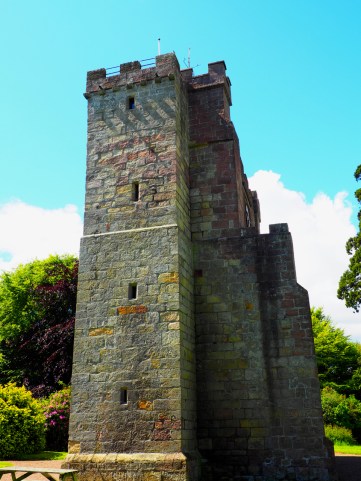
 Warkworth Castle was not always in the hands of the Percy family. It was presented to them in 1332 by Edward III. Our interest today is in the 1st earl of Northumberland who was so created at the coronation of Richard II. The earl’s mother was Mary of Lancaster, a great granddaughter of Henry III. Ultimately the 1st earl sided with his cousin Henry Bolingbroke and helped to topple Richard II from power in 1399. Henry, who had been exiled by Richard II returned to Ravenspur after his father’s death ostensibly to claim the Duchy of Lancaster which Richard had decided to confiscate upon John of Gaunt’s death. Richard II was in Ireland at the time of Henry’s arrival at Ravenspur. Richard returned to England via Wales. He found himself in Conway Castle having a discussion with the Earl of Northumberland and the Archbishop of Canterbury. From there he found himself in the Tower of London, deposed by Parliament on an assortment of charges agains this realm and from there sent to Pontefract where he died- either because he was starved, forgotten about or refused to eat. Henry IV did not see himself as a usurper because legally the throne became vacant when Richard was deposed by Parliament. He had merely stepped up to take the role.
 Now in 1403 the initially pro-Lancastrian Percies needed a reason to turn against Henry IV as they discovered that their courses were not running in parallel. They had initially supported Henry Bolingbroke to regain what was rightfully his but he had then taken matters further and toppled Richard II from the throne – or so they said- demonstrating the History is about stories and that one person’s story is another person’s work of fiction. Having been badly disappointed in Henry IV who had taken what was not his, the Percies now decided that it was only right and proper that they help put Mortimer on the throne.
 The grief-stricken earl of Northumberland made his peace with Henry IV on that occasion but it was not long before he rebelled once again, fled to Scotland with his grandson and finally returned to die at Bramham Moor.
 Eleanor was born in about 1397 to Joan Beaufort and Ralph Neville, 1st earl of Westmorland. Eleanor, like the rest of her sisters, was married off to another cousin – Richard le Despenser- who if you want to be exact was her second cousin. His mother was Constance of York who was the daughter of John of Gaunt’s younger brother Edmund of Langley, Duke of York.
 Jane Seymour, perhaps the original Plain Jane if Chapuys comments are to be believed, became wife number three on 30th May 1536. She was another descendent of Edward III via Hotspur. She’d also been a lady-in-waiting to Catherine of Aragon and also to Anne Boleyn. One story said that Anne was deeply distressed to encounter Jane sitting on Henry’s lap. Her chosen motto was “Bound to serve and obey” – a wise choice given Henry’s complaints about wife number two and presumably wife number one’s implacable logic and argument. Her emblem is the phoenix rising from a tower surrounded by those burgeoning roses reflecting both a Plantagenet and Lancastrian inheritance. The pheonix is a symbol of love and renewal. Jane is the renewed Tudor hope for an heir.

