

Feudalism was the method by which society was structured across the tenth to thirteenth centuries. Essentially the tenant-in-chief was the monarch. William the Conqueror regarded the whole of conquered England as his along with the deer, the boar and the wolves who were owned by no one except God and since God had clearly given William England by right of Conquest then the large beasts which roamed the land must also be his….
The monarch then distributed land or fiefs to his lords – the lands varied in size and location. There was a promise of military and legal protection along with the land. In return the monarch’s tenants, or vassals, promised obedience through an act of homage and payment in the form of military service and/or goods. Sometimes a lord might pay for mercenaries to take his place rather than offering military service himself – this was called scutage. One of the advantages for William was that he was able to call on a large army when he needed one but it was not a standing army which he would be required to pay for – it also ensured that he was able to reward is supporters.
The lords or barons as medieval history tends to term them, who received land from the monarch often had more than they could manage themselves and in different parts of the country. These vassal of the king would sub-let land, manors and estates to their own adherents, the knightly class or less important barons, in return for loyalty, military service and goods. Just as the baron expected protection so the baron’s tenant would expect the lord to protect him militarily and legally as the lord was himself protected by the king.
The knights might in their turn give land to freemen to hold in return for goods and service.
All of the above would be served by peasants who might hold their land in return for labour and a percentage of their crops or by serfs who were tied to the land.
Clearly it was more complicated than this but this is the basic pyramid that we learn at school.

Bastard feudalism was not what a serf might describe the social structure as being (sorry – couldn’t resist.) Bastard feudalism developed during the fourteenth century and was at its most influential during the fifteenth century. This system was different from feudalism in that it was based on a contract that involved much more than land in exchange for service and loyalty. Edward III had the twin problems of the black death and a weakened kingdom thanks to his mother and her lover deposing his father.
Put very simply, the black death meant that there were insufficient villeins/serfs to work the land. Rather than being tied to the manor where they were born or having no choice in how much they were offered for their services, land owners now found that the people who worked their land were valuable commodities that had to be paid for.
Edward III needed the support of his nobility. He did not require another Mortimer situation on his hands. Therefore he gave his nobility more concessions than earlier medieval monarchs had done. This ultimately weakened the crown – again this is putting things at their most straight forward.
Titled noblemen or important members of the gentry (we’ve moved away from barons) developed networks or affinities as a consequence of the greater freedoms that Edward III had been forced to grant them. He also created the “super-noble” in the form of his royal sons who he made dukes. John of Gaunt’s Lancaster Affinity is the most widely signposted example of an affinity. Basically the person at the centre of the affinity created a network of retainers who provided him and his family with military service, domestic service and political and legal support – there was no prerequisite for land to exchange hands- the affinity was superglued into place by extended family – someone who was part of an affinity might reasonably expect an advantageous marriage to be arranged within the affinity either for themselves or their children. In return the network of retainers would expect protection, office, power and money. Bastard feudalism and the widespread use of these powerful networks was once the reason given for the Wars of the Roses – think of the feuds between the Nevilles and the Percys. However, it would be fairer to say that feudalism and bastard feudalism required a strong monarch to control the various factions.
An additional factor in the equation of bastard feudalism and social structure is the Hundred Years War. When the English were winning it was an opportunity for younger sons and those lower down the social ladder to gain wealth which they spent on upping their position within the social hierarchy. Militarily talented men might gain battlefield knighthoods and jump up the social ladder at a stroke but they would need the patronage of someone more powerful if they were to continue their upward journey. Then when the English ultimately lost the Hundred Years War there were powerful nobles who had financed armies and put men in the field who were now looking for political influence. Again, I have presented the case in its most straight forward format.
Year seven pupils (eleven-year-olds) are required to have a grasp of the feudal pyramid as a social structure introduced by William the Conqueror. Clearly social structures were more complicated than this. The Church needs to fit into the equation along with the merchant classes and the impact of a changing economy.
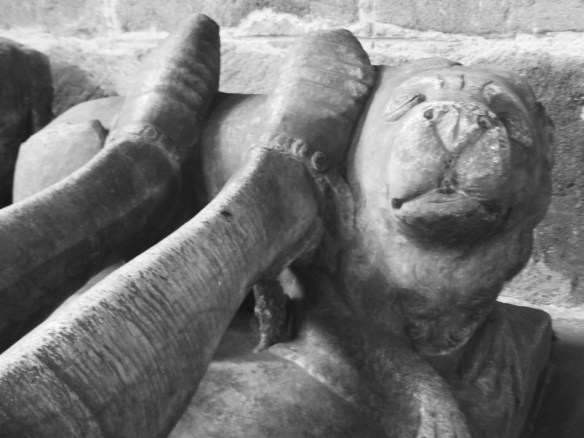
 Edmund Cokayne or Cockayne, depending on the source and your own preference, is buried in St Oswald’s Church, Ashbourne but he lived near Alport at Harthill Hall. His parents were Sir John Cokayne and Cecilia Vernon. Sir John Cokayne was John of Gaunt’s steward for the duke’s estates north of the Trent – so very much part of the Lancaster Affinity. As might be expected the family including Edmund were MPs for Derbyshire.
 I’ve posted before about Henry Vernon being a canny politician. He was ordered to attend Richard III prior to the Battle of Bosworth but there is no evidence for him on the battlefield – on either side. Having been in good odour with Edward IV, the duke of Clarence and the earl of Warwick if the letters in the Rutland Archive are anything to go by it is a little surprising that Sir Henry did so well under the Tudors – In fact a study of a range of Vernon’s letters gives helpful insight into the changing politics of the period – which is exactly what I intend to do in a couple of weeks with my Wars of the Roses group, along with a peek at Sir Henry’s will.
 Sir Thomas Hungerford is generally recognised as the first Speaker of the House of Parliament (Sir Peter de la Mare actually did the job first but no one at the time bothered to give him a job title so technically its Sir Thomas). His family had all represented Parliament for Wiltshire so it is unsurprising that Sir Thomas should have taken the mantle on his shoulders in 1376 having been knighted the previous year – more unexpected, to the modern way of thinking at least, is the fact that he held the constituency of Wiltshire and also Somerset in the parliaments of 1384 and 1389. He was already part of the Lancaster Affinity when he sat in his first parliament. He was an member of parliament during the so-called Bad Parliament of 1377 when he fulfilled the role of Speaker. In all, he would serve as a member of parliament sixteen times.
 John Pole of Hartington (the picture is of Hartington Church) in Derbyshire held some important offices in the Duchy of Lancaster – not least being the steward of the High Peak – which I think you’ll agree is a rather wonderful title as is the title of forester of Crowdecote – another of John’s nice little money spinners. The Crowdecote office came with the purchase of land which appears to have occurred shortly after Pole inherited the family lands in the area. The Parliamentary website also suggests that it was the purchase of the land at Crowdecote which first brought Pole into the orbit of Gaunt’s sphere of influence certainly it was from this time that Pole acquired grazing rights to land in Hartington in the ownership of Gaunt as part of the Duchy of Lancaster (Hartington had been in the hands of the Ferrers family until involvement with de Montford’s rebellion saw his estates ending up in the hands of Edmund of Lancaster).
 John of Gaunt’s estates were huge, including much of Derbyshire. It should not be surprising that Sir John Curson of Kedleston was one of his retainers nor should we be surprised that there was more than one John Curson in the area at the time – one of whom was found guilty of poaching deer from Gaunt’s Duffield’s estate – history is unclear whether it was Curson of Kedleston who went on to redeem the theft of Gaunt’s deer by his good service or another, possibly shadier Curson!
 Before we start and at the risk of telling folk something they already know Scrope is pronounced “Scroop.” The Scrope family is one of the great northern families who arrived with the Conquest and gradually grew in power. They can be found in a number of official capacities down the centuries from the fourteenth century onwards including as Lord Wardens of the Western March. It should be added that like everyone else I’m reading about at the moment Richard Scrope was decidedly chummy with John of Gaunt. Goodman describes him as a mentor to the duke – after all Scrope had campaigned with Edward III since the early days of the Hundred Years War as well as during various Scottish conflicts (p289).
 Testifying for Sir Robert was a little known Welshman called Owen Glyndwr – possibly demonstrating that Fourteenth century Britain was a small place when all was said and done! The depositions were made to establish who used the arms and when – making them a gift for military historians wishing to piece together information about the specifics of a particular campaign. Judgement was eventually handed down in Westminster in Scrope’s favour and Grosvenor chose a new coat of arms which changed the bend or for the Chester wheat sheaf – that particular coat of arms is still used by the very unrural sounding dukes of Westminster. It should be added that the Grosvenor family remembered the loss of their coat of arms and in the 1880’s named a race horse “Bend Or.” It won the Derby.
 Michael De La Pole ( born circa 1331) was created Earl of Suffolk in 1385. It was a meteroric rise to power given that his father was a Hull wool merchant. Of course, there was money involved. Edward III needed a financier and William de la Pole was the man for the job. Unsurprisingly, Michael benefitted from his father’s wealth and influence at the court of Edward III.