

England was not the only place to see its’ peasants revolt during the fourteenth century. The city-state of Florence had similar problems at about the same time.
In 1380, in England, the third poll tax in four years was levied. The poor were required to pay as much as the rich but somehow or other in 1380 there was large-scale tax avoidance.
In March 1381 commissions were sent to exact payment one way or an other – anyone who looked like they were over fifteen was expected to pay.
It wasn’t long before people began to make their feelings on the subject quite plain. By April, a poll tax collector in Oxfordshire was attacked and at the end of April tax collectors in Essex came under fire (of the bow and arrow kind).
30 May men from Fobbing in Essex joined with other protesters from Corringham and Stanford to attack a court in session at Brentwood. Sir Thomas Brampton, the poll tax collector for Essex, was chased out of town. Similar uprisings were reported across the river in Kent.
On 2 June – Bocking in Essex- Rebels swore ‘to destroy divers lieges of the king and his common laws and all lordship’. Sir Robert Belknap the chief justice for Essex and his men are attacked and two of the men are killed as they flee. It was as though someone had lit a touch paper. The rebellion spread through Essex, Hertfordshire, Cambridgeshire and Suffolk. In North Kent the band of rebels swelled with each passing day.
7 June Wat Tyler is elected head of the rebels in Kent and John Ball is rescued from Maidstone prison.
9 June- The peasants march on Canterbury and the following day they ransack the town before beginning their journey to London. Groups of rebels stop at manors to destroy records. It means that the evidence of serfdom is destroyed.
12 June – Men from Kent arrive at Blackheath while rebels from Essex arrive at Mile End. There are approximately 30,000 very cross people on London’s doorstep.
13 June- King Richard II is taken to the Tower of London for safety. Simon of Sudbury and Richard Hales, both important ministers, have gone with him. The king talks to the rebels at St Catherine’s Wharf and War Tyler sends him a letter. The king agrees to meet the rebels at Rotherhithe. When he arrives be barge, he very sensibly refuses to get off, especially when the rebels demand that he have his principal advisors including John of Gaunt, who is on campaign in Scotland, executed.
14 June Wat Tyler and the king meet at Mile End outside London’s city walls. Tyler asks for an end to all feudal services and for pardon for any offences committed during the rebellion. Richard II immediately agrees and Tyler pushes for the execution of corrupt officials. Richard II announces that anyone found guilty by a court of corruption will be punished. He also hands out charters – signed by himself- to be given to serfs- confirming their freedom. The serfs who have got what they wanted clear off home. Inside London, the rebels have a number of supporters – one of them opens the town’s gates and let those that remain inside the city the same afternoon.
14 June pm. Radical rebels attack the Tower of London. The king’s ministers including Simon Sudbury and Robert Hales are murdered by the rebels in a display of summary justice or brutality depending upon your viewpoint. John of Gaunt’s Savoy Palace is burned to the ground – somewhat unfortunately a number of rebels who broke into the Savoy’s cellars, had become drunk and did not make their escape before the fire. The rebels target royal officials, churchmen and also wish to destroy evidence of their serfdom. Also targeted are records of land ownership and any debts.
15 June The mayor of London, William Walworth, raises an army of 5,000 men and Richard II arranges to meet Wat Tyler that evening at Smithfield. Tyler makes more demands including an end to tithes (the taxes that people have to pay to the church), the abolition of bishops (the Church’s equivalent of the barons), redistribution of wealth, equality before the law, and the freedom to kill the animals in the forest – because remember the Forest Laws are still in force.
William Walworth argues with Wat Tyler then stabs and kills him. it could have been nasty but Richard II, who is only 14, calls on the rebels to accept him as their rightful leader and sends them home.
22 June Richard II goes back on his word and cancels the charters that gave the serfs their freedom. On the 28 June the king’s army defeats the rebels at Billericay in Essex. many rebels are captured, tried and executed during the following weeks.
13 July John Ball is captured at Coventry. In addition to preaching that all men should be equal he also argued that the Church exploited the peasants. He and John Wycliff, the writer of the Bible in English, argue that men shouldn’t have to pay for indulgences for the pardon of sins. They also believe that its wrong that the church is as wealthy as it is.
15 July Ball is tried and executed at St Albans.
Government went on much as usual afterwards. The rebels did not target the king. They blamed his bad advisors. The rebel leaders were executed but longer term Parliament did stop trying to control wage increases. Some historians argue that there was no need for the rebellion and that it didn’t achieve much – feudalism was already declining. Others take the view that this was the first rebellion by ordinary people. It saw the first expression by ordinary men and women of the need for representation before taxation. It was also a warning to the rulers who came after Richard II about what a sufficiently disgruntled bunch of ordinary people might be capable of.
A G.C.S. E question worth 8 marks asks students to explain two ways in which the Peasants’ Revolt and the campaign for the People’s Charter were similar. So the next post but one will see us leaping forward 500 years. The next post will be about Froissart’s Chronicle and the illustrations it contains relating to the Peasants’ Revolt. For a start the king looks much older than a teenager and that before we get on to the peasants sneaking across the bridge or the fact that the outskirts of London are remarkably picturesque!
For those of you looking for more about the Peasants Revolt – A Summer of Blood by Dan Jones originally published in 2010 and Juliet Barker’s 1381 are good reads.


 The Black Prince, Edward of Woodstock, did not get married until 1361 when he was thirty. He chose to marry his first cousin once removed – Joan of Kent who was a few years older than him. She had already been married twice before, once bigamously. The pair married and had two children: Edward of Anglôume born in 1365 who died when he was five and Richard of Bordeaux born in 1367.


 The story of the Holland family begins with Robert de Holland from Upholland in Lancashire. He was born about 1283. He was a trusted part of Thomas of Lancaster’s household. He benefitted from being within the Lancaster affinity by acquiring land as well as a wife in the form of Maud de Zouche – a co-heiress.
 Thomas died in December 1360. The following year his widow married her cousin Edward, the Black Prince. The Holland children now had access to patronage with a very heavy clout. Thomas (Joan’s son) gained a wealthy and aristocratic bride from the FitzAlan family. More importantly it was the Hollands’ half-brother, Richard, who ascended the throne after Edward III died in 1377.
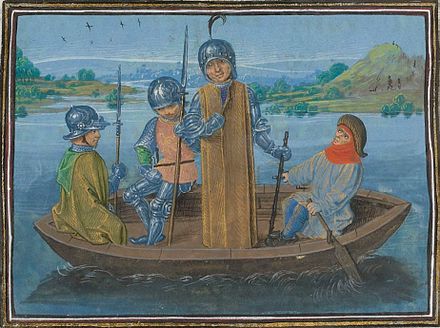
 Thomas’s uncle John (Joan’s second son) was executed at the same time. John Holland had married another wealthy royal cousin, Elizabeth of Lancaster (John of Gaunt’s daughter). This may have been because of the Black Prince’s patronage and it may have been because his mother Joan of Kent got on well with her cousin John of Gaunt. John became Earl of Huntingdon in 1388 and in 1397 became the Duke of Exeter. He was also involved in removing Richard II’s enemies. In John’s case not only had he arrested his uncle Richard FitzAlan (the 11th Earl of Arundel) he has gone to Calais to arrest Thomas of Woodstock, Richard’s youngest Royal uncle. Thomas had died whilst in Calais as pictured in Froissart – the story involves a mattress…
 Let us begin. The earl of Nottingham, Thomas de Mowbray, managed to eventually find his way back into Richard II’s good books by helping to get rid of another Lord Appellant. It is likely that Mowbray helped with the murder of the Duke of Gloucester in 1397 – he had a nasty accident in Calais. As a result of this Richard elevated him from being the Earl of Nottingham to the first Mowbray Duke of Norfolk – so we’ll count him as two lords for the time being given his key titles. It didn’t end well for de Mowbray though as he had an argument with Bolingbroke presumably about killing off co-conspirators. Bolingbroke reported de Mowbray’s comments to the king and there was another argument. They were due to fight a duel in Coventry to resolve the matter but Richard banished them both in 1398. De Mowbray was exiled for life. He died in Venice in 1399 of Plague.
 Henry of Bolingbroke initially got away with his involvement with the Lords Appellant after Richard regained power because of the importance of Henry’s father John of Gaunt. Bolingbroke can also be counted a second time because Richard made him the Duke of Hereford during the lull in proceedings. Upon the death of John of Gaunt Richard changed Henry ‘s sentence to life in exile and he kept John of Gaunt’s land for himself rather than allowing Henry the revenue. It was for this reason that Henry returned to England, ostensibly to reclaim the duchy of Lancaster which had been his father’s. From there it was one short step to becoming Henry IV.