It’s sometimes helpful to see something in a diagrammatic form to make sense of what’s happening. Beginning with the Royal House of Wessex -King Æthelred was married twice. His second wife was Emma of Normandy who was the mother of Edward the Confessor . Æthelred had a brood of sons by his first wife but the one we need to look at is Edmund Ironside who briefly co-ruled England with King Cnut before being murdered in 1016 whilst in the toilet if the chroniclers are to be believed – and for those of you who like the gory details the assassin was given his orders by Edmund’s own brother-in-law Eadric Streona who was possibly one of the least pleasant political figures in English history, which is saying something as there’re plenty of contenders.
Cnut now claimed the whole of England and married the widowed Queen Emma. He may have hoped that Edmund Ironside’s sons Edward and Edmund would be quietly bumped off when he sent them overseas. Edward the Exile as he became known had three children, only two feature on my table. He was invited back to England by his uncle, Edward the Confessor who succeeded King Cnut’s sons Harold Harefoot (the son of Cnut’s hand fasted wife but now’s not the time to go into that) and Harthacnut (the son of Emma.) Edward the Exile died a very short time after landing on English shores and the suspicion is that he was also bumped off – but in a rather more subtle way than his father.
Whilst he was in exile he married Agatha of Hungary. The couple had three children (yes I know there’re only two on the diagram.) The child I’m interested in today is St Margaret. She married Malcolm Canmore after she fled to Scotland following the Conquest. Her daughter Edith married King Henry I, changed her name to Matilda and was the mother of the Empress Matilda. Every monarch since King Henry II has been descended from the Royal House of Wessex.
The descent of Scottish kings is more complex but it is, I think, also true to say that every king since King David I has been descended from the Royal House of Wessex. King David fathered a line that led to the eight-year old Maid of Norway who died after making the sea crossing from Norway to the Orkneys in 1090. There was no direct claimant to the Scottish Crown- but there were very many contenders. The First Interregnum began whilst King Edward I of England looked at the thirteen competitors who had a claim to the Crown. The man Edward chose, John Balliol was descended from King David on his mother’s side of the family tree. The House of Bruce was also descended from King David. Unsurprisingly the Stewarts are also descended from King David. One of Robert II’s ancestors was the base born daughter of William the Lion and another married the daughter of the Earl of Huntingdon – a title which King Henry I of England gave to King David and which he passed on to his son to avoid the complications of vassalage and overlordship
St Margaret’s ancestry – British Library BL Royal 14 B VI
David born in 1080 was a younger son of Malcolm Canmore and St Margaret. After Malcolm died his throne was inherited by his brother Edgar – which did not go down particularly well with their uncle Donald who claimed the crown as Donald III – in Scotland crowns usually moved sideways through siblings before being inherited by sons but Margaret wanted her sons to inherit rather than her brother-in-law or step-sons.
Edgar received some support from William Rufus not least because the Earl of Northumbria was revolting and Uncle Donald and Edgar’s older brother Edmund who supported his uncle’s claim) were supporting the rebellion Robert de Mowbray who was the Earl of Northumbria between 1086-1095. This was a slightly unexpected allegiance as the earl had killed Malcolm Canmore and his son Edward at the Battle of Alnwick in 1091 – if nothing else it says that the complexities of northern politics should Never be underestimated.
Mowbray ended up in prison, without a title and without a wife before being allowed to become a monk. His fellow conspirators had an even less pleasant time, William of eu being blinded and castrated. Rufus having dealt with the rebellion of 1095 helped Edgar to depose his uncle in 1097. Once in power Edgar made a treaty with Magnus Barefoot which saw the scandavians take control of the Western Isles and send his sister Edith off to `England in 1100 to marry the new king – Henry I. In 1107 Edgar died leaving his throne to his brothers Alexander and David.
Alexander ruled the northern half of Scotland and was Henry I’s brother-in-law and son-in-law having married Sybilla of Normandy, one of the English king’s flock of illegitimate daughter. When he died in 1124, his kingdom was inherited by brother David who ruled all of Scotland until his death in 1153.
David ruled the southern half of Scotland. He, aged nine-years, accompanied his sister Edith to the English court and acquired Norman culture and a Norman wife in the form of Matilda of Huntingdon – making the scottish king a man with estates in Northampton and the south of England – which meant he was an English vassal (but only for English lands.) And incidentally King Henry had made him the prince of Cumbria and married him to the widow of an earl of Northumberland to give him a bit more of a punch in the north.
David established a feudal system in Scotland and founded 15 religious houses, including the abbeys at Jedburgh, Kelso and Melrose after he returned to Scotland in 1124. An intensely pious man, it didn’t stop David from invading England on behalf of his niece the Empress Matilda.
In 1138 he came second in the Battle of the Standard – one of only two pitched battles to take place during the Anarchy. The second being the Battle of Lincoln in 1141 but if we’re going to be pedantic about it, David wasn’t really promoting Matilda’s cause, he was aiming at making Scotland that bit bigger – which he did because in 1139 the Treaty of Durham saw King Stephen recognise David as king of an independent Scotland which included Cumberland and Northumbria.
He died on 24 May 1153, in his bed, in Carlisle Castle – which was definitely Scottish at the time.
Carlisle Castle and one of the stranger comments I’ve heard…
Arnulf was a younger son of Roger de Montgomery, Earl of Shrewsbury and Mabel de Bellême. He is associated with the earldom of Pembroke Castle and the founding of Pembroke Priory. His birthdate is usually given as 1066 but there is no exact record. The de Bellêmes were part of the Conqueror’s extended kinship network and although de Montgomery didn’t take part int he Conquest he was in England by 1067 where he was granted extensive land holdings. By 1086 he was a very wealthy man having been rewarded with land in Sussex, including manors which had belonged to King Harold, and Shropshire.
It was in 1086 that Arnulf first made his appearance on the known historical record when he witnessed a grant made by his father to a monastery in Normandy. Arnulf is also in evidence rebelling against William Rufus along with the rest of his family in support of Robert Curthose, the Conqueror’s eldest son. The family did not suffer when the rebellion failed and was soon involved in extending its landholdings and power base by an invasion of Wales- specifically the kingdom of Deheubarth – including modern day Dyfed. He is associated with the capture of Nest of Wales pictured at the start of this post with her lover King Henry I – the crowns are to represent their status rather than to suggest that they retired to bed wearing nothing but headgear.
When Roger died in 1094 he was succeeded by his son Hugh and after his death by Robert de Bellême, who was Arnulf and Hugher’s elder brother. De Bellême and his family supported Robert Curthose’s claim to the English throne against that of Curthose’s younger brother King Henry I in 1102. Arnulf had sent his steward, Gerald of Wales, to Ireland to arrange a marriage contract with Muirchertach Ua Briain of Munster which included military assistance as well as a bride. When the rebellion failed, the Montgomery family were banished from England and Arnulf lost Pembroke and the power that he wielded on the marches between England and Wales. The story of their rebellion and subsequent banishment is recounted by Orderic Vitalis, who quite frankly wasn’t totally impressed by the family then or in earlier times.
Following the banishment of the Montgomeries from English shores Arnulf took himself to Ireland and his father-in-law who had no doubt hoped to benefit from Arnulf’s potential as a trading ally. He spent the next twenty years in either Ireland or Normandy. He died circa 1122 at the latest but maybe as early as 1118.
Arnulf’s daughter, Alice, married Maurice FitzGerald the son of Nest the daughter of King Rhys and Arnulf’s steward Gerald of Windsor.
We have clearly left my start date of 1066 behind – to the tune of some five hundred years – but nothing happens in a vacuum historically speaking: territories and politics evolve.
Hadrian’s Wall marked the border of the Roman Empire but by the fifth century things were looking grim and there was a proliferation of military based kingdoms. The kingdom of Rheged could be found in modern day Cumbria extending into the Eden Valley and Westmorland. It’s ruler Urien or Urbgen can be found in twelfth century Welsh poetry. One of Taliesin’s poems refers to him as the ruler of Aeron which might be Ayr – meaning that on the flimsiest of circumstantial evidence the Romano-British kingdom of Rheged could have extended from Ayrshire south of the Solway. The inhabitants of the kingdom spoke a Celtic language and its rulers were descended from Coel Hen – that’s ‘Old King Cole’ to you and me and I doubt very much whether he was a ‘merry old soul.’ Needless to say there is a lack of paper evidence and after Urien’s death, probably at the hands of one of his own extended kinship network, the kingdom disintegrated and was subsequently incorporated into the kingdoms of Strathclyde and, more definitely, Northumbria.
In the early medieval period, which was the Dark Ages when I was at school, the British kingdom of Strathclyde covered the area, at various times, between the Clyde and as far south as the River Lune in Lancashire. It’s thought that the kingdom derived from a fourth century state that was a buffer zone designed to hold off the Picts from Scotland and the Scots from Ireland (they settled in Argyle).
Bede – The British Library – 12th Century copy of his life of StCuthbert
Now we throw the Angles into the mix. Æthelfirth was the king of Bernicia (think Bamburgh) and of Deira (think East Riding and North Yorkshire). His period in power was 592-616. He was a successful warlord who gained significant territories at this time. It’s likely that Rheged disappeared into his power and that the Lothians also came under his control. The Venerable Bede paints a picture of ravaged Britons. At the same time as Rheged disappeared Strathclyde also faded for a time.
A succeeding king – Edwin of Northumbria- even had an impact on the Isle of Man. Northumbria became the most dominant of the early medieval kingdoms during the seventh century. The territories around it shrank or were subsumed. It was at this point that the Northumbrians probably sought to establish overlordship over the kingdom of Strathclyde which had undergone some shrinkage since the second paragraph of this post. Bede also records that some Britons who lived in Strathclyde looked to the Picts and the Scots for support. Inevitably after the initial bonhomie, the Britons of Strathclyde faced danger on two fronts. In 711 and 717 the people of Strathclyde were defeated by the Scots. The area Bede was describing included Dumbarton, Renfrewshire and Lanarkshire. The Solway probably marked the edge of the kingdom of Strathclyde at that time. And needless to say there was an awful lot of slaying going on. By 750 the Northumbrians had annexed southern Aryshire.
During the 840s Kenneth Mac Alpin united the Scots and the Picts. The royal families of the region formed alliances, intermarried and carried on bumping one another off. The shape of their territories changed and developed according to who was handiest with their army.
St Curthbert’s journey – Durham
And because I like a date to pin these things to – this all happened before 875 (or thereabouts) when Bishop Eardulf of Lindisfarne fled with the body of St Cuthbert as a result of the arrival of the next set of invaders – the Vikings (but that’s a different story and a new post.) As the saints body was kept at Whithorn in Galloway for a while it has been suggested that the area was still part of Northumbria at the time – certainly there were earlier monastic affiliations which meant that the saint was welcome.
Uhtred of Galloway, born in 1128, was the grandson of King Henry I. His mother married to Fergus of Galloway was one of the king’s illegitimate daughters. The alliance on the northern edge of England would have helped to secure the border through an extended kinship network. The same pattern of marriage to strategic border barons and lords can be seen across Henry’s domains. He married one daughter, called Alice, to Matthew of Montmorency. On that occasion the king’s ploy proved ineffective as Matthew later became the Constable of France. Rather than invading and maintaining an army in hostile territory Henry sought to absorb local nobles into a wider affinity of kinship to create a buffer zone. There is also the element of assimilation to consider in the case of Elizabeth Fitzroy, Uhtred, the grandson of a king was part of the Anglo-Norman aristocracy which led to resentment in the border region of Scotland.
As a boy Uhtred was sent to the court of Malcolm IV as a hostage. Malcolm’s mother, Ada or Adeline, was a great-grand daughter of the king. By 1157 Malcom did homage for his possessions in England at Peveril Castle in 1157. At the time Malcolm was granted the earldom of Huntingdon in exchange for Cumberland which he claimed by right of his father and grandfather.
At some point Uhtred married Gunhilda of Dunbar and became a father of a family of five sons and daughters. Through their father they were descended from the Normans and from their mother they were descended from the House of Dunkeld One of his daughters, Christina born about 1170, became the wife of William de Brus, the 3rd Lord of Annandale , making her the two times great grandmother of Robert the Bruce – assuming I’ve counted back up the family tree correctly.
In 1160 Fergus of Galloway died and Uhtred became a co-ruler of Galloway with his brother Gilla Brigte. The fought alongside William the Lion in the Scottish invasion of Northumbria in 1174. The result was a disaster for William the Lion but also for Uhtred. The Galwegians took the opportunity to rebel against the Anglo-Normans. Uhtred’s brother and nephew blinded and castrated him before killing him. Gille Brite took control of all of Galloway and allied himself with Henry II.
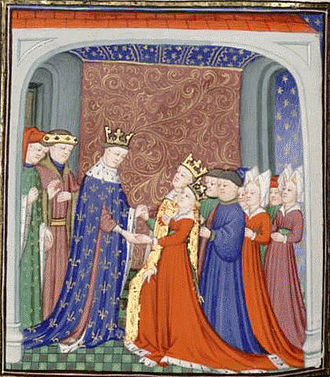
Joan and David being greeted by Philip IV of France
Edward III’s youngest sister was called Joan of the Tower. She died in September 1362 at Hertford Castle four years after her mother died. They were both buried in Greyfriars Church in London. She spent the last years of her life living with her mother Queen Isabella (the one who got the She-wolf nickname thanks to deposing her husband and allegations of red hot pokers.) Edward III mourned for his sister and paid every year to commemorate her passing.
Joan, the daughter of Edward II and Isabella of France was seven when she married the son of Robert I of Scotland. The aim was to bring the Scottish Wars of Independence to a close with a treaty and a royal marriage. For the Scots it was an opportunity to be recognised as independent. In 1328 a border was recognised and negotiations for a royal wedding started in earnest. David was three years younger than Joan so the marriage would not be a true one until David reached the age of fourteen. If the marriage wasn’t consummated then the terms of the treaty were void – the treaty also stipulated that replacements could be founding the event of the death of the happy couple. What could possibly go wrong?
The treaty was signed by the English at Northampton in May 1328, the Scots having already signed it in Edinburgh. Queen Isabella and Roger Mortimer were behind the treaty so perhaps it’s not a surprise that Edward III didn’t hurry north when his mother and sister went to Berwick where the groom was waiting – though his father Robert I was also absent. After the wedding Joan travelled to Scotland with her new family. Joan gained the name ‘make peace’ which wasn’t necessarily complimentary. The treaty was seen as the cowardly option.
It was two years before Edward III was able to take control of his own kingdom. Edward pursued different policies from his mother and her lover. He supported Edward Balliol’s claim to the Scottish kingdom rather than his own brother-in-law’s simply because he wa snot happy at having conceded independence to the Scots and he thought that the Balliol claimant would accept English overlordship. Needless to say Edward III’s interference in Scottish politics had an effect and before long Edward Balliol was king. King David’s forces gathered against Balliol and he was forced to flee to England. In July Edward III took an army north and on the 19 July 1333 fought the Battle of Halidon Hill. Sir Archibald Douglas’s army was defeated. Archibald was the Guardian of the Realm during David’s minority. To cut a long story short Balliol did homage to Edward III and recognised the English as Scottish overlords.
Moving swiftly on – King David and Joan were sent for their own safety to France. Philip IV was Joan’s cousin once removed. There remained there from 1334 until 1341 when Balliol lost power. Unfortunately David did not know how to rule. He had received no training so there was the usual faction fighting. To make matters worse, Edward III was now waging the Hundred Years War and won the Battle of Crecy in August 1346 triggering a Scottish invasion of England thanks to a Franco-Scottish treaty dating from 1295.
On 17 October 1346 the Scots lost the Battle of Neville’s Cross and King David was taken prisoner. He spent the next eleven years in England. Joan’s position was now more difficult than ever. She had insufficient funds. Queen Isabella provided her with clothes. She was effectively a hostage for the safekeeping of David although history knows that a safe conduct was issued for her to visit David at Windsor in 1348.. To make matters worse – if possible- David fell in love with Katherine Mortimer during his captivity. When he was allowed to return to Scotland he took Katherine with her. Joan packed her own bags and came home when she was issued with another safe conduct from her brother. Edward III gave his sister and annual pension.
Gilbert of Sempringham founded the Gilbertine Order. It was the only English founded order and it was also the only one with double houses. Gilbertine nuns followed the Benedictine pattern whilst the monks followed the Augustinian pattern of canons. Not all houses were double but the one at Watton in East Yorkshire was.
The story was recorded by Ailred of Rievaulx in the early 1160s. Essentially the nun in question was an oblate in that she had been in the priory since she was four years old. Interestingly, the Gilbertines had an age requirement for entry to their order – 24 for men and 20 for women. However, our nun gained admittance as a child at the request of the Bishop of York.
The nun became enamoured of either a lay brother or one of the canons. The attraction was reciprocated. They arranged to meet. The inevitable happened. The nun was found to be pregnant. The nun was beaten and imprisoned and when her lover captured she was forced to castrate him herself. He was returned to the male side of the house at Watton and disappears from the story.
However, the nun returned to her prison, was visited by the now deceased archbishop and two women who took the baby leaving the teenage nun in her original state of virtue. At which point she was allowed out of prison – a miracle having occurred.
It would have to be said that the Gilbertines had strict rules about segregating the canons from the nuns. Nonetheless the priory at Watton which was one of the most important Gilbertine Foundations was said to have many secret passages.
Watton was where Marjory Bruce, the eleven year old daughter of Robert the Bruce, was imprisoned by Edward I in 1306. She regained her freedom after the Battle of Bannockburn.
G. Constable, ‘Aelred of Rievaulx and the Nun of Watton: an episode in the early history of the Gilbertine order’, Medieval women, ed. D. Baker, SCH, subsidia, 1 (1978), 205–26
Kenneth III became king of Scotland in 997. He made it into the eleventh century but died in 1005 where upon he was succeeded by a cousin Malcom II who is often identified as Prince of Cumbria, demonstrating that the northern borders between England and Scotland were not as we would recognise them today. He died in 1034 and was succeeded by his grandson – Duncan.
Duncan I signals the start of the reign of the House of Dunkeld. He’d become King of Strathclyde in 1018, again demonstrating that the late tenth – early eleventh century was a time of shifting borders and the amalgamation of kingdoms. King Duncan as all G.C.S.E. students can tell you was bumped off by Macbeth. He became king in 1040 and was succeeded by his step-son who was killed in 1058 when King Duncan’s son took the throne.
Malcolm III is also known as Malcolm Canmore which apparently means “bighead” – there’s not much one can say to that other than to move swiftly on to him marrying a Saxon refugee who promptly became St Margaret of Scotland and filled the court with her Saxon friends and relations making her unpopular with the resident Scots. Malcolm was killed in 1093 near Alnwick – which is the History Jar’s opening gambit on the Anglo-Scots wars that continued intermittently and with varying degrees of ferocity until the beginning of the seventeenth century – not counting the reprise under a different guise in the Civil War in the middle of the century.
St Margaret – Edinburgh Castle chapel
Malcolm was succeeded by his brother Duncan III who usurped the throne from Malcolm’s son which is going to make the Duncan numbering somewhat complex at this point – don’t query it, just accept that in this instance Duncan III comes before Duncan II! He grabbed the throne on 13 November 1093 but was turfed off it by the rightful successor the following year – another Duncan. Malcolm’s son is identified as Duncan II because that’s the correct ordering genealogically. Duncan II having gained the throne promptly died meaning that in a game of musical crowns Duncan III became king once more, ruling north of the Forth/Clyde line whilst his nephew Edmund ruled south of the line. Both Donald and Edmund were deposed in 1097 by King Edgar – and then you wonder why I haven’t ventured into Scottish history very much!
The parents of both Edmund and Edgar were Malcolm and Margaret so at least the Crown stayed in the family. When Edgar died the crown passed to his brother Alexander I. History records him as Alexander the Fierce. He married Sybilla who was one of King Henry I’s illegitimate daughters. The couple appear to have had no children so when he died the throne was passed to yet another brother – David who became King David I in April 1124.
If you recall, the inter-marital links between the royal houses of Scotland and England were strong at this time. Henry I had married one of St Margaret’s daughters – Edith who changed her name to Matilda when she married to fit into the Norman court better. Alexander was married to Edith/Matilda’s step-daughter and David I was married to another member of the royal family – Matilda of Huntingdon who was William the Conqueror’s niece or put another way Henry I’s cousin. By right of his marriage to Matilda, David became the earl of Huntingdon which raises the problem of a Scottish king having to do homage to a king of England for his lands in England. And you can see why politics swiftly became very complicated. Most Scottish kings got out of the bind by swearing very specific allegiance to the king of England for their lands in England “saving their own” i.e Scotland wasn’t part of the deal.
David I ruled Scotland whilst England tore itself apart during The Anarchy. He took advantage of the warfare between Stephen and Matilda to reclaim parts of Cumberland which William Rufus had annexed circa 1092, doing building work on Carlisle Castle and eventually dying there in 1153. He was succeeded by his grandson, another Malcolm.
Malcolm IV is know rather unflatteringly to history as Malcolm the Maiden. He was only eleven when he became king. He died in 1165 and was succeeded by his brother William the Lion. He married into the English royal family as well. His wife Ermengarde was the great-granddaughter of Henry I by descent from yet another illegitimate child of the English king.
Their son became Alexander II in 1214. He also married into the English royal family to cement a treaty of friendship. He married Joan Plantagenet, the legitimate daughter of King John- there are two English Joans, this one and Joan Beaufort so be aware when you’re reading about Queen Joan that there were two of them at different times. They married in York Minster in 1221. Joan was only eleven at the time of the marriage. She seems not to have had a strong position at court where her mother-in-law was the power behind the throne. She ultimately returned home to England. The chronicler Matthew Paris suggests that the royal couple were estranged and it is perhaps fortunate for Alexander that Joan died enabling him to remarry. An annulment would have led at the very least to political difficulties.
Alexander III succeeded his father in 1249. He was only eight at the time and on one occasion during his childhood was kidnapped during a power struggle between two noble families. He married in 1251 another English bride sent north to represent parental interests and keep the peace. Margaret was the daughter of King Henry III of England. Henry III didn’t help things when he tried to make Alexander recognise Henry as his overlord. In 1262 Alexander took charge of his kingdom and got round the overlord thing by swearing loyalty to Henry III “saving my own lands” as in what’s in England I am loyal to you for but what’s in Scotland’s mine! Margaret died in 1275. Unfortunately both the couple’s sons died and their daughter Margaret had married Eric II of Norway following Alexander’s attempt to remove the Scandinavians from the Western Isles.
Alexander remarried to ensure that he had a son but was so keen to see his bride that he rode off into a dark and stormy night. His horse threw him and to make matters worse his granddaughter, known as the Maid of Norway, who now inherited the Scottish crown died on her way from Norway to England. Some sources say seasickness whilst others speculate that it was food poisoning.
Thirteen claimants to the throne now emerged – which was not good news which ever way you looked at it.
Initially the Crown was claimed by the House of Balliol in the person of King John. He was the great-great grandson of King David I. He was chosen to become king of Scotland by King Edward I of England who had been asked to referee the situation. John’s wife, for those of you with enquiring minds, was part of the extended Plantagenet family. The situation gave Edward I an opportunity to promote claims of English overlordship – so King John did not necessarily win friends and influence people with his promotion to the kingship – there were also, of course, many other peeved claimants who cheerfully overlooked that genealogically by right of the first born, it was John who should be king.
Robert de Bruce was the next claimant and his claim was that he was closest to the throne by “proximity of blood.” Or put another way he might have been further away in terms of primogeniture i.e. there were older sibling family lines but he was higher up the family tree e.g. if a son survived then that son should inherit rather than a grandson even if he was the heir of the first born.
To cut a long story short John abdicated in 1296. There was an Interregnum without anyone on the throne. Then Robert Bruce seized the throne.
Robert Bruce became King Robert I. He was succeeded by his son David II in 1328 but was then overthrown in 1332 by Edward Balliol who fancied his chances despite his father having abdicated. David II regained the throne the same year but there was another throne swap in 1333 and 1334 and 1335 and 1336 – think of it as an arm wrestling contest where first one then the other seems stronger – David ruled until 1371 when he died. He had no children so was succeeded by his nephew Robert Stewart.
The House of Stewart in the form of Robert II took the throne in 1371. He died in 1390 having produced many children. His son John became king but to avoid confusion…seriously…became Robert III. His son became James I in 1406 which was unfortunate as he was a prisoner of the English at the time.
James I married Joan Beaufort, the daughter of the Earl of Somerset, granddaughter of John of Gaunt and Katherine Swynford. It was a royal love story. He wrote her a poem and dropped roses out of his window for her to find. When they returned to Scotland James was eventually assassinated and Joan took a bloody vengeance on the men who’d killed her husband.
Their son became James II when he was seven years old. Joan was marginalised after her second marriage. James II was killed on 3rd August 1460 when a canon exploded during the Siege of Roxburgh during an attempt to remove it from English custody. James III was nine years old and was assassinated in his turn in 1488. He was succeeded by his son James IV who married Margaret Tudor the eldest daughter of King Henry VII. James was killed by his royal brother-in-law’s army at the Battle of Flodden on 9th September 1513. His head and body are probably buried in separate locations having been carried back to London – which possibly didn’t help Anglo-Scottish relations very much let alone sibling ones.
James V was just seventeen months old when he became king of Scotland. he ruled until his own death after the Battle of Solway Moss in 1542. He allegedly turned his face to the wall when he heard the news of the Scottish defeat saying of his new born daughter that the crown came with a lassie and would go with one. His demise resulted in the so-called “Rough Wooing” with Henry VIII forcibly attempting to marry off his sister’s granddaughter – the infant Mary Queen of Scots – to his own son Edward. The Scots arranged a marriage with the French dauphin and sent their queen to France where she remained until Francis died and she returned home.
Images of Mary Queen of Scots
Mary , queen from seven days old, married for a second time to Henry Stuart. Henry’s father Matthew Stewart decided he liked the French spelling of the name better for those of you wondering about the difference in spelling – same family – fashionable Matthew. Henry, styled Lord Darnley from birth was the grandson of Margaret Tudor from her second marriage which meant that Mary’s son James who was born on 19th June 1566 had a double dose of Tudor blood. His grandmother Margaret Douglas (Margaret Tudor’s daughter by her second husband) had been born on the English side of the border when Margaret Tudor had fled Scotland – so the Darnley side of the equation were English born and English subjects so not legally debarred from inheriting English titles.
More importantly James VI of Scotland as he became was male, with a direct Tudor bloodline and by 1603 had his own heir and a spare. Following the death of Elizabeth I who died without naming an heir James was invited into England to become James I of England.
Time for a cold compress and a lay down in a darkened room?….
Verso from a manuscript of Froissart’s Chronicle: English fight the Scots led by their king, David Bruce (1341). Bibliotheque Nationale de France, MS Fr. 2643, Folio 97
There were fourteen (ish) landmark battles fought on English soil between 1066 and 1403. I have mentioned a couple of other battles in this post for the sake of neatness.
The two key battles of the Norman Conquest are:
25th September 1066 – the Battle of Stamford Bridge
This saw the defeat of Norwegian king Harald Hardrada by Harold Godwinson. According to legend a Norseman wielding a battle axe held the bridge crossing on his own for half an hour before a Saxon overcame the warrior by the simple expedient of finding his way beneath the bridge without being seen and used his spear to wound the man from below. The English put Hardrada to flight but then had to march from Yorkshire to the south coast. Hardrada and Harold’s brother Tostig who had sided with Hardrada were killed.
14th October 1066 – The Battle of Hastings
There were various skirmishes, sieges and revolts during this period but only two set piece battles. There were no more set piece battles until The Anarchy (1135-1153).
Stephen of Blois became king in 1135. His uncle Henry I had made his barons swear to recognise the rights of his only surviving legitimate child the Empress Matilda but after he died many barons decided that they preferred a king to a queen; Stephen arrived in England first and secured the treasury. Matilda was supported by her half-brother Robert Earl of Gloucester and her uncle David I of Scotland. David also made a claim on Northumberland by right of his wife – Matilda, Countess of Huntingdon who was the daughter of Waltheof of Northumbria. He began his campaign by capturing Carlisle and then advancing to Northumbria via Hexham. Inevitably the Scots and the English clashed.
22nd August 1138 The Battle of the Standard (Northallerton)
Eventually the English were victorious but David still retained control over the north of the country. Carlisle would not become English again until Henry II gained the throne.
2nd February 1141The Battle of Lincoln Stephen had been besieging Lincoln Castle when he received word that Robert of Gloucester and Ranulph of Chester were on their way to raise the siege. Stephen decided to fight and was captured for his pains.
1st July 1143 The Battle of Wilton. Robert of Gloucester attempted to capture King Stephen at Wilton Abbey. It was a surprise attack taking place at sunset. Stephen and his army attempted to break out but were forced back – Stephen escaped under cover of darkness from the abbey which was on fire by that point in proceedings. I’m in two minds about whether this is a key battle or not so have set it in italics – I don’t think it’s a landmark battle, it didn’t change the course of history – although it would have done had Stephen been killed or captured.
The Anarchy involved rather a lot of sieges, skirmishes and pillaging. As with the earlier Normans warfare was more to do with tactics and attrition than a set piece battle unless it was unavoidable. Stephen besieged Matilda in Arundel Castle for instance and again during the Siege of Oxford in 1142, Matilda had to escape over the frozen river in order to reach safety.
Under the Anjevin monarchs there was relative peace until King John proved unable to keep the empire that his father had built up. He resorted to taxation in order to pay mercenary armies in an attempt to regain his continental territories. This might have been acceptable had he been victorious – but he wasn’t. This led to the First Barons’ War (1215-17)
The First Barons’ War is more notable for its sieges than its battles. However, it is worth noting that the revolting barons had invited the French to invade which meant that after the death of King John, Henry III’s regent William Marshal, Earl of Pembroke had restore order and evict them. First he re-issued the Magna Carta which meant that the barons had very little reason to support the French.
20 May 1217 The Second Battle of Lincoln followed by “the Lincoln Fair” – i.e. a spot of pillaging. William Marshal attacked the Count of Perche who was holding the town but not the castle. There may have been 1000 men involved where as the Battle of the Standard involved armies of four and five thousand on each side. This battle is in italics because of the numbers. This was followed by a sea battle – the Battle of Sandwich.
The Second Baron’s War(1264-1267)
Henry III was nine when he became king. Marshal re-issued Magna Carta. Henry’s barons became used to power during his minority and expected more of a say in the way the country was run. Unfortunately when Henry III began ruling for himself he had a tendency to rely on foreign favourites rather than homegrown barons. He also set about trying to win his grandfather’s empire back – it wasn’t a success. Nor for that matter was his attempt to make his brother Richard the King of the Romans or his son Edmund the King of Sicily. All those campaigns required lots of taxation! In 1258 the barons forced Henry to accept the Provisions of Oxford which gave the barons more of a say in the way the kingdom was ruled. This did not go down particularly well with Henry who was a Plantagenet with the usual autocratic tendencies of medieval monarchs. The was a period of instability followed by outright revolt led by Simon de Montfort in 1263.
14th May 1264The Battle of Lewes
Simon de Montfort V Henry III & his son Prince Edward. Henry III narrowly escaped death and fled the battle field before being captured This resulted in a fifteen month imprisonment for Henry and Edward. This allowed de Montfort and the barons to rule under the auspices of Parliament under the Provisions of Oxford.
4th August 1265 Battle of Evesham
Prince Edward eventually escaped with the aid of Gilbert de Clare, Earl of Gloucester. Edward rallied marcher lords, took on de Montfort and won.
There was another battle at Chesterfield on 15 May 1266 to bring the Earl of Derby to heel but it wasn’t on the scale of Lewes or Evesham which is why it is not on the list as a key battle.
First War of Scottish Independence
I did say England but it’s almost impossible not to mention the Battle of Stirling Bridge in 1297 that saw William Wallace defeat the English or the Battle of Bannockburn in 1314 which saw Edward II put to flight by Robert the Bruce. These victories, together with Edward II’s unmartial outlook, allowed the Scots to invade Northumberland and Yorkshire .
20 September 1319 Battle of Myton
The Scots killed some 4000 English when an English army attempted to prevent the Scots from taking York. The Scots did not then take York because Edward II signed a peace treaty.
The Dispenser War (1321-1322)
Various barons including Edward II’s cousin Thomas of Lancaster rebelled against the king because of his reliance upon the Despensers. They weren’t terribly impressed with the way Edward handled the Scots either.
16th March 1322 The Battle of Boroughbridge Thomas was captured and executed.
14th October 1323 The Battle of Byland – Edward II was staying at Rievaulx Abbey when the Scots and the english encountered one another. The English, led by the Earls of Richmond and Pembrokeshire assumed that they would simply prevent the Scots from ascending Sutton Bank and force them to go the long way round. Instead the Scots chose to fight and ultimately Edward II was forced to flee.
Second War of Scottish Independence
King David II was too young to rule after the death of Robert the Bruce. This was the opportunity for Edward III to regain Scotland. He was supported by Scots who had been dispossessed by Robert the Bruce because they had supported the English during the First War of Independence. There were a series of invasions and King David was sent to France for safety. Edward gained the upper hand and there was a truce until David returned from Scotland. The truce was soon in tatters.
19th July 1333 The Battle of Halidon Hill saw Sir Archibald Douglas being defeated by Edward III. The battle was precipitated by Douglas’s attempt to raise the siege on Berwick which was at that time in Scottish hands.
1346 The Battle of Neville’s Cross David II arrived outside Durham, lost the battle and was captured. He spent the next eleven years in the Tower.
19th August 1388 Battle of Otterburn James, Earl of Douglas crossed the border with 6,000 men. Harry Hotspur, son of the Earl of Northumberland was sent to stop them. During the battle the earl was killed but Hotspur was captured. It was a decisive Scottish victory for the Scots despite the death of their general.
14th September 1402 Battle of Homildon Hill something like 22,000 men clashed. The English were once again led by Harry Hotspur but unlike Otterburn this time the English were victorious.
21st July 1403 Battle of Shrewsbury Between Otterburn and Homildon Richard II was deposed by his cousin Henry of Bolingbroke, who became Henry IV. He was initially supported by the Percies but by 1403 they had changed their minds. The earls of Worcester and Northumberland renounced their loyalty to Henry IV saying that he was guilty of perjury. In reality Northumberland was irritated that Henry had taken the Scottish hostages that had been captured at Homildon which Northumberland regarded as Percy profit. Hotspur joined with Owain Glyndwr and the result was the Battle of Shrewsbury. The victory belonged to Henry IV.
Edith or Matilda of Scotland was the wife of Henry I. The couple had four children but only two survived to adulthood – Matilda and William. It was the death of William that ultimately plunged England into a lengthy and rather bloody civil war.
Edith was born circa 1080 in Dunfermline to Malcolm III and Margaret , grand-daughter of King Edmund Ironside and great niece of Edward the Confessor . Somewhat confusingly since Margaret fled England along with her family at the time of the Norman Conquest it turns out that Edith’s godfather was Robert Curthose, the eldest son of William the Conqueror. William’s queen, Matilda of Flanders was also present at Edith’s baptism as godmother. It’s recorded that little Edith pulled at the royal headdress – this was later seen as a sign that Edith would herself be queen one day. Tyler identifies the fact that Edith’s name identifies her Saxon royal heritage whilst the choice of godparents reflects the political capital of the infant.
When she was about six Edith was sent to England to be educated by the nuns of Romsey Abbey in Wiltshire. The Royal House of Wessex had a tradition of association with the abbey and Edith’s aunt Christina was the abbess there. She had left Scotland in 1086 to become a nun. Edith’s older sister Mary went with her. As well as spending time in Romsey the girls also spent time at Wilton Abbey – again there was a royal connection to the House of Wessex – Edward the Confessor’s wife Edith Godwinson was associated with the nunnery and had retired there after the Conquest. Wilton was regarded as a centre for female learning as well as a centre of spirituality. The nunnery had a nail from the True Cross, bits of the Venerable Bede and St Edith.
The choice of these nunneries perhaps reflects the political heritage of Edith of Dunfermline. The Normans weren’t necessarily secure on the throne and by maintaining their royal behaviours Malcolm III and his wife were leaving a path open to reclaiming the crown as well as arranging good marriages for their daughters.
Unsurprisingly Edith had lots of prospective suitors including the 2ndearl of Surrey (de Warenne) and Alan Rufus the Lord of Richmond. It is also suggested that William Rufus might have been a candidate for Edith’s hand – it is perhaps one reason why Edith was required to wear a religious habit during her childhood.
Edith’s settled life came to an end on November 13 1093 when her father and one of her brothers was killed at the Battle of Alnwick. Her mother died on the 16thNovember at Dunfermline where she is buried. Aside from a controversy about whether she was a nun or not History does not know where Edith was between 1093 and 1100.
At some point in 1093 Edith left Wilton and was ordered back there by Anselm the Bishop of Canterbury. He believed that she had taken holy orders – that she was in fact a nun. In 1100 Edith was called upon to testify before a council of bishops that although she had been educated at Romsey and Wilton that she had not taken any vows. She stated that Christina had required her to wear a habit to protect her from unwanted attention from Norman lords. Edith does not appear to have had a good relationship with Christina – she stated that her aunt would often give her a sound slapping and “horrible scolding.” She further added that when she was out of her aunt’s sight she tore off the monastic veil that her aunt made her wear and trampled it in the dust.
In addition to Edith’s testimony there was also the fact that Archbishop Lanfranc had ruled that Saxon women who went into hiding in nunneries in the aftermath of the Conquest could not be deemed as having taken monastic vows when they emerged from their hiding places. Although Edith clearly hadn’t gone into hiding due to ravaging Normans, Christina’s dressing of the girl in a monastic habit was seen as having stemmed from the same root. William of Malmsebury notes that Christina grew old and died at Romsey so perhaps the move to Wilton was partially to get away from an unloved relation – but that is entirely speculation.
On one hand its evident that Edith/Matilda’s bloodline was ample reason for Henry I to marry her but William of Malmsebury states that Henry loved his new bride. Henry I and Edith married on November 11thin Westminster Abbey. Anselm performed the marriage but before doing so told the entire congregation about Edith potentially being a nun and asked for any objections. The congregation- possibly knowing what was good for it- cried out in Edith’s favour. Afterwards she took the name Matilda – not that it stopped Henry I’s lords mocking him by calling him Godrick and his queen Godiva because of the return to Saxon customs that Henry instituted.
And for anyone doubting whether Edith/Matilda was legally able to marry, the fact that a healthy baby daughter, the future Empress Matilda, was born in February 1102 followed by a boy called William in September 1103 put an end to those niggling concerns that Henry might have married a nun – would God have blessed a marriage if it was invalid?
Honeycutt, Lois L. (2005) Matilda of Scotland: A Study in Medieval Queenship
“Edith Becomes Matilda.” England in Europe: English Royal Women and Literary Patronage, C.1000–C.1150, by ELIZABETH M. TYLER, University of Toronto Press, Toronto; Buffalo; London, 2017, pp. 302–353. JSTOR, http://www.jstor.org/stable/10.3138/j.ctt1whm96v.14. Accessed 24 Feb. 2020.