

Most people think that in the aftermath of 1066, having won the Battle of Hastings, that William the Conqueror was able to sit back on his newly acquired throne and twiddle his fingers – after all the story is the Conquest of England and that is usually where the topic stops if you are a school child.
However, William spent the rest of his life dealing with rebellions both in England and in Normandy. His neighbours in Normandy also assumed that if William was in England that the Norman border would make an easy target.
As a result of the various rebellions in England many of the Saxon nobility sought shelter at the Scottish court of Malcolm III. He ended up married to Edgar the Atheling’s sister Margaret in 1071 – who renowned for her piety became St Margaret. Edgar with his family arrived in Scotland in 1068 having previously submitted to William only to join with Gospatrick of Northumbria to rebel against William. According to legend the family was on board a vessel destined for the Continent, remember they were originally from Hungary before being invited by Edward the Confessor to return to England.
So far as Malcolm was concerned his marriage to Margaret gave him a claim to the English throne – stories tend to linger more on the romance of the fleeing princess rather than the potential for a land grab. It was an opportunity for Malcolm to expand his borders southwards during times when William had his hands full elsewhere. He celebrated his marriage by invading various bits of Northumberland and Cumberland. It is probable that he was looking to establish a secure border and annex Cumberland which the Normans had not yet got around to quelling aside from the easily accessible coastal areas.
In 1072 William, having dealt with the revolting Northerners, turned his attention to the Scots. He sent an army across the border as well as a fleet of ships. The Scots and the Normans met at Abernethy in Perthshire. Malcom lost the ensuing battle and he was forced to sign the Treaty of Abernethy. The Anglo-Saxon Chronicle recorded that Malcolm agreed to become William’s man and his son Duncan was handed over as surety for future good behaviour. Edgar was asked politely to leave Scotland and William gave Malcom lands in Cumberland – but which in reality did not receive the Norman stamp until the reign of William Rufus – and even then in times of trouble the Scots were quick to shift the border south. Just as an aside the Norman habit of giving Scottish nobility land in the north of England as a way of turning them into liege men did ultimately change the Scottish language and the politics of the region.
This all sounds very clear cut but the Normans did not successfully invade Scotland – Scotland remained firmly in the hands of the Scots – albeit a Scottish court which many felt was becoming anglicised by the presence of Margaret, her children by Malcolm and the assorted ragtag of Saxons who had sought shelter across the border.
Throughout this period there were skirmishes and battles across the borders between England and Scotland. In 1079 the treaty had to be re-imposed after a Norman army skirmished across the border in retaliation for Malcolm’s incursions into Northumberland.
The treaty broke down completely in 1093. Malcom was killed at the Battle of Alnwick on the 13th November and Margaret, apparently from grief, died on the 16th November. Malcolm was succeeded by his brother Donald.
 Paxton House in Berwickshire, pictured here from the gardens to the rear of the property, is a Regency delight stuffed with Chippendale furniture. It was built by Patrick Home who had to pay for the design of the house by John Adam (younger brother of Robert), the quarrying, dressing and building of his delightfully symmetrical home a few miles from Berwick. Ironically having built it he never actually lived in it.
 Unfortunately Margaret pictured above (image accessed from
  In 1415 there were about 78 peel or pele towers in Northumberland. These towers were essentially private fortifications for protection in the event of Scottish raids – or neighbours you didn’t necessarily agree with. The idea was that you could secure your family and portable valuables until it was safe to emerge or help arrived – beacons were kept on the top of the towers which could be lit to summon help and to worn the surrounding countryside of danger.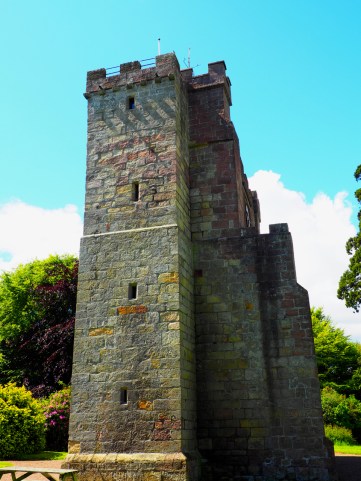
 England had been Protestant since the death of Mary Tudor in 1558. The majority of the population had quietly got on with the change from Protestantism under Edward VI to Catholicism under Mary and then back to Protestantism with the ascent of Elizabeth.
 In 1590 James VI of Scotland got married. His wife was a Protestant princess. She had been raised in a Lutheran court. The dowry of £150,000 helped as did a hand full of islands including Orkney which Scotland already held but which now legally became Scottish rather than Scandinavian.
 John of Gaunt owned more than thirty castles – many came though his marriage to Blanche of Lancaster, others came by gift from his father Edward III. One of them, Liddel Strength, sitting on the banks of the River Liddel, quite close to the wonderfully named village of Moat in Cumbria, went through assorted hands until it came into the ownership of the Earls of Kent – John the 3rd Earl of Kent died in 1352. He was twenty-two. He died without children and his titles passed to his sister Joan.
 John of Gaunt was born in March 1340 whilst Edward III was on campaign in France trying to claim the French throne through his mother’s, Isabella of France, bloodline – someone hadn’t explained salic law to him. John was probably born in St Bavo Abbey in Ghent. In later years the rumour would arise that he was no true son of Edward’s but was instead a Ghentish butcher’s brat – no one ever paused to wonder how Philippa of Hainhault might have met this butcher given that queen’s aren’t prone to popping out to do the shopping for the evening meal.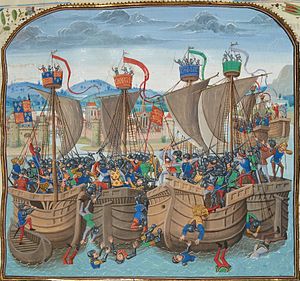
 According to the Scotsman Berwick Upon Tweed changed hands some thirteen times in its turbulent history. So, it was originally part of the Kingdom of Northumbria and these are the key changes of occupier.
 In 1018 following the Battle of Carham the border moved to the Tweed and Berwick became Scottish which it remained until William I of Scotland became involved in the civil war between Henry II and his sons in 1173. After his defeat Berwick became English. In all fairness Henry II had rather caused bad feeling between the Scots and English when he forced the Scots to hand Carlisle back to England – which given how supportive King David of Scotland had been to him seems rather ungracious. William I of Scotland (or William the Lion if you prefer) had simply taken advantage of the family fall out between Henry II and his sons. Unfortunately for him he was captured in 1174 at the Battle of Alnwick. He was released under terms of vassalage and made to give up various castles as well as Berwick.
 August 24 1482 Berwick became English once more having fallen into the hands of Richard, Duke of Gloucester who strengthened his army with assorted European mercenaries until there were somewhere in the region of 20,000 men in his force. Richard marched north from York in the middle of July. Once at Berwick Richard left some men to besiege the town whilst he went on to Edinburgh where he hoped to meet with King James III of Scotland in battle (it should be noted that one of James’ brothers was in the English army). It wasn’t just James’ brother who was disgruntled. It turned out that quite a few of his nobles were less than happy as they took the opportunity of the English invasion to lock James away. It became swiftly clear to Richard that he would not be able to capture Edinburgh so returned to Berwick where he captured the town making the thirteenth and final change of hands.
 Brinkburn is an Augustinian Priory. Usually I’m not terribly keen on buildings that have been restored during the Nineteenth Century. The Victorians were not always terribly sensitive in the changes that they made. However, in this instance the priory church is a truly splendid thing.
 Alnwick, like most of the great castles, has had a succession of owners beginning with Ivo de Vesci who married the granddaughter of Gilbert Tyson, a Saxon killed at Hastings in 1066. The zigzag moulding on the arch in the arch that leads to the inner courtyard reminds visitors that Alnwick has been a fortification for the better part of a thousand years. The barony of Alnwick and its castle continued in the de Vesci hands until the fourteenth century with intermittent lapses into the hands of David of Scotland and William the Lion although it should be noted that during the reign of Henry I Eustace FizJohn was the castle’s owner. He married the de Vesci heiress of the period and their son William assumed his mother’s name.
 Ivo built a motte and bailey castle from timber – by which we can suppose some hapless Saxons found themselves moving soil and digging ditches. There were two baileys – one to the east and one to the west. Over the years fortifications were added to the central shell keep and to de Vesci’s two baileys. By 1135 it was one of the strongest castles in Northumberland. In actual fact when William the Lion besieged the castle in 1172 he was unable to capture the castle from William de Vesci. In 1174 the Lion had another go at it and was captured by the English. Part of the reason why William spent so much time hammering on Alnwick’s doors was that he had originally been the Earl of Northumberland but Henry II had removed it from him some twenty years earlier. Perhaps that was why William joined in the revolt by Henry II’s sons and his queen against Henry II in 1173. William found himself bundled off to Newcastle and from there to Normandy. William was forced to recognise Henry II as his feudal overlord and in so doing sewed the seeds of the Scottish Wars of Independence when Edward I insisted on the right to naming the Scottish king and to being the feudal overlord of Scotland.
 The outer wall, around those two baileys encloses something like five acres of ground. The wall contains several towers and turrets. One of them houses a water tower and very sensibly it was here that the castle’s laundry was done. There is also a rather fine well in the inner court yard near the entrance to the keep. The Constable’s Tower is open to the public
 The fortunes of the Percys declined with the Wars of the Roses and the accession of the Tudors. Margaret of Anjou had garrisoned Alnwick with three hundred french troops in the aftermath of Town in a bid to retain a toehold on her husband’s kingdom. It was a Scot who rode to the garrison’s rescue on that particular occasion so that Margaret’s troops could make good their escape from the forces of the Earl of Warwick.