Eleanor Cobham – duchess, witch, convicted traitor.

eleanorcobhamEleanor Cobham should not have become a duchess; she certainly shouldn’t have been the first lady in Henry VI’s court. She didn’t have the right bloodlines.


She was the daughter of Sir Reginald Cobham of Sterborough but was fortunate that she found a place in the household of Jacqueline, Countess of Hainault as a lady-in-waiting. Jacqueline had fled her husband John, Duke of Brabant – so a bit of a wayward woman by medieval standards. As it turned out young Eleanor had her own fair share of waywardness that would take her all the way to the top of English society before she crashed from grace on a charge of witchcraft and treason.

Of course this all has a back story attached to it.  Henry V, the English king died from dysentery contracted during the Hundred Years War. He left a son, Henry VI, as his successor – unfortunately young Henry was still in swaddling clothes. Henry V’s brother, John, Duke of Bedford, governed France as regent, while his youngest brother, Humphrey, Duke of Gloucester, was named protector of England during the young king’s minority. Henry’s two brothers did not get on. In fact if John said it was day, Humphrey would probably have declared it to be night.

Jacqueline was a Countess without a country. She wanted help recovering Hainault from her husband. If that wasn’t enough of a challenge she also sought to recover Holland and Zeeland from her uncle, John of Bavaria. Duke Humphrey, perhaps because his brother was making a marriage with the Burgundians, married Jacqueline. This rather rained on John, Duke of Bedford’s carefully negotiated treaty with the Burgundians and caused some dissent between the new allies because Philip of Burgundy had his own eyes on Hainault.


In October 1424, the Duke Humphrey and his bride landed at Calais. Eleanor Cobham went with them. It was a disaster. Philip of Burgundy was amore popular ruler than Humphrey with the good people of Hainault. So, he did what all sensible men do in an emergency, he deserted his wife and returned home – leaving Jacqueline to be captured by Philip of Burgundy.


Eleanor having no desire to be mired in Jacqueline’s disaster took herself home as well. It wasn’t long before the former lady-in-waiting became Humphrey’s mistress. Gossip soon whispered that Eleanor had inveigled Humphrey into her snare with the help of a witch called Margery Journemayne. The gossip must have buzzed when the duke and his mistress were married. Stow reported that a group of women sent a letter to Humphrey pointing out that it wasn’t very honourable of him to leave poor Jacqueline as a prisoner in the hands of the Duke of Burgundy or for him to carry on in public with Eleanor.


Whatever nobility wives thought of Eleanor she was now a duchess and in 1440 Henry VI made her a Lady of the Garter.

In September 1435, John, Duke of Bedford died. Humphrey was now heir to the throne – the thought of being king seems to have gone to both Humphrey and Eleanor’s heads. Eleanor had gone from being the daughter of a knight to the first lady in the land. The crown was a heartbeat away. The trouble was that Eleanor was not particularly gracious in her new role. One chronicler wrote that she showed off “her pride and her position by riding through the streets of London, glitteringly dressed and suitably escorted by men of noble birth.”   So clearly tact and diplomacy were not high on her list of skill sets.


Duke Humphrey was university educated. He loved books. In his collection was one on astrology. Eleanor appears to have had an interest in the topic as well because in June 1441, Eleanor, having dined at Cheapside was informed that three members of her household had been arrested on charges of conspiring against the king. The suspects implicated Eleanor – as must have been the intention all along. Eleanor seeing which way the wind was blowing took herself off to Westminster and into sanctuary.


Eleanor was told to go to Leeds Castle but pretended that she was too ill to go. It was to no avail. She faced trial and admitted that she had turned to witchcraft to get a child with Humphrey and to having the future of Henry VI told. Humphrey remained silent on the matter. He made no move to defend his wife but once she was found guilty his political life was as good as over. Following the trial Humphrey and Eleanor were forcible divorced and Eleanor made to do public penance which was, all things considered, a narrow escape – poor Margery Journemayne was burned at the stake as a witch in Smithfield.

From London, at the beginning of 1442, Eleanor was sent to Cheshire; via Kenilworth and from there to the Isle of Man – a duchess no more.

Edmund Mortimer, 5th Earl of March – from the House of Mortimer to the House of York.

white rose

Edmund Mortimer, 5th Earl of March (born in 1391), was descended from the second surviving son of King Edward III – Lionel of Antwerp. Lionel had only one legitimate child (well at least that’s straight forward). Her name was Philippa. Her mother was Elizabeth de Burgh, Daughter of the Earl of Ulster.  Edmund is not a York claimant to the throne.  He is a Mortimer claimant – but he is the link that takes us from the Mortimers to the House of York.

Philippa, Lionel’s daughter,  married Edmund Mortimer, third Earl of March – his grandfather had run off with her great-grandmother (Isabella of France) and plotted to overthrow and possibly murder her great-grandfather (Edward II). Philippa had four children. The one we are interested in for the purposes of this post is her eldest son Roger although the others will get a mention before the end. He became the 4th Earl of March as well as Earl of Ulster. So far so good – the Mortimer claim to the succession is good – though female in origin.

There are no Salic Laws in England to prevent a female claim to the throne.  Henry IV tried to argue that his claim was better than Philippa’s and her descendents because he was a male.  However, this was the same man who fought in France basing the English claim to the French throne on the fact the Edward III was Isabella of France’s son.  When Charles IV of France died, Isabella and her descendants were the next closest claimants to the French throne – a fact which the French refused to accept based on their Salic Law.  Henry IV was essentially trying to have his cake and eat it.


But back to the Mortimers – Roger, Philippa’s son, married Eleanor Holland- who adds to the blue blood running through the veins of the Mortimers with the blood of the Earls of Arundel and Henry III.


Roger, managed to get himself killed by the Irish when young Edmund, who this blog is about, was just six. This was unfortunate because Roger Mortimer’s claim to the throne was better than that of Henry Bolingbroke who went on to become King Henry IV. Roger was descended from the second son of Edward III while Henry was descended from the third son- John of Gaunt.

Richard II had recognized Roger as heir to the throne in 1385 according to one source. Other accounts suggest that Roger was walking a difficult tightrope in his cousin Richard II’s affections from which he could have easily fallen. Certainly after Roger’s death Mortimer’s lands were swiftly set upon by an avaricious king (Richard II as averse to Henry IV who was just as bad so far as Mortimer land was concerned).

Things went from bad to worse after Henry Bolingbroke usurped the throne. Edmund (now the 5th Earl of March) and his younger brother Roger became royal wards – they were in line for the succession after all and family as well…  In reality, they were largely brought up in Windsor as prisoners.  Edmund was not permitted anywhere near his estates.

Henry IV did have reason to feel nervous of the Mortimers. The boys had an uncle- helpfully also called Edmund- who felt that young Edmund had a better claim to the throne than Henry. Uncle Edmund felt so strongly about it that he joined up with Owain Glyndwr to rebel against Henry IV. Elizabeth Mortimer- the 5th earl’s aunt, wasn’t to be trusted either. She had been married to Henry “Hotspur” Percy who had died at the Battle of Shrewsbury (1403). In short Henry IV must have looked at his Mortimer cousins and regarded them as treacherous nuisances.

Just to complicate things that little bit further another cousin, Constance Plantagenet who was the daughter of Edmund of Langley, the 4th surviving son on Edward III, attempted to free Edmund and Roger Mortimer from Windsor in 1405. She thought if she could get them to Wales and Glyndwr that Edmund could be declared king. She wasn’t terribly keen on Henry IV although she’d kept her feelings hidden long enough to be trusted to care for Edmund and Roger. She was the widow of Thomas le Despenser, Earl of Gloucester who was executed for treason in 1400. Cousin Constance managed to get the two boys as far as Cheltenham before Henry IV caught up with them. What a happy family reunion it must have been for all concerned!

Things changed somewhat when Henry V ascended the throne in 1413. Edmund was knighted and finally allowed to inherit his estates. He married Anne Stafford, the daughter of the Duke of Buckingham and appears to have done so without asking Henry V’s permission because he was fined a huge amount of money for doing so. Interestingly there is no evidence that it was paid. In any event the 5th Earl of March, perhaps because of his somewhat dysfunctional childhood and adolescence, was a loyal and quiet subject to the Lancastrian Henry V before he died of plague in Ireland – and I’m sure by this stage you’re just as pleased as the regency council of baby Henry VI must have been- without any heirs.

Edmund’s younger brother Roger also died without an heir.  So that was that, so far as a direct Mortimer claim to the throne was concerned.

However, a claim remained within the family – (I’ve nearly arrived at the York claim to the throne – hurrah!)  Roger, the 4th Earl of March, and Eleanor Holland had four or five children – Edmund, the 5th Earl who died without an heir in 1425; Roger who died sometime around 1410 without an heir; Eleanor who did get married but when widowed became a nun – died without an heir; Alice, who according to Alison Weir might not even have existed and finally the eldest child of the family – Anne Mortimer.


Perhaps Henry IV would have been better locking her up because she married another cousin – Richard, Duke of Cambridge the son of Edmund of Langley.  Edmund of Langley (the fourth surviving son of Edward III) was also the Duke of York. Richard’s sister was the rather daring Constance who managed to extract two small boys from their imprisonment in Windsor and get to Cheltenham with them before she was caught.


If Plantagenet family gatherings look as though they might have been somewhat difficult by the time of Henry VI’s birth in 1421 it is also worth remembering that Richard, Duke of Cambridge was part of the Southampton Plot of 1415. The plan was that the plotters would get rid of Henry V and replace him with Richard’s brother-in-law – i.e. Edmund Mortimer, 5th Earl of March.


Edmund may have been involved in the plot up to his neck or there again he might not. The information is lost somewhere down the back of the sofa of history. Clearly Edmund got to thinking about the chances of the plot succeeding. He didn’t have to worry about hurting his sister’s feelings. She’d died four years previously. Edmund went to see Henry V to tell him all about the plot. Richard of Cambridge was executed.

However – Anne Mortimer left a son called Richard.  He became Duke of York and never forgot that his claim to the throne was much better than that of King Henry VI.


John of Lancaster, First Duke of Bedford

john of lancasterJohn of Lancaster,the man with the pudding basin haircut and rather sumptuous gown on his knees in prayer, was the third surviving son of King Henry IV and his first wife Mary Bohun. He was born in 1389.  His mother died when he was just five.

He is better known in history as the First Duke of Bedford. And he is famous, or perhaps infamous, for having Joan of Arc burnt at the stake for witchcraft.  As a mere girl she shouldn’t have been wearing trousers and she certainly shouldn’t have been leading French armies that thrashed English armies.

John’s eldest brother was Henry of Monmouth who went on to become King Henry V after a dissolute youth causing his father Henry IV despair (refer to Shakespeare Henry IV Part One and Part Two for a full litany of drinking, gambling and womanising along with princely reformation).  In any event Henry of Monmouth shook boorish habits from him as soon as he became king and went off to do what medieval English nobility expected of their monarchs – he went to war with someone, gained victory and land.

Henry IV’s second son was called Thomas but he was killed in 1421 at the Battle of Bauge in France. John was the third son and he was followed by Humphrey.  Much of the period of Henry VI’s minority is filled with the political machinations of John and Humphrey who was created Duke of Gloucester and Earl of Pembroke. Each of the brothers wanted more power than the other. Henry V had relied upon John when he was away fighting to rule in his absence.  He took the reigns of power for his brother three times in total.  However it fell to John to continue the English campaign in France despite the fact that he had been named Regent.  This left Humphrey at home.  He became the Lord Protector during John’s long absences in France.

Not that this stopped Humphrey from dabbling in politics in an attempt to destabilize John’s alliances with other European magnates. There was also the small matter of Humphrey antagonizing the next most important man in the kingdom during Henry VI’s minority – Henry Beaufort who was the Bishop of Lincoln, a key figure on the regency council and the half-uncle of Henry IV’s children. (Henry IV’s parents were John of Gaunt and Blanche of Lancaster while Henry Beaufort’s parents were John of Gaunt and Katherine Swynford).


John’s time in France had been successful – the French might not have been his greatest admirers given his severe administration techniques- until about 1427 at which point a quiet country girl with a dodgy hair cut, a large sword and angels telling her what to do rather rained on his parade. Her name was Joan of Arc.  He was forced to raise the siege of Orleans in 1429 on account of the peasant girl. Joan’s army took the Loire Valley and defeated the English after which she had King Charles VII of France crowned at Rheims which was against the treaty that the French had agreed to after Agincourt which saw King Henry V marry Katherine of Valois.  The French felt there was a world of difference between a mature victorious king and a baby boy – they perhaps had a point given the chaos that often resulted in England when a child was on the throne.

In any event it didn’t do Joan much good.  She was burned for witchcraft in 1431 – the French king who owed her his crown didn’t lift a finger to help her.  John had his young nephew crowned King of France in Paris so that for a little while at least there were technically two kings of France at the same time, though it rather depended where you were as to which one you recognised in public.

John’s second wife was the seventeen year old Jacquetta of Luxembourg, daughter of Peter I, Count of Saint-Pol. She caused a scandal after John’s death by marrying a mere knight called Richard Woodville.  She went on to have sixteen children and the knight became the first Earl Rivers  for his services to Henry VI and his queen Margaret of Anjou.  So when the Yorkists looked down their nose at Elizabeth Woodville, Jacquetta’s daughter and King Edward IV’s wife, they were forgetting that she was the grand-daughter of a Count and that her mother had once been at the heart of the royal court – albeit a Lancastrian one.

John, as well as being a soldier and a politician, was also a scholar. He founded the University of Caen and had a collection of important religious manuscripts, many of which survive today including The Bedford Hours which is held by the British Library. John’s first wife Anne of Burgundy gave the book to young Henry VI for Christmas in 1430 (I wonder how the grandchildren would react to a beautifully hand painted devotional text rather than the usual jigsaws, board games and selected Disney dvds).

John’s died at Rouen in 1435 during negations with the Burgundians who were breaking their alliance with the English to make a separate peace with the French.  His demise further weakened the stability of the English court where opposing and increasingly vociferous factions now had no one sufficiently intimidating to hold them in check.  The Plantagenet family were moving ever closer to implosion.


Henry Bolingbroke

Henry IVYoung Henry Bolingbroke was just eleven years old when he carried the ceremonial sword at his cousin Richard II’s coronation. The king was a year younger than Henry.

Henry, named after one of his father’s (John of Gaunt) Lincolnshire castles was also known as Henry of Lancaster. His mother was Blanche of Lancaster and as his father’s heir the title is one that makes sense. However, just to confused things he was also created the Earl of Derby and upon his marriage to Mary Bohun he was created Earl of Hereford – oh yes, then he deposed his cousin and became known as King Henry IV.


Henry’s variety of names is confusing enough but his familial relations look like spaghetti rather than a tree. Henry’s grandfather was King Edward III, his father John of Gaunt and his mother Blanche of Lancaster. So, far so good. However, when Henry married Mary Bohun, who was just eleven at the time and remained at home with her widowed mother after the wedding, Henry’s aunt became his sister-in-law! Edward III’s youngest son Thomas of Woodstock was already married to Mary’s older sister Eleanor. They were the co-heiresses of the Earl of Hereford. Henry’s mother-in-law was the widow of the earl and the daughter of Richard FitzAlan third Earl of Arundel.


As Richard II grew to manhood he became convinced about the authority of kings. It was this king who introduced the terms ‘Majesty’ and ‘Highness’. It was this king who demanded that anyone entering his presence should bow three times before they approached him. This high handed attitude, not to mention failure to go to war with France, didn’t win him friends within his family. Nor did his preference for ‘new men’ such as his chancellor Michael de La Pole help matters very much.


Inevitably there were plots. Eventually in 1387 the Lords Appellant, as they became known, forced Richard to tow the line. He spent some time in the Tower – possibly on the naughty step. Amongst the Lords Appellant were Thomas of Woodstock (Henry’s uncle and brother-in-law) and Richard Fitzalan, the fourth Earl of Arundel (Henry’s uncle-in-law), Thomas Beauchamp (Earl of Warwick), Thomas Mowbray (Earl of Nottingham) and Henry himself.


Of course, Richard didn’t take kindly to being told what to do by the nobility even if he was related to most of them. Eventually he regained his power and had Thomas of Woodstock sent to Calais where he ordered his royal uncle to be murdered. The man who organized this was another of Thomas’s nephews ….it’s always nice to see a happy extended family, isn’t it?

Henry’s uncle-in-law, Arundel, was given a show trial and executed. The Earl of Warwick must have heaved a huge sigh of relief when he found himself on a slow boat to the Isle of Man with instructions not to come back. The king seized the estates of all three of these Lords Appellent. Henry and Mowbray seemed, at least for the time being, to have escaped Richard’s wrath.


However, Mowbray suggested that the king would do to him and Henry what he’d done to the other three lords. The conversation was not a particularly private one and inevitably word got back to the king that Mowbray was plotting again. Henry denounced Mowbray before he could be accused of being involved.  He went on to challenge Mowbray to trial by combat. The two men were to have met at Coventry on the 16th September 1398. They were just about to attack one another when Richard banned the combat and exiled its combatants: Mowbray for life, Henry for ten years – demonstrating that Mowbray had been right all along.


Then John of Gaunt died. Richard changed Henry’s exile to life and claimed Lancaster’s estates as his own.


Henry landed at Ravenspur in July 1399. Men flocked to his banner. Richard, who was in Ireland at the time, hurried to meet his cousin but by the time he reached Conway Castle it was evident that Richard had lost his kingdom to his cousin.


Henry Bolingbroke became Henry IV by popular acclaim. If Richard’s abdication was real rather than forced – and the deposed king was to die very soon afterwards in Pontefract Castle.  The next rightful heir was eight-year-old Edmund Mortimer, Earl of March- and no one wanted another child on the throne.   Henry however, did not claim his right to rule exclusively from his grandfather. He claimed his right to rule through his mother Blanche of Lancaster. Blanche was descended from Edmund Crouchback, the second surviving son of Henry III. Henry IV allowed it to be known that rather than being the second born, Edmund Crouchback was actually the first born child but had been set aside in favour of his brother Edward (King Edward I) on account of his ‘crouchback’.   Given that crouchback meant cross-back it was probably a reference to his crusading zeal rather than any physical deformity.


Henry did not have a peaceful reign. Owen Glendower rose with the Welsh in rebellion and the Earl of Northumberland joined in with his son ‘Hotspur’. Hotspur was the husband of Ann Mortimer and therefore uncle to Edmund Mortimer (the child with a better claim to the throne than Henry). It would be nice to think that he was outraged that his nephews Edmund and Roger Mortimer were being imprisoned simply because of their ancestry but it is much more likely that he, together with his father Northumberland, was furious that they hadn’t received what they perceived to be their dues for supporting Henry when he arrived at Ravenspur. They were also expected to guard the border with Scotland more efficiently now that Henry was on the throne.


In any event, Henry had to quell rebellions, assassination attempts, deal with financial difficulties, his own heir’s apparent waywardness and his poor health. It was widely reported that he became a leper- he certainly suffered from an unpleasant skin disease of some description. He had difficulty walking and had a fit whilst praying in Westminster Abbey before dying on the 20 March 1413.


He left a warrior son to become King Henry V. Unfortunately for England, King Henry died when his own son by Katherine of Valois was an infant.

The Mortimers had not forgotten their claim to the throne (though Edmund and Roger died without children- their sister Ann had married and had children).  Their claim to the throne was  better than baby Henry VI’s. The stage was set for The Cousins War or as we know it, thanks to Sir Walter Scott, the Wars of the Roses – which strange though it may seem given that I’ve cantered through the reigns of both Richard II and his cousin Henry IV,  is what I’m warming up for with this post.


The Battle of Tewkesbury

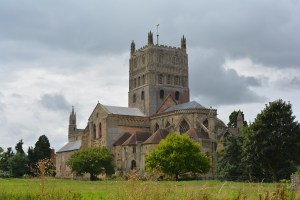
Tewkesbury AbbeyThe Battle of Barnet in April 1471 saw the defeat and death of the Earl of Warwick. A Lancastrian defeat was not the kind of news that Queen Margaret (of Anjou), wife of Henry VI, wished to hear when she came ashore with her son Prince Edward  at Weymouth on the same day.


Her only option was to meet with Jasper Tudor in Wales. The Yorkist king, Edward IV, needed to prevent this from happening. The two armies came face to face with one another on the 3rd of May 1471. Margaret managed to avoid Edward at Sodbury and was heading for Gloucester when the armies finally met. A battle would be fought the following day that would see Margaret and Henry’s only child, Prince Edward, killed.


The Lancastrians held the land to the south of the abbey. Edward used artillery and bowmen to attack the Lancastrians. The Lancastrian right wing came to the aid of its center and caught the Yorkists by surprise. Things could have gone very wrong for Edward had not his brother Richard, then Duke of Gloucester, met the attack. As it was the Lancastrians found themselves caught on marshy ground and 2,000 men died resulting in the name of ‘Bloody Meadow’ being attached to the area of battle where the Lancastrians fell.  The Duke of Somerset held John Wenlock (the  1st baron) responsible for the disaster as he’d commanded the centre of the Lancastrian army.  The Duke who’d commanded the right wing of Margaret’s forces was so incensed that he killed his compatriot on the field of battle. The army fled, many of its soldiers killed in the fields and hedgerows where the A38 runs today.  Other men sought sanctuary in the abbey.


However, Tewkesbury Abbey did not hold legal sanctuary status so the Yorkists forced their way into the abbey two days after the battle. They laid hold of the Lancastrians who sheltered there. The abbey church was so desecrated that it required purification the following month while the Lancastrians who survived the onslaught found themselves dragged into the market square where they were summarily beheaded. Amongst the executed were Edmund Beaufort, Duke of Somerset (Margaret Beaufort, mother of Henry VII was his niece) and his younger brother John. They were returned to the abbey for burial.

Prince Edward was also buried in the abbey.  The other Plantagenets to find a final resting place in the abbey were Isabella (wife of the Duke of Clarence and daughter of the Earl of Warwick) and the Duke of Clarence, Edward IV’s brother who was drowned in a butt of Malmsey.


As for Margaret of Anjou, she was captured on the 7th May. She remained a prisoner until 1475 when a ransom was paid for her release.

Click on the picture to open up a new window for a BBC page showing a Victorian interpretation of the Yorkists and Lancastrians in Tewkesbury Abbey.

A Little Bit of Luck

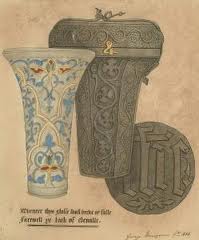
Luck of Edenhall

Luck of Edenhall

When I was a child we used to refer to a bird splattering the car window screen  with its guano as leaving ‘luck’.  As an adult responsible for washing my own car I fail to see what luck has to do with it.  However, back to matters in hand, the lucks of today’s post as rather prettier and infinitely more historic – although once again in some instances ‘luck’ seems to be missing from the equation.

The first luck is the ‘Luck of Edenhall’ which used to be in possession of the Musgrave family of Edenhall. The ‘luck’ is a beautiful gilded and enamelled glass beaker (it looks like a vase to me but what do I know).  It was made in Syria so the chances are that it made its way home in the trunk of a Musgrave crusader.  Remarkably it survived the joys of reiver warfare, heavy handed drinkers and the washing up bowl.  Though to be fair it must always have been prized because when not in use it was kept in a leather container that had been made in the Fourteenth Century. The case bears the letters IHS suggesting that it was once used as a communion challice.

The luck was still in one piece at the beginning of the Eighteenth Century when the current owner decided it would be a good idea to drink the health of the entire family from the priceless heirloom.  Luck must indeed have been on the side of the Musgraves because it survived and went on to feature in a ballad.

Border ballads had been popularised by Sir Walter Scott and James Hogg at this time and “The Drinking Match” was a modern contrivance which featured the medieval glassware.

If this cup should break or fall,

Farewell the Luck of Edenhall.

From there it was one small step to the fairies – quite literally at the bottom of the garden – who were supposed to have given the luck to the Musgraves after water was drawn for them at a well.

The Musgraves aren’t the only family to have a ‘concrete’ luck that they need to guard against disaster.  The Lamb Family of Great Salkeld had a brass dish allegedly given by hobgoblins at a wedding feast.  A girl from the wedding family went to a nearby well to fetch water where she was accosted by a hungry hobgoblin – or gaggle of hungry hobgoblins depending on the account- who said that they would bless the bride and groom in exchange for food and drink.

Sir John Pennington was the Lord of Muncaster Castle during a portion of the Wars of the Roses.  In the aftermath of the Battle of Hexham (15 May 1464) King Henry VI was found wandering over the fell.  He was taken to Muncaster where Sir John and his wife cared for the broken monarch for the next nine days.  When he left the monarch – who could have done with a bit more luck himself- gave the family a glass cup telling them that they would prosper so long as it remained unbroken.  It is still on display in Muncaster Castle.

View across fells from Muncaster Castle

View across fells from Muncaster Castle

The final luck in this post brings us to the Luck of Workington.  Mary Queen of Scots fled across the Solway Firth in a fishing boat with sixteen companions.  When she arrived she had very few possessions and needed shelter.  Lord Herries, a Scottish Lowland laird who’d remained loyal to his queen sent a message to Sir Henry Curwen of Workington with whom he had a friendship.  Sir Henry sheltered Mary until she could be escorted to Carlisle Castle.  When she left she gave the family a small agate cup as a token of her gratitude.  It became known as the Workington Luck.

Thomas Merks – the loyal bishop.

This is one of those posts without a picture.  I may track one down eventually.  Thomas Merks or Merke died in 1409.  He was Bishop of Carlisle for three years between 1397 and 1400.  His duties were not terribly onerous.  After all, Richard II could not really do without one of his principle advisors.  It was Merks who helped negotiate the King’s marriage to Anne of Bohemia.  The Westminster monk did much to make himself indispensable to Richard II.  He helped to negotiate the dowry of Isabella of Valois and he went with Richard to Ireland.  Some chronicles accused the bishop of enjoying evenings of carousing rather than prayer but these were Lancastrian chronicles and they had no love for the king’s bishop.

 In 1400 Merks found himself in the Tower.  He had remained loyal to his king even when Richard no longer had his throne.  Only one other bishop was deprived of his see by Henry Bolingbroke, Duke of Lancaster who took on the title King Henry IV.  Merks  stood up in court to defend his master and paid a significant price.  He ended his days deputising for the Bishop of Winchester.  The family had links to the area – Merks nephew is buried in a local church.

Wakefield Cathedral

wakefield cathedralUntil 1888 the cathedral was a parish church.  At 247 ft, it also has Yorkshire’s tallest church spire which is a marked improvement on the first tower which collapsed in 1320.  It’s a building that has seen change, redevelopment and neglect in its time and lets not forget the plague and the Wars of the Roses.  The Vicar of Wakefield died of the plague in 1349 and the Battle of Wakefield occurring in December 1460 saw the death of Richard, Duke of York along with his second son Edmund Earl of Rutland.  The twelve-year-old lad having pleaded in vain for his life was killed by Lord Clifford on Wakefield’s Bridge in vengeance for the death of Clifford’s father at the First Battle of St Albans.

My favourite part of the cathedral is the quire where the fifteenth century choir stalls are housed.  The carvings range from an owl to a green man. The owl is the emblem of the Savile family and it was placed here when Thomas Savile commissioned the stalls in celebration of his marriage to Margaret Bosworth in 1482.  The green man is more problematic.  The motif first appeared in England in the twelfth century in the form we recognise him today with foliage and tendrils of hawthorn or oak sprouting from his mouth.  However, it was a common motif in Europe before this period and has its roots in a pagan past.   It was replicated down the centuries and as well as the medieval example there are some clean cut Victorian interpretations on display. Other carvings on the misericords – the hinged seats on the stalls to ease tired legs during long church services – include a Victorian pelican which symbolises charity and a cheeky medieval acrobat showing us his bottom although decorum is maintained as a leaf covers his dignity.

It’s odd to think that many of these carvings were made at a time when England was in the throes of a bloody civil war.  Perhaps it was with some relief that the craftsman who created the misericord depicting the tudor rose completed his work.owl

A City Livery Company and Spotty Panthers or maybe Leopards.

DSC_0107The livery company in question is the Worshipful Company of Dyers and leopards or even panthers are heraldic beasts.  I actually think you’ll agree that the phrase ‘big spotty cats’ just about sums up these wonderful creatures.  It looks as though someone under the age of ten has had a wild time with a paintbrush. Dying- and I think I’ve spelled that right- has been going on in London, so far as records are concerned, since the twelfth century but it was Lancastrian King Henry VI who gave the company its first charter in 1471.  Given that this was not an auspicious time for the English monarchy it is perhaps not surprising that the following year the Yorkist King Edward IV dished out a brand new charter.

The dyers have had their headquarters of Dowgate Hill since Tudor times which means that this building isn’t the original one on the site – yes, the 166 Great Fire of London strikes again.

But back to the coat of arms.  The three corded bags on the shield are bags of madder – the plant used to produce a red dye.  The motto, ‘Da Gloriam Deo’ meaning give glory to God.  So far so good. From now on the explanation gets a bit more complicated. I have, of course, arrived at the two supportive large spotty red-whiskered cats.  The Worshipful Company of Dyers describe them as panthers and they should know; after all it’s their coat of arms.

There are three big cats in heraldry – lions, leopards and panthers…though tigers do turn up occasionally but let’s leave them out of the equation for the time being as things are going to get difficult enough as it is. As I understand it – and I’m not an expert on heraldry- if the cat is ‘passant‘ which means three feet on the ground, one paw raised and face turned to look at you – think cat stalking while pausing to have its photo  taken- then its a leopard.  This in turn raises some interesting questions about the three lions on the royal coat of arms and the famous three English lions of the football song.  If the cat is standing on its back legs- rampant– then in medieval English heraldic terms it is a lion.  Just to confuse matters even further in medieval terms a leopard was the offspring of a lioness and a panther. Thankfully I don’t have to try to work out the change from leopard to lion for myself. There is a very helpful article on the subject in the BBC History Magazine website BBCHistory Magazine Extra. Basically the leopards on the royal coat of arms turned into lions during the Hundred Years War – something similar, I expect, to the rebranding exercise carried out by the House of Saxe-Coburg-Gotha when they turned into Windsor during World War One at the point when links with Germany became somewhat uncomfortable.  If you want to read the article click on the picture.

Anyway back to our big cats – the red whiskers and red wavy dog like ears are neither whiskers nor ears.  It’s flame.  This turns our cats in to heraldic panthers incensed- and I think I’d be fairly annoyed if I started breathing fire out of my ears.  According to the tattered remnants of my old heraldry book, this represents the very sweet breath of the panther.  Apparently the heraldic panther is more of a mythical beast than a real animal and has its origins in Greek beliefs.  The breath of the panther, as symbolised, by the flames, lures animals into its lair.  You will be pleased to hear that dragons are immune from the panther’s breath and are afraid of panthers as a consequence where as every other animal goes traipsing off to the panther’s lair – possibly to be turned into a mid morning snack but don’t quote me on that because medieval sources couldn’t agree either, some of them have the panther down as an exceptionally gentle beast.

Back to safer ground.  Heraldic panthers are also often shown with spots – that’ll be these two then- in ‘heraldic speak’ the spots are semeé of roundels. Initially I thought that the spots and bright colours of the incensed panthers was an excellent choice for the dyers – those bright colours are pretty good advertising after all. Then when I carried out a web search I discovered that there was a heraldic link to Henry VI who gave the dyers their first charter. “King Henry VI used the panther for his badge, to indicate that “a Kinge should have so many excellent and severall vertues as there are diversities of spottes and most beautifull Coullors in this Beast, and then his People will love and followe him for his vertues as all other Beastes love and follow the Panther for his sweete smell and glorious coullors” (Coll. Arms MS. L. 14, pt 2, f. 380). Other descendants of the House of Lancaster also used the panther.” http://bestiary.ca/beasts/beast79.htm

I bet there was a lively discussion held by the dyers the following year when the Lancastrians were shown the door and it looked as though the Yorkists were triumphant.  It just goes to show though that the streets of London, while not paved with gold, are knee-deep in history even if you have to do a little digging sometimes. DSC_0108