Fortified Churches in Cumbria

DSC_0065There are officially three fortified churches in Cumbria.  Two of them lie on the Solway Firth and the third, the first picture in this post, lies in the Eden Valley at Great Salkeld a few miles north of Penrith.

St Cuthbert’s Church in Great Salkeld was a brief resting place for the body of St Cuthbert when the monks spent seven years wandering through the north in fear of the Danes.  These days it is more noticeable for its tower.  The thick walls, narrow doorway and staircase as well as the ironbound door indicate that it was a place of safe haven from marauding Scots.

At Newton Arlosh they say that the door is so narrow that the bride and groom have to decide who is leaving the church first.  The spouse who sees daylight first will be the one in charge of the partnership so the locals say…I couldn’t possibly comment.

The third church is at Burgh-By-Sands and it is probably the oldest of the fortified towers which is not surprising given that it lays so very close to Scotland.  Its stones once formed part of the Roman fort of Aballava; a Celtic carved head reminds visitors that people have lived here for thousands of years.  The church lay in the domain of one of the knights who killed Thomas Becket and in 1307 Edward I was laid here in state after dying on his way to war with the Scots.  The tower caused the Bishop of Carlisle some distress because when the villagers built it they managed to undermine the foundations of the church.  One thing is for sure the builders meant business.  The tower is heavily buttressed and several feet thick as well as the narrow entrance, the iron yet is still in place with its three great bolts and there is a huge slot in the masonry for a bar to be slid into place.  There are narrow windows through which arrows could be fired and there is evidence of archers having sharpened the tips of the arrows on the walls of the tower.  When gunpowder became more readily available someone cut a gun loop in the lower room and a height that would leave attackers facing kneecapping at best.  The tower is vaulted and there is a narrow spiral staircase just the same as in Great Salkeld.DSC_0128

Of course there are a number of other churches in the area where villages- and certainly the priest- sought sanctuary in time of trouble.  The tower on the church at Edenhall (another St Cuthbert’s and another resting location for the saint’s mortal remains) has a funny little tower that includes a ‘mini’ steeple.  It was built in the fourteenth century and was probably used in much the same way as the three fortified churches already described but unlike the towers at Newton Arlosh, Burgh by Sands and Great Salkeld the tower in Edenhall lacks the narrow doorway and the iron bound door.

Other strategies were devised elsewhere. In Corbridge the vicar came up with an alternative means of self-preservation.  There is a peel tower in the churchyard where the vicar could flee in the event of trouble and the wall around the churchyard is fairly stout too.  At Kirkby Stephen the church tower is a handy vantage point that enabled two Westmorland’s Pilgrimage of Grace ringleaders to evade capture by Henry VIII’s men and is also part of a more general defense strategy whereby the streets narrow so that the townsfolk could defend their property more easily against border reivers.

Richard II – who do you think you are? Or meet the family.

tumblr_m94jocf45j1qeu6ilo1_500Richard II is one of those monarchs in history who is remembered for coming to a rather nasty end.  Incidentally he is also the first English monarch for whom we have a realistic portrait.

So who was the unfortunate king who lost his throne and starved to death in Pontefract Castle.  Richard’s grandparents were Edward III and Philippa of Hainhault.  His father was Prince Edward known as the Black Prince on account of the colour of his armour but only from the sixteenth century.  The prince died a year before his father of an illness that he’d contracted in Europe.  He is best remembered for his military importance at the Battle of Crecy and later on for capturing the french king.  He campaigned in Spain and made himself unpopular with the people of Aquitaine when he taxed them for his Spanish campaigns – for that and for the massacre of some 3000 inhabitants of a town that rose up in revolt against him.

Edward was married to Joan who was the daughter of the Earl of Kent.  He was the son of Edward I and Margaret of France.  So, he was the chap who supported his brother (Edward II) and was executed on the orders of Mortimer and Isabella – so not exactly a peaceful childhood.  As if that weren’t enough she’d been married before – twice.  Unfortunately the second marriage was bigamous and it took papal decree to sort the tangled matrimonial web out.  She produced five children before her legitimate husband Sir Thomas Holland died.  She then married the Black Prince and bore two sons.  The first child, a boy called Edward, died age six or seven.  Her second son, Richard, was born in 1367 in Gascony.  He succeeded his grandfather as king, the year after the Black Prince died.

Richard was a minor with lots of half-siblings on his mother’s side of the family and plenty of cousins and uncles on his father’s side of the family – the most notable one being John of Gaunt.  The stage was set for a familiar family saga of murder and mayhem.

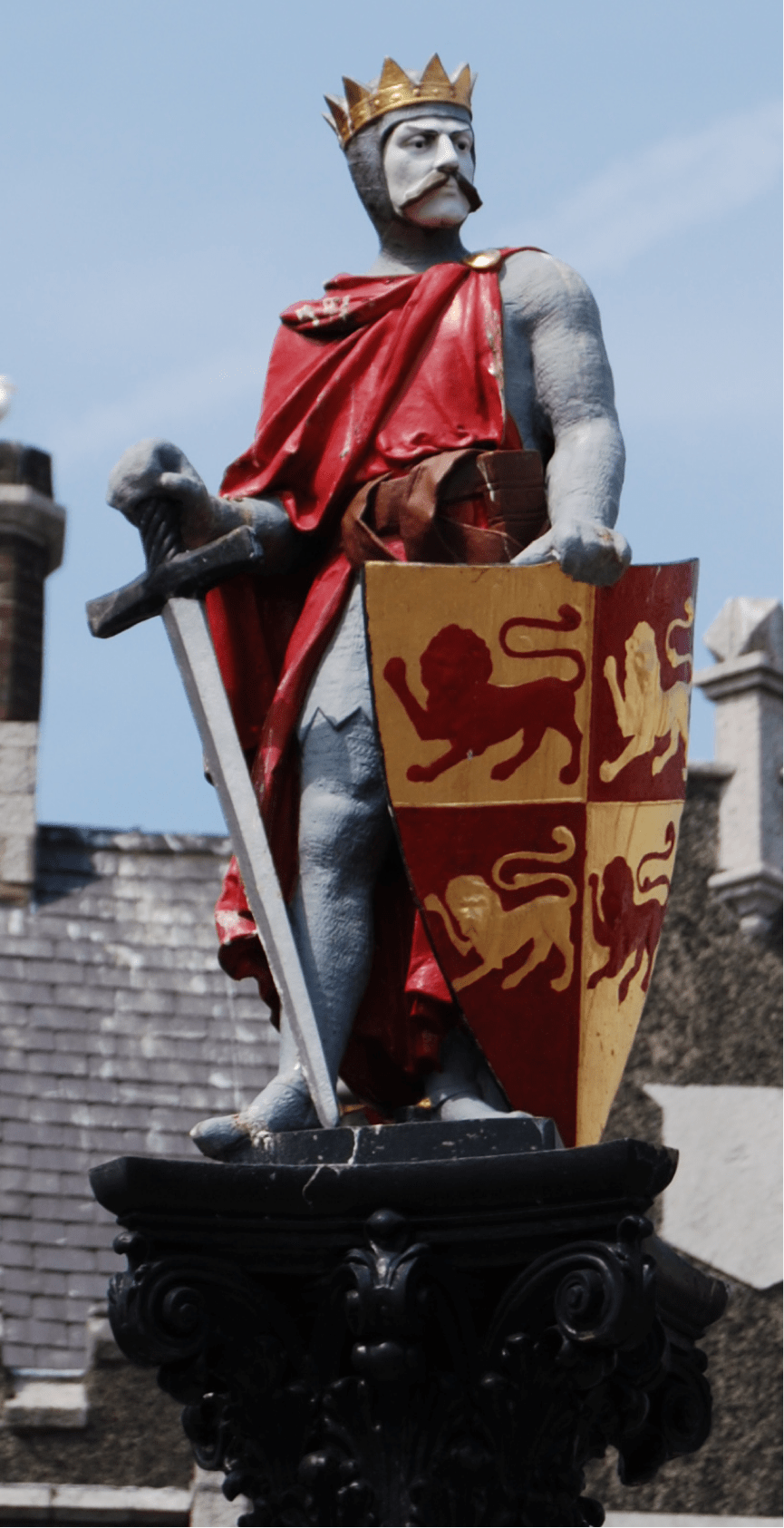
Dafydd ap Gruffydd

EdwardDafydd was the grandson of Llywelyn the Great.  He was also the first nobleman in Britain to be executed by being hanged, drawn and quartered for treason.

The story is a complicated one and begins with Llywelyn the Great.  Llywelyn married Joan, the natural daughter of King John.  They had one son who inherited his father’s kingdom.  He died without heirs so the kingdom was inherited by the heirs of Llywelyn’s other son Gruffydd who had been excluded from a share in the power because of his illegitimacy.  This had followed the English way of excluding all but the legitimate heirs.  Now though Gruffydd’s four sons all had an opportunity to make a bid for power.

In 1256 Llywelyn ap Gruffydd managed to wrest power from his brothers.  The early years of his reign were helped by the fact of the Baron’s War in England and the role of Simon de Montfort.  Dafydd formed an alliance with King Henry in 1263 and continued to fight against his brother alongside Edward I from 1274.

The alliance with King Edward served Dafydd well.  He married Lady Elizabeth Ferrers, the daughter of the Earl of Derby and widow of William Marshall (2nd Baron Marshall).  He gained land and prestige in England.  But then Dafydd thought better of his links with the English and returned to fight alongside his brother.  He attacked Hawarden Castle during Easter 1282.  Edward was unamused.

That same year Llywelyn was killed and Dafydd became the next Prince of Wales.  It probably wasn’t a very comfortable position as Edward was hot on Dafydd’s heels.  In fact he was captured once but managed to escape into the Snowdonian Mountains.  Finally he was cornered along with his younger brother Owain.  Also imprisoned were Dafydd’s wife, their seven daughters, two sons and one niece.

The Lanercost Chronicle takes up the story:

The King sent him forward to the Tower of London with wife and children….David’s children were condemned to perpetual imprisonment, but David himself was first drawn as a traitor, then hanged as a thief; thirdly, he was beheaded alive, and his entrails burnt as an incendiary and a homicide; fourthly his limbs were cut into four parts as the penalty of a rebel.


This all took place in Shrewsbury.  As for his wife and children.  Their fates are not completely known.  His wife is thought to be buried in the church at Caerwys.  One daughter, Gwladys, a child, was sent to the Gilbertine convent in Sixhills Lincolnshire where she spent the rest of her life along with her cousin.  Her brothers Llywelyn and Dafydd were imprisoned for the rest of their lives.  Llywelyn died in suspicious circumstances in 1287 in Bristol Castle.

Edwin’s Place

KSCN0001King Edwin’s kingdom stretched from Edinburgh – Edwin’s Town- to the River Trent.   This was the Kingdom of Northumbria He was accepted as the High King or Bretwalda.  Following his marriage to Ethelburga of Kent (daughter of Ethelbert) in AD 627 he became Britain’s second Christian king. Bede described Edwin  as more powerful than any earlier king and as time passed he extended his kingdom to the Isle of Man and Anglesey.

His invasion of North Wales resulted in Cadwallada of Wales and Penda of Mercia forming an alliance against him and invading his kingdom in 633.  He and two of his sons were killed at the Battle of Heathfield  which could be near Cuckney or alternatively at Hatfield near Doncaster – though it would be unlikely for the next part of the story to be true if this were the case.

Edwin’s comrades carried his body from the scene of the battle and buried it in the forest.  They carried his head back to St Peter’s in York., though another version has Cadwallada displaying Edwin’s head on the ramparts of York’s city walls following a veritable  Saxon-killing spree.  In either event the battle was bloody and decisive.


Eventually it was decided that Edwin’s body should be buried in Whitby Abbey where his niece St Hilda was abbess.  By that time people were calling him a saint.  The spot where his body had been buried was deemed a holy place and a wooden chapel built on the site.  This became known as the ‘place of Edwin’ or Edwinstowe.

Edwinstowe was part of the royal manor of  Mansfield in 1066.  Inevitably, given the Norman kings love of hunting the land around Mansfield and Edwinstowe became part of a royal forest.  The Domesday Book of 1086 records the church, a priest and four bordars – these were essentially slaves working the priest’s land.  Twenty years later there was even less land being cultivated.


In later times King John, who had a hunting lodge at Ollerton, paid a priest to live in a nearby chantry to say prayers for his soul and for the souls of the people he had wronged.

The local people probably felt they ought to have been included in the number as they were bound by the strict forest laws that protected the timber and the game of royal forests.   Those caught breaking the law were taken before the Forest Court or Eyre which was held every six or seven weeks.  More serious offences were tried at the Nottingham Eyre.

Thomas Merks – the loyal bishop.

This is one of those posts without a picture.  I may track one down eventually.  Thomas Merks or Merke died in 1409.  He was Bishop of Carlisle for three years between 1397 and 1400.  His duties were not terribly onerous.  After all, Richard II could not really do without one of his principle advisors.  It was Merks who helped negotiate the King’s marriage to Anne of Bohemia.  The Westminster monk did much to make himself indispensable to Richard II.  He helped to negotiate the dowry of Isabella of Valois and he went with Richard to Ireland.  Some chronicles accused the bishop of enjoying evenings of carousing rather than prayer but these were Lancastrian chronicles and they had no love for the king’s bishop.

 In 1400 Merks found himself in the Tower.  He had remained loyal to his king even when Richard no longer had his throne.  Only one other bishop was deprived of his see by Henry Bolingbroke, Duke of Lancaster who took on the title King Henry IV.  Merks  stood up in court to defend his master and paid a significant price.  He ended his days deputising for the Bishop of Winchester.  The family had links to the area – Merks nephew is buried in a local church.

Kirkby Stephen

DSC_0020At Kirkby Stephen I am hard on the trail of Sir Andrew de Harcla, First Earl of Carlisle – hero and traitor.  I’ve posted elsewhere about his treaty with Robert Bruce that left Edward II so enraged that he had Sir Andrew arrested, stripped of his titles and sent to a traitor’s death on Harraby Hill in 1325 despite the fact that Edward owed his crown to Sir Andrew.  Various bits of Sir Andrew’s anatomy were nailed to various city gates but eventually his sister was allowed to gather his remains together and bury him near his childhood home- Hartley Castle- which is just down the road from Kirkby Stephen.

Hartley Castle lies beneath the Eighteenth/Nineteenth Century house that stands on the castle’s outer court.  On Sir Andrew’s death all his property was forfeit to the crown.  It passed from Harcla or Hartley hands into those of Ralph Neville of Raby.  He sold it on to Thomas de Musgrave. The stones from Hartley Castle were used by the Musgraves to build a manor house at Edenhall.

There are two memorials to the Musgraves in Kirkby Stephen Church and until I read the notes in the church I assumed the knightly effigy in the Hartley Chapel belonged to Sir Andrew.  It turns out that the knightly chap is Sir Richard de Musgrave- a good century later than the earl (note to self revisit medieval costume)- while the humble red sandstone slab next to the altar belongs to Sir Andrew.  It makes sense because this is, after all, the position with most honour attached to it.

The church really is well worth a visit. The Norman church stands on the site of an earlier Saxon church.  This in itself sums up Kirkby Stephen.  It’s knee-deep in history  going back to the Stone Age and Bronze Age.  But back to the church.  You enter the church precincts through a cloistered area built in 1810.  Once inside the church, known as ‘the Cathedral of the Dales,’ as well as the mellow smell of wax and polish there’s plenty of evidence of generations of worshippers.  There’re eighteenth century shelves for bread to be given as alms to the poor.

And a Loki stone.  There are only two Loki stones in the whole of Europe and one of them is in Kirkby Stephen.  Loki was the Norse god of mischief.  The other Norse gods chained him up because he was a very naughty god…or words to that effect.  Kirkby Stephen’s Loki stone has been Christianised as he comes from the shaft of a tenth century Anglo-Danish cross shaft.  Loki has been transformed into the devil in chains.

After all that excitement it was time to brave the rain once again and go in search of tea and scones – all of which, I think you will find, are essential to most acts of historical research.

The sun had come out by the time we’d had a nice cup of tea and I was able to explore the town.  It was once on the borders and the inhabitants built it so that the streets were deliberately narrow.  They’ve been widened but it is easy to see how the people of Kirkby Stephen set about protecting themselves from the Scots.

There  was also a fascinating leaflet in the tourist information office about Kirkby Stephen’s secret tunnels.  One of the suggestions made is that there is a tunnel leading to Hartley Castle as part of the defences against the aforementioned Scots- having said that the leaflet also suggests tax avoidance, plague tombs and links with Pendragon Castle which is just down the road.  And yes, Pendragon Castle does have links with King Arthur.  He gets everywhere.

On a more historically viable basis I discovered that Kirkby Stephen was heavily involved in the Pilgrimage of Grace in 1536/7 which was the North’s response to Henry VIII’s dissolution of the monasteries.  James I managed to irritate the citizens of the town when he tried to confiscate some of their land and perhaps unsurprisingly in the light of the previous two facts the town supported Parliament during the English Civil War.  They even managed to get themselves involved with a plot against Charles II in 1663.  The Kaber Rigg Plot failed and its leaders were hung in Appleby.  Who would have thought that such a tranquil little place could have so much fascinating history?

DSC_0023

A City Livery Company and Spotty Panthers or maybe Leopards.

DSC_0107The livery company in question is the Worshipful Company of Dyers and leopards or even panthers are heraldic beasts.  I actually think you’ll agree that the phrase ‘big spotty cats’ just about sums up these wonderful creatures.  It looks as though someone under the age of ten has had a wild time with a paintbrush. Dying- and I think I’ve spelled that right- has been going on in London, so far as records are concerned, since the twelfth century but it was Lancastrian King Henry VI who gave the company its first charter in 1471.  Given that this was not an auspicious time for the English monarchy it is perhaps not surprising that the following year the Yorkist King Edward IV dished out a brand new charter.

The dyers have had their headquarters of Dowgate Hill since Tudor times which means that this building isn’t the original one on the site – yes, the 166 Great Fire of London strikes again.

But back to the coat of arms.  The three corded bags on the shield are bags of madder – the plant used to produce a red dye.  The motto, ‘Da Gloriam Deo’ meaning give glory to God.  So far so good. From now on the explanation gets a bit more complicated. I have, of course, arrived at the two supportive large spotty red-whiskered cats.  The Worshipful Company of Dyers describe them as panthers and they should know; after all it’s their coat of arms.

There are three big cats in heraldry – lions, leopards and panthers…though tigers do turn up occasionally but let’s leave them out of the equation for the time being as things are going to get difficult enough as it is. As I understand it – and I’m not an expert on heraldry- if the cat is ‘passant‘ which means three feet on the ground, one paw raised and face turned to look at you – think cat stalking while pausing to have its photo  taken- then its a leopard.  This in turn raises some interesting questions about the three lions on the royal coat of arms and the famous three English lions of the football song.  If the cat is standing on its back legs- rampant– then in medieval English heraldic terms it is a lion.  Just to confuse matters even further in medieval terms a leopard was the offspring of a lioness and a panther. Thankfully I don’t have to try to work out the change from leopard to lion for myself. There is a very helpful article on the subject in the BBC History Magazine website BBCHistory Magazine Extra. Basically the leopards on the royal coat of arms turned into lions during the Hundred Years War – something similar, I expect, to the rebranding exercise carried out by the House of Saxe-Coburg-Gotha when they turned into Windsor during World War One at the point when links with Germany became somewhat uncomfortable.  If you want to read the article click on the picture.

Anyway back to our big cats – the red whiskers and red wavy dog like ears are neither whiskers nor ears.  It’s flame.  This turns our cats in to heraldic panthers incensed- and I think I’d be fairly annoyed if I started breathing fire out of my ears.  According to the tattered remnants of my old heraldry book, this represents the very sweet breath of the panther.  Apparently the heraldic panther is more of a mythical beast than a real animal and has its origins in Greek beliefs.  The breath of the panther, as symbolised, by the flames, lures animals into its lair.  You will be pleased to hear that dragons are immune from the panther’s breath and are afraid of panthers as a consequence where as every other animal goes traipsing off to the panther’s lair – possibly to be turned into a mid morning snack but don’t quote me on that because medieval sources couldn’t agree either, some of them have the panther down as an exceptionally gentle beast.

Back to safer ground.  Heraldic panthers are also often shown with spots – that’ll be these two then- in ‘heraldic speak’ the spots are semeé of roundels. Initially I thought that the spots and bright colours of the incensed panthers was an excellent choice for the dyers – those bright colours are pretty good advertising after all. Then when I carried out a web search I discovered that there was a heraldic link to Henry VI who gave the dyers their first charter. “King Henry VI used the panther for his badge, to indicate that “a Kinge should have so many excellent and severall vertues as there are diversities of spottes and most beautifull Coullors in this Beast, and then his People will love and followe him for his vertues as all other Beastes love and follow the Panther for his sweete smell and glorious coullors” (Coll. Arms MS. L. 14, pt 2, f. 380). Other descendants of the House of Lancaster also used the panther.” http://bestiary.ca/beasts/beast79.htm

I bet there was a lively discussion held by the dyers the following year when the Lancastrians were shown the door and it looked as though the Yorkists were triumphant.  It just goes to show though that the streets of London, while not paved with gold, are knee-deep in history even if you have to do a little digging sometimes. DSC_0108

Dick Whittington

DSC_0089DSC_0089Just exactly what, you might be asking, is a pantomime character doing in a history blog?  Except of course, that  Sir Richard Whittington really was the Mayor of London – not once, twice or even thrice but four times…okay three and a half if you’re being picky about it.  He first became mayor in 1397 having been asked by Richard II to fill in for a defunct mayor (hence the half prior to the election), 1406 and 1419.  He even went on to become one of London’s members of Parliament. So far so good.

However, he was not a penniless orphan. He was the son of a Gloucestershire knight born in 1350.  When Richard’s father died, young Dick – who was by way of the spare in the phrase an heir and a spare- was apprenticed to Ivo Fitzwarren, a wealthy mercer.

In reality Richard did marry Alice Fitzwarren and he did become a wealthy and influential man though that’s about as far historically as anyone can go.  There is no historical record of worldly goods being tied up in a red handkerchief, no historical record of informative city bells and no account of the cat which helped secure his fortune. Though one does feature in the window of St Michael Paternoster church on College Hill which Whittington helped to fund. Oh yes – and when excavation work was carried out in the church in 1949 a mummified cat was discovered during a search for Dick’s missing tomb- not really surprising given the amount of demolition work and rebuilding that the church has experienced over the centuries. The idea of a real cat is rather more intriguing and definitely more appealing than the suggestion that the cat originated like a game of chinese whispers from the more merchantish preoccupation with ‘achats’ or purchases.

Cat owner or not,  in reality Richard Whittington was a canny and influential mercer who sold his cloth to the royal court and lent Richard II, Henry IV and Henry V money.  In 1399 for example, Richard II owed Dick Whittington £1000. It was Richard II who chose Whittington to be mayor when the mayor at the time died, very inconveniently, mid way through his term of office. He also appears to have been able to export cloth without paying taxes – a perk of lending money to kings.

Dick died, childless, in 1423.  Alice was already dead.  He was buried by her side.  He left most of his money to charity including for St Bartholomew’s Hospital.  It should be added at this point that the original St Michael Paternoster Church burned down during the Great Fire of London in 1666 and was rebuilt by Sir Christopher Wren (the last of his London churches).  The new church didn’t fare too well during World War Two.  Trouble arrived in the form of a flying bomb which left the church a derelict shell.  It was rebuilt in the 1960s.

When history becomes mystery – or perhaps its the other way round. A brief look at Robin Hood.

P2101335So much for a catchy title!  Before we begin I need to admit that Robin Hood is my all time hero.  My father used to read me the tale of Robin Hood, at my request, again and again.  I visited Nottingham when I was seven and was disappointed with the castle in the way that only a seven-year-old can be.  I was expecting Hollywood turrets, battlements and assorted drawbridges.  Even worse, so far as fair Nottingham was concerned, what the bombing raids of Luftwaffe didn’t destroy, the city planners had mangled.  I can still remember my Dad going round the one way system getting progressively more irritated.  Things only really got better when we arrived in Sherwood Forest and we went in search of the Major Oak.  But enough of my personal history – just be aware that I have a not altogether unbiased viewpoint as to whether Robin existed or not.

Legend, film versions at any rate, places  Robin Hood and his merry band firmly in the reign of Good King Richard and Bad King John.  Other versions place him in the reign of Henry III, possibly dying with Simon de Montfort at the Battle of Evesham.

In some respects it doesn’t really matter.  The fact is that The Lyttell Geste of Robin Hood was set in print by William Caxton.  This is a version of an oral tradition that must have been handed down over the generations. And here its worth a moment’s digression. If we look at the ballads of the border reivers such as the tale of Kinmont Willie it is possible to see where history has become embroidered by the needs of a good story and the formula of the  ballad.  There’s also a little bit of a hint that Sir Walter Scott may have tidied the whole thing up somewhat.  It is possible to see a sixteenth century historical event turning into a story.  The same, perhaps, can be said for Robin Hood excepting the fact that there isn’t anywhere near as much paper based evidence for Robin Hood as there is for William Armstrong of Kinmont who took for himself rather than anyone else irrelevant of the wealth of his victims but still seems to have managed to stay one step ahead of the law.  And yes, Sir Walter Scott did embroider the Robin Hood story – who could forget Ivanhoe?

There is, however, a faint trace of a historical paper trail for the man in green.  The Court Rolls of the Manor of Wakefield; the Contrarient Rolls of King Edward II and the Household Expenses Account of Edward II reveal an archer by the name of Robin Hood. The key thing is though, not whether he existed or was fabricated by disgruntled over-taxed peasants, but that he became a national hero – and was sung about in English.  Robin reflects the fact that during the Plantagenet period the English were beginning to get a sense of themselves as a nation.  In part, this was because King John lost his continental empire and was forced to concentrate on England – not that the barons were terribly grateful for the favour. The accession of Henry III, the first child monarch in English history, saw a time of some weakness for the monarchy and the reissue of Magna Carta; the concept of shared power (well shared if you were a baron); a rising group of free men and a somewhat fairer legal system.  It is perhaps not surprising then that Robin’s story should be associated with a period in history when the English were beginning to evolve as a nation.

Of course, the Black Death killing one-third of the British population between 1349-50 helped matters along rather nicely as the English-speaking hoi-poloi suddenly found that they had more economic clout than previously but the fact that  English was reinstated in schools that same year, although the universities of Oxford and Cambridge continued to use Latin, reflects the growing importance of the English language and the changing perspectives of the ruling classes.  They were beginning to see themselves as English rather than Norman.  In 1362 English replaced French as the language of law by the Statutes of Pleading but records continued to be kept in Latin and English was used in Parliament for the first time.

Now if you don’t mind, I’m off to re-watch Errol Flynn being heroic in the green wood. If you want to find out more about the history of Edwinstowe where Robin Hood is supposed to have married Maid Marian, click on the image at the beginning.  It will take you to an article I wrote and had published a couple of years ago.  You might be surprised to discover that even Henry II gets in on the act as well.

King John and St Wolstan

king john1According to Roger of Wendover, as King John lay dying he commended his body and soul to God and St Wolstan. Wolstan was the Saxon Archbishop of Worcester, consecrated in 1062, who remained in post after the Norman Conquest.  Legend says he was called upon to resign his bishopric but lay his crozier upon the shrine Edward the Confessor in Westminster from whom he’d gained his bishopric.  No one could move the crozier except for Wolstan.  This was taken as a sign that the devoted, but not especially learned priest, should retain his see. king john It is hard to find a rationale for King John’s appreciation of Wolstan – who incidentally was canonised during John’s reign. Certainly chroniclers do not record a lifetime of prayer on John’s lips.  Perhaps John admired a man who overcame his temptations and turned aside from ambition but who still ended his life as a bishop.  Whatever the reasons, John was drawn to St Wolstan.  He visited Wolstan’s shrine at Worcester twice – once in 1207 and again in 1214.  He may have visited more often.  He came to Worcester to negotiate with the Welsh and also to hunt in nearby forests. John asked to be buried next to his favourite saint which is why he lies in Worcester Cathedral, as does Prince Arthur (Henry VIII’s elder brother).  The cathedral library contains John’s will and one of his thumb bone’s in its collection.