Robert, First Lord Clifford

IMG_4008Robert Clifford was born in 1274. He was the son of Isabella de Vieuxpont and Roger Clifford. The Cliffords were an old Norman family who took their name from their main seat in Herefordshire meaning that the Lords of Skipton were distantly related to Rosamond Clifford (Fair Rosamond) who was Henry I’s mistress. On his mother’s side – Isabella and her sister Idonea were coheirs to the lordship of Westmorland which, together with Edward I’s campaign to subdue Scotland, would ultimately change the marches upon which the Cliffords prowled.


Young Robert lost his father early so the vast lands (including Brough, Brougham and Appleby) that would one day be his passed into other hands for the time being. When he reached his majority Robert would spend years trying to regain property which had been stolen during his minority.  He ultimately grew to maturity under the care of Edward I from whom he learned the art of warfare in North Wales before making a name for himself in Scotland. By 1297 he was responsible for Edward’s castles in Cumberland as well as taking part in the perennial border warfare of the period. The following year, according to Summerson, he became Keeper of Nottingham Castle and the justice in the royal forests north of the River Trent. That same year Edward I gave Robert Clifford Caerlaverock Castle and all the lands that belonged to Sir William Douglas as a reward for his work. On one hand this was very nice for Robert on the other hand the Douglas family were not best pleased. Edward’s grant triggered a feud between the Douglasses and the Cliffords that lasted for the next hundred years.  It probably didn’t help that Robert’s actions in Dumfries and Annan were recorded in the Song of Caerlaverock. Clifford was undoubtedly a capable as well as loyal officer to the crown – it certainly helped him to build an extensive power base on which to build his family’s fortunes.

He attended Edward I until his death and from his appointment as Marshall of England by Edward II whom Clifford had served during the Prince of Wales’ time on campaign in Scotland. He didn’t hold the job for long. He also gave up his role of Justice and Keeper of Nottingham Castle.  In October 1309 he was appointed keeper of the English West March with Carlisle as its headquarters, and was ordered to act as Warden of Scotland, with a force of 100 men-at-arms and 300 foot soldiers – so he probably didn’t have much time to sit around in Nottingham.


It was at about this time Robert came to an accommodation with his childless aunt (Idonea) which ultimately resulted in the Lordship of Westmorland being granted to him. Robert Clifford already held Brough Castle and Appleby and now he was granted Skipton Castle making him a force to be reckoned with in the north.


Unfortunately the business of the Scottish Wars of Independence were somewhat sidelined by Edward II’s relationship with Piers Gaveston. The King’s favourite was greedy for wealth and power. In October 1310, just as Clifford was building a substantial power base for himself in the north-west the king granted the Honour of Penrith to Gaveston – a bit of a fly in the ointment so far as Clifford was concerned but not sufficient to make him join with many of the other English barons who formed a commission against Edward II to reform the way in which Edward governed his household and the realm.  The barons issued ordinances from which they gained the name Lords Ordainers.  One of the ordinances made Edward II take back into royal custody all the land which he’d given away.  This meant that Robert having gained Skipton was forced to return it to the crown.  A bizarre game of pass the castle then followed in which Skipton was then handed back to Clifford.  The reason behind this probably lies in the fact that Clifford had given his lands in Monmouth in exchange for the Honour of Skipton – so he wasn’t depriving the crown of its revenue. Clifford resumed his building work on the outer defences of the castle.


This uncertainty and his previous record for loyalty didn’t mean that Clifford wasn’t sympathetic to the demands of the Lords Ordainers. In 1312 he prevented Gaveston from receiving Scottish help, besieged him in Scarborough Castle and recovered royal jewels from Newcastle when they were abandoned by the king and his favourite. Later he acted as a go-between for the Earls of Lancaster and Warwick who sought a pardon when Edward II regained control of his realm. The earls received a pardon and so did Robert Clifford.


The pardons signaled a resumption of the Scottish War of Independence. In June 1314 Clifford was summoned to Berwick and the start of the campaign that ended in disaster for the English at Bannockburn. Clifford was killed in action. His body was taken to Carlisle and from there to Shap Abbey where he was buried.

Skipton Castle was about to face Scottish invasion and be plunged into civil war – life wasn’t going to be very restful for the Clifford family either.

Edgar the Atheling

Edgar_the_ÆthelingEdgar is Edward the Exile’s son born in 1050 or 1051.  On his father’s death in February 1057, probably by poisoning, he and his great-uncle King Edward (the Confessor) became the last remaining male descendants of Cerdic (essentially the founder of the royal house of Wessex) – hence the Atheling title meaning of ‘noble  or royal blood.’ As such Edgar was an appropriate candidate for the English crown.  King Edward took Edward the Exile’s family into the English court and cared for them.  Had Edward lived a little while longer Edgar might have been the natural heir to the crown just as his father had once been viewed in a similar way.

On King Edward’s death in January 1066 Edgar was a contender for the throne. Initially he was supported by the Earls Edwin of Mercia and Morcar of Northumbria at the Witan (council) which met to select the king.  However, across the Channel, Duke William of Normandy was making his own claim to the crown based on his relationship with Edward, promises made and a certain well-known oath made by Harold. In reality a youth without experience either leading men nor of war was not an ideal choice for a country about to be invaded.

In the aftermath of the Battle of Hastings the Witan selected Edgar to replace King Harold who famously died during the battle. Technically Edgar rather than King Harold was the last pre-conquest king of England but he was never crowned and besides which spent most of the nominal two months he was king on the run from Duke William.  Eventually he submitted to William in Berkhamstead in December 1066.

Edgar lived in William’s court where he was well treated but was, understandably,  kept by William as a hostage to his new subjects good behaviour.  He went to Normandy with the duke in 1067 but when he returned in 1068 he became involved with the earls Edwin and Morcar once more and soon found himself up to his neck in insurrection.  He fled to Scotland very soon afterwards – unlike the folk of York who had to live with the consequences of William’s irritation.

However, Edgar did have a secret weapon that kept him firmly on the political map – his sister Margaret, blogged about in an earlier post, who’d won the heart of King Malcolm (Canmore) of Scotland when the Atheling’s family fled to Scotland in 1067.  Malcolm agreed to support Edgar in his bid for the English throne.  They didn’t have long to wait.  In 1069 the people of the north rose against William once more – history repeated itself.  Edgar fled once more into Scotland.  This process was repeated once more by which time everyone must have been heartily fed up – there wasn’t much left in some parts of the North either.  The Domesday Book shows a marked drop in the value of rents from pre-conquest to post-conquest revenues in many parts of Yorkshire.  Though as with everything there are two sides to every story. One of William’s sidekicks – a chap called Alan the Red- who’d acquired rather a lot of real estate probably ensured his own lands weren’t terribly badly ‘harrowed’.  Not withstanding this salient point it is always worth mentioning that William the Conqueror was allegedly troubled on his deathbed by his unfriendly actions in the north (its a good story anyway though not necessarily fair to William.)

Eventually King Malcolm III signed the Treaty of Abernethy (1072) and that was the end of Edgar’s Scottish sojourn. The Atheling was forced to seek protection from King Philip I in France – Edgar was not a lucky lad.  En route to his new host he was shipwrecked and had to flee back to Scotland.  Malcolm sat his brother-in-law down and had a long chat with him then waved Edgar over the border into England into William’s hands.

The Conqueror treated the troublesome atheling well. He received a pension of £1 a day from 1074 onwards.  Clearly the relationship between Duke William and Edgar must have eased further over time because Edgar went to South Wales campaigning on William’s behalf. He was present at William Rufus’s coronation, went on diplomatic missions for William II and became embroiled in the unseemly squabble over the English crown that raged between William and his elder brother Robert.

In the end Edgar sided with Robert once too often after having spent most of his adult life steering difficult political waters to remain on good terms with everyone.  William Rufus is the king who had the unfortunate accident with an arrow in the New Forest. The English crown should have gone to his brother Robert (known as Curthose) but, hey, little brother Henry was right there while Robert was abroad.  Having got his hands on the crown and the royal treasury he did what anyone would do in the circumstances…became King  Henry I.

Edgar, who had been on a crusade with Robert was at the Battle of Tinchebray in 1106 – it didn’t do Robert much good- he was captured and imprisoned for the rest of his life.  On the other hand Edgar was welcomed back to court by Henry I who had handily married Edgar’s Scottish niece Edith.  Edith – who clearly wanted to win friends and influence people dropped the Saxon Edith and became the Norman Matilda.

Edgar died in 1125 having spent his latter years away from court. He was probably due a few quiet years!

Richard III – evidence in the bones.

Richard_III_of_EnglandIt turns out that someone somewhere has been skulking along the medieval corridors of power  late at night on their way to an assignation– the problem is that we can’t be sure when or even who was encouraging the aforementioned skulk and for the last five hundred years no one – with the obvious exceptions- have been any the wiser. An article published in this month’s edition of Nature has changed that along with the revelation that Richard was a blue-eyed blond or at least a blond baby whose hair darkened with the passage of time.


The story begins with Richard III. He’s a chap who’s provided history with more than one mystery and now there’s another to add to the collection.  Most folk are aware of the conflicting theories about the disappearance of Princes Edward and Richard in the Tower of London in the summer of 1483. Was Richard a wicked uncle responsible for the demise of his nephews or has history framed the last Yorkist king for a crime that he didn’t commit? Were King Edward V and Prince Richard done away with as Tudor chroniclers would have us believe and if so who did the deed and who gave the orders? Other scenarios suggest that one or more of the princes were spirited to safety; other folk suggest that the Lancastrians did the terrible deed to ensure their own man’s success. I wouldn’t like to make any definitive suggestions as there’s evidence that can be offered in support of all these options as well as plenty of circumstantial evidence and there are plenty of passionate advocates for the different theories.

This post isn’t about that.   It’s partly about a pleasant trip down memory lane and the way that history isn’t something that’s static – it shifts like quicksand. Richard and the missing princes were the first topic that was covered at my secondary school by way of an introduction to history and the trustworthiness of sources. As I recall there was a folder full of ‘evidence’ that had to be sorted and categorised to try to decide whether Richard did the deed – and that’s before we even advanced to his portrait – was he really as physically repellent as Shakespeare portrayed him? While we now know the answer to his appearance thanks to the work of countless professionals– including the surprising blue eyes and baby blonde hair- we still don’t know about his role as murderous uncle – its certainly not a debate I want to get tangled in; not least because I can never quite make up my mind. What I do recall is that I progressed from the facts to Josephine Tey’s Daughter in Time in the space of an afternoon and at the age of eleven became hooked on historical fiction.


What I’m really blogging about this evening are the findings from the Leicester University that were all over the weekend’s papers – the quicksand bit of history.  Something which appeared to be solid turns out to be mired in uncertainty.   Maternal DNA reveals that Richard really was the king under the car park but further analysis reveals that somewhere along the line of the Beaufort family the paternal line was broken – Richard has a rather unusual Y chromosome but the brave souls- Beaufort descendants who offered their own DNA for comparison do not match up to that of the last Yorkist King. Their Y chromosomes are much more pedestrian. Someone somewhere in the family tree between Edward III and Richard III was a bit of a naughty girl on the quiet.


One line of thought is that John of Gaunt might not have been the son of Edward III and Philippa of Hainault. There was a persistent rumour that he was the son of a Flemish butcher….an odd possibility. I mean, I can see how Duchess Cecily Neville (the wife of Richard of York and mother to Edward IV and Richard III) might have fancied a fling with a tall handsome archer (more of that in a moment) but how on earth would a butcher have met, let alone struck up a conversation that progressed to a liaison with the English queen?


Generally speaking it has always been assumed to have been a vile slander. John of Gaunt wasn’t popular in England. His palace at the Savoy was destroyed during the Peasant’s Revolt. Folk believed that he wanted the crown for himself even though he was always loyal to his nephew the young Richard II. Apparently the rumour of his supposed parentage made John very, very irritable as depicted in that wonderful fictional evocation of his mistress’s life Katherine by Anya Seyton.


It is equally possible that the cuckoo in the nest could have been John Beaufort,  Gaunt’s son by Katherine Swynford – one of history’s love stories… so I really hope not. It would be deeply ironic if the legitimised illegitimate son of the Duke of Lancaster turned out not to belong to the man who claimed him as a son.


Another possibility presents itself.  What if Richard was the progeny of a cuckoo in the nest? Or indeed not quite what he seemed. Rumours about Duchess Cecily, his mother, sprang up in relation to Richard’s brother Edward IV. It was suggested that Edward’s father was actually an archer called Blaybourne. There is also contention over the conception dates. Richard, Duke of York was in Pontoise while Cecily was in Rouen. It seems quite difficult to reach a definitive conclusion without the existence of undisputed primary evidence – though that’s only my opinion. Certainly Edward’s baptism at Rouen was very low-key but then again the Duke of York didn’t deny paternity and in Medieval terms that meant Edward was legitimate. The rumour floated to the surface at a time when George, Duke of Clarence took a shine to the crown and its not difficult to see that George might have used gossip for his own ends (supposition again).  When Richard needed a public justification for his claim to the throne in 1483 the rumour was aired again. And as we all know mud sticks and there’s no smoke without fire. I’m sure if I think I can come up with a few more clichés.


Whatever the truth about Plantagenet goings-on in the bedroom department, the very informative University of Leicester website reveals that false paternity is to be expected – apparently it runs at 1-2% per generation which if you’re a family historian should make for disturbing thoughts about your own ancestry.


Ultimately, the fact that someone passed off the child of their lover as legitimate makes no difference whatsoever to the events of the Wars of the Roses or the monarchy thereafter but what it does do is add another fascinating layer to a story that already has many complex twists and turns. Who needs soap opera  or even Cleudo when we’ve got the Plantagenets?


Edmund Mortimer, 5th Earl of March – from the House of Mortimer to the House of York.

white rose

Edmund Mortimer, 5th Earl of March (born in 1391), was descended from the second surviving son of King Edward III – Lionel of Antwerp. Lionel had only one legitimate child (well at least that’s straight forward). Her name was Philippa. Her mother was Elizabeth de Burgh, Daughter of the Earl of Ulster.  Edmund is not a York claimant to the throne.  He is a Mortimer claimant – but he is the link that takes us from the Mortimers to the House of York.

Philippa, Lionel’s daughter,  married Edmund Mortimer, third Earl of March – his grandfather had run off with her great-grandmother (Isabella of France) and plotted to overthrow and possibly murder her great-grandfather (Edward II). Philippa had four children. The one we are interested in for the purposes of this post is her eldest son Roger although the others will get a mention before the end. He became the 4th Earl of March as well as Earl of Ulster. So far so good – the Mortimer claim to the succession is good – though female in origin.

There are no Salic Laws in England to prevent a female claim to the throne.  Henry IV tried to argue that his claim was better than Philippa’s and her descendents because he was a male.  However, this was the same man who fought in France basing the English claim to the French throne on the fact the Edward III was Isabella of France’s son.  When Charles IV of France died, Isabella and her descendants were the next closest claimants to the French throne – a fact which the French refused to accept based on their Salic Law.  Henry IV was essentially trying to have his cake and eat it.


But back to the Mortimers – Roger, Philippa’s son, married Eleanor Holland- who adds to the blue blood running through the veins of the Mortimers with the blood of the Earls of Arundel and Henry III.


Roger, managed to get himself killed by the Irish when young Edmund, who this blog is about, was just six. This was unfortunate because Roger Mortimer’s claim to the throne was better than that of Henry Bolingbroke who went on to become King Henry IV. Roger was descended from the second son of Edward III while Henry was descended from the third son- John of Gaunt.

Richard II had recognized Roger as heir to the throne in 1385 according to one source. Other accounts suggest that Roger was walking a difficult tightrope in his cousin Richard II’s affections from which he could have easily fallen. Certainly after Roger’s death Mortimer’s lands were swiftly set upon by an avaricious king (Richard II as averse to Henry IV who was just as bad so far as Mortimer land was concerned).

Things went from bad to worse after Henry Bolingbroke usurped the throne. Edmund (now the 5th Earl of March) and his younger brother Roger became royal wards – they were in line for the succession after all and family as well…  In reality, they were largely brought up in Windsor as prisoners.  Edmund was not permitted anywhere near his estates.

Henry IV did have reason to feel nervous of the Mortimers. The boys had an uncle- helpfully also called Edmund- who felt that young Edmund had a better claim to the throne than Henry. Uncle Edmund felt so strongly about it that he joined up with Owain Glyndwr to rebel against Henry IV. Elizabeth Mortimer- the 5th earl’s aunt, wasn’t to be trusted either. She had been married to Henry “Hotspur” Percy who had died at the Battle of Shrewsbury (1403). In short Henry IV must have looked at his Mortimer cousins and regarded them as treacherous nuisances.

Just to complicate things that little bit further another cousin, Constance Plantagenet who was the daughter of Edmund of Langley, the 4th surviving son on Edward III, attempted to free Edmund and Roger Mortimer from Windsor in 1405. She thought if she could get them to Wales and Glyndwr that Edmund could be declared king. She wasn’t terribly keen on Henry IV although she’d kept her feelings hidden long enough to be trusted to care for Edmund and Roger. She was the widow of Thomas le Despenser, Earl of Gloucester who was executed for treason in 1400. Cousin Constance managed to get the two boys as far as Cheltenham before Henry IV caught up with them. What a happy family reunion it must have been for all concerned!

Things changed somewhat when Henry V ascended the throne in 1413. Edmund was knighted and finally allowed to inherit his estates. He married Anne Stafford, the daughter of the Duke of Buckingham and appears to have done so without asking Henry V’s permission because he was fined a huge amount of money for doing so. Interestingly there is no evidence that it was paid. In any event the 5th Earl of March, perhaps because of his somewhat dysfunctional childhood and adolescence, was a loyal and quiet subject to the Lancastrian Henry V before he died of plague in Ireland – and I’m sure by this stage you’re just as pleased as the regency council of baby Henry VI must have been- without any heirs.

Edmund’s younger brother Roger also died without an heir.  So that was that, so far as a direct Mortimer claim to the throne was concerned.

However, a claim remained within the family – (I’ve nearly arrived at the York claim to the throne – hurrah!)  Roger, the 4th Earl of March, and Eleanor Holland had four or five children – Edmund, the 5th Earl who died without an heir in 1425; Roger who died sometime around 1410 without an heir; Eleanor who did get married but when widowed became a nun – died without an heir; Alice, who according to Alison Weir might not even have existed and finally the eldest child of the family – Anne Mortimer.


Perhaps Henry IV would have been better locking her up because she married another cousin – Richard, Duke of Cambridge the son of Edmund of Langley.  Edmund of Langley (the fourth surviving son of Edward III) was also the Duke of York. Richard’s sister was the rather daring Constance who managed to extract two small boys from their imprisonment in Windsor and get to Cheltenham with them before she was caught.


If Plantagenet family gatherings look as though they might have been somewhat difficult by the time of Henry VI’s birth in 1421 it is also worth remembering that Richard, Duke of Cambridge was part of the Southampton Plot of 1415. The plan was that the plotters would get rid of Henry V and replace him with Richard’s brother-in-law – i.e. Edmund Mortimer, 5th Earl of March.


Edmund may have been involved in the plot up to his neck or there again he might not. The information is lost somewhere down the back of the sofa of history. Clearly Edmund got to thinking about the chances of the plot succeeding. He didn’t have to worry about hurting his sister’s feelings. She’d died four years previously. Edmund went to see Henry V to tell him all about the plot. Richard of Cambridge was executed.

However – Anne Mortimer left a son called Richard.  He became Duke of York and never forgot that his claim to the throne was much better than that of King Henry VI.


John of Lancaster, First Duke of Bedford

john of lancasterJohn of Lancaster,the man with the pudding basin haircut and rather sumptuous gown on his knees in prayer, was the third surviving son of King Henry IV and his first wife Mary Bohun. He was born in 1389.  His mother died when he was just five.

He is better known in history as the First Duke of Bedford. And he is famous, or perhaps infamous, for having Joan of Arc burnt at the stake for witchcraft.  As a mere girl she shouldn’t have been wearing trousers and she certainly shouldn’t have been leading French armies that thrashed English armies.

John’s eldest brother was Henry of Monmouth who went on to become King Henry V after a dissolute youth causing his father Henry IV despair (refer to Shakespeare Henry IV Part One and Part Two for a full litany of drinking, gambling and womanising along with princely reformation).  In any event Henry of Monmouth shook boorish habits from him as soon as he became king and went off to do what medieval English nobility expected of their monarchs – he went to war with someone, gained victory and land.

Henry IV’s second son was called Thomas but he was killed in 1421 at the Battle of Bauge in France. John was the third son and he was followed by Humphrey.  Much of the period of Henry VI’s minority is filled with the political machinations of John and Humphrey who was created Duke of Gloucester and Earl of Pembroke. Each of the brothers wanted more power than the other. Henry V had relied upon John when he was away fighting to rule in his absence.  He took the reigns of power for his brother three times in total.  However it fell to John to continue the English campaign in France despite the fact that he had been named Regent.  This left Humphrey at home.  He became the Lord Protector during John’s long absences in France.

Not that this stopped Humphrey from dabbling in politics in an attempt to destabilize John’s alliances with other European magnates. There was also the small matter of Humphrey antagonizing the next most important man in the kingdom during Henry VI’s minority – Henry Beaufort who was the Bishop of Lincoln, a key figure on the regency council and the half-uncle of Henry IV’s children. (Henry IV’s parents were John of Gaunt and Blanche of Lancaster while Henry Beaufort’s parents were John of Gaunt and Katherine Swynford).


John’s time in France had been successful – the French might not have been his greatest admirers given his severe administration techniques- until about 1427 at which point a quiet country girl with a dodgy hair cut, a large sword and angels telling her what to do rather rained on his parade. Her name was Joan of Arc.  He was forced to raise the siege of Orleans in 1429 on account of the peasant girl. Joan’s army took the Loire Valley and defeated the English after which she had King Charles VII of France crowned at Rheims which was against the treaty that the French had agreed to after Agincourt which saw King Henry V marry Katherine of Valois.  The French felt there was a world of difference between a mature victorious king and a baby boy – they perhaps had a point given the chaos that often resulted in England when a child was on the throne.

In any event it didn’t do Joan much good.  She was burned for witchcraft in 1431 – the French king who owed her his crown didn’t lift a finger to help her.  John had his young nephew crowned King of France in Paris so that for a little while at least there were technically two kings of France at the same time, though it rather depended where you were as to which one you recognised in public.

John’s second wife was the seventeen year old Jacquetta of Luxembourg, daughter of Peter I, Count of Saint-Pol. She caused a scandal after John’s death by marrying a mere knight called Richard Woodville.  She went on to have sixteen children and the knight became the first Earl Rivers  for his services to Henry VI and his queen Margaret of Anjou.  So when the Yorkists looked down their nose at Elizabeth Woodville, Jacquetta’s daughter and King Edward IV’s wife, they were forgetting that she was the grand-daughter of a Count and that her mother had once been at the heart of the royal court – albeit a Lancastrian one.

John, as well as being a soldier and a politician, was also a scholar. He founded the University of Caen and had a collection of important religious manuscripts, many of which survive today including The Bedford Hours which is held by the British Library. John’s first wife Anne of Burgundy gave the book to young Henry VI for Christmas in 1430 (I wonder how the grandchildren would react to a beautifully hand painted devotional text rather than the usual jigsaws, board games and selected Disney dvds).

John’s died at Rouen in 1435 during negations with the Burgundians who were breaking their alliance with the English to make a separate peace with the French.  His demise further weakened the stability of the English court where opposing and increasingly vociferous factions now had no one sufficiently intimidating to hold them in check.  The Plantagenet family were moving ever closer to implosion.


Henry Bolingbroke

Henry IVYoung Henry Bolingbroke was just eleven years old when he carried the ceremonial sword at his cousin Richard II’s coronation. The king was a year younger than Henry.

Henry, named after one of his father’s (John of Gaunt) Lincolnshire castles was also known as Henry of Lancaster. His mother was Blanche of Lancaster and as his father’s heir the title is one that makes sense. However, just to confused things he was also created the Earl of Derby and upon his marriage to Mary Bohun he was created Earl of Hereford – oh yes, then he deposed his cousin and became known as King Henry IV.


Henry’s variety of names is confusing enough but his familial relations look like spaghetti rather than a tree. Henry’s grandfather was King Edward III, his father John of Gaunt and his mother Blanche of Lancaster. So, far so good. However, when Henry married Mary Bohun, who was just eleven at the time and remained at home with her widowed mother after the wedding, Henry’s aunt became his sister-in-law! Edward III’s youngest son Thomas of Woodstock was already married to Mary’s older sister Eleanor. They were the co-heiresses of the Earl of Hereford. Henry’s mother-in-law was the widow of the earl and the daughter of Richard FitzAlan third Earl of Arundel.


As Richard II grew to manhood he became convinced about the authority of kings. It was this king who introduced the terms ‘Majesty’ and ‘Highness’. It was this king who demanded that anyone entering his presence should bow three times before they approached him. This high handed attitude, not to mention failure to go to war with France, didn’t win him friends within his family. Nor did his preference for ‘new men’ such as his chancellor Michael de La Pole help matters very much.


Inevitably there were plots. Eventually in 1387 the Lords Appellant, as they became known, forced Richard to tow the line. He spent some time in the Tower – possibly on the naughty step. Amongst the Lords Appellant were Thomas of Woodstock (Henry’s uncle and brother-in-law) and Richard Fitzalan, the fourth Earl of Arundel (Henry’s uncle-in-law), Thomas Beauchamp (Earl of Warwick), Thomas Mowbray (Earl of Nottingham) and Henry himself.


Of course, Richard didn’t take kindly to being told what to do by the nobility even if he was related to most of them. Eventually he regained his power and had Thomas of Woodstock sent to Calais where he ordered his royal uncle to be murdered. The man who organized this was another of Thomas’s nephews ….it’s always nice to see a happy extended family, isn’t it?

Henry’s uncle-in-law, Arundel, was given a show trial and executed. The Earl of Warwick must have heaved a huge sigh of relief when he found himself on a slow boat to the Isle of Man with instructions not to come back. The king seized the estates of all three of these Lords Appellent. Henry and Mowbray seemed, at least for the time being, to have escaped Richard’s wrath.


However, Mowbray suggested that the king would do to him and Henry what he’d done to the other three lords. The conversation was not a particularly private one and inevitably word got back to the king that Mowbray was plotting again. Henry denounced Mowbray before he could be accused of being involved.  He went on to challenge Mowbray to trial by combat. The two men were to have met at Coventry on the 16th September 1398. They were just about to attack one another when Richard banned the combat and exiled its combatants: Mowbray for life, Henry for ten years – demonstrating that Mowbray had been right all along.


Then John of Gaunt died. Richard changed Henry’s exile to life and claimed Lancaster’s estates as his own.


Henry landed at Ravenspur in July 1399. Men flocked to his banner. Richard, who was in Ireland at the time, hurried to meet his cousin but by the time he reached Conway Castle it was evident that Richard had lost his kingdom to his cousin.


Henry Bolingbroke became Henry IV by popular acclaim. If Richard’s abdication was real rather than forced – and the deposed king was to die very soon afterwards in Pontefract Castle.  The next rightful heir was eight-year-old Edmund Mortimer, Earl of March- and no one wanted another child on the throne.   Henry however, did not claim his right to rule exclusively from his grandfather. He claimed his right to rule through his mother Blanche of Lancaster. Blanche was descended from Edmund Crouchback, the second surviving son of Henry III. Henry IV allowed it to be known that rather than being the second born, Edmund Crouchback was actually the first born child but had been set aside in favour of his brother Edward (King Edward I) on account of his ‘crouchback’.   Given that crouchback meant cross-back it was probably a reference to his crusading zeal rather than any physical deformity.


Henry did not have a peaceful reign. Owen Glendower rose with the Welsh in rebellion and the Earl of Northumberland joined in with his son ‘Hotspur’. Hotspur was the husband of Ann Mortimer and therefore uncle to Edmund Mortimer (the child with a better claim to the throne than Henry). It would be nice to think that he was outraged that his nephews Edmund and Roger Mortimer were being imprisoned simply because of their ancestry but it is much more likely that he, together with his father Northumberland, was furious that they hadn’t received what they perceived to be their dues for supporting Henry when he arrived at Ravenspur. They were also expected to guard the border with Scotland more efficiently now that Henry was on the throne.


In any event, Henry had to quell rebellions, assassination attempts, deal with financial difficulties, his own heir’s apparent waywardness and his poor health. It was widely reported that he became a leper- he certainly suffered from an unpleasant skin disease of some description. He had difficulty walking and had a fit whilst praying in Westminster Abbey before dying on the 20 March 1413.


He left a warrior son to become King Henry V. Unfortunately for England, King Henry died when his own son by Katherine of Valois was an infant.

The Mortimers had not forgotten their claim to the throne (though Edmund and Roger died without children- their sister Ann had married and had children).  Their claim to the throne was  better than baby Henry VI’s. The stage was set for The Cousins War or as we know it, thanks to Sir Walter Scott, the Wars of the Roses – which strange though it may seem given that I’ve cantered through the reigns of both Richard II and his cousin Henry IV,  is what I’m warming up for with this post.


Charles I in York


stwilliamscollegeyorkKing Charles I stayed in the King’s Manor, York in 1633 and again in 1639.  The building which had formerly been part of St Mary’s Abbey was in the aftermath of the Reformation turned into the residence of the President of the Council of the North. Charles’ father stayed there on his journey from Edinburgh to London.

The 1633 visit that Charles made followed his journey to Edinburgh to be crowned King Charles I of Scotland.  Six years later Charles arrived in York on his way to make war with the Scots because they refused to accept Archbishop Laud’s Prayer Book.  The resulting war, known as The Bishop’s War was ultimately a disaster for Charles.

The King’s Manor where he stayed on both these occasions  is now part of the University of York  but Charles’ coat of arms can still be seen above the door  near to the art gallery– but not seen in this blog because I focused on the bricks around it rather than the heraldry when I took my photograph (not once but thrice): don’t ask me why!

In any event York was to become the stage on which King Charles I played once more in March 1642.

Charles attempted to arrest five MPs  at the beginning of January 1642.  The unrest that followed disturbed him so much that the king fled with his family first to Hampton Court and from there to Windsor on the 10th January.

The Royal family split up soon afterwards.  Queen Henrietta Maria escorted her eldest daughter Princess Mary to Holland. Mary had married William of Orange the previous year. Charles accompanied his wife and daughter to Dover. It is said that the king was in tears when he said his farewells to Mary whom he never saw again. The queen, in addition to ensuring her daughter was settled into her new home also had other business in Holland.  She had a selection of the crown jewels in her luggage which she intended to sell in order to pay for men, munitions and weaponry as civil war looked inevitable.


Charles meanwhile travelled north to York with his court.  He remained there for the next six months.  What this effectively meant, given that Charles I governed by personal rule, was that if anyone wanted anything done that required the king’s attention then they had to travel to York.

York became England’s capital city if not in fact then in practice. A procession of officers of state, petitioners, foreign ambassadors and even a parliamentary committee arrived in the city to keep an eye on the king, although officially they were there to keep the channel of communications open. Unfortunately the king’s supporters were also gathering so occasionally the communications involved fisticuffs  as well as hard words.


A printing-press was set up in St. William’s College (more recently it featured in the recent adaptation of P.D. James’ Death Comes to Pemberly as the location for the trial scenes). The press enabled Charles to issue declarations and to send messages around the country in a bid to increase his support. The country was not at war yet but the war of words was well under way. Propaganda was an essential part of the war effort for both king and parliament.


As winter turned into spring  and then into summer more and more men arrived in York to offer their swords to their king. Other men came to the city in a bid to persuade Charles that negotiation with Parliament was the only way forward.


Charles held two important meetings in York; one in the castle on 12 May 1642 and the other on Heworth Moor on the 3rd June. Charles summoned over 70,000 lords and gentry of Yorkshire. Not everyone attending the meting was sympathetic to the Charles. Lord Ferdinando Fairfax petitioned the king to stop raising troops against Parliament and was virtually ridden over for his pains when the king refused to accept the petition.

Events took yet another turn for the worse when Hotham (who was Governor of Hull) refused Charles entry to the city.

Fortunately for York although Charles talked about raising his standard which would in effect be a declaration of war on his own parliament he didn’t do so until August by which time he was in Nottingham.


The image in this blog depicts the gateway to St William’s College.

Robert Carr, the king’s favourite…murderer.

carr-miniatureRobert Carr was a Scotsman born in Somerset. He was the son of Sir Thomas Kerr of Ferniehurst Castle in Scotland. The Kerrs – a border family – were known for their left-handedness; they even built their castle staircases to favour their choice of weapon hand. In parts of Scotland, to this day if you’re ‘kerr-handed’ then you’re a left hander. Carr’s mother, Sir Thomas’s second wife, was a sister of the Bold Buccleugh, otherwise known as Walter Scott.


Carr began his rise to prominence in James I’s favour in 1606 when his broke his leg, in some accounts it is his arm and there’s also the possibility that it was a deliberate act to attract the king’s attention, during a tilting match at which the king was present. Apparently the king witnessed the accident, recognised Carr and helped nurse the young man back to health whilst at the same time distracting him from the tedium of a broken leg by teaching him Latin. It turned out he needed the help. Carr a handsome and athletic young man was not naturally academically gifted.  He had to rely on the advice of his friend Sir Thomas Overbury for ‘brainwork.’

James conferred the Manor of Sherbourne upon the handsome young man. Lady Raleigh nee Throckmorton was given some compensation for the loss of her home but it was something else toehold against the king’s Scottish favourites- and Carr was undoubtedly the king’s favourite. The young man, who needed help with his Latin because he wasn’t the sharpest cookie in the jar, began advising the king. In 1610 Parliament was dissolved on Carr’s advice and after Robert Cecil’s death in 1612 it appeared that there was no stopping the man. He became a privy councillor, the Earl of Somerset and the Lord Chancellor. Carr garnered wealth from his position, presents from the king and from the bribes that he collected.  He was at the heart of the court.


Carr’s first mistake was to marry Francis Howard, who was still married to her first husband the Earl of Essex at the time when their courtship began. His second was to be implicated in a plot to poison his one time friend and advisor Sir Thomas Overbury. Overbury, Carr’s principle advisor, henchman and ‘go-getter’ distrusted the Howard faction and had initially advised against the marriage.  Francis’s family saw to it that Overbury ended up in the Tower where he died of natural causes…or so it seemed.

Thanks to Carr, James’s relationship with his Parliament deteriorated and after the fiasco of Frances Howard’s first marriage being annulled James’s reputation as a law-maker was sullied.

His third and biggest error was to fall out with King James in 1615. He was quickly replaced by George Villiers, Duke of Buckingham. Shortly afterwards Carr found himself in trouble, along with his conniving wife, for the murder of Overbury. Francis was guilty but Carr always maintained that he was innocent. Neither he nor his wife were executed. They remained in the Tower until 1622. Carr died in 1645.


Kings and Queens

Detail from Ripon Cathedral.

Detail from Ripon Cathedral.

I still have the wooden ruler I was given as a child that lists all the rulers from 1066 onwards.  I shall be buying a modern version to give to my middle grand-daughter as she is currently undertaking a project on the kings and queens. I’m sure it will come in useful.

What else might she need if she is to know all that needs to be known about our assorted monarchs?  Well in addition to the royal family tree – I have two (one that’s been lurking in a cupboard since I left university and a second that came free with a newspaper), I’ll also be sending along a copy of the Kings and Queens of England & Scotland by Plantagenet Somerset Fry.  There’s also a Ladybird book (come to think of it I think I may have had that once upon a time).

However, the reason for this post is the rather fun mnemonic rhyme to help remember the monarchs in order….

Willie, Willie, Harry, Stee,
Harry, Dick, John, Harry Three,
One-To-Three Neds, Richard Two,
Harrys Four-Five-Six… then who?

Edwards Four-Five, Dick the Bad,
Henrys seven and eight, Ned Six (the lad),
Mary, Bessie, James you ken,
Then Charlie, Charlie, James again…

Will & Mary, Anne of gloria,
Georges ( 4 ), Will Four, Victoria,
Edward Seven next, and then
Came George the Fifth in 1910…

Ned the Eighth soon abdicated,
So George Six was coronated,
Then Number Two Elizabeth…
And that’s all, folks (until her death…)!!


I’m a bit sad that the Empress Matilda doesn’t get a look in or the Young King – Henry was crowned king of England by his father Henry II while he was still very much alive.  I suppose that would be rather complicating matters as indeed would Lady Jane Grey.  To find out more about some of the monarchs click the tab marked “Rulers” at the top of the page.

I have also discovered that there’s a sentence to help remember the Royal Houses:

No Plan Like Yours To Study History Wisely!

Norman, Plantagenet, Lancaster, York, Tudor, Stuart, Hanover, Windsor

How brilliant is that? I’d love to find out if there are any more helpful historical memory devices.

A Little Bit of Luck

Luck of Edenhall

Luck of Edenhall

When I was a child we used to refer to a bird splattering the car window screen  with its guano as leaving ‘luck’.  As an adult responsible for washing my own car I fail to see what luck has to do with it.  However, back to matters in hand, the lucks of today’s post as rather prettier and infinitely more historic – although once again in some instances ‘luck’ seems to be missing from the equation.

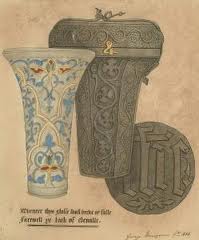
The first luck is the ‘Luck of Edenhall’ which used to be in possession of the Musgrave family of Edenhall. The ‘luck’ is a beautiful gilded and enamelled glass beaker (it looks like a vase to me but what do I know).  It was made in Syria so the chances are that it made its way home in the trunk of a Musgrave crusader.  Remarkably it survived the joys of reiver warfare, heavy handed drinkers and the washing up bowl.  Though to be fair it must always have been prized because when not in use it was kept in a leather container that had been made in the Fourteenth Century. The case bears the letters IHS suggesting that it was once used as a communion challice.

The luck was still in one piece at the beginning of the Eighteenth Century when the current owner decided it would be a good idea to drink the health of the entire family from the priceless heirloom.  Luck must indeed have been on the side of the Musgraves because it survived and went on to feature in a ballad.

Border ballads had been popularised by Sir Walter Scott and James Hogg at this time and “The Drinking Match” was a modern contrivance which featured the medieval glassware.

If this cup should break or fall,

Farewell the Luck of Edenhall.

From there it was one small step to the fairies – quite literally at the bottom of the garden – who were supposed to have given the luck to the Musgraves after water was drawn for them at a well.

The Musgraves aren’t the only family to have a ‘concrete’ luck that they need to guard against disaster.  The Lamb Family of Great Salkeld had a brass dish allegedly given by hobgoblins at a wedding feast.  A girl from the wedding family went to a nearby well to fetch water where she was accosted by a hungry hobgoblin – or gaggle of hungry hobgoblins depending on the account- who said that they would bless the bride and groom in exchange for food and drink.

Sir John Pennington was the Lord of Muncaster Castle during a portion of the Wars of the Roses.  In the aftermath of the Battle of Hexham (15 May 1464) King Henry VI was found wandering over the fell.  He was taken to Muncaster where Sir John and his wife cared for the broken monarch for the next nine days.  When he left the monarch – who could have done with a bit more luck himself- gave the family a glass cup telling them that they would prosper so long as it remained unbroken.  It is still on display in Muncaster Castle.

View across fells from Muncaster Castle

View across fells from Muncaster Castle

The final luck in this post brings us to the Luck of Workington.  Mary Queen of Scots fled across the Solway Firth in a fishing boat with sixteen companions.  When she arrived she had very few possessions and needed shelter.  Lord Herries, a Scottish Lowland laird who’d remained loyal to his queen sent a message to Sir Henry Curwen of Workington with whom he had a friendship.  Sir Henry sheltered Mary until she could be escorted to Carlisle Castle.  When she left she gave the family a small agate cup as a token of her gratitude.  It became known as the Workington Luck.