
 Anne was the fifth daughter of Elizabeth Woodville and Edward IV, born in 1475 had her father not died in April 1483 she would have found herself married to Philip of Burgundy. However, Edward IV died unexpectedly and the treaty with Burgundy was never ratified. Had she married Philip she would have gone to live in the court of her aunt Margaret of Burgundy.
Instead, Anne’s uncle Richard arranged a betrothal to Thomas Howard who would one day become the 3rd Duke of Norfolk. Once Richard III was overthrown in 1485 Howard petitioned for the betrothal to stand – meanwhile Anne served her sister Elizabeth of York as a lady-in-waiting. She featured during the baptism of both Arthur and Margaret. The problem was that the Howards were not supporters of the house of Lancaster.
John Howard, Thomas’s grandfather, served Edward IV and was knighted by him. Richard ennobled John making him the Duke of Norfolk on 28th June 1483 with Thomas’s father another Thomas, becoming the Earl of Surrey at the same time thus ensuring their continued loyalty. In fact John, the 1st Howard Duke of Norfolk was killed at the Battle of Bosworth as he commanded the vanguard of Richard’s army by an arrow which struck him in the face. The Earl of Surrey spent the next three years in the Tower until he convinced Henry VII of his loyalty.
 Meanwhile Anne married Thomas junior on 3rd February 1495. She was never the Duchess of Norfolk Anne died in 1510 or 11 depending on the source. It was only in 1514 that the Earl of Surrey was allowed to inherit his father’s title which had been made forfeit by his attainder following Bosworth.
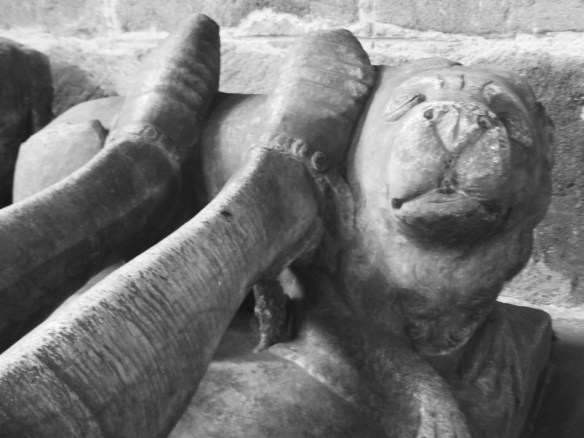
 As for Anne’s widower depicted above -Thomas junior- he would remarry Lady Elizabeth Stafford but would go down in history as the rather brutal third Duke of Norfolk, uncle of Anne Boleyn and Katherine Howard and arch-Tudor politician. Anne had a son who died young but the Howard heirs came from the third duke’s marriage to Elizabeth Stafford (the eldest daughter of the Duke of Buckingham who revolted against Richard III and Eleanor Percy the eldest daughter of the Duke of Northumberland – and thus having more sound Lancastrian credentials.)
Anne was buried originally in Thetford Priory but upon the Dissolution of the Monasteries she was reinterred in Framingham Church. Thomas Howard 3rd Duke of Norfolk managed to survive both his nieces’ downfalls, topple Thomas Cromwell from power and generally demonstrated more political wiliness than a cat with nine lives but he was ultimately charged with treason and was sent to the Tower to await his execution. Henry VIII died the night before he was due to be executed. He eventually died in 1554 having been freed by Mary Tudor.
His tomb is in Framingham next to Anne who lays on his righthand-side because she, as a princess, is more important than a mere duke.
The Church of St Michael Framingham guidebook
 Yesterday’s post covered all of points 1-3 and most of 4:
 He and Elizabeth of Lancaster had three sons. The eldest and youngest died without heirs whilst the middle son, conveniently called John regained the dukedom from Henry V following the victory at Agincourt. John, the second Duke of Exeter, married the widow of Edmund Mortimer and had two children. The boy was called Henry and he was born in 1430 so we have now arrived at the Wars of the Roses generations.
 The story of the Holland family begins with Robert de Holland from Upholland in Lancashire. He was born about 1283. He was a trusted part of Thomas of Lancaster’s household. He benefitted from being within the Lancaster affinity by acquiring land as well as a wife in the form of Maud de Zouche – a co-heiress.
 Thomas died in December 1360. The following year his widow married her cousin Edward, the Black Prince. The Holland children now had access to patronage with a very heavy clout. Thomas (Joan’s son) gained a wealthy and aristocratic bride from the FitzAlan family. More importantly it was the Hollands’ half-brother, Richard, who ascended the throne after Edward III died in 1377.
 Thomas’s uncle John (Joan’s second son) was executed at the same time. John Holland had married another wealthy royal cousin, Elizabeth of Lancaster (John of Gaunt’s daughter). This may have been because of the Black Prince’s patronage and it may have been because his mother Joan of Kent got on well with her cousin John of Gaunt. John became Earl of Huntingdon in 1388 and in 1397 became the Duke of Exeter. He was also involved in removing Richard II’s enemies. In John’s case not only had he arrested his uncle Richard FitzAlan (the 11th Earl of Arundel) he has gone to Calais to arrest Thomas of Woodstock, Richard’s youngest Royal uncle. Thomas had died whilst in Calais as pictured in Froissart – the story involves a mattress…
 Alice of Norfolk, was born about 1324. She was the daughter of Thomas of Brotherton and Alice Hales. She was the youngest of their three children.
 It is perhaps not surprising then that Thomas used his youngest child as a political pawn and married her into the Montagu family in 1333. William Montagu had been raised alongside Edward III and had married into the extended royal family in the person of thirteen year old Joan of Kent. Unfortunately it had turned out to be a bigamous marriage. Joan having already married Thomas Holland before the knight went on crusade in Prussia. Eventually, after much wrangling, the pope told Joan to return to Thomas Holland.
 Eventually, in 1312, after the birth of his own heir, Edward II confirmed his half brother as Earl of Norfolk and Earl Marshal of England. He also appears in the legal record as being an executor of his mother’s will. We also have records of Thomas’s half sister Mary visiting him regularly when he was a child. Mary was a nun at Amesbury.
 Edmund Cokayne or Cockayne, depending on the source and your own preference, is buried in St Oswald’s Church, Ashbourne but he lived near Alport at Harthill Hall. His parents were Sir John Cokayne and Cecilia Vernon. Sir John Cokayne was John of Gaunt’s steward for the duke’s estates north of the Trent – so very much part of the Lancaster Affinity. As might be expected the family including Edmund were MPs for Derbyshire.
 The tabloids would have had a field day in 1361 when Edward, Prince of Wales – better known as the Black Prince married the love of his life. The people’s princess in this instance was his cousin, Joan of Kent.
 Eleanor de Clare was the eldest of Gilbert de Clare 7th Earl of Gloucester’s three daughters. She was also the eldest granddaughter of Edward I, her mother being Joan of Acre. You would think under those circumstances that her marriage would have been fairly auspicious. Unfortunately her royal grandfather owed a Marcher Lord 2,000 livres. Eleanor was what you might describe as “settlement of the debt” that Edward I owed to Hugh Despenser the Older. Her wedding to Hugh Despenser the Younger took place in 1306. It included a dowry that settled an annual income on Eleanor. She was thirteen years old. The Despensers were an old family but they were somewhat cash strapped. Eleanor gave their family added prestige, took them a step closer to court and there was also the promise of future patronage.
 The 7th Earl of Gloucester, Gilbert, the Red Earl, was born in 1243. He took part of the second Barons War in 1262 which saw the barons rise against King Henry III. He was one of Simon de Montfort’s supporters and took part in the Battle of Lewes. They were turbulent times and although de Montford effectively toppled the Crown it wasn’t long before there was a falling out amongst the barons. This resulted in Gilbert changing sides and fighting on the side of Prince Edward at the Battle of Kenilworth and the Battle of Evesham where de Montfort was killed.
 In 1378 Westminster Abbey had to be closed for several months after an unfortunate interlude. Murder had been done in the choir and John of Gaunt was implicated. It didn’t help his reputation as the abbey had to be reconsecrated.