The complicated extended family of the Tudors – The St John family

Margaret Beauchamp of Bletsoe

I’ve posted about Margaret Beauchamp of Bletsoe before. She is the mother of Margaret Beaufort – to the maternal grandmother of Henry VII. She was born in about 1410, the daughter of Sir John Beauchamp of Bletsoe in Bedfordshire.

In 1421 her brother John died and she became an heiress. She inherited the manors of Lydiard Tregoze in Wiltshire, Ashmore in Dorset as well as Bletsoe and Keysoe in Bedfordshire.

Four years later she married Sir Oliver St John. He died in 1437 in France. Margaret would marry again to John Beaufort, Duke of Somerset and have one child – Margaret Beaufort the mother of Henry Tudor. Margaret Beauchamp had effectively been elevated from the gentry to the aristocracy and her St John children became, at different times, more significant players upon the political chessboard as a consequence, sometimes with disastrous consequences.

Margaret Beaufort (Hever Castle)

Sir John St John, Oliver St John, Edith St John, Mary St John, Elizabeth St John, Agnes St John and Margaret St John were Margaret Beaufort’s half-siblings. Where there was close contact to Margaret Beaufort and the Tudors elevation followed.

Margaret St John became the prioress of Shaftesbury Abbey. She was elected in 1492 demonstrating that the nuns knew which sides their bread was buttered and were demonstrating their loyalty to the Tudor regime.

Edith St John married Geoffrey Pole a member of the Cheshire gentry and that would have been fine had not her son Richard then been married to Margaret the daughter of the Duke of Clarence (the one who drowned in a vat of wine). Henry VII regarded it as a safe marriage which would effectively remove Margaret from the political game of crowns. Unfortunately for Edith’s Pole grandchildren and at least one great grand child Henry VIII was less convinced – Henry, Reginald, Arthur and Geoffrey Pole came to represent the last of the Plantagenet line. Margaret, Countess of Salisbury was executed without trial. Henry Pole her eldest son was executed and his son who had been imprisoned in the tower with his grandmother Margaret never emerged. Geoffrey narrowly escaped execution and went into exile where he had a breakdown. He eventually died in 1558 a few days before his more famous brother Cardinal Reginald Pole who spoke out against Henry VIII’s divorce.

Two more of Margaret Beaufort’s half-siblings married into the Scrope family. The Scropes were an important North Yorkshire family who spent a lot of time on the borders fighting the Scots. Elizabeth St John was initially married to William la Zouche, the fifth baron. The Zouches were later attainted for their loyalty to Richard III but by then Elizabeth having been widowed in 1462 had married John Scrope, Baron Scrope of Bolton (Bolton Castle in Wensleydale) and another Yorkist.

Elizabeth, despite her Lancastrian antecidents, was one of Edward V’s godparents. Perhaps this isn’t so surprising given that Margaret Beaufort, Elizabeth’s half-sister, was herself godmother to one of Edward IV’s daughters. It reflects the fact that all parties thought that the battle for the throne was over and were settling down to winning power and influence under the Yorkist regime. There was no reason to suppose that Edward IV would die young and leave a minor on the throne.

John Scrope despite being Henry Tudor’s step-uncle supported Richard III at Bosworth so required a pardon, which was forthcoming. Unfortunately he then became involved with Lambert Simnel’s rebellion of 1487 and was forced to pay a large fine and stay in London. Ultimately his services as a northern lord were required for the traditional activity of fighting the Scots which he did in 1497 by which time Henry’s Aunt Elizabeth had died.

Elizabeth’s brother Oliver, the younger of the Margaret Beaufort’s two half-brothers married the twice widowed Elizabeth Scrope of Bolton, sister of John Scrope. He died in 1497 in Spain but his body was returned for burial to East Stoke.

And that just leaves John St John who for the purposes of this post married and had children – all related to the Tudor crown. What it takes is a little bit of digging to discover is that John’s grandson born in 1495- perhaps unsurprisingly another John – was raised by Margaret Beaufort and that he became a courtier. We know for instance that he went to Calais with Cardinal Wolsey in 1521 and that he began to take a key role in the administration of Bedfordshire and Huntingtonshire.

We know that John attended the coronation of Ann Boleyn in 1533. Much of the information comes from the inscription on his tomb. It describes him as ‘custos’ to Princess Mary. A letter of 7 Jan. 1536 sent to Cromwell by ‘John St. John’ request that the King excuse the writer’s wife from being a mourner at the ex-Queen’s funeral, both because she was recovering from a pregnancy and because the writer, ‘being in service with my Lady Princess’, could not furnish the horses and servants needed for the occasion. Although Princess Mary had been officially deprived of that title since 1533, this is who St John must have meant. History can continue to track St John at his royal cousin’s family occasions including the funeral of Jane Seymour and the baptism of Prince Edward. He was also on hand to help put down the rebels in the 1536 Pilgrimage of Grace. In 1547 he stood down from Parliament so that his eldest son – an Oliver- could take his place. He died in 1558.

John had positioned his son to advance in the Tudor court by obtaining a place for Oliver in Prince Edward’s household. It is perhaps not surprising therefore that when Elizabeth I was crowned in 1558 that Oliver became Lord St John of Bletsoe. The family continued its loyalty to the Crown into the Stuart period gaining titles on the accession of Charles I but siding with Parliament at Edge Hill.

So on one hand the St John family remained part of the gentry but on the other they were trusted by the Tudors because they were family and as a consequence their value on the political board rose…sometimes rather dangerously.

And why am I digging around the St John family? Well it turns out that Sir Robert Dudley the illegitimate son the Duke of Leicester was descended via his maternal grandmother from the St John family making him a someone distant member of the Tudor family circle, proving once again that in Tudor England everyone appears to be related to everyone else!

.
Jumballs – festive biscuits – time to get knotting

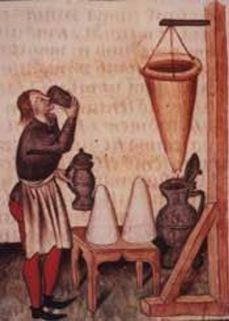
Twelfth century sugar cone

Jumballs can be found in many different sixteenth and seventeenth century recipe books. They were a popular biscuit at the time. They could be flavoured with caraway seeds, rosewater or almonds depending on personal preference and what was in the cupboard.

25g (1oz) soft butter)

2tsp rosewater

70g (3oz) caster sugar

1 egg beaten

15g (2oz) caraway seeds

160g (6oz) plain flour

Preheat the oven to 180c. Line two baking sheets with greaseproof paper.
Beat the butter and rosewater well together, then cream in the sugar.

Mix in the beaten eggs. Then add the caraway seeds and flour. Work the mixture into a dough. It should be possible to handle. If too wet, add some more flour. Separate the dough into balls the size of a walnut, then form them into rolls about 5mm in diameter and 15cm long. Shape into rings, knots and plaits.

Bake for 15 to 20 minutes. (knots and plaits will take longer than rings).

Tudor jumballs

This recipe comes from A Taste of Townend and were written by Elizabeth Burkett in 1699. Along with Christmas treats her recipe books contains cures and charms. Other recipes are available including one from the BBCGood Food magazine:

https://www.bbcgoodfood.com/recipes/spice-vanilla-jumbles You can even find a Bake Off recipe for the Tudor treat:

https://thegreatbritishbakeoff.co.uk/recipes/all/paul-hollywood-jumbles/

So why small biscuits in a festive count down to Christmas? – the spices and sugar would be expensive so these little biscuits represent a treat. They are also representative of the fact that society became more affluent because more people could afford the spices and sugars which were now becoming more readily available because of trade and the growth of Empire -which draws us on to the less pleasant fact that the sugar was becoming cheaper because it was being grown by slaves.

Sugar was taxed until the Nineteenth Century. If you couldn’t afford sugar then sweetness was provided by the use of honey. From medieval times until the Victorian period sugar was sold in cones or loafs. For more about sugar cones/loafs follow this link: https://livesandlegaciesblog.org/2018/12/13/all-about-sugar-cones/

A medieval/Tudor merchant’s house

Payecocke’s House, Coggeshall nr Colchester

Paycocke House in Coggeshall was the home of a prosperous sixteenth century wool merchant.  It was built- or rather added on to an existing building- at the beginning of the centry by Thomas Paycocke for his bride Margaret. Their initials are carved on the house along with the Paycocke merchant’s mark.   

Not only did Thomas and his wife live in the house but it was also the centre of his business.  What today is a lovely garden would have been a bustling hive of industry when Thomas was alive.

Coggeshall was famous at the time for undyed broadcloth – it’s sometimes called Coggeshall White. It’s described as a “bays”  – so a baize if I’ve got it right is a variety of worsted fabric. Thomas not only used his own home for the cloth but he also sent pieces out to the homes of his workers  – preparing, weaving and finishing.  One of the reasons for “putting out” of work may have been that the extension was designed to impress rather than to be practical – the wealth on display certainly suggests that Thomas wanted to make an impression to his visitors – think of it as a showroom perhaps?

Thomas didn’t have sons. His second wife had a daughter. The house left the family in 1584 when the last male Payecock, a great nephew of Thomas, died. It passed into the hands of the Buxton family, who were related by marriage.  The house continued to evolve. These days it’s a National Trust property and like many other National Trust properties in the area it has been partly planted with dye plants.

Thomas’s father had set Thomas on his way but the economic conditions of the period helped Thomas to become very wealthy. Raw wool prices slumped at the end of the fifteenth century – it began to rise relatively early in Henry VIII’s reign.  In the meantime Payecock was able to export his cloth at a substantial profit.

https://www.essexlifemag.co.uk/people/500-years-of-paycockes-house-1-5729009

Picture Quiz 6 answers

How many of you spotted Cardinal Wolsey’s travelling sundial this week?

Cardinal Wolsey’s travelling sundial
Museum of the History of Science


This delightful object was created by the German mathematician Nicolaus Kratzer in 1522. He came to England in about 1518 and was astronomer to King Henry VIII. The base has Wolsey’s coat of arms on one side, the arms of York Minster – he was it’s archbishop form 1514 onwards- on the other and on the two smaller sides there’s a cardinal’s hat.

The sundial is polyhedral – basically it tells the time in a number of different ways depending on which side you’re using. And yes it is completely covered in gold. Aside from being a very busy man who needed to get to his meetings on time Wolsey was also demonstrating that he was a cultured and learned chap. Or put another way he liked beautiful and complicated things and if you were really lucky you might be invited to take a closer look if you visited him – so a conversation piece as well.

Holbein depicted Kratzer holding a sundial and there’s a polyhedral sundial in his picture of the Ambassadors which can be seen in the National Gallery.

Nicholas Kratzer, Hans Holbein Held by the Louvre

For a happy half hour finding out more about the importance of mathematical objects including sundials visit the National Gallery page below to explore the Ambassadors by Hans Holbein.

https://www.nationalgallery.org.uk/paintings/hans-holbein-the-younger-the-ambassadors

What is an affinity and what is a livery badge?

Richard III’s white boar livery badge – York Museum

Having set a challenge about Royal Arms I thought I probably ought to post a little about the way in which arms and badges were used during the medieval period. Clearly a personal badge was originally designed so that people knew who was who on the battle field or tournament ground – either on a banner, a surcoat or a shield for instance but by the fourteenth century they had developed into something that was given out almost like a contract between a noble and the group of people who served him in a variety of capacities.

An affinity was a set of political and social connections – like an extended family- but with a nobleman at the centre of the web based on his links to royalty, personal patronage, family and territory. The noble would have a household and a set of retainers, or followers, who were sworn to provide the lord with help in terms of military service, political support etc in return for which they would receive protection; a leg up the social ladder and dating agency for their offspring; offices; land. As the fifteenth century progressed these retainers wore either his livery or someothe badge that associated them with their noble – the bear with the ragged staff is a well-known badge associated with the Earl of Warwick for instance.

A powerful lord like John of Gaunt would attract local gentry as well as family and tenants. The Gaunt affinity was particularly noticeable in Derbyshire for instance. This meant that men with a large affinity, such as the duke, effectively had an army that they could call upon whenever they needed one – something of increasing importance as the fifteenth century moved into the wars of the roses. Consider the impact of the Neville affinity in the escalation of feuding during the fifteenth century.

Livery badges and colours were used to show that you belonged to a particular affinity. More can be found on livery colours here: https://history.stackexchange.com/questions/13103/whose-colors-coat-of-arms-did-men-of-arms-wear-in-a-feudal-army-14th-century and if you’re interested in the Wars of the Roses here: https://murreyandblue.wordpress.com/tag/livery-colours/

Livery badges could be displayed anywhere, but usually on the outside of the upper left sleeve, on the left breast. They turn up in jewellery – think of the medieval livery collar -(https://thehistoryjar.com/2015/07/17/nicholas-and-ralph-fitzherbert-a-glimpse-of-the-wars-of-the-roses/), on horse trappings, weapons and their scabbards, stained glass windows and masonry. In fact, now I come to think of it there’s a photographic project there when we’re allowed out again!

Richard, Duke of Gloucester, later Richard III’s personal livery badge was a white boar. Sometimes the badges were taken from a charge (an emblem from the shield) on a coat of arms but they might also be more personal than that – they could be to do with an event in the lord’s life or a play on the lord’s name. Richard II’s white hart is a pun on Rich hart.

Henry VII needed to stamp out the concept of the affinity as the bands of men that nobles could gather up as part of their affinity could be used for the king but also form armies that fought against him. The Statute of Liveries of 1506 forbade issuing livery badges to men of rank; they had to be domestic servants unless the livery was covered by a specific royal licence.  Eventually livery badges were reserved only for those who were part of the monarch’s affinity and for household servants of the aristocracy. Henry made sure that everyone rocked the Tudor rose rather than their own personal livery. John of Gaunt’s livery chains of entwined “esses” ultimately became associated with chains of office rather than with the Lancastrian royal house.

Bear and ragged staff

The bear and ragged staff was associated with the Earl of Warwick during the Wars of Roses but in the reign of Elizabeth I it was associated with Robert Dudley, Earl of Leicester who was the successor of the Earl of Warwick (via a circuitous route.)

The blue lion – or lion rampant azure- is associated with the Percy family.

The Prince of Wales feathers were first associated with the Black Prince when he chose them as a device on hearing about the bravery of the blind King of Bohemia.

The Stafford knot is associated with the Dukes of Buckingham.

The Talbot dog is associated with the Talbot Earls of Shrewsbury

The portcullis is associated with the Beaufort family and was used widely in Tudor iconography.

The white rose of York and Edward IV’s sun in splendour – St Andrew’s Church, Penrith

Livery badges issued by the livery companies of the City of London are of a later date.

Heartsease (viola tricolour) – Elizabeth I’s flower

“There’s pansies, that’s for thoughts”.  Ophelia

Detail of pansy on hemline of Hardwick Portrait

The regular post has moved to a midweek time to accommodate the weekly history challenges. Let’s hope I can stay organised.

I’ve been doing some gardening today, making the most of the lovely weather. At this rate I’ll have the tidiest garden ever. Today I did some weeding and planted some seeds that I’ve found lurking in the back of a cupboard. Apparently heartsease populate walls, rockeries and paths easily. Time will tell. Anyway, heartsease as I know it has many different names including Jack-behind-the-garden-gate; kiss-behind-the-garden-gate; Kit-run-around; godfathers-and-godmothers; herb trinity and herb constancy to name but a few.

The name heartsease comes from the days when if you were suffering from a broken heart you could take an infusion of the pretty little plant to treat your woes. I don’t suggest that you try it. In Victorian times when courting couples couldn’t speak openly the flower represented happiness and if you gave it to someone the meaning might be that the recipient occupied the giver’s thoughts – presumably leading to the kiss behind the garden gate.

Gerard’s herbal reveals other medicinal uses for the pansy or heartsease:

It is good … for such as are sick of ague, especially children and infants, whose convulsions and fits of the falling sickness it is thought to cure. It is commended against inflammation of the lungs and chest, and against scabs and itchings of the whole body and healeth ulcers.’

So back to the history – the pansy was Elizabeth I’s favourite flower, and as a consequence it was everyone else’s as well. For Elizabeth the humble heartsease was not linked with kissing behind gates, it represented chastity- an important facet of being the Virgin Queen. In medieval times, prior to the Reformation, it was linked with the Virgin Mary. The colours of the heartsease, white, yellow and purple relate to purity, joy and mourning respectively which relate in turn to the Virgin’s life. 

The Stowe Inventory of the Wardrobe identifies many of Elizabeth’s clothes in 1600 as well as her new year’s gifts which included many hand embroidered items. Elizabeth herself hand embroidered gifts for her own family, most famously Katherine Parr’s prayer book cover stitched when Elizabeth was eleven-years-old, which includes pansies or heartsease.

Katherine Parr’s Prayer book cover stitched by Princess Elizabeth

Look closely at any number of Elizabeth’s portraits including the Pelican Portrait, the Hardwick Hall portrait and the Rainbow Portrait for example and you will find pansies.

Dr Simon Forman – a Tudor version of Pepys…with magic and poison

Simon Forman was born on December 30, 1552, near Salisbury. Unlike Shakespeare for whom there is no evidence of attending grammar school we have Forman’s account of his teacher and his education which began when he was seven. Unfortunately Simon’s father died suddenly and the boy had to leave school taking employment with a merchant who sold herbs and drugs.

Ten years later Simon left Salisbury, apparently after an argument with his master’s wife, and went to Oxford to live with his cousins. It appears that although he was eager to continue his education that he was unhappy in Oxford so when back to Salisbury where he became a teacher.

In 1579 things changed, Simon became a prophet! “I did prophesy the truth of many things which afterwards came to pass…the very spirits were subject unto me”. He also moved to London where presumably there was more need for doctoring, astrology and magic – remember these three things weren’t at odds with one another during the Tudor period. What made the real difference to Forman’s career as a doctor was that he remained in London during the plagues of 1592 and 1594. As a result he became known for his skills and the publication in 1595 of a book entitled Discourses on the Plague. He claimed that he was able to work with plague cases because he had caught and recovered from the disease.

Unfortunately the Royal College of Physicians took umbrage because he lacked their training. They described his herbal medicines as “magical potions.” In short they determined that he was a quack, fined him and told him not to call himself a doctor. Forman ignored them but within nine months a man died soon after taking one of his prescriptions and he found himself in prison. He finally gained a licence from Cambridge University in 1603 despite the fact that he had never studied there.

Forman wrote a lot of books and kept a diary which recorded his own life as well as his consultations with people from all ranks of society. He recorded some of his womanising activities even though he’d married Jane Baker in 1599.

William Lilly

We even know how Forman died thanks to another astrologer, William Lilly. In September of 1611, Forman apparently told his wife that he was about to make his last prophesy, namely that he would die the next Thursday evening which he did whilst rowing on the Thames.

That wasn’t the end of Forman though. Frances Howard, Countess of Somerset went on trial in 1616 for the murder of Sir Thomas Overbury in 1613. Whilst she was still Lady Essex married to Robert Devereux. Frances had gone with her friend Anne Turner to see Forman for potions that would keep Lord Essex at arm’s length and another to attract the attentions of James I’s favourite Robert Carr as he seemed a better financial and political bet than the spouse that she had been required to marry when they were both children. Forman was also accused of providing the poison which added to some tarts killed Sir Thomas Overbury whilst he was in the Tower.

Frances Howard, Countess of Somerset

Ultimately Forman’s papers ended up in the care of Elias Ashmole, the founder of the Ashmolean in Oxford and thus his diary which includes visits to the theatre to see Macbeth and The Winter’s Tale survive – though not without some dispute as to their veracity.

Kassell, Lauren (2007) Medicine and Magic in Elizabethan London: Simon Forman: Astrologer, Alchemist, and Physician

Rowse, A.L. (1974) The Casebooks of Simon Forman

B

Garendon Abbey

Garendon Hall

Garendon Abbey in Leicestershire was founded in 1133 by Robert, Earl of Leicester.  It was a daughter house of Waverley, the earliest Cistercian monastery to be established in England. As well as holding land in Leicestershire it extended its grand holdings into Nottinghamshire and Derbyshire – Roystone Grange near Ashbourne was gifted to the monks by Adam de Harthill.

By 1225 the abbot had obtained permission to export wool to Flanders which is typical of the order and a reminder of the great Cistercian houses in Yorkshire. The monks weren’t always the best example of monastic chastity or sobriety – one of the abbots was married and another had a bit of a drink problem. Abbot Reginald was murdered in 1196 according to the Monastic Anlicanum. By the reign of Edward III the abbey had got itself into severe financial difficulties and seems to have been harbouring robbers.

By 1535, the year in which Cromwell sent his commissioners to the monastic houses of England and Wales, Garendon was worth less than £160 p.a. There was also the matter of three monks wishing to escape their vows and two more being deemed guilty of unnatural vices. There were only 14 monks at the time. However, they were also providing a home for old people and children. This didn’t save it from dissolution the following year.

Lady Katherine Manners after the death of her husband – the Duke of Buckingham

The estate and it’s buildings were granted by Henry VIII to Thomas Manners, the Earl of Rutland. He paid £2,356 5s 10d for his new property. Garendon remained in the hands of the Earls of Rutland until 1632 when it formed part of Lady Katherine Manners dowry. She was the sole surviving heir of the 6th Earl. She ended up married -by trickery- to the Duke of Buckingham. https://thehistoryjar.com/2018/01/20/witchcraft-scandal-and-the-duke-of-buckingham/

Katherine’s son sold Garendon in 1683 to Ambrose Phillipps, a successful London barrister.

I have posted about Garendon before: https://thehistoryjar.com/2016/11/14/garendon-abbey-granges-and-a-spot-of-drunkenness/

Roystone ended up in the hands of Roland Babington. Roland was born in Dethick along with his brother Thomas. Thomas tried to secure land from Beauchief Abbey in Sheffield upon its dissolution. Thomas’s descendent is the more famous Sir Anthony Babington.

The Duke of Buckingham’s mistake

Edward_Stafford.jpgEdward Stafford the third Duke of Buckingham really should have known about the dangers of irritating monarchs.  His father the second duke was executed by Richard III and Edward a mere child of five was forced to flee into hiding having been dressed by his mother Katherine Woodville as a girl.

The problem was that Edward was descended thrice over from Edward III despite the fact that his mother was Katherine Woodville.  The Stafford family had been around for centuries whereas the Tudors were Johnny-Come-Late-lies.  This was so much the case that after the death of Prince Arthur in 1502 it was suggested in some quarters that the Duke of Buckingham might make an appropriate monarch.  Not only was Edward a Plantagenet with clear  and legitimate lines of descent but he had also benefitted from a royal upbringing having been made a ward of Margaret Beaufort.

Seven years later  when Edward discovered that his sister had become the king’s mistress he was absolutely furious.  He believed that his family was far to important for Anne to be the mistress of a mere Tudor, a marked contrast to the Duke of Norfolk who would spend most of his political career from the 1520s onwards dangling Howard girls under Henry’s nose.

Buckingham knew how the court worked under Henry VII – a man not admired for his lack of mistresses and had failed to notice that whilst the Plantagenets were first amongst equals – in a country where rulers appointed men to effectively rule their own regions that the Tudors centralised and appointed administrators – that they were absolute rulers for want of a better description.

Henry VII sought to use Edward’s Plantagenet blood in the marriage market when he suggested a marriage with Anne of Brittany but avarice won out when the Earl Northumberland offered the king £4000 for Edward to marry his daughter Eleanor.  By 1509 Edward Stafford had claimed the hereditary right of being Lord High Constable and was on Henry VIII’s newly appointed council having performed in a series of diplomatic and high status court roles.

Buckingham’s sense of self worth was probably reinforced when he received a licence to crenelate, i.e. to fortify a property.  He was treading the path of the fifteenth century over mighty subject who ruled his own domain. He had failed to spot that his second cousin   Henry VIII granted favours to his friends but woe betide them if they didn’t play by his rules.

Thus when Edward heard from Anne’s sister Elizabeth that Anne was conducting an affair with the king he thought that there would be no repercussions when he summoned his brother-in-law and removed Anne to a nunnery some sixty miles from court.  Even worse the affair became common knowledge.  Queen Katherine who was pregnant became very upset and Henry was embarrassed. Anne would return to court and the affair probably continued for another few years if Henry’s New Year’s gift list is anything to go by.  However, the damage was done – Henry knew how to carry a grudge.

In 1520 Buckingham was suspected of treason. It had become clear that Katherine of Aragon was not as fertile as her mother.  A child, Mary, had been born the pervious year but it was unthinkable that a girl might inherit – the Tudors were in danger of dying out.  Edward Stafford was the man, so he said, to take up the Crown –   Henry personally interviewed the witnesses. In April 1521 he was packed off to the Tower for imagining the death of the king and executed on the 17th May. The evidence was flimsy.

Jane Parker, Lady Rochford

Jane-Parker.jpgJane Parker or Mrs George Boleyn has gone down in history as the woman who accused her husband and sister-in-law of incest.  She was also the woman who connived to allow Katherine Howard to meet her lover  Thomas Culpepper- resulting in Katherine being executed and Henry VIII changing the law to allow for the execution of the insane so that Jane could share the same fate on the 13th February 1542.

The image at the start of the post is a Holbein. Recent consensus is that this particular Lady Parker is actually Grace Parker – nee Newport the wife of Jane’s brother Henry rather than Jane.

Jane was described by Henry as a “bawd” because she had helped Katherine to meet with Thomas, had passed on letters and kept watch whilst the pair conducted their assignations during the royal progress to York.. It can’t have come as a total surprise that Henry ordered her arrest when he discovered what had been going on. rather unreasonably Thomas Culpepper and Katherine Howard both tried to put the blame on Jane for orchestrating the meetings.  Jane had a nervous breakdown whilst in confinement.

So, what else do we know about her?  She was descended from Margaret Beauchamp of Bletsoe,  Margaret Beaufort’s mother – making Jane a distant Tudor relation which accounts for her court links. Her father was raised in Margaret Beaufort’s household. Jane first appears in the court records in 1520 pertaining to the Field of the Cloth of Gold.  She would have been about fifteen. She served in the households of Catherine of Aragon, her sister-in-law Anne Boleyn, Jane Seymour, Anne of Cleves  and also in Katherine Howard’s.  We know that she appeared in court masques and we know that in 1524 /25 she married George Boleyn.

Warnicke theorises that Jane and George were unhappily married  because of George’s sexuality- certainly something wasn’t right if Jane was prepared to send her husband to the block on some rather unpleasant charges.  The primary source evidence for this comes from George Cavendish’s account of Boleyn.  However to counter this it should be noted that Cavendish was loyal to Wolsey and there was little love lost between the Cardinal’s faction and the Boleyns. It should also be noted that George had a bit of a reputation with the ladies. The only bad thing that Chapuys, the Imperial Ambassador, could say about George was that he was very Protestant in his outlook.  It’s safe to say that had Chapuys got a whiff of George being homosexual that it would have been recorded in his letters.

Whatever the family relationship, in 1534 Jane helped Anne to get rid of an unnamed mistress of the king’s and that Jane was banished as a consequence.  This allowed Anne the opportunity to place another potential mistress under Henry’s nose – a Howard girl- possibly Madge Shelton and someone who was unlikely to be used by the conservative faction at court to weaken Anne’s position.  Jane herself was back at court the following year.

Popular history claims that Jane told the king that one of Anne’s lovers was George but whilst the primary sources talk about ‘one woman’ they don’t actually name Jane as the culprit and there is certainly no written evidence to support the idea although that doesn’t preclude the possibility of verbal evidence.  Like so much popular history we think we know what happened but the closer you look at the evidence the more elusive the truth becomes.

Julia Fox, Jane’s biographer states that Jane was only named during the reign of Elizabeth I.  Jane was long dead and who else cold have told such blatant lies – but a mad woman?  Alison Weir on the other hand concludes that Jane was probably instrumental in George’s execution.  It is also true to say that an anonymous Portuguese writer claimed a month after Anne’s execution that Jane was responsible for the incest accusation.  Weir deduces that Jane was jealous of the closeness that existed between her husband and Anne.

It is true though that the evidence of George’s trial points to Jane telling Cromwell that Anne Boleyn had talked of Henry VIII’s impotence which one imagines would have been more than enough to get Anne into serious hot water with her spouse.

Jane didn’t benefit from her husband’s death.  Thomas Boleyn refused to pay Jane’s jointure.  She was forced to write to Cromwell asking for help.

And whilst we’re at it we should perhaps also look at the idea that Jane was insane at the time of her execution.  Primary evidence supplied by Ottwell Johnson reveals a woman who went to her maker calmly and with dignity despite the fact that no one in her family had attempted to intervene on her behalf. Lord Morley (Jane’s father) and his son Henry perhaps realised the extent of Henry’s anger.

Finally – just to make life that little bit more interesting in 1519, the year before the first written account of Jane at court Henry VIII had a fling with  “Mistress Parker” or at least court rumour said he did.  At fourteen Jane fitted Henry’s liking for young mistresses best typified by Katherine Howard.  Jane like so many other of his mistresses was related to him and like many other of his mistresses a large wedding gift was given.  Alternatively maybe Mistress Parker was Jane’s mother Alice St John?

In 1519 Henry was in the midst of his affair with Bessie Blount the mother of his illegitimate son Henry Fitzroy. Mistress Parker was a diversion whilst Bessie was pregnant.  Could Alice have been Henry’s mistress and gained her daughter a place in Catherine of Aragon’s household?  It’s possible.

Alice outlived her daughter and like her husband she did not publicly mourn the death of Jane.

Fox. Julia,  (2008) Jane Boleyn: The Infamous Lady Rochford

Retha M. Warnicke “The Rise and Fall of Anne Boleyn: Family Politics at the Court of Henry VIII”