Tudor succession – the problem-a spot of light revision

By February 1553 it was clear that King Edward VI was likely to die. Until then, with the notably unsuccessful exception of Henry I’s daughter Matilda, no woman had sat upon England’s throne. Now though all heirs to the Crown were female:

Mary Tudor – the Catholic daughter of Henry VIII and his first wife Katherine of Aragon. She had been declared illegitimate by her father but under the terms of his will and the Third Act of Succession passed in 1544, she was next in line to the throne.

Elizabeth Tudor – the Protestant daughter of Henry VIII and his second wife Anne Boleyn. She had also been declared illegitimate. Under the terms of Henry’s well and the act of succession, she was next in line after Mary, if Mary had no heirs. Elizabeth’s birth in 1533 had been something of a disappointment to Henry VIII who wanted a legitimate male heir. In 1536 Anne Boleyn was executed after failing to provide him with one and Elizabeth was rendered illegitimate. Eleven days after Anne’s execution, Henry married Jane Seymour who produced Edward before dying as the result of complications in childbed. No one expected Elizabeth to ever become queen. Her upbringing was difficult as her status shifted.

Mary Queen of Scots – the grand daughter of Henry VIII’s sister Margaret Tudor. There was no doubting her legitimacy but she was married to the French dauphin and was Catholic.

Lady Jane Grey – the eldest grand daughter of Henry VIII’s youngest sister Mary. She was legitimate, Protestant and English. Initially Edward decided to leave his crown to Jane’s legitimate male heirs but it became clear that he did not have enough time to see his teenage cousin married with a child in her arms. Certainly the idea appealed to John Dudley, Duke of Northumberland. If either Mary or Elizabeth took the throne he would lose the power that he wielded during Edward’s reign.

On 25 May 1553 Jane was married to Guildford Dudley, the fourth son of the Duke of Northumberland. She had been bullied into the match. On 12 June Edward changed the wording of his ‘Device’ leaving the throne to Jane but the Device was not ratified by Parliament. Mary and Elizabeth were deemed illegitimate. When King Edward VI died on 6 July 1553 Northumberland hoped that Jane would sit upon the throne and he would continue to wield power. In time he hoped that the House of Tudor would become the House of Dudley.

In reality Mary realising what was about to happen went to Kenninghall in Norfolk and on 8 July was proclaimed queen to popular acclaim. Her supporters began to assemble at Framingham Castle. Northumberland’s council began to panic even though Jane was proclaimed queen in London on 9 July. She was deposed on the 19th turning in an instant from queen to prisoner.

Elizabeth wrote from her home in Hatfield in support of her sister and joined Mary for her entry into London. Mary had the support of most of England because she was Henry VIII’s eldest daughter. religion was not an issue at that stage of Mary and Elizabeth’s story. Mary would become increasingly suspicious of her sister, especially as religion became a factor in England’s political life. There were times when Elizabeth feared for her life before Mary’s death in 1558. It was perhaps unsurprising. Mary soon lost her popularity. Wyatt’s Rebellion followed hard on the heels of her coronation and she increasingly saw Elizabeth as a symbol for Mary’s enemies. Elizabeth had the opportunity, if she could survive, to watch and learn from her sister’s mistakes.

There were three threads that would follow Elizabeth through her long reign:

  1. John Knox stated that it was against natural law for a woman to rule a man – they being ‘weak, frail, impatient, feeble and foolish creatures’ – essentially a queen needed a king to be in charge – so when Mary and Elizabeth each became queen in turn the need for a husband for both an heir and wise leadership was something that exercised the Privy Council’s mind.
  2. Who exactly was illegitimate? For some Catholics, Elizabeth was an illegitimate child born to Anne Boleyn when Henry VIII put his legitimate wife to one side. After Mary Tudor’s death, in the eyes of some it was Mary Queen of Scots who was the rightful queen of England because she was the child of Henry VIII’s eldest sister. It helped that she was Catholic.
  3. Religion became an increasingly important factor in politics in England. The Northern Rebellion of 1569, the Rudolf Plot of 1571, Throckmorton Plot of 1583 and the Babington Plot of 1586 sought to topple Elizabeth from her throne and replace her with her Catholic cousin Mary Queen of Scots who had been a prisoner in England since 1568.

Katherine of York

Katherine was one of Elizabeth of York’s younger sisters. Her parents were Edward IV and Elizabeth Woodville. When her father died in 1483 she was not yet four years of age but like her older siblings found herself in sanctuary at Westminster and declared illegitimate under the terms of Titulus Regius which accepted Bishop Stillington’s declaration that Edward was pre-contracted in marriage to Lady Eleanor Talbot (Butler) prior to his secret marriage to Elizabeth Woodville.

Eventually Elizabeth Woodville came to terms with Richard III and her daughters returned to their nursery or to court. Richard promised that he would provide for his brother’s children but the marriage of an illegitimate daughter of a king would never be as sparkling as that of a princess.

However, in 1485 Fortune’s wheel took a downward turn for Richard on the battlefield at Bosworth and Henry Tudor became king. He had sworn to marry Katherine’s sister Elizabeth, and with no sign of the two sons of Edward IV, Titulus Regius was revoked and an order was issued for all copies to be destroyed. Katherine was once again a Plantagenet princess. Her care and education lay in the hands of her sister Elizabeth who married Henry uniting the houses of York and Lancaster but her marriage was in her brother-in-law’s gift.

Katherine and her sisters were valuable pawns in the marriage game. it was suggested at one time that she marry the Duke of Ross but nothing came of the proposal. It was essential so far as Henry was concerned that the princesses were either married out of the country to countries sympathetic to Henry Tudor or else they should be married to men he trusted at home. Henry trusted precious few people – which isn’t surprising given the number of rebellions he had to deal with once he became king.

In 1495, Henry thought he had found just the man – William Courtenay, heir to the Earl of Devon. She was packed off to Tiverton where she became a mother in 1496. In 1497 her husband rose further in royal favour when he helped to defeat Perkin Warbeck, a royal pretender. Two more children followed, a daughter Margaret and another son named Edward. Catherine could often be found at court with her sister and she took an active part in royal events including the betrothal celebrations of her niece Margaret Tudor to James IV of Scotland.

Unfortunately Courtenay’s favour was not to last. He was implicated in the Duke of Suffolk’s rebellion in 1502 and found himself incarcerated in the Tower – although evidence was lacking. Henry VII swiftly confiscated all his goods leaving Katherine and her three children dependent on Elizabeth of York, but at least they were still free and Courtney did not suffer a traitor’s death. His main problem was that he was married to a Plantagenet princess and Henry VII simply didn’t trust that he wouldn’t make an attempt on the throne. Poor Katherine faced difficult times which were compounded by the death of her youngest son while she was with Elizabeth. Without the funds to pay for Edward’s funeral, Katherine was reliant upon her sister’s kindness for the burial of the little boy and for her mourning robes.

The following year, it was Katherine who led the mourners to Westminster where Elizabeth of York was buried. The queen had died as a result of complications following childbirth. Katherine had lost the sister to whom she was closest and the source by which she was able to live. Now she had to turn to her father-in-law for help and to her young nephew Prince Henry who was fond of his aunt.

After Henry VII’s death, Katherine’s life changed for the better. She was welcome at court, her husband was finally freed from his prison and Katherine was granted estates by which the couple could live, although she had to sign away her rights to her share of the earldom of March. When Courtenay died in 1511, Katherine took a vow of celibacy so that no new husband could be found for her. She also set about ensuring that her son, Henry Courtenay, who was now ten years of age should inherit his father’s title. In 1512 she arranged for her daughter Margaret to marry the heir of the Earl of Worcester.

She came rarely to court after that but she did become Mary Tudor’s godmother in 1516. She did not know that her Plantagenet bloodline would send Fortune’s wheel turning once more when her nephew Henry VIII attempted to divorce his wife Katherine of Aragon. Her son Henry Courtenay would be executed for corresponding with another cousin, Cardinal Reginald Pole. Her grandson Edward Courtenay would spend time in prison and because of his involvement in Wyatt’s Rebellion, which sought to topple Mary Tudor, be exiled from the country.

Katherine died on 15 November 1527 having spent the latter part of her life living in Tiverton.

The king’s cousin – Sir Richard Pole

Portrait purported to be Margaret Pole, Countess of Salisbury

The Poles owned land in Cheshire and Buckinghamshire. Richard’s father, a Welshman, was buried in Bisham Abbey, the mausoleum of the Montagu Earls of Salisbury in 1479. Richard Neville, the Kingmaker’s father was reinterred there along with his wife Alice, the last of the direct Montagu line, in 1463. Richard’s mother was called Edith St John. Her mother Margaret Beauchamp of Bletso married three times – firstly to Oliver St John, secondly to the Duke of Somerset and finally to Lionel Lord Welles. Edith’s younger half sister from her mother’s second marriage was Lady Margaret Beaufort – making Richard Henry Tudor’s cousin.

When Henry became Henry VII returned to his family for support. Pole fought at the Battle of Stoke and was knighted in its aftermath. Richard was so trusted that Henry married him off in 1494 to George Duke of Clarence’s daughter Margaret. Whilst he might trust Richard the king had also married off a prospective source of opposition to his rule to someone without status or power themselves effectively nullifying Margaret’s Plantagenet blood and removing the prospect of her becoming a figure head for rebellion. Her brother Edward the young Earl of Warwick would spend most of his short life as a prisoner in the Tower of London before being executed on trumped up charges of treason.

Dugdale recorded that Richard served Henry when the king went to war with Scotland over the matter of the pretender Perkin Warbeck and that he received assorted offices in Wales. In time became the Chief Gentleman of the Privy Chamber to Henry’s son Arthur. Pole and his wife were sent to Ludlow with Arthur when the prince went to Wales to learn how to be a king. Arthur was given the role of President of the Council of Wales and the Marches but Henry expected his cousin to mentor the boy.

So what does a gentleman of the privy chamber do? For a start it was a very influential posting as it gave access to all areas of private life from the bed chamber to the lavatory. Some servants, because that’s what Richard effectively was, were only allowed into the outer or presence chamber. If you wanted real influence you needed to get behind the closed doors of the privy chamber. Richard had his cousin’s favour and could execute any verbal commands without handing over an order in writing first. Just being Richard Pole was enough to get people to do what he wanted!

Richard found himself with the uncomfortable job of telling Henry that his beloved son died on 2 April 1502. he didn’t live much longer himself being dead before the end of 1505. King Henry VII, noted for his parsimony, paid for his cousin’s funeral. Margaret, with her five young children, was forced to live in near poverty at Syon Abbey where she would remain for the next three and a half years until Henry died and was replaced by his younger son King Henry VIII. Margaret who became a friend of Katherine of Aragon during their time together at Ludlow was restored to favour when the princess became Henry’s queen.

Note: Richard owned manors at Medmanham and Ellesbrough in Buckinghamshire. His main residence apparels to have been Bockmer which was part of the manor of Medmanham and which had been much restored by his father.

The Treaty of Perpetual Peace…which wasn’t very long lasting

Reference: National Library of Scotland
MS, Seaton Armorial, Acc. 9309, f. 18 (date: early 17th century)
By kind permission of Sir Francis Ogilvy. https://www.nationalarchives.gov.uk/utk/scotland/popup/james.htm

In 1497, Henry VII, a man who avoided war when possible, sought to end the ongoing conflict between England and Scotland by the Treaty of Ayton which reinforced march law and sought to prevent cross-border feuding and cattle theft erupting into full scale conflict. The treaty was ratified in London on 24 January 1502 and sealed by a diplomatic marriage between Tudor’s daughter Margaret and King James IV of Scotland. The following year the Pope also ratified the treaty.

Margaret travelled to Edinburgh to marry in August 1503. She was not yet fourteen but had not left England any sooner because her grandmother, Lady Margaret Beaufort, was insistent that she was of an age to be married. She was not yet six when she was betrothed to James IV who was twenty-two-years old in 1497. Inevitably he already had a mistress and children by the time Margaret arrived in Scotland but as things turned out James was a kindly husband who treated his new bride with consideration.

It wasn’t a particularly popular match with the English who did not take kindly to the Scots after two hundred years of intermittent warfare not to mention James IV’s involvement with Perkin Warbeck which had resurrected the Wars of the Roses for a short time.

Unfortunately for all concerned, James IV was tied by the Auld Alliance to France which meant that when Tudor’s son Henry VIII resumed the centuries old habit of going to war against the French that James was obliged to open up a northern front breaking the perpetual treaty and getting himself killed at the Battle of Flodden on 9 September 1513.

Ladies in waiting and maids of honour

Lady Catherine Knollys

And what exactly is the difference? The ladies are married and the maids are not generally speaking. The roles changed slightly with each queen so this is a look at ladies in the reign of Elizabeth I. The complication arrives with whether the lady in question a Lady of the Privy Chamber or a Lady of the Presence Chamber. As the name would suggest a lady of the privy or private chamber was on closer terms with the Queen than a lady who was part of the public arena. All good so far. On occasion the word lady is replaced with Gentlewoman.

The four most senior Ladies of the Privy Chamber were the ladies with the job title “Lady of the BedChamber.” These ladies looked after Elizabeth’s most intimate needs.

The Mother of the Maids was the woman, either married or widowed, appointed to look after the unmarried maids-of-honour. This was a salaried post of £20 per year. It wasn’t necessarily a straight forward job. One of them, Elizabeth Jones found herself in the Tower in 1591 when one of the maids, Katherine Legh, gave birth gave birth to Francis Darcy’s child. Katherine became a maid-of-honour in 1588 and ordinarily would have stayed in post until she married. Unsurprisingly producing an illegitimate child in the room opposite the Queen’s Privy Chamber resulted in dismissal. The couple married upon release from the Tower although other versions of the story suggest that the couple were already married. In any event they went on to have three children.

Not all maids left after their marriage, some returned in the role of ladies-in-waiting. Catherine Carey who was the Queen’s cousin (and in all likelihood her half sister) was a maid of honour for Anne of Cleves and Katherine Howard She married Sir Francis Knollys in 1540. She returned to court as a lady-in-waiting for Elizabeth where she was the Chief Lady of the Bedchamber.

The Lord Protector’s daughter – Anne

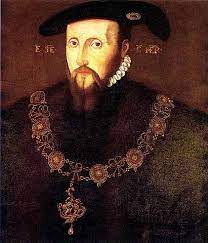
Edward Seymour, 1st Duke of Somerset

Edward Seymour was swift to elevate himself to the Dukedom of Somerset when he took control of his nephew, Edward VI’s, Regency Council in 1547. The duke had twelve children as a result of his two marriages. His first marriage was to Catherine Filliol by whom he had two sons – or rather he thought he did but after his wife’s affair with her father-in-law came to light it all became rather complicated. John and Edward found themselves excluded from their inheritance on the grounds that no one knew if their father was actually their half-brother. Catherine was packed off to a nunnery where she conveniently died circa 1535 before nunneries became a thing of the past. I should point out that there is no existing contemporary evidence that Catherine and her father-in-law were rather closer than they should have been.

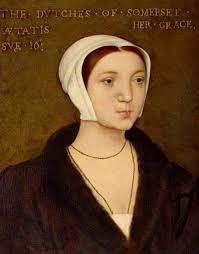
Anne Stanhope

Seymour married for a second time to Anne Stanhope. Today’s post is supposed to be about her daughter – Anne. She had more sisters including Margaret and Jane. All three of them were noted writers of their day. Anne, the oldest married John Dudley the eldest surviving son of John Dudley, Earl of Warwick as he was when the engagement was contracted and Duke of Northumberland when the marriage came to pass. John died of goal fever as a result of being locked in the Tower following froths father’s cunning but not terribly successful plan to put Lady Jane Grey on the throne.

The girls received a humanist education of the kind that included Latin, French, Italian and Greek as well as other subjects. The sisters were also supposed to be notable singers. Her first marriage was supposed to seal a political alliance between Seymour and Dudley but within weeks of the marriage Seymour was off to the Tower for a date with the headsman. When John died Anne was still only sixteen or seventeen years old. An old family friend of the Seymours arranged a second marriage to Sir Edward Unton. She and her husband had seven children, though it didn’t stop him from going off on a Grand Tour. During that time and whilst her youngest child was scarcely out of babyhood she was declared to be a’ lunatic with lucid intervals.’ She was twenty-eight years old.

Anne and her sisters composed 103 Latin distichs- choric praise in couplets and rhyming quatrains- for the tomb of Margaret of Navarre which were published in France in 1550. This then makes the three young women an important voice in the development of the female written word but at the time they were regarded as political pawns on the marriage board. Marriage to John Dudley bought disaster but also financial advantage. Elizabeth I saw to it that she received an income from her jointure. Her second marriage saw her as a footnote. There is no explanation of her insanity.

There is even less known about Margaret Seymour who may have died at a similar time to her sister Jane who was born circa 1541 and died in 1561 from tuberculosis having served for a short time as one of Elizabeth I’s ladies. It was she who was the sole witness to her brother Edward Seymour’s marriage to Lady Katherine Grey.

Demers, Patricia. “The Seymour Sisters: Elegizing Female Attachment.” The Sixteenth Century Journal, vol. 30, no. 2, 1999, pp. 343–365. JSTOR, http://www.jstor.org/stable/2544708. Accessed 30 May 2021.

A Henry VIII interlude

I came across this on the C J Sansom Appreciation Society (https://www.facebook.com/groups/15046129703/) as posted by one of its members. It made me smile and I hope that you enjoy it as well – and the C J Sansom Appreciation Society has some lovely posts.

The caption is Henry VIII’s wives if they hadn’t married him – they certainly look different when smiling.

The Wheel of Fortune

Detail of a miniature of the Wheel of Fortune with a crowned king at the top, from John Lydgate’s Troy Book and Siege of Thebes, with verses by William Cornish, John Skelton, William Peeris and others, England, c. 1457 (with later additions), Royal 18 D. ii, f. 30v. https://blogs.bl.uk/digitisedmanuscripts/2012/02/the-wheel-of-fortune.html

The wheel of fortune or rota fortunae features in Chaucer’s writing and in Shakespeare’s. Both Hamlet and Lear have something to say on the topic.

Dating from Classical times the goddess Fortuna is pictured blindfolded with a cornucopia in one hand and a wheel or a rudder in the other. The original concept of the wheel or even sphere was linked to the astrological frame in which the signs of the zodiac were placed. Boethius, writing in the sixth century, extended the idea. The problem with Fate was that it was pagan and the Church didn’t necessarily approve.

But by the medieval period the rota fortunae was being used to remind people that it was probably best to concentrate of God and the hereafter rather than earthly things because Fortuna can bring luck, fortune and power or can remove all those things at a slip of the wheel and because everyone is bound to their wheel they have no choice but to accept what Fate throws at them. Fortuna isn’t being capricious – she’s more of a Heavenly enforcer. It is God’s will whether your business venture is successful, whether there is a famine, whether you suddenly find yourself being usurped from your throne.

The concept of destiny is an important one in the medieval and Tudor world views. It is linked also to the concept of the Great Chain of Being – everything has it’s place and shouldn’t try to step out from the place that God has allotted. Another way of describing the Great Chain of Being is to call it Divine Order. Essentially the more “spirt” something has the closer it is to God so therefore the higher up the Great Chain of Being it is – ladies you will no doubt be delighted to know that we’re lower down the chain than men. You are where you are in a rigid social hierarchy because God wants it that way – so please don’t revolt because if you do the Divine Order will be upset and this will reflect across the universe…there will be storms and floods and strange and monstrous happenings.

So – we’ve all been given a place in the universe based on the Great Chain of Being. Our destinies are in the stars and allotted to us when we’re born – remember horoscopes are cast as part of the medical process and Books of Hours contain dates which are more auspicious than others for things like moving house, having blood taken and going on journeys. The wheel of fortune is in the background as the main controlling force in life – explaining all life’s successes and adversities, joys and tragedies. It helped explain all those things for which there seemed to be no explanation.

Of course the Renaissance and the concept of humanism sees things a bit differently.

Radding, Charles M. “Fortune and Her Wheel: The Meaning of a Medieval Symbol.” Mediaevistik, vol. 5, 1992, pp. 127–138. JSTOR, http://www.jstor.org/stable/42584434. Accessed 16 Feb. 2021.

Blowing up the bed…the queen and the plotter’s mother.

Elizabeth I – The Armada Portrait

In 1586 the younger brother of Sir Edward Stafford, the English ambassador in Paris, went to see the secretary of the French ambassador, a man called Leonard des Tappes. Stafford had a plan. Des Tappes informed his master – Chateauneuf.

Stafford explained that the plan was to blow up the queen’s bed with the queen in it. Unfortunately the queen was afraid of the dark and never slept without one of her ladies in waiting. Stafford’s own mother Lady Dorothy Stafford served Elizabeth faithfully. Although the job title Mistress of the Robes hadn’t yet been created it was what Dorothy did.

Lady Dorothy Stafford

The ambassador pointed out that the risk of blowing up Lady Dorothy was quite great. Stafford said that in that case it would probably be best to stab Elizabeth or possibly poison her.

Stafford was very swiftly arrested and escorted to the Tower as was Des Tappes. The ambassador was questioned and eventually admitted that he knew about the plot. What he should have done was to reveal to the Privy Council, to Cecil, to Walsingham…to any one who would listen really…that there was a dastardly plot afoot. He hadn’t blabbed which wrong footed him and effectively put him out of the complicated Anglo-French game of spies and intrigue for a significant month of two. He was placed under house arrest and thus unable to get anywhere near Mary Queen of Scots who was being quietly entrapped by Walsingham (Babbington Plot)

Elizabeth’s guard was doubled and she became much more wary of Mary Queen of Scots which was exactly what Walsingham hoped to achieve.

And Stafford, described in documents as “a lewd, discontented person?” His mother was very distressed at the thought that he might try to blow either her or the queen up so it’s unlikely that Elizabeth was aware that it was a ruse. Certainly he was in Walsingham’s pay as indeed had Moody been at various times.

The Spanish Ambassador wrote to Philip II telling the story. Apparently Lady Dorothy and her older son were not on good terms with little brother William but that William had pretended to be a Catholic and told the French that he would place a barrel of gunpowder in the bedroom and er, well – kerboom!

And whilst we’re on the subject of Dorothy Stafford her grandmother was Margaret Pole the 8th Countess of Salisbury – yes – that one. The daughter of the Duke of Clarence (the one drowned in a vat of Malmsey) married off to a member of Margaret Beaufort’s extended family and eventually executed without trial by Henry VIII in 1541 making her grand daughter Dorothy Stafford doubly related to some degree to Elizabeth I.

Margaret Pole Countess of Salisbury

Whitelock, Anna. The Queen’s Bed.

Elizabeth I’s health before she became queen.

According to existing records Elizabeth I was healthy and active child apart from teething problems as documented by Lady Margaret Bryan. However as she arrived at adolescence her health deteriorated and she began to experience a series of chronic ailments.

There were some very obvious additional stress factors to take into consideration – at six she’d gained her fifth step-mother, a cousin, Katherine Howard. Less than two years later Katherine was sent to the block.

In Katherine Parr Elizabeth found some sort of family life and stability, although on occasion wife number six’s head did not rest easy on her shoulders.

Not long after the death of her father, Thomas Seymour asked her to marry him. She was thirteen. Less that six weeks after Henry VIII’s death Thomas went on to marry Katherine Parr and Elizabeth found herself living in the same household as Seymour. It was not long before the thirty-eight year old began making in appropriate advances to the fourteen year old princess. Ultimately she was sent away from the household, Katherine died after giving birth to Seymour’s daughter and Seymour’s ambition became so great that he once again looked to a taking a Tudor bride. This resulted in his execution. Elizabeth now became ill and required the attended of Edward VI’s physicians.

When Mary Tudor became queen Elizabeth used her health – stomach ache in particular- to avoid attending mass. After Wyatt’s Rebellion in 1554 Elizabeth began to look ill – so much so that the French ambassador de Noailles reported that she was being poisoned. Mary’s doctors examined her and blamed her poor health on watery humours. And no wonder, Elizabeth spent the years between 1554 and 1558 dissembling. Just before Mary’s death Elizabeth became ill and complained of pain when moving. She also experienced painful swelling. One of the problems was that Mary and her advisors did not know whether she was really ill or not.

Elizabeth also experienced fainting fits, insomnia, debilitating headaches, nightmares and depression. There was much stress involved in the preparation to become Gloriana!

“The Medical Personnel of Elizabeth I (1558–1603).” The Royal Doctors, 1485-1714: Medical Personnel at the Tudor and Stuart Courts, by Elizabeth Lane Furdell, NED – New edition ed., Boydell & Brewer, Rochester, New York; Woodbridge, Suffolk, 2001, pp. 67–97. JSTOR, http://www.jstor.org/stable/10.7722/j.ctt14brw4d.7. Accessed 11 Jan. 2021.

Taylor-Smither, Larissa J. “Elizabeth I: A Psychological Profile.” The Sixteenth Century Journal, vol. 15, no. 1, 1984, pp. 47–72. JSTOR, http://www.jstor.org/stable/2540839. Accessed 11 Jan. 2021.