The Lion and the Unicorn

stcuthbert'scoatofarmsThe lion and the unicorn are the heraldic supporters of the royal coat of arms.  The lion represents England, while the unicorn stands for Scotland.  This current combination of supporters dates back to 1603 and the accession of James I of England or James VI of Scotland depending upon your viewpoint.  There is a fine example of James’ coat of arms in the church of St John the Evangelist, Leeds.

Earlier kings used different supporters.  Tudor kings used a Welsh dragon and sometimes a greyhound.  Richard II used a white hart.  In addition, the arms  have changed over the centuries as Ireland, Scotland and Wales were added.

The royal coat of arms in its various guises, usually supported by a lion and a unicorn, began to appear in English churches and cathedrals in the aftermath of the English Reformation – a reminder to congregations that the monarchy was in charge of matters spiritual as well as temporal. There was never a law, although the “great council” issued an “injunction” in 1660 (Records of Buckinghamshire, p386) to say that churches required coats of arms, they tended to be put on display during times when it was sensible to demonstrate loyalty to the crown– after the restoration of Charles II; in the aftermath of the Jacobite uprisings and upon the accession of a new monarch for example.

This means that the coats of arms on display are not always the same. The arms on display in Halifax date from the reign of Queen Ann, while in Woodkirk near Morley the arms are those of King George I.

Not every church and cathedral has a royal coat of arms. The Victorians got rid of many of them or consigned them to less prominent positions. Apparently there are even one or two arms where thrifty churchwardens turned the board around and painted ones on the back.

The Churches Conservation Trust provides an interesting summary of the way in which the royal arms changed over the centuries with examples. Double click on the image of the fairly rare King Charles I coat of arms that was added to St Cuthbert’s in Wells in 1631 to open the page.

Cleeve Abbey

Cleeve Abbey TileCleeve Abbey was a Cistercian foundation.  Cistercians were initially an order of Benedictine monks who felt that the rule of St Benedict had slackened over time. A group of these reformers founded the abbey at Citeaux in 1098. They placed emphasis upon prayer, manual labour, austerity and poverty.


The Cistercians or White Monks, named after their undyed rough woolen habits came to England in 1132. They arrived from Clairvaux in order to establish a ‘daughter house’ to the abbey in Clairvaux.  The abbot and his twelve companions (the usual number for a new daughter house) journeyed north until they arrived at the River Rye.

Rievaulx Abbey would become one of the greatest abbeys in the country founding daughter houses of its own in England and Scotland.  Patrons of Rievaulx included kings of England and Scotland. Little wonder that they began with twelve choir monks but exceeded one hundred and fifty less than a century later. Much of this expansion was due to the influence one of Rievaulx’s abbots – a monk called Aelred who later became a saint.


Rievaulx’s own daughter houses can be found north and south of the border between England and Scotland. Melrose Abbey in Scotland was a daughter house, as were Warden Abbey in Bedfordshire, Revesby in Lincolnshire and Rufford Abbey in Nottinghamshire. A second abbey was founded in Scotland – Dundrennan.


Each of these abbeys in their own turn founded daughter houses; grand-daughter houses to Rievaulx. For example Melrose Abbey is the mother house of Hulm Cultram Abbey in Cumbria. In England, Revesby Abbey created a daughter house in Somerset – Cleeve Abbey to be precise – so you can take a blogger out of Yorkshire but you can’t take Yorkshire out of the blog for very long as I discovered this morning.


Having listened to the aftermath of Hurricane Bertha pass overhead in the night in the form of a heavy downpour and a thunderstorm we ventured coastwards to Cleeve Abbey in Washford with our fingers firmly crossed that we would avoid any rain.


The information that follows comes from the very informative display at the beginning of the tour and the ever helpful Victoria County History.


The 3rd Earl of Lincoln, William de Roumare,  was the founder of the monastery in the late twelfth century when abbey building was at its peak. His own grandfather had been one of the patrons who founded Revesby.

The abbey was known as Vallis Florida meaning ‘flowering valley’ – it still does have plenty of flowers.


The first abbot was called Ralph. He and twelve monks arrived from Revesby to found the only Cistercian abbey in Somerset. It was never wealthy but by 1300 there were twenty-eight monks. In the years that followed monks from this picturesque community toiled on the land, studied (rather than the usual cupboard of books, the brothers at Cleeve had an entire room of them) and a couple were even raised to the rank of papal chaplain.

And so things might have continued but Henry VIII was a man in need of a son. In Autumn 1535 Thomas Cromwell’s commissioners came knocking on the gatehouse door. The man of the moment was Dr John Tregonwell. He liked what he saw –even if it was only worth in the region of £155 a year- in fact he liked it so much that he wrote a politely worded note to Cromwell asking if he could rent it as he had a wife and children to support. Given that the monastery hadn’t even been dissolved his request seems to be ‘a bit previous’ as my step-son would say.


The plot thickened as there’s also a letter in existence dated 1537 written by Sir Thomas Arundell, the king’s receiver who was writing to ask what Cromwell intended with Cleeve as it was still operational and rumour said that King Henry VIII had ‘pardoned it.” He went on to ask for clarification and to comment that Cleeve contained “seventeen priests of honest life.”

It was to no avail. The abbey was required to submit. The abbot received a pension of 40 marks a year (about £9000 these days apparently). One of the monks – John Hooper- went on to become Bishop of Gloucester. He managed to irritate Queen Mary in 1555 and was burned as a heretic.


Tregonwell was not successful in his suit. Still, there were plenty of other abbeys for him to lay hands upon. He acquired Milton Abbas in 1540 and numerous other Dorset properties. According to his parliamentary biography there appears to have been some irregularity about the number of leases he handed over for the nunnery of St Giles at Flamstead which must have been resolved and not to his credit. He went on to become Chancellor of Wells Cathedral and later,  during the reign of Queen Mary, the MP for Scarborough.

As for Cleeve Abbey itself, it was granted in January 1538 to Robert Radcliffe, Earl of Sussex by way of a thank you present.

Radcliffe was a loyal servant to the Tudors. He was the privy councilor who suggested that Henry Fitzroy, Henry VIII’s illegitimate son with Bessie Blount, should be named heir to the crown ahead of the legitimate but female Mary. He was an active agent in promoting Henry’s divorce from Catherine of Aragon and later after the suppression of the minor monasteries he helped to put down the Pilgrimage of Grace (1536) in Lancashire.


The church of Cleeve Abbey was swiftly demolished but the cloister remains as do many lovely, if cracked thirteenth century floor tiles, which lay hidden beneath the soil for many centuries. The display in the abbey buildings includes tiles showing Richard the Lionheart and Saladin on horseback. The display also explains how the tiles were made.  Other tiles are heraldic and reflect the names of the abbey’s patrons including Richard of Cornwall who was the brother of  Henry III.  His tiles are the ones with the lion rampant on them.

Henry III was also a patron.  He gave the monks of Cleeve Abbey the right to any wrecks that arrived on Cleeve’s stretch of shoreline.


Muchelney Abbey

Tiles from Muchelney AbbeyMuchelney Abbey on the Somerset Levels was founded by the Saxon Kings of Wessex.  Unfortunately it is impossible to be precise about which one, as some of the charters granting land to Muchelney are medieval forgeries.  Evidence does suggest that King Ine of Wessex founded the abbey and then King Athelstan refounded it when he gave gifts to the abbey – in thanks for his victory over the Vikings at Brunanburgh or possibly as an ‘oops I’ve been a bit of a naughty boy’ offering in relation to his involvement in the murder of the Atheling Edwin in 933. The confusion about the abbey’s foundation may be because the area suffered under the Vikings.  After all, Muchelney is in the vicinity of the hovel where Alfred the Great burnt the cakes. Wedmore, where there was once a royal palace and where Alfred made a treaty with Guthrum is just up the road.


The ruins that remain today date from the twelfth century and reflect the Norman desire to found or support existing monastic houses.  There is also a very smart sixteenth century staircase in the abbot’s residence that must have looked a bit out of place when it became a farm house after the dissolution as well as some wonderful recumbent lions over the fireplace which date from a century earlier.


Muchelney is mentioned in the Domesday Book.  It turns up again some five hundred years later in Thomas Cromwell’s Valor Ecclesiasticus as being worth £447 with eight monks in addition to the abbot and prior. It had never been a large monastery – Glastonbury was too close for that to happen.


There were earlier visitations. The Victoria County History for Somerset mentions a visit in 1335 when the Bishop of Shrewsbury found the Benedictine monks sleeping in richly covered beds and going off for their meals on horseback rather than eating in the monastery itself. In addition the cloisters were being polluted with the presence of the laity – and not just men either. The Bishop also noted that the church was in a bad state of repair. The monastery was swiftly reformed by a new abbot but it didn’t spare the monks from a visit by the Black Death.


Cromwell’s commissioners also sent many letters about Muchelney.  The commissioner who arrived in January 1538 was Thomas Leigh (he made himself deeply unpopular during the first phase of the dissolution in Yorkshire.)   By 1538 Leigh had a handy assortment of damning phrases with which to write to his master. He described the abbot as being of “doubtful character” and the monks “unlernyd.” Unlearned or not the brethren at Muchelney could see which way the wind was blowing and swiftly surrendered the abbey into Leigh’s hands.

Henry VIII granted the abbey to his brother-in-law the Earl of Hertford.  The Earl, Edward Seymour whose sister Jane Seymour married the king two years earlier, went on to become Protector of England during his nephew Edward VI’s minority.

Seymour kept the abbot’s lodging turning it into a farm house which he let out to tenants. He used the rest of the monastery as a quarry.

When Seymour was executed for treason Muchelney returned to the Crown where it remained until 1614 when it was sold off by James I.

The church of Muchelney which stood next door to the abbey was not part of the abbey itself – so Seymour couldn’t strip the lead from the roof or take away its dressed stone!  However, the abbey had the living for the church. This meant that they could appoint the priest. An informative display also mentions the fact that the abbey was responsible for providing the vicar with bread and ale every day, meat twice a week, and eggs and fish on the other five days.


Victorian excavation of Mucheleny Abbey revealed medieval floor tiles belonging to the Lady Chapel. These were placed inside the church where they remain today as a reminder of how beautiful English abbeys must have once been.


Corbels, corbel tables and label stops


Wells lizard

Every profession and specialism has its own jargon.  It makes life a lot easier than referring to the ‘thingy’ or having to keep pointing and saying “that one over there.”  Communication becomes precise and efficient.  While an assortment of words (largely nouns if we’re going to be accurate)  may be helpful for people in the know, for those of us who are just getting to grips with these things, jargon can also be plain confusing – not to mention intimidating.

The other problem with jargon is that you may think that you know something but then a new word comes along to sling the proverbial spanner in the works.  Such was the case for this blog.  Half an hour ago I knew what a corbel was; ten minutes after that I read a guide on a local church website and discovered a new word which threw my poor brain cell  (yes  one – the other one seems to have gone on holiday) into confusion.

A corbel to quote Scotland’s Churches Trust is “a stone which projects from a wall-face, to support a floor or roof, or some other structure. A row of corbels, with spaces in between, at a wallhead, is known as a corbel table. A continuous row of such projecting stones is known as corballing.”  http://www.scotlandschurchestrust.org.uk/maintain-your-church/glossary/?term=73

Corbels can be seen both inside and outside buildings from parish churches to royal castles.  A corbel isn’t always decorated – sometimes it just looks like a neatly cut lump of stone holding something else up.  So far so good.   A  corbel is different from a gargoyle in that a corbel is just one end of a load bearing lump of masonry whereas a gargoyle is a waterspout jettisoning water from the roof after it rains.

Now for the new terminology that had me confused. A label stop, again to quote the excellent Scotland Churches Trust is “the name given to the lower end of a drip mould. Usually a short horizontal section of the same form as the drip mould, but sometimes a carving of a human head, a grotesque animal, or a bunch of leaves.” http://www.scotlandschurchestrust.org.uk/maintain-your-church/glossary/?letter=l

So why was I confused?  I began writing this blog thinking that the delightful little salamander munching his way through a selection of fruit just off the north transept of Wells Cathedral was a corbel – then I did my research for this blog using the Internet to see if I could find out any thing else about him. I landed on the aforementioned local church website.  The words corbel and label stop occurred in close proximity to one another without clarifying the difference between them.  The result was that my brain cell had a minor panic.  Was the lizard a corbel or a label stop?

Further research ensued.  I then found the Scotland’s Churches Trust website with its lovely clear glossary of architectural terms – the brain cell heaved a huge sigh of relief and added another term to the long list of useless information stored in the dim recesses of my skull.

To summarise my convoluted meanderings – the Wells lizard sits at the end of a shaft that shoots off to form an arch – so he is load bearing.  This means that  he is very definitely a corbel.  Look at it and pause to wonder at the engineering capacity of medieval builders as well as their creative genius.  Photographically he is delightful to behold and required me to stand only on tip toes with my arms extended (who’d have thought that a visit to a cathedral could also be an aerobic work out?)

A  label stop, on the other hand, is a dinky piece of sculpture (no that’s not a technical term)  found at the end of a length of decorative moulding so not holding up anything but pretty to look at- but still pause and marvel at the skill it took to create something so very small in so much detail.

If you’d like to browse a glossary of church related architectural terms double-click on the picture to open up the Scotland’s Church Trust glossary.

Capital

Wells capitalsI’m sitting here feeling slightly dazed – and perhaps it’s not surprising.  I’ve just spent five hours in Wells Cathedral taking photographs (okay there was a pause for a very moorish ginger and chocolate tray bake which contained absolutely no calories what-so-ever and a cup of tea.)  Aside from the scissor arch, the medieval crazy patchwork stained glass and the cathedral cat – a glorious and imperious ginger called Louis I spent an awful lot of time craning my neck for some capital shots.

A capital coming from the Latin capitulum meaning of the head refers to the top bit of a column – so it’s load bearing.  A very nice guide even talked me through the different parts of a capital this morning.  The very top of the capital is flat – that’s called the abacus.  The abacus tends to be plain – though by the late Gothic masons were decorating them as well.  Then comes the necking which thins to join the shaft of the column beneath it.  Sometimes the necking runs straight into the column but more often than not there’s a thin moulding to separate the column from its capital.

It’s possible to tell the age of a capital in an English church by the kind of decoration on the necking.  Norman capitals are solid and largely undecorated – those are the Romanesque ones.  Having said that the Normans do decorate their capitals often with symmetrical patterning and rather chunky looking people if my memory serves me correctly.

In any event  the next stage  in the evolution of the capital involved foliage – in some cases foliage that looks rather like a tree drawn by a small child – one stem and one leaf in neat rows.   Somehow the Gothic evolved out of the Romanesque so that by the thirteenth century masons were running riot carving sinuous leaves, green men, strange birds, beasts and odd little figures.

In Wells there are doves, dragons and lions as well as a fox running off with a goose in its mouth.  The fox is being pursued around the capital by a very cross farmer.  There’s a spoonbill swallowing a rather plump frog; a devil who has caught a fish; a pedlar with his pack and a string of beads; a man with terrible toothache; a cobbler; a man removing a thorn from his foot; a thief; assorted Old Testament types; someone being martyred and rather a lot of different kinds of leaves as well as a bewildering collection of heads peering down from their hiding places.  The more you look the more that you see – English Gothic at its best – at least that’s what the very nice guide told me and I’m not going to disagree.

So next time you go to a church or cathedral if you’re not crawling around on your hands and knees attempting to photograph misericords  without moving them or crossing any barriers that have been erected to keep the public at a safe distance you can vary your posture by standing on tip-toe developing a crick in your neck while trying to hold your camera steady in order to capture capitals.


The last abbot

Glastonbury AbbeyGlastonbury Abbey was the richest abbey in Somerset. Pilgrims came to see the graves of King Arthur and Guinevere and to hear the story of the Holy Grail, Joseph of Arimathea and the Glastonbury thorn. So, the Abbot of Glastonbury, Richard Whiting, didn’t initially have anything to fear when Cromwell started the process of dissolving the minor monasteries. Gradually the reformation gathered pace and the elderly abbot must have prayed for guidance.  In 1537 monks, implicated in the Pilgrimage of Grace, were executed – amongst their number the Abbots of Sawley, Jervaulx and of Fountains.

Two years later on 15 November 1539 the last abbot of Glastonbury Abbey, an old man in his seventies, followed his brothers when he lost his life on Tor Hill following two trials and having spent some time in the Tower of London.


Richard Whiting had been a young man when the Tudors came to power.  He’d been a student in Cambridge at the time of the Battle of Bosworth and was ordained at the beginning of the sixteenth century. Wolsey nominated him when the position of abbot fell vacant noting his upright character. John Leland, Whiting’s friend, described him as “truly upright”.

His life might have passed peacefully had it not been for Henry VIII’s desire for a son and his determination to divorce Catherine of Aragon. Unlike Sir Thomas More, Whiting signed the 1534 Act of Supremacy along with the monks of Glastonbury. The following year Cromwell sent his commissioners around every monastic house in the country. The Valor Ecclesiasticus was an inventory of monastic wealth as well as a monastic fault-finding tour. At Glastonbury the monks were kept upon the straight and narrow by their abbot – the commissioner Richard Layton found nothing to fault (he apologised to Cromwell for his error in a later letter.)


In 1539 the act was passed suppressing all the remaining monasteries in the country by then Glastonbury was the last remaining abbey in Somerset.  The National Archives houses a positive flurry of letters sent from the abbot and his supporters to Cromwell.  Ink, paper, fair words – none of them mattered a jot.  Cromwell had plans for Glastonbury.   The commissioners returned. They found a copy of the life of Thomas Becket and a book in support of Catherine of Aragon in the abbot’s quarters. It was enough to send him to the Tower.


While the elderly abbot languished in a dungeon, Cromwell’s men got to work. They uncovered financial irregularities and further evidence of Whiting’s treasonable opinions – which have conveniently been lost in the following centuries. Letters to Cromwell quoted in the Victoria County History of Somerset reported that three hundred pounds of cash was uncovered along with a gold chalice and parcels of plate which the “we think he ought to make his hand by this untruth to his King’s Majesty.” Their discovery would see the abbey’s treasurer share his abbot’s fate.

Whiting was tried in London, on evidence that was never made public, and found guilty. Then he was shipped back to Wells where he was tried for a second time in the Palace of the Bishop of Bath and Wells. His judges included men who had, in former times, written on his behalf to Cromwell. It was a show trial with a catalogue of people coming forward to testify against him. The abbot was not permitted to defend himself or question his accusers.


It was a show execution as well. The elderly man, nearly eighty by some reckoning, was forced to walk barefoot from Wells to Glastonbury – a distance of some seven miles. He was then tied to a hurdle and dragged through the town, by the gateway of his abbey and up onto the tor where a gibbet awaited him and two other of his brothers. They each faced a traitor’s death. Whiting’s head ended on a spike looking out over his own gateway.


The Battle of Tewkesbury

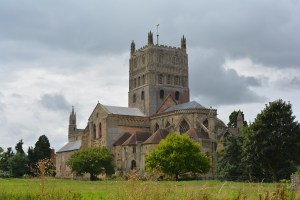
Tewkesbury AbbeyThe Battle of Barnet in April 1471 saw the defeat and death of the Earl of Warwick. A Lancastrian defeat was not the kind of news that Queen Margaret (of Anjou), wife of Henry VI, wished to hear when she came ashore with her son Prince Edward  at Weymouth on the same day.


Her only option was to meet with Jasper Tudor in Wales. The Yorkist king, Edward IV, needed to prevent this from happening. The two armies came face to face with one another on the 3rd of May 1471. Margaret managed to avoid Edward at Sodbury and was heading for Gloucester when the armies finally met. A battle would be fought the following day that would see Margaret and Henry’s only child, Prince Edward, killed.


The Lancastrians held the land to the south of the abbey. Edward used artillery and bowmen to attack the Lancastrians. The Lancastrian right wing came to the aid of its center and caught the Yorkists by surprise. Things could have gone very wrong for Edward had not his brother Richard, then Duke of Gloucester, met the attack. As it was the Lancastrians found themselves caught on marshy ground and 2,000 men died resulting in the name of ‘Bloody Meadow’ being attached to the area of battle where the Lancastrians fell.  The Duke of Somerset held John Wenlock (the  1st baron) responsible for the disaster as he’d commanded the centre of the Lancastrian army.  The Duke who’d commanded the right wing of Margaret’s forces was so incensed that he killed his compatriot on the field of battle. The army fled, many of its soldiers killed in the fields and hedgerows where the A38 runs today.  Other men sought sanctuary in the abbey.


However, Tewkesbury Abbey did not hold legal sanctuary status so the Yorkists forced their way into the abbey two days after the battle. They laid hold of the Lancastrians who sheltered there. The abbey church was so desecrated that it required purification the following month while the Lancastrians who survived the onslaught found themselves dragged into the market square where they were summarily beheaded. Amongst the executed were Edmund Beaufort, Duke of Somerset (Margaret Beaufort, mother of Henry VII was his niece) and his younger brother John. They were returned to the abbey for burial.

Prince Edward was also buried in the abbey.  The other Plantagenets to find a final resting place in the abbey were Isabella (wife of the Duke of Clarence and daughter of the Earl of Warwick) and the Duke of Clarence, Edward IV’s brother who was drowned in a butt of Malmsey.


As for Margaret of Anjou, she was captured on the 7th May. She remained a prisoner until 1475 when a ransom was paid for her release.

Click on the picture to open up a new window for a BBC page showing a Victorian interpretation of the Yorkists and Lancastrians in Tewkesbury Abbey.

Baile Hill, York

Baile Hill, YorkBaile Hill is the site of William the Conqueror’s second motte and bailey castle in York. It lies across the Ouse from Cliffords Tower. Both castles were destroyed following an eight day siege in 1069.  Very few of the garrisons of either castle survived the experience – although the sheriff’s wife and children were allowed to escape with their lives.

It’s easy to miss Baile Hill.  These days its one more set of steps on the way round York’s city wall, though there is a handy plaque with an explanation about building technique for motte and bailey castles.

Archeological survey in the 1970s revealed that William utilised the remnants of earlier fortifications, a practice seen elsewhere including the Tower of London and Colchester Castle where he used Roman fortifications.  At Almondbury in the West Riding the Normans made the most of an Iron Age Hill fort.  In this case, as in London and Colchester,  there are Roman remains buried deep within the motte. The archeologists also discovered the remnants of a timber palisade and a wooden building that dated from the twelfth century along with assorted small medieval finds.

The castle was no longer required by the early fourteenth century and by 1322 it had become part of York’s city wall. There is further recorded reference to it as there was some debate about who had responsibility for the upkeep of that part of the wall.  Edward II ordered the city’s defences to be repaired, not surprising given the Scots had the upper hand in the Scottish Wars of Independence at the time.  The land and stretch of wall that Baile Hill was part of lay in the bishop’s remit, hence the other name for the area Bishops Hill. In the end the archbishop William de Melton complied, albeit unwillingly.

Leland, the Tudor mapmaker, was not impressed with the remnants of the castle when he visited “ it is of no very great quantity.”

The find on Baile Hill that intrigues me most is an early nineteenth century discovery  of a hoard comprising  silver pennies of Edward the Confessor and coins from the early part of William I’s rein.  (‘The Old Baile’, An Inventory of the Historical Monuments in City of York, Volume 2: The Defences (1972), pp. 87-89. URL: http://www.british-history.ac.uk/report.aspx?compid=125178 Date accessed: 27 July 2014.).    Who buried them and why did they not return for their savings?  Was it a Norman soldier who met a sticky end in 1069 or was it a local who buried his or her savings to secure them from the Normans?


The Heimskringla Saga

reading linkEngland became a prize for the taking when Edward the Confessor died on 5th January 1066 England.  The man on the scene, Harold Godwinson lost no time staking his claim but his brother Tostig, furious not to be reinstated to the Earldom of Northumbria attempted to take the throne for himself.  First he crossed the channel with a fleet of sixty  ships from Flanders.  He initiated his attempted invasion by attacking Harold’s lands on the south coast.

Harold proved equal to the occasion when Tostig finally fled he had only twelve vessels remaining.  Harold 1: Tostig 0.

Tostig fled via Scotland to Denmark and then on to Norway where he and King Harold Hardrada – the Hard Rider- prepared another invasion.  In September 1066, when the wind stood against William of Normandy’s invasion fleet, a Scandinavian armada  of some three hundred and thirty ships sailed first for Scotland and then down the east coast towards the Humber Estuary pausing only to do nasty things to Scarborough.

On the 20th September 1066 having sailed up the Humber  and making anchor at Riccall, Hardrada advanced on York.

The Earls of Northumbria and Mercia (Morcar and Edwin) met the Scandinavians in battle just outside York.  The Battle of Fulford Bridge saw an English defeat.  The earls were lucky to escape with their lives.  The best primary account of the battle can be found in the Heimskringla Saga.

It also offers the best account of the Battle of Stamford Bridge which is sometimes described as Harold’s Saga.  Harold hearing of the invasion made a forced march north and caught Hardrada and his brother by surprise and proceeded to beat them – having first of all overcome a beserker who occupied the bridge at Stamford Bridge until one of Harold’s men crept under the bridge and speared him from below (nasty but typical of sagas). Harold 2: Tostig 0.

Having said all that the words of the saga weren’t committed to paper – or parchment- until 1225 by Snori Sturlson, a story teller and historian in the the Scandinavian skaldic tradition, who wrote a chronicle of the Kings of Norway.  As A L Binns  comments:

The earliest survIving Norse account of the events of 1066 is
probably the brief passage from Grkneyinga saga. The four long
Old Norse accounts of Stemford Bridge here compared for the first
time in English are by no means independent either of each other,
or of English sources. So one should not think of a single account
(usually Heimskringla, of which many translations already exist) as
‘the saga account’; and one should not regard them as contemporary
sources, but rather the work of historians who had very definite
views on the characters and motives ofthe participants and selected
their material in order to express them.

Binns, A.L. (1966). East Yorkshire in the Sagas. Hull: East Yorkshire Local History Society p.5

The full text including the sagas can be accessed by clicking on the image at the start of this post.  I’ll be using this image in future to sign post links to a range of texts – and indeed any other images of folks reading that I come across.


Rebellion in the North

Clifford's TowerWilliam faced a rebellion each year for the first five years after his conquest of England in 1066.  The problem for the Saxons was that their uprisings from the West Country to Northumbria via Herefordshire were localised.  There was no one central figure to unify and organise resistance.

Earls Morcar of Northumbria and Edwin of Mercia were powerful and politically dangerous men.  In part their failure to march south to support King Harold in 1066 had led to his defeat. They’d submitted to William along with Edgar the Atheling in late 1066 at Berkhamstead but they swiftly became dissatisfied with their new lord and rebelled against him in 1068.  It couldn’t have come as much of a surprise to William given that he’d taken them with him to Normandy in 1067 amongst the hostages he demanded. Perhaps it was his suspicions about the northern earls that led to him not promoting a marriage between Edwin and one of his daughters and perhaps (that’s many perhaps’s) it was for this reason that Edwin and Morcar decided to revolt, although it could have been William’s new taxes that did the trick.

In any event, William marched north via Warwick and Nottingham.  Resistance crumbled and the two earls submitted again. There is no evidence that the two men took part in any further uprising in the north.  Edwin managed to get himself killed by his own men in 1071 when he left William’s court once more and headed off towards Scotland.  Morcar took part in the uprising in Ely and ended his days a prisoner of the Normans.

The inhabitants of York seeing which way the wind was blowing in 1068 sent hostages and the keys to the city before William could arrive to express his irritation.  William  did what he always did when he wanted to stamp his authority on an area.  He built a motte and bailey castle in York and left a garrison of five hundred men to guard it.

The north did not remain at peace for long.  In January 1069 William’s man Robert de Commines  was burned to death in the Bishop of Durham’s house by an angry mob who had already slaughtered his men according to the Orderic Vitalis.  The people of York were not slow in getting in on the act.   The garrison withstood the attack. The Victoria County History for York records,  “Edgar and his supporters began an attack on the castle, whence the sheriff William Malet reported to the king that in default of assistance he would be driven to surrender.”

If one castle is good then two must be better!  William had a second castle built (Bailes Hill) which he gave into the care of William Fitz Osbern (the Earl of Hereford) before heading back south to Winchester.

There was a brief third uprising that was swiftly suppressed by Fitz Osbern.

At this point you’d think that the citizens of York would have had enough but in August 1069 King Sweyn of Denmark,  who had formed an alliance with Earl Waltheof of Northumbria, anchored his  fleet of 240 vessels on the Humber. This was a much more sustained and serious attack upon William’s rule.

The Normans facing the combined forces of the Danes and the northerners took refuge in their two new castles.  They attempted to clear a field around the castles by burning the nearby houses.  It has to be said that it doesn’t seem wildly clever to believe that in a city of wood and straw that fire can be controlled.  It certainly wasn’t in this case.  Even the Minster found itself being scorched.  According to Florence of Worcester the town was still burning two days after the initial conflagration.


But then again the Normans knew that they were fighting for their lives.  One of the castles sheltered the sheriff’s wife and children.  The slaughter was terrible.  Waltheof  was remembered by later generations in song for slaying Normans one after another with his battle-axe. William of Malmesbury’s account is according to the Cambridge History of English Literature taken from a ‘ballad’ or rather from a professionally worked song written by a Scandinavian scald or storyteller. William’s nice new castles were both destroyed.

Quite what the alliance of Danes and Saxons expected William to do next is unclear.  The Danes took themselves back to their boats with their booty and then set about a spot of ‘viking’ – William found one party of them plundering Lindsey but sent them scuttling back across the Humber.

What followed next wasn’t particularly pleasant if the chroniclers are to be believed and although William kept Christmas on 1069 in York there was little cause for celebration amongst the locals.  However, the North had been put in its place.

Not that their problems were over, far from it.  Malcolm Canmore, King of Scotland, took the opportunity to do a spot of his own harrying in the summer of 1070 and would return several times more before his death at the Battle of Alnwick.

For a chronology, which remains ongoing – I add dates as I come across them- double click on the picture.