Parliament was summoned in September 1399 because King Richard II had been deposed by his cousin, Henry of Bolingbroke, the eldest son of John of Gaunt. Parliament unanimously accepted the 33 articles of deposition on 1 October and a fortnight later Henry IV was crowned king. Effectively, Henry used parliament to validate his actions and to give authority to his reign. Of course one of the difficulties was that Richard had already by deposed so there was technically no monarch to open the so called Convention Parliament which was then recalled after the 13th October in the name of Henry IV.
Parliament increasingly recognised that it held the right to withhold new taxes. It used this power to withhold funds until it got what it wanted from the monarch and in 1414, the Commons successfully ensured that it was them rather than the Lords who held the power in voting taxes for the king or not. By the time Henry V died in 1422 there could be no taxation and no new laws without parliamentary agreement, and more importantly it was the Commons who wielded the stronger power.
As the fifteenth century progressed Parliament was often used to pass acts of attainder against either the Yorkist or Lancastrian nobility depending which side was in the ascendent and by kings to justify why they should be on the throne. The monarchy was still powerful but because of the challenges it faced during the fifteenth century parliament was growing in importance and felt more able to challenge the king, even if he was still on the throne by Divine Right. King’s validated their rule through acts of Parliament and by using acts of attainder to punish men who fought against them.
Today I’m offering a warm welcome to Paul, the son of Michael Hodgetts who wrote Secret Hiding Places first published in 1989. Given my views about the religious beliefs of the original designer of the Unstitched Coif project from 2023, this re-publication seems serendipitous as does the idea of hiding in plain sight.
The English Reformation was given official approval because King Henry VIII wished to divorce his first wife, Katherine of Aragon, in order to marry Anne Boleyn. Inevitably, Henry’s marital disharmony led to the mid Tudor crisis of which religion was a part and to difficulties for those of his daughter, Elizabeth I’s, subjects who chose to remain Catholic. So, over to Paul for a fascinating guest post.
_____________________________________
Priest-holes are a familiar feature of the English country house. Some are on show to the public – King Charles II’s hide at Boscobel has been a tourist attraction for nearly 300 years – and at Harvington Hall in Worcestershire children and small adults can squeeze into one of the hides. But while most people are aware that they were built to shelter Catholic priests at the end of the sixteenth century, and the name of Nicholas Owen has become well known, very few realise quite how many of these strange spaces there originally were or know of the carefully planned strategy behind them.
From almost the start of the reign of Elizabeth I, Catholic services were supressed and fines could be imposed for non-attendance at the Parish Church, but for the first fifteen years or so the laws were not enforced very strictly. The early 1570s saw a tightening, with searches and arrests becoming more frequent: the first record of a purpose-built hide is in 1574 and in 1577 the first execution took place of an overseas-trained priest. The Jesuits arrived in 1580 but the real turning point was after 1585, when a new law made, not only the priests, but also their hosts, liable to execution. A year later, the government was winning the war: fewer than one-third of the 300 priests who had returned from abroad over the previous twelve years were still at work and the tempo of arrests and executions was increasing.
But in July 1586 at a week-long conference organised by the only three Jesuits then at liberty (William Weston, Henry Garnet and Robert Southwell) and attended by other non-Jesuit priests and some young noblemen, a new strategy was born. Instead of priests moving around constantly as they had previously been doing, each would now have a base of operations in a country house and a network of sympathisers would be set up to smuggle incoming priests to holding points until a suitable base could be found for them. Because the priests would be henceforth static, these houses also had to be equipped with hides. Most such houses would only need a single hide, but the holding points would need more, to be able to conceal larger numbers of priests. Weston was arrested two weeks later and spent the next seventeen years in prison, but Garnet and Southwell put the scheme into effect and it is not an exaggeration to say that Catholicism in England and Wales would not otherwise have survived. Southwell, who had relatives all over the Sussex and Hampshire aristocracy, created the ‘underground railroad’ whilst Garnet took into his service a carpenter from Oxford called Nicholas Owen with a very particular set of skills – the ability to create hidden spaces within the fabric of buildings.
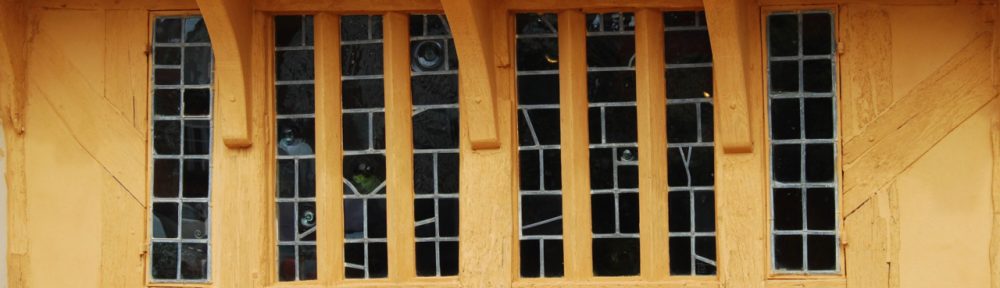
In this private house, the two plaster panels and the sturdy upright beam are a secret door into a large hide. The house was owned by two of the Gunpowder Plotters and the hide may have been built by Nicholas Owen.
All three eventually met grisly deaths: Southwell was arrested in 1591 and executed four years later and Owen and Garnet were arrested in the crackdown that followed Gunpowder Plot. Owen was tortured to death in the Tower of London without revealing any of his hides and Garnet was hanged, drawn and quartered. But the network they had set up survived and grew. By 1610 there were 400 priests at work in England and Wales and the danger of extinction had passed. Eventually, this network sustained Charles II after the Battle of Worcester and took him safely to exile in France.
Secret Hiding Places, first published in 1989, uses eyewitness documents and the physical evidence of the buildings themselves to tell the story of how Owen and others created enough safe hides to enable the Catholic mission to grow to by 1610 and details many searches, narrow escapes, arrests and executions. The book was originally written by Michael Hodgetts, leading Catholic historian and undisputed authority on priest holes. Following his death in 2022, his family have reissued the book and advances in printing technology have enabled, for the first time, full colour illustrations to show these fascinating spaces in unprecedented detail and the new edition has 250 photographs of the hides and their houses.
One of the first priests to be arrested and executed, Edmund Campion, was captured because the searchers saw light shining out of his hide through cracks in the panelling. The door to this hide, at Ripley Castle in Yorkshire, has the remains of cloth that was glued along the inside of the hinge line to prevent that problem.
Amazon Associate
This hide, at Towneley Hall in Burnley is enormous – big enough to stand up and walk around in, as shown by the two members of Hall staff. The floor is of sound-deadening clay. This house has a list dating from around 1710 listing no fewer than eleven hides that then existed.
The book covers all the famous houses and hides but here are some pictures of places that are less well known and that the public cannot see. The book is available on Amazon at
The G.C.S. E question worth 8 marks asks students to explain two ways in which the Peasants’ Revolt and the campaign for the People’s Charter were similar. This is not a complete answer. It could be developed and tweaked but it covers the key points. It raises the interesting question of what other key events in British history might be compared – for instance could Chartism be compared to the English Civil War? And what else could the Peasants’ Revolt be compared with – certainly to the French and American revolutions.
The Peasants Revolt of 1381 and Chartism which was most active for the decade between 1838 and 1848 were both about ordinary people trying to improve their lives with more freedom or a greater say in how their lives were governed. In both cases, economics had a part to play. The peasants of 1381 were tied by serfdom, the wage limits of the 1351 Statute of Labourers that kept pay to pre-Black Death rates and by the poor harvests that followed the Black Death and the impact of the medieval mini Ice Age. Trade was also badly impacted by piracy resulting from the Hundred Years War and the French raids on the Isle of Wight and southern ports including Rye. The 1830s saw bad harvests and the impact of the corn laws keeping bread prices artificially high.
In 1831, peasants wanted their freedom from a feudal hierarchy that saw 40% of them described as serfs, unable to leave the manor where they lived without their lord’s permission, to work without pay and to pay feudal dues including the right to inherit their father’s property. They also wished to abolish the poll taxes that saw everyone over 15-years-old paying the same taxes, whatever their rank in society. Wat Tyler demanded that corrupt officials should be punished. During the Nineteenth century the ordinary working classes were disappointed by the failure of the 1832 Reform Act to give people more rights and in 1833 the Factory Act failed to limit the working day to 10 hours. For those who fell into poverty there was also the impact of the 1834 Poor Law Act which forced paupers into workhouses and made poverty a crime to be punished. Ordinary people in Medieval England and the Nineteenth Century felt that there should be better wages and living conditions for everyone not just the elite. The Chartists demanded regular elections and full male suffrage, ending the 40 shilling property bar that prevented most adults from voting.
The peasants were united in their demands and turned to violence to ensure that evidence of their servitude was destroyed and that local JPs and churchmen were punished. Simon Sudbury, one of Richard II’s advisors and the Archbishop of Canterbury was murdered by the peasants when they were let into London. The Chartists were more divided in the way that their goals could be achieved. Some of them preferred argument and moral force but in the end violence was less easy to ignore. In 1837, Feargus O’Connor, an Irish lawyer living in Leeds, published the Northern Star, a newspaper that campaigned for better wages and living standards. O’Connor supported Physical Force Chartism, which championed using violent means. He felt that even if the violence was negative, that in the long term there would be positive outcomes.
The Chartists were emulating the men and women who were part of the reform movement that led to the Peterloo Massacre of 1819. The event, named after Waterloo, was something of a turning point for the working classes in the nineteenth century. The meeting in Manchester asking for universal male suffrage ended in chaos and 11 deaths when the authorities seized Henry Hunt, a political reformer. Some people blamed the violence on the authorities while others blamed the 60,000 strong crowd. The poet, Shelley, urged the working classes to ‘rise like lions from slumber’ but his words weren’t published until 1832. The authorities wanted to keep the country calm but they feared a revolution of the kind that happened in France. On 4 November 1839, 10,000 Welsh Chartists at Newport, many of them miners, were waylaid by soldiers. Between 22 and 24 of the protesters were killed. The chartists who were not armed really stood no chance – something of a difference to the peasants of 1381 who were armed with whatever they could find and who had killed justices and churchmen during May and June 1381. The Newport chartists’ leader, John Frost, was sentenced to be executed along with several other men who were at the forefront of the campaign – it was the same fate of hanging drawing and quartering that befell the leaders of the Peasant’s Revolt. For John Frost and other chartists the sentence was changed to transportation.
The cost of keeping the History Jar up and running has led me to opt to become an Amazon Associate rather than to extend any advertising. Every time someone clicks on a book cover they will be taken to Amazon. A purchase will result in a commission being paid to me. In future the caption under any image of a book, or anything else that matter, which I have added as a link as an Amazon associate will simply state ‘I am an Amazon associate’ and the information will appear on the ‘About me’ page the blog.
Something for any G.C.S.E. students or anyone interested in the concept of power and the people.
Jean Froissart was a fourteenth century monastic chronicler. He was not sympathetic to the peasants when he recounted the English Peasants Revolt of 1381. He wrote, ‘Never was any land or realm in such great danger as England at that time. It was because of the abundance and prosperity in which the common people then lived that this rebellion broke out.’ Despite the ‘never had it so good’ viewpoint – which would have gone down well with his European patrons who did not want to see the peasants getting a different deal, he did explain that the peasants believed that they were treated like animals and were determined to be free ‘and if they laboured or did any other works for their lords, they would be paid for it.’
There are different editions of the chronicles. In one version the illustrator makes Richard II look like a young boy but in another, fifteenth century version, he is an adult with dark hair.
Wat Tyler and John Ball meet outside London – they’re carrying English banners so that readers know who they are. Wat and John are labelled for clarity by the artist but the background and the buildings are stylised. It is unlikely that the rebels would have been as well equipped as the illustrations show them – the illustrators were used to armies of the Hundred Years War and even then it was only the wealthy who could afford armour. Most ordinary soldiers were fortunate to have a padded jerkin known as a ‘jack’ or a coat reinforced with chain links. Armour was expensive – and peasants could not afford it.
The king meets the rebels at St Catherine’s wharf. The back ground is stylised but the image also shows rebels being admitted to London in the background. The next scene shows the killing of the Archbishop of Canterbury, Simon Sudbury and other officials by the peasants.
The death of Wat Tyler- killed by the mayor of London William Walworth – apparently for not taking his hat off to the king. The scene also shows Richard II winning over the peasants by promising to be their leader. Wat was drawn into the revolt because, amongst the other grievances, a poll tax collector had assaulted his daughter. The image below is the same scene by a different illustrator – the king is shown as an adult. Smithfield has taken on a stylised urban aspect.
Image showing Richard II meeting peasants at St Catherine’s Wharf near the Tower of London on his barge – Froissart’s Chronicles.
England was not the only place to see its’ peasants revolt during the fourteenth century. The city-state of Florence had similar problems at about the same time.
In 1380, in England, the third poll tax in four years was levied. The poor were required to pay as much as the rich but somehow or other in 1380 there was large-scale tax avoidance.
In March 1381 commissions were sent to exact payment one way or an other – anyone who looked like they were over fifteen was expected to pay.
It wasn’t long before people began to make their feelings on the subject quite plain. By April, a poll tax collector in Oxfordshire was attacked and at the end of April tax collectors in Essex came under fire (of the bow and arrow kind).
30 May men from Fobbing in Essex joined with other protesters from Corringham and Stanford to attack a court in session at Brentwood. Sir Thomas Brampton, the poll tax collector for Essex, was chased out of town. Similar uprisings were reported across the river in Kent.
On 2 June – Bocking in Essex- Rebels swore ‘to destroy divers lieges of the king and his common laws and all lordship’. Sir Robert Belknap the chief justice for Essex and his men are attacked and two of the men are killed as they flee. It was as though someone had lit a touch paper. The rebellion spread through Essex, Hertfordshire, Cambridgeshire and Suffolk. In North Kent the band of rebels swelled with each passing day.
7 June Wat Tyler is elected head of the rebels in Kent and John Ball is rescued from Maidstone prison.
9 June- The peasants march on Canterbury and the following day they ransack the town before beginning their journey to London. Groups of rebels stop at manors to destroy records. It means that the evidence of serfdom is destroyed.
12 June – Men from Kent arrive at Blackheath while rebels from Essex arrive at Mile End. There are approximately 30,000 very cross people on London’s doorstep.
13 June- King Richard II is taken to the Tower of London for safety. Simon of Sudbury and Richard Hales, both important ministers, have gone with him. The king talks to the rebels at St Catherine’s Wharf and War Tyler sends him a letter. The king agrees to meet the rebels at Rotherhithe. When he arrives be barge, he very sensibly refuses to get off, especially when the rebels demand that he have his principal advisors including John of Gaunt, who is on campaign in Scotland, executed.
14 June Wat Tyler and the king meet at Mile End outside London’s city walls. Tyler asks for an end to all feudal services and for pardon for any offences committed during the rebellion. Richard II immediately agrees and Tyler pushes for the execution of corrupt officials. Richard II announces that anyone found guilty by a court of corruption will be punished. He also hands out charters – signed by himself- to be given to serfs- confirming their freedom. The serfs who have got what they wanted clear off home. Inside London, the rebels have a number of supporters – one of them opens the town’s gates and let those that remain inside the city the same afternoon.
14 June pm. Radical rebels attack the Tower of London. The king’s ministers including Simon Sudbury and Robert Hales are murdered by the rebels in a display of summary justice or brutality depending upon your viewpoint. John of Gaunt’s Savoy Palace is burned to the ground – somewhat unfortunately a number of rebels who broke into the Savoy’s cellars, had become drunk and did not make their escape before the fire. The rebels target royal officials, churchmen and also wish to destroy evidence of their serfdom. Also targeted are records of land ownership and any debts.
15 June The mayor of London, William Walworth, raises an army of 5,000 men and Richard II arranges to meet Wat Tyler that evening at Smithfield. Tyler makes more demands including an end to tithes (the taxes that people have to pay to the church), the abolition of bishops (the Church’s equivalent of the barons), redistribution of wealth, equality before the law, and the freedom to kill the animals in the forest – because remember the Forest Laws are still in force.
William Walworth argues with Wat Tyler then stabs and kills him. it could have been nasty but Richard II, who is only 14, calls on the rebels to accept him as their rightful leader and sends them home.
22 June Richard II goes back on his word and cancels the charters that gave the serfs their freedom. On the 28 June the king’s army defeats the rebels at Billericay in Essex. many rebels are captured, tried and executed during the following weeks.
13 July John Ball is captured at Coventry. In addition to preaching that all men should be equal he also argued that the Church exploited the peasants. He and John Wycliff, the writer of the Bible in English, argue that men shouldn’t have to pay for indulgences for the pardon of sins. They also believe that its wrong that the church is as wealthy as it is.
15 July Ball is tried and executed at St Albans.
Government went on much as usual afterwards. The rebels did not target the king. They blamed his bad advisors. The rebel leaders were executed but longer term Parliament did stop trying to control wage increases. Some historians argue that there was no need for the rebellion and that it didn’t achieve much – feudalism was already declining. Others take the view that this was the first rebellion by ordinary people. It saw the first expression by ordinary men and women of the need for representation before taxation. It was also a warning to the rulers who came after Richard II about what a sufficiently disgruntled bunch of ordinary people might be capable of.
A G.C.S. E question worth 8 marks asks students to explain two ways in which the Peasants’ Revolt and the campaign for the People’s Charter were similar. So the next post but one will see us leaping forward 500 years. The next post will be about Froissart’s Chronicle and the illustrations it contains relating to the Peasants’ Revolt. For a start the king looks much older than a teenager and that before we get on to the peasants sneaking across the bridge or the fact that the outskirts of London are remarkably picturesque!
For those of you looking for more about the Peasants Revolt – A Summer of Blood by Dan Jones originally published in 2010 and Juliet Barker’s 1381 are good reads.
In the last post, the Black Death killed off about one third of Britain’s population, although some sources put it at half the total number of people, resulting in famine, wage increases and if the sumptuary laws are to be believed, people who had no business looking good started to rock new fashion trends as well as to eat better food – disgraceful. It was a slow fuse – or a long-term causation to the Peasants Revolt. A more significant short term causation of the Peasants Revolt in 1381 was an increase in taxation caused by yet another Anglo-French war.
The Hundred Years War between France and England, started by King Edward III who had a claim to the throne through his mother Isabella of France (the clue being the of France part). It started in 1337 after Philip VI of France, who was Edward’s cousin, invaded parts of Aquitaine and Ponthieu. Edward refused to pay homage to the French. Instead, he announced that he was the only living person through his maternal grandfather with a claim to the French crown – and thus should be king rather than Philip. The French invoked the Salic law that said girls couldn’t rule and nor could their descendants make random claims to the throne. Not realising that the war would last quite so long, 116 years in total, Edward promptly invaded.
However, making wars costs rather a lot of money as King John and his son Henry III discovered. Parliament was not pleased. In 1340 Edward was forced by parliament to accept some limitations – as in money doesn’t grow on trees! Without going into a blow by blow account of the reign of Edward III who died in 1377 and his grandson King Richard II, the financial pressures of the Hundred Years War led to the introduction of various poll taxes. Nor were matters helped when by 1377 trade was badly disrupted. For instance, in that year the French invaded the Isle of Wight and destroyed the port of Rye.
Richard II’s uncle, John, Duke of Lancaster better known as John of Gaunt introduced a tax in 1377 of 4 pence per person – about two days pay for an ordinary citizen. A second poll tax was introduced in 1379 which many people simply avoided paying and then in 1381 every person over the age of 15, whether they were a baron, a knight, merchant or peasant, had to pay 1 shilling 4 pence per year to the king. This was a lot of money representing something like two weeks pay. Even worse, by then the English were losing the Hundred Years War (remember kings were supposed to win wars because it showed God was on their side) and the Statute of Labourers had been reinforced by King Richard II’s regents.
In 2021 the AQA GCSE History examination asked students:
Have ideas, such as equality and democracy, been the main reason for protest in Britain? Explain your answer with reference to ideas and other factors. Use a range of examples from across your study of Power and the people: c1170 to the present day. [16 marks]
Interestingly, before the Peasants Revolted because they weren’t happy about the poll taxes, priests including John Ball had been preaching that everyone was equal in the eyes of God. He preached a sermon at Blackheath just before the peasants revolt took them into London. He asked the famous question – ‘When Adam delved and Eve span, Who then was the gentleman?’ Ball a Lollard (An early Protestant who ‘lolled’ or read the Bible in English – and no one read silently at that time) effectively became the first person to challenge the legitimacy of the hierarchy from the bottom up. – More on Ball in due course, but suffice it to say the authorities had him hanged, drawn and quartered for his cheek.
The Black Death illustrated in the Toggenburg Bible – the plague of boils.
Up until now this series has explored the king’s relationship with his barons and elite members of society. In this post, medieval peasants finally find the lever they needed for change to happen – they died in droves…
But first a reminder. Medieval society worked on the premises of feudalism – the king sits at the apex, he owns everything. In return for land, the barons swear fealty to the king – this means that they will be loyal to him and provide him with troops and a variety of feudal dues. The barons sub-let their land to their own men. These lesser nobles and knights swear loyalty to the baron who gives them parcels of land. Knights and lesser nobility offer military service and loyalty to their overlords. At the bottom of the pyramid, the peasants work the land in return for protection, food, justice and shelter. Some of them are free men. They pay the lord of the manor rent and feudal dues.
Another group of peasants, approximately 40% of them, are villeins. In return for some land of their own, they have to work for the lord and are not free to leave the arrangement if they become dissatisfied. They are tied to the manor where they were born and raised. In addition to working for the lord of the manor all peasant are obliged to pay all manner of feudal dues, fees and fines. For instance, a villein needs his lord’s permission for his daughters to get married or for any of his family to leave their village. They are also required to pay fines to inherit their family lands and rights after the senior member of their family dies – in much the same way that the heirs of barons have to pay fines to enter into their inheritances.
Essentially a villein was somewhere between a freeman and a slave – remember that the Normans did not have slaves – I’m just using slavery as an example to demonstrate where villeins sat in the social order i.e. at the bottom of feudal society. The words villein and serf are often used interchangeably. It was possible to become a freeman by paying for freedom if you could save enough money or else villeins who ran away to a town and who remained free for a year and a day could not be forced to return to their former lord.
Magna Carta, the Provisions of Oxford and the parliaments of Simon De Montfort, Henry III and Edward I offered nothing to the peasants. They were in no position to make demands of their lords.
Things changed in 1348 when the Black Death, or bubonic plague, arrived on English shores. It is estimated that a third of Britain’s population died. It originated in China during the 1300s and was carried to Europe by merchant vessels. It arrived in England in June 1348 and moved north, infecting Wales and Scotland as it went. The Scots were initially delighted with the epidemic’s effects and thought that they could use the opportunity to invade England – which was, perhaps, something of an error. The first wave of the Black Death in Britain lasted until about 1350.
After the plague came famine and even more death. Harvests were bad not only because there weren’t enough peasants to look after the fields but because of changing climate which caused a so-called Little Ice Age during the fourteenth century. Many chroniclers thought that the end of the world was on its way.
Wharram Percy, to the north of York, is probably the best known example of a medieval deserted village in the country. The lord of Wharram Percy died when the plague had reached Yorkshire, in 1349. A third of the village died with him. Records show that the new lord of the manor was a minor and that only 45 people survived. The village never really recovered. It continued to shrink throughout the fourteenth and fifteenth centuries. There are many other examples of deserted medieval villages around the country – though not all of the depopulation was because of the Black Death, some of it was because farming methods changed – sheep farming was not so labour intensive.
The shortage of labour after the Black Death changed the relationships between the peasants and landowners and it also changed preferred farming methods – sheep became more common, landlords such as the Duchy of Lancaster in Derbyshire chose to rent its land to tenants rather than continuing to be the ‘farmer’ – there were fewer risks that way.
Peasants who survived, both freemen and villeins, often sought new lives for themselves away from the manors that their forefathers had been tied to. Landowners began to offer better wages and conditions. This was called commutation- or the replacement of one form of payment with another. It meant the substitution of wages for labour rather than the previous feudal practices of land and protection.
The Pastons, a famous medieval family from Norfolk, began their story as villeins. Clement Paston was born in about 1350. By the end of his life he was a free man – he was able to work for wages and no lord of the manor could dictate the manner by which he lived his life. He purchased land that had belonged to men who died from the plague, on the strength of his landholdings he was able to have his son William educated. William Paston eventually became a lawyer and then a judge. His wife, Agnes, was the daughter of a knight. Their eldest son, John Paston, became an MP and held Caister Castle. By the 1470s Clement’s grandsons were knighted and part of the royal household. This would have been unthinkable before 1348. Freedom from feudal bondage gave men the chance to rise.
It didn’t take long for the barons and the king to recognise the dangers of the feudal pyramid losing its base or the problems of peasants trying to improve their lives and positions in society. During 1349, an Ordinance of Labourers was issued. This became the Statute of Labourers in 1351 and fixed wages at pre-plague rates. It also determined that villeins must remain on the manor where they were tied. It proved an ineffective law. The Black Death was not responsible for the start of the change in method of payment but the plague did speed up the process of commutation and the decline of feudalism. Be warned though that not all historians agree about the extent to which feudalism declined because of the Black Death.
Once the changes began, peasants were often able to improve their living conditions and their status. In 1363 a Sumptuary Law was passed that shows the extent to which the elite were becoming alarmed by the changes going on all around them. The act decreed the quality and colour of cloth that people at different levels of society (below the nobility) could wear. It also tried to limit what ordinary people could eat. The law was impossible to enforce, but it is useful to show that for the ordinary men and women who survived the plague there was the potential of wealth from higher wages and from holding the lands of their neighbours who had died from the plague.
When Prince Edward ascended the throne in 1272 as King Edward I, he demonstrated an understanding of the lessons of his father’s reign. For the first twenty years of his rule it met almost twice a year. In total (he ruled until 1307) Parliament met 46 times. He called the barons and important churchmen – bishops and abbots. Each county and borough was represented by two members of parliament. Obviously, the main reason why Edward summoned them in 1275, to attend his first parliament, was to approve a new tax. Edward didn’t always stick to the model agreed by Simon de Montfort and the barons. Most of Edward’s parliaments ignored the town burgesses and only summoned two representatives from each shire.
1275 Edward I’s first parliament – he wanted money to wage war. This became the usual reason for summoning parliament in medieval England. The more money the king needed or the more desperate he was for the cash, the more likely it was for parliament to get something they wanted from the king in return for agreeing to a new tax. It is important to remember though that Edward I understood that there could be no taxation without representation (think of the reasons behind the American War of Independence and the Boston Tea Party).
In 1278 the official records of Parliament, known as the Parliamentary Rolls, from the way the parchments were kept on long scrolls commenced.
1295- Edward I’s model parliament – in preparation for war on the Scots. For the first time since 1275, burgesses (the town representatives) were summoned at the same time as the knights of the shires. From now on it would be the more usual format for parliament. So – although the model for lords, commons and the king was put into effect early in Edward’s reign, it wasn’t until almost the end of it that the pattern was established – even then the people in parliament were elite rather than ordinary. In return for taxes, parliament demanded the right to present grievances to the king.
It wasn’t until 1327 (when Edward II was deposed) that the Commons won the right to attend all parliamentary meetings rather than just the Lords. When Edward II was deposed (he’s the one who is alleged to have met with a nasty accident involving a hot poker), his son King Edward III (pictured at the start of this post) became king but he was not yet an adult, so his mother, Isabella, and her lover Roger Mortimer governed the country. When Edward III began to rule for himself, having got rid of the regent – he decided that Parliament should meet every year – and the more that they met, the more that the Commons wanted a voice in deciding how the country was run.
1341 the Commons won the right to meet separately from the Lords – as well as the need for money, the commons provided the soldiers and the archers that English kings needed in their armies – war helped improve the rights of the knights who represented the English counties.
1376 Parliament was becoming tired of the way that King Edward III’s favourites dictated what happened. The king was getting old and court factions were becoming more powerful. The commons elected Sir Peter de la Mare to act as its spokesperson with the king – he was the first Speaker of the House of Commons but in 1377, it was Thomas Hungerford who was named Speaker for the first time. The Good Parliament of 1376 set about prosecuting some royal favourites and ministers because they were so corrupt.
The Commons had come a long way from the beginning of Edward I’s reign to the end of Edward III’s – and the Peasants had decided that enough was enough – they wanted a voice as well.
Margaret Beauchamp from Rous Roll, John Rous, Public domain, via Wikimedia Commons
Many thanks to those of you who spotted a missing ‘great’ in the previous post. Elizabeth Grey who married Edmund Dudley was Margaret Beauchamp’s great grand daughter , rather than grand daughter. The family tree is at the front of The Son that Elizabeth I Never Had for those of you who would like a closer look but I have set it out here in simple format.
Margaret Beauchamp = John Talbot, 1st Earl of Shewsbury
John Talbot, 1st Viscount Lisle = Joan Cheddar
Elizabeth Talbot = Edward Grey
Elizabeth Grey = first to Edmund Dudley and secondly to Edward IV’s illegitimate son, Arthur Plantagenet who became Baron Lisle by right of his wife.
Joan Cheddar was something of an heiress in her own right when she married John Talbot who was Margaret Beauchamp’s fourth son (though one elder brother died in infancy). When Thomas Cheddar, Joan’s father, died in 1442 (ish) he left two daughters, Joan and Isabel, who became co-heiresses to his estates. Their mother, Isabel Scobahull, outlived her spouse by about 30 years – so was entitled to her dower rights of that length of time as well as any jointure lands that the pair held together. Her brass, in Cheddar Church, was described by the Somerset Archeological and Natural History Society. Joan Cheddar’s monument can be found in the south transept of Wells Cathedral while her sister Isabel is interred in Yatton Church, Somerset.
Margaret Beauchamp’s mother Elizabeth de Berkeley, suo jure Baroness Lisle, (through her mother’s inheritance) gained her father’s estates thanks to a dodgy legal manoeuvre by her father, Thomas 5th Baron Berkeley. In 1417, about five years before his death, he placed his possessions in the hands of trustees – or feoffees – which meant that in 1422 when he died, his only surviving legitimate child, Elizabeth de Berkeley, the first wife of 13th Earl of Warwick was able to inherit the estates even if her cousin, James Berkeley, the son of Thomas’s brother, inherited the title. The feud between the two cousins and their families was bitter and protracted. Legal disputes gave way to drawn swords.
The barony of Lisle fell into abeyance despite the fact that it should have been inherited by Margaret Beauchamp as the eldest of Elizabeth de Berkeley’s three daughters – and the estates associated with the barony became entangled in the Berkeley dispute. The title was resurrected by King Henry VI for Margaret’s fourth son, John Talbot, in 1444. Margaret Beauchamp and her Talbot kin never ceased to promote her claim to the Berkeley estates.
John Talbot, Viscount Lisle died beside his father, 1st Earl of Shrewsbury, at the disastrous Battle of Castillon in 1453. It is unknown where he is buried. His father’s remains were later returned to England.
I seem to be drawn to the bear and ragged staff. Robert Dudley, Earl of Leicester gained his earldom when Elizabeth I proposed that he marry her cousin Mary, Queen of Scots in 1564 – it might have been a method of ensuring that Dudley had a title that made him a worthy candidate for a royal match, or it might simply have been a way for Bess to make Robert an earl, knowing that Mary wouldn’t be keen on the idea of marrying a second-hand favourite. Little did I realise that two books on I would find myself writing about Anne Beauchamp and her daughters. And the link between the two groups?
Robert Dudley was descended from Margaret Beauchamp, the eldest of the three half-sisters of Anne Beauchamp, Countess of Warwick (The Kingmaker’s wife and mother to Anne Neville).
Robert’s grandfather, Edmund Dudley, the hated tax collector of Henry VII was married to Elizabeth Grey who was Margaret Beauchamp’s great granddaughter. Margaret married to John Talbot who became the 1st Earl of Shrewsbury . Robert Dudley and his brother Ambrose were both exceptionally proud of their descent from the Beauchamp Earls of Warwick and the Talbot Earls of Shrewsbury. Robert Dudley adopted the bear and ragged staff device of Warwick’s earls and acquired Kenilworth Castle while brother Ambrose was given the earldom of Warwick.
For more on the Kingmaker’s women – check out the Pen and Sword blog for Women’s history month.