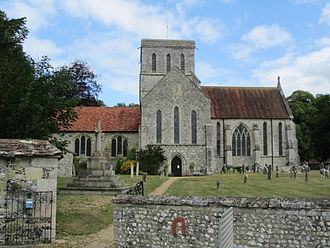
Queen Aelfthryth founded a nunnery at Amesbury in 979 to atone for her sins – the murder of Edward the Martyr while he was visiting his step-mother at Corfe to ensure that her own son Æthelred (the Unready) became king. Until Æthelred reached adulthood it placed Aelfthryth in a position of considerable power. Whether she had a hand in killing her step-son or not, she founded two abbeys at about the same time. The second was at Wherwell. Amesbury may have been located on the site of an earlier monastic house. It was written by Sir Thomas Malory, for those of you who like Arthurian tales, that Queen Guinevere became abbess at the first of the monastic foundations upon the site.
Amesbury was mentioned in the Domesday book but in 1177 Henry II refounded the nunnery with nuns from Fontevraud. The old nuns were required to co-operate with the change but could, if they wished, be transferred to a different nunnery. Unfortunately things were not so clear cut. The existing abbess did not depart without a fight. She and thirty of her sisters were expelled – apparently they all led scandalous lives- and the abbey became a priory – a daughter house of Fontevraud.
Eleanor of Brittany, Henry II’s granddaughter, was during the reign of her uncle, Richard the Lionheart, a very marriageable young woman indeed. However, when her Uncle John ascended the throne, and personally murdered her brother Arthur of Brittany (who actually should have inherited being the son of John’s older brother Geoffrey) her situation deteriorated. John kept her a prisoner as did his son, Henry III. By the time she died she had been in custody for thirty-nine years. She was buried in Amesbury. The priory had long established royal links and its dedication to St Melor who was a Breton prince murdered by his wicked uncle was a reminder of her own life. There is no memorial to her now and nor is there a memorial to Henry III’s queen, Eleanor of Province whose body was placed before Amesbury’s high altar after her death. She is known to have had her own quarters at the nunnery, having retired there in 1285, even though she was never a Benedictine nun.
It should be added that King John had other links with the priory. During the Barons’ revolt, he hid part of his treasury with the nuns while Henry III visited on several occasions and made several gifts to the sisters. Plantagenet links with the monastic foundation at Amesbury continued down the years. Edward I sent his youngest daughter, Mary, to become a nun there but she does not seem to have had a calling preferring travel, cards and potentially an affair with the Earl of Surrey to prayer. She cannot have been short of company. Many other noble girls were sent to Amesbury to receive an education. Isabel of Lancaster, Henry III’s great granddaughter, became a nun there before 1337 and ended up as prioress.
By the end of the medieval period, Amesbury was still wealthy – Cromwell ranked it in the top five nunneries in the country. A clock was commissioned during the fifteenth century that can still be found in the church.
Inevitably the Dissolution of the monasteries saw the end of Amesbury’s long monastic tradition. The nuns signed the surrender in 1539. The Seymour family acquired much of the foundations lands while the church remained as the parish church for the population of Amesbury. Edward Seymour, who was 1st Earl of Hertford at that time, had the abbey pulled down. Amesbury Abbey is today a seventeenth century mansion and nothing remains of the priory above ground, other than the church.