
 Eleanor was born in about 1397 to Joan Beaufort and Ralph Neville, 1st earl of Westmorland. Eleanor, like the rest of her sisters, was married off to another cousin – Richard le Despenser- who if you want to be exact was her second cousin. His mother was Constance of York who was the daughter of John of Gaunt’s younger brother Edmund of Langley, Duke of York.
The pair were married some time after 1412 but he died in 1414 aged only seventeen. He’s buried in Tewkesbury Abbey along with his other more notorious Despenser ancestors – his two times great grandfather was Hugh Despenser who was Edward II’s favourite. Once again though the Nevilles’ had made a wealthy match for their child. The Despensers were amongst the wealthiest families in the country and were also Plantagenet in ancestry thanks to Constance.
Richard’s early death meant that the title of Baron Burghersh, which he had inherited from Constance, passed to Richard’s sister Isabella. Just from point of interest it is worth noting that she would marry the Earl of Warwick and in turn her daughter, Anne Beauchamp, would marry a certain Richard Neville – better known to history as the Kingmaker – demonstrating once again that very few families held the reins of power during the medieval period and that they were all interconnected.
Eleanor meanwhile married into one of the great northern families – the Percy family – which must have caused her heartbreak in later years given that the Percy-Neville feud would be one of the triggers for the Wars of the Roses. Henry Percy, the 2nd Earl of Northumberland was the son of “Hostpur.” In a strange twist his family hadn’t done terribly well under the Lancastrian kings despite supporting Henry Bolingbroke against his cousin Richard II. The Percys had been rewarded in the first instance but had become disillusioned by Henry IV. Both Henry Percy’s father and grandfather had been killed as a result of rebelling against Henry IV. It was only when Henry V ascended the throne that our particular Henry Percy was able to return from exile in Scotland in 1413. It was at the same time that Eleanor’s parents arranged the marriage between Henry and Eleanor. It says something that Joan Beaufort who was the king’s aunt when all was said and done was able to work at a reconciliation between the king and the house of Percy whilst at the same time strengthening the Neville affinity in the north.
Percy, having returned to the fold, did what fifteenth century nobility did – he fought the Scots and the French. He was also a member of the privy council during Henry VI’s minority. But by the 1440s Percy was in dispute with various northerners over land. He had a disagreement of the violent kind with the Archbishop of York and then fell out with the Nevilles which was unfortunate because not only was he married to Eleanor but he’d married his sister to the 2nd earl of Westmorland (let’s just set aside the Neville-Neville feud for the moment). The problem between the Percys and the Nevilles arose from a disagreement over land. Eleanor’s brother, the Earl of Salisbury married his son Thomas to Maud Stanhope who was the niece of Lord Cromwell. Wressle Castle passed into the hands of the Nevilles as a result of the marriage. The Percy family was not pleased as the castle was traditionally one of their properties. Eleanor’s husband did not become involved in a physical fight with his in-laws but his younger son Thomas, Lord Egremont did. He attacked Thomas Neville and Maud Stanhope’s wedding party at Heworth Moor in August 1453. The two families were forced to make the peace with one another but the hostility continued to mount. The Nevilles were associated with Richard of York so naturally the Percy faction adhered to York’s opponents who happened to be best represented by Edmund Beaufort, Duke of Somerset of represented Henry VI. The feuding which was really about dominance in the north was a bit like a set of dominoes knocking against one another until the whole affair moved from local to national significance. Each side became more and more determined to support their “national” representative in the hope that either York or Somerset would gain the upper hand and the patronage system would see rewards in the form of confirmation of landownership.
Henry Percy was with the king on 22 May 1455 at St Albans and was killed. At the time it was regarded as the Earl of Salisbury’s way of dealing with the problem- meaning that he targeted and killed his own brother-in-law. This in its turn escalated the hostility between the two factions. The death of Eleanor’s husband made the Percy family Lancastrians to the back-bone and would ensure that the feud continued across the battle fields of the Wars of the Roses.
Eleanor and Henry had ten children. Their eldest son called John died young. The next boy – inevitably called Henry- became the 3rd Earl of Northumberland upon his father’s death in 1455 and he in his turn was killed in 1461 at the Battle of Towton along with his brother Richard. Eleanor’s son Henry had his own feud with the Nevilles on account of his marriage into the Poynings family. This Henry was present at the council meeting in 1458 that demanded recompense for the events of St Albans in 1455. He took part in the so-called Love-day orchestrated by Henry VI to demonstrate an end of the feuding but in reality Henry worked politically to have his Neville relations attainted of treason by the Coventry Parliament and he was on hand to take his revenge at Wakefield in 1460 when Richard of York and the Earl of Salisbury were killed.
Thomas Percy, Baron Egremont, the Percy responsible for the attack at Heworth Moor, was killed in 1460 at the Battle of Northampton. Ralph Percy was killed in 1464 at the Battle of Hedgeley Moor near Hexham leaving George who died in 1474 and William Percy who was the Bishop of Carlisle ( he died in 1462). Rather unfortunately for the troubled family, Eleanor’s daughter Katherine was married to Edmund Grey, 1st Earl of Kent – the name may be familiar. He was the man who laid down his weapons in the middle of the Battle of Northampton costing Henry VI the battle. Another daughter Anne, lost her first husband in 1469 after he joined with the Earl of Warwick in conspiring to put Henry VI back on the throne and finally as you might expect there was a daughter called Joan who married into the northern gentry.
Eleanor’s son Henry was posthumously attainted of treason after Towton by Edward IV. Her grandson, another Henry, was packed off to prison and would only be released when Edward IV shook off the influence of the Kingmaker in 1470. The Percy family lost the earldom of Northumberland in the short term to the Neville family as a result of their loyalty to Henry VI in 1464 when Edward IV handed it over to the Nevilles in the form of John Neville Lord Montagu but unfortunately for Montagu Northumberland’s tenantry did not take kindly to the change in landlord and Edward IV found himself reappointing the Percys to the earldom – which contributed massively to the Kingmaker throwing his toys from his pram and turning coat.
The new Earl of Northumberland – the fourth Henry Percy to hold the title had learned a lot from his father and grandfather. Instead of rushing out wielding weapons Eleanor’s grandson was much more considered in his approach. He did not oppose Edward IV and he did not support Richard III despite the fact that Richard returned lands which Edward IV had confiscated. This particular Earl of Northumberland was on the battlefield at Bosworth but took no part in the conflict. Once again the locals had the final word though – the fourth earl was killed in 1489 in Yorkshire by rioters complaining about the taxes…and possibly the earl’s failure to support the last white rose king.
Eleanor died in 1472 having outlived her husband and most of her children.
Michael Hicks makes the point that securing an inheritance and a title was extremely important to the medieval mindset. Once these had been gained the aim was to hold onto them. The Neville clan headed by Joan Beaufort appear to have been increasingly single-minded about the retention of title and property and this was the key deciding factor in the variety of feuds they became involved with. (Hicks:325).
Just Cecily to go…
Hicks, Michael, (1991)Richard III and His Rivals: Magnates and Their Motives in the Wars of the Roses. London: Bloomsbury
Wagner, John A. (2001). The Encyclopaedia of the Wars of the Roses. Oxford: ABC
 Katherine Neville, daughter of Ralph Neville earl of Westmorland and his second wife Joan Beaufort, was married first to John Mowbray, 2nd Duke of Norfolk. The pair had only one child – a boy named John. He’s the chap who turned up late to Towton in Easter 1461 and helped the Yorkists to win. He died in 1461and was succeeded by his son also named John – this particular Duke of Norfolk as well as being Katherine Neville’s grandson was also the one who had the on-going feud with the Paston family about Caistor Castle.
 1644 was a year where no one gained the upper hand and the casualties of war grew. The arrival of the Scots in the Civil War ultimately tipped the balance of power in Parliament’s favour but as a result of amateur approaches to warfare the Second Battle of Newbury failed to end matters once and for all. This had the knock on effect of ensuring the rise of the New Model Army and Cromwell’s Ironsides.
 Meanwhile two of the Parliamentarian generals were at loggerheads with one another. Robert Devereux, 3rd Earl of Essex felt that Edward Montagu, Earl of Manchester (pictured above) was getting the better part of the deal from Parliament. Montagu, married to a cousin of George Villiers in the first instance married for a second time to Ann Rich, the daughter of the Earl of Warwick – the Parliamentarian Lord Admiral. He turned from Court towards a more Puritan way of thinking and did not support the king in the Bishop’s War. He was also the peer who supported John Pym at the opening of the Long Parliament and was the one member of the House of Lords who Charles I wanted to arrest at the same time as the five members of the House of Commons. In 1642 he was on his third wife (another member of the Rich family) and had become the Earl of Manchester upon his father’s death. Manchester had been at the Battle of Edgehill but his was one of the regiments that had fled the battlefield. After that he was eventually appointed to the command of the Eastern Association Army – regiments covering Hertfordshire, Suffolk, Norfolk, Essex and Cambridge. By the end of 1643 East Anglia was very firmly in Parliamentarian hands and Manchester’s men had broken out into Lincolnshire and Yorkshire. This should be contrasted with Essex and the Western Association Army performance. It is perhaps not surprising that Parliament effectively allowed Manchester to by pass Essex and to liaise with the Scots and with the Fairfaxs.
 Fairfax opposed Goring on the right wing: Goring 1 – Fairfax O. Goring and his men got side tracked by the baggage wagons. Crowell was on the left wing facing Lord John Byron (pictured right): Ironsides 1 – Royalists 0. Prince Rupert turned the fleeing royalists round and sent them back into battle. Rupert and his men were evenly matched with the Ironsides. Essentially they hacked one another to a standstill at which point the Scottish cavalry charged in on the Royalist flank and scattered them.
 I am currently feeling slightly out of kilter time wise as I have classes running on topics ranging from Kathryn Swynford to the English Civil War with a side interest in the names on my local war memorial – the research for which in the hundredth anniversary is proving fascinating. I almost feel that I should do more blogs to give every area of History an airing!
 Ralph Cromwell, Lord Treasurer to Henry VI, built a castle from brick in Lincolnshire complete with turrets, winding stair cases and baronial fireplaces. So who was he and what was so special about his castle and his other estates?
 Cromwell’s finances were in rather better shape than the monarch’s. He made a good marriage (unlike Henry VI who married in return for peace but lost Maine and gained no dowry in the process much to the average Englishman’s disgust. Henry VI even had to pawn the crown jewels to pay for the wedding.) Cromwell’s wife was Margaret, Lady Deincourt – conveniently a wealthy co-heiress in her own right. Tattershall Castle was his main residence which he inherited in 1419 but he owned the manor of South Wingfield in Derbyshire; Collyweston in Northamptonshire; Wymondham in Norfolk (hence the Paston interest) and had a quarrel with the duke of Exeter over the lordship of Ampthill in Bedfordshire and was involved as patron of the Foljambes of Walton near Chesterfield in a dispute about the Heriz inheritance that led to the murder of Sir Henry Pierpoint’s brother-in-law in the church at Chesterfield. Cromwell, it should be noted, had a number of property disputes on the boil during his lengthy career.
 I’ve posted before about Henry Vernon being a canny politician. He was ordered to attend Richard III prior to the Battle of Bosworth but there is no evidence for him on the battlefield – on either side. Having been in good odour with Edward IV, the duke of Clarence and the earl of Warwick if the letters in the Rutland Archive are anything to go by it is a little surprising that Sir Henry did so well under the Tudors – In fact a study of a range of Vernon’s letters gives helpful insight into the changing politics of the period – which is exactly what I intend to do in a couple of weeks with my Wars of the Roses group, along with a peek at Sir Henry’s will.
 By 1460 rivalries between Richard of York and Henry VI’s favourites had descended from political hostility into open warfare. Having fled to Calais in 1459 in the aftermath of the Ludford Bridge disaster, the earl of Warwick, his father the earl of Salisbury, his uncle Lord Fauconberg and his cousin Edward earl of March arrived back in England at Sandwich with 2,000 men in June 1460. Their numbers snowballed. The city of London fell to the Yorkists with only the Tower of London remaining in Lancastrian hands.
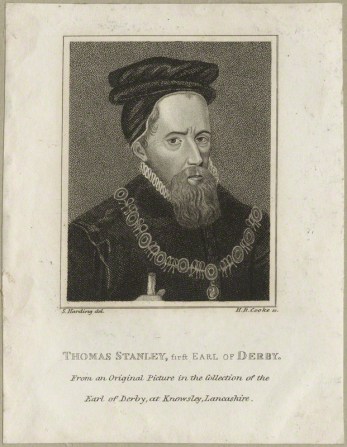 Thomas Stanley is known either as a politically adroit magnate who successfully navigated the stormy seas of the Wars of the Roses or a treacherous little so-and-so – depending upon your historical view point. Stanley is the bloke married to Margaret Beaufort who is best known for being a tad tardy at Bosworth whilst his brother, Sir William, turned coat and attacked Richard III. Stanley wasn’t the only one whose behaviour during the various battles of the wars seems lacking in the essential codes of knightly behaviour but he certainly seems to have been the most successful at avoiding actually coming to blows with anyone unless there was something in it for him – and no this post is not unbiased.
 In 1457 Margaret Beaufort, shown here in later life, along with her brother-in-law Jasper Tudor left Pembroke Castle. They were on their way to arrange a marriage. The groom in question was Henry Stafford. He was the second son of the Duke of Buckingham.
 John Dudley, son of an executed traitor suffered the same fate as his father in 1554 when he failed to place his daughter-in-law Lady Jane Grey on the throne. He’d risen to the highest place in the country and become the first non-royal
