
 Yesterday I found myself in the garderobe, sliding into a small space, ducking my head to avoid a low beam and then straightening to find myself in a priest hole. Fortunately for me no one was going to slam the lid back into place and leave me in total darkness until it was safe for me to emerge or I was discovered and dragged off to the Tower. I was enjoying a sunny afternoon at Oxborough Hall.

During the reign of Elizabeth I Jesuits priests were feared as enemies of the state and hunted down by pursuivants. Catholic priests moved from Catholic household to catholic household, often purporting to be cousins or other distant relations. Wealthy families built hiding places in their homes so that when the priest hunters came calling there was somewhere to hide their illicit guest.

The most successful priest holes were built by Nicholas Owen – not that he built the hole at Oxborough. Owen, an Oxfordshire man, was born in 1562. He had three siblings one was a Catholic priest and another printed illegal Catholic books. The brothers’ father was a carpenter and Nicholas in his turn was apprenticed to a joiner. By the time he was in his mid twenties he was working for Father Henry Garnet and had become a lay brother in the Jesuit order. He suffered from ill health including a limp from a poorly set bone and a hernia. Despite his physical frailty he travelled from house to house constructing priest holes. Most of the people he worked for didn’t know his real name – to them he was Little John. He worked by night in total secrecy to create his hiding places. Many of the priest holes were so well concealed that they were only discovered in later centuries when houses underwent renovation. Unfortunately the occasional hole is still found with its occupant still in situ.
Owen’s favoured locations seem to have been behind fireplaces and under stairs. The pursuivants were men who could judge if an interior wall looked shorter than an exterior wall so Owen had to be very careful as to where he located his priest holes.
Nicholas was a man strong in faith. He was eventually captured in 1606 at Hindlip Hall in Worcestershire in the aftermath of the Gunpowder Plot. It is thought he allowed himself to be captured in order to distract attention from Father Henry Garnet who was hiding nearby.
There were rules about torturing people with disabilities but this didn’t stop Robert Cecil from demanding that Owen be taken to the Tower and taxed about his knowledge by Topcliffe. He was racked. This caused his intestines to bulge out through his hernia. Topcliffe ordered that they be secure by a metal plate. This cut into the hernia and he bled to death in his cell. He died rather than give away his secrets and the lives of the men who depended upon him keeping them. The State announced that he had committed suicide.
St Nicholas Owen was canonised in 1970 and is the patron saint of illusionists and escape artists.

Hogge Alice. God’s Secret Agents
Reynolds, Tony. (2014) St Nicholas Owen: Priest Hole Maker
 In many ways the defeat of the Spanish Armada in 1588 can be seen as the apex of Elizabeth’s reign – the Armada Portrait shows that God was definitely on her side and that in addition to reigning over England Elizabeth also ruled the waves and other parts of the globe – the latter can be seen from her proprietorial grip on a globe whilst the former is manifested in the carving of a mermaid on her chair – admittedly the artist had to do some reworking as the traditional symbolism of a mermaid was the opposite to that which usually depicted the Virgin Queen’s qualities.
 As you might expect Elizabeth I had many godchildren including Mary Queen of Scots’ infant son James – her proxy had to lurk outside the chapel during the baptism as Mary obviously had her son baptised within the Catholic faith whilst Elizabeth was very clearly Protestant. Once Mary was forced to abdicate and her half-brother the Earl of Moray took charge of the new king crowned by John Knox in Stirling, James was raised a Protestant. In later years, when James was nineteen Elizabeth started to write to James with advice. The pair exchanged correspondence occasionally thereafter.
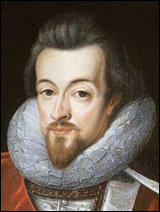 Robert was born in 1563, the second son of William Cecil. His mother was Mildred Cooke. Robert had an elder half-brother called Thomas who would become the 1st Earl of Exeter but it was this younger, much more clever son, upon who William lavished his affection as well as training him to take over the reins of government.
 David Cecil, William’s grandfather had turned up at Bosworth on the victorious side. he went on to become one of Henry VII’s newly formed yeomen of the guard. His son meanwhile settled down to the business of being a Lincolnshire gentleman with court connections.
 Margaret’s son Ferdinando Stanley the 5th earl of Derby was much less lucky. Ferdinando became earl in 1593 after his father’s death. The following year the fifth earl died rather unexpectedly following a sudden and violent illness. At the time witchcraft was mentioned but poisoning was the more generally accepted reason – as this extract from Camden’s history reflects:
