
 John of Gaunt was born in March 1340 whilst Edward III was on campaign in France trying to claim the French throne through his mother’s, Isabella of France, bloodline – someone hadn’t explained salic law to him. John was probably born in St Bavo Abbey in Ghent. In later years the rumour would arise that he was no true son of Edward’s but was instead a Ghentish butcher’s brat – no one ever paused to wonder how Philippa of Hainhault might have met this butcher given that queen’s aren’t prone to popping out to do the shopping for the evening meal.
Froissart states that Gaunt’s godfather was John, Duke of Brabant, a reminder of the shifting tides of political affiliation in Europe.
In November the royal family returned to England. We know very little of John’s early year’s although, as ever, it is the accounts that give us some insight. We know for instance from Edward III’s wardrobe account for 1340-41 that the baby was provided with some rather snazzy red and green bedding, that he had silken robes and a household of servants. As well as his nurse there was a female cradle-rocker. And, as if this wasn’t enough, there were two esquire of the body, six chamber servants and three “domicelli.” Domicelli are also servants but they are of a higher social status.
John probably found himself in the royal nursery with his sisters Isabella and Joan and his older brother Lionel as well as the new baby Edmund. At the age of seven he would have been deemed old enough to leave the nursery and begin his training as a knight. We also know, thanks to the accounts again, that Edward set aside £1000 a year for his children and that Philippa of Hainault of seems to have been a very hands on royal mother was granted their guardianship in 1342 whilst Edward was busy across the Channel.
John was also created the Earl of Richmond. This may have been because his father was already scouting around for prospective brides for his young son. The earldom was reconfirmed in 1351.
Ecclesiastical documents also reveal that the young John was admitted to the confraternity at Lincoln and later to St Mary’s in York. The later took place in 1349 just after the Princess Joan had died from the plague.
John’s next step towards adulthood was being placed in the care of his brother, Edward, the Black Prince. John was probably in his brother’s household between 1350 and 1355 – the accounts tell us this because there were purchases of knightly accoutrements for the young prince.
It was in 1350 that John found himself in the middle of the Battle of Winchelsea. He was too young to take part in the fight but according to Froissart John was on board the ship with his father because the king was very fond of his son. Edward III was attempting to intercept the Castilian fleet of Pedro I who had become an ally of France rather than England – despite Edward III attempting to negotiate a marriage between England and Castile. Edward III won the battle but it was touch and go. He knighted his son immediately afterwards according to some versions of Gaunt’s history although others think that the narrator was confused in remembering events that had taken place thirty years previously and that Lionel and John were both knighted in 1355. In either case Philippa of Hainhault spent an unpleasant afternoon with a good view of a sea battle.
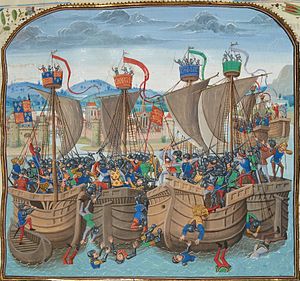
This particular image is from Froissart’s Chronicle. It depicts the Battle of Sluys which was fought in 1340 between england and France but it gives a good idea that a sea battle was really about getting the ships alongside one another and then being engaged in hand to hand fighting.
In 1355 John was old enough to join his father and older brother on their military campaigns in Normandy and from Calais. Whilst Edward was occupied in France the Scots took the opportunity to capture Berwick-Upon-Tweed but that’s a different story. The key thing is that John was part of the winter campaign to recapture the town which surrendered on 13 January 1356.
The following year John was granted the lordship of Liddel – John was going to be a northern lord getting to grips with those pesky Scots. The next step in securing John’s future would be his marriage to Blanche of Lancaster. Childhood – such as it had been- was over.
Goodman, Anthony. (1992) John of Gaunt. London: Longman.
 We tend to think of Thomas Cromwell as the man who did for England’s monasteries but before he became Henry VIII’s Vicar General, Cardinal Wolsey had already demonstrated various ways and means of milking the cloisters.
 Nunnington Hall in Ryedale is built on land originally owned by St Mary’s Abbey in York. The hall is fifteenth and sixteenth century in origin –so no medieval links to feasting or law should you pause a while in the double height hallway with its baronial fireplace but its perhaps unsurprising to discover that there was a building here in the thirteenth century.
 The history of Nunnington’s owners is lively. It passed into the Parr family when Maud Green married Sir Thomas Parr of Kendal. As the elder of the two co-heresses it was Maud who acquired Nunnington. Maud died in 1532. Her son William inherited the property but unfortunately for him the then Marquess of Northampton became involved in Wyatt’s Rebellion of 1553. The bid to replace mary Tudor with Lady Jane Grey failed. Jane had not plotted but her father the duke of Suffolk had become involved. He, his daughter and his son-in-law were promptly executed. Parr was fortunate to suffer only attainder. Nunnington was forfeit to the Crown.
 Nunnington was leased out to various families including Elizabeth I’s physician but in 1655, after the English Civil War, the manor was sold to Ranald Graham. He was succeeded by his nephew Sir Richard Graham of Netherby in Cumbria. He was made Viscount Preston and Baron Esk in 1681. He would also marry into the Howard family when he married the daughter of the earl of Carlisle. He served under Charles II and James II. He even did a turn as English ambassador in France. In 1689 his luck turned when he sided with James II rather than William of Orange and James’ daughter Mary. Graham was captured on his way across the Channel. Even as his escape vessel was boarded he made every attempt to destroy incriminating documents. He was attainted and sentenced to death in 1691. The sentence was never carried out because Queen Mary spared him when his daughter Catherine pleaded for his life- it may also have helped that he did turn evidence against his fellow conspirators- but his lands were parcelled out to, amongst others, the earl of Carlisle. It was just as well that it had all been kept in the family because Richard was allowed home and his son Edward eventually inherited Graham’s estate although it was his daughter Catherine by then Lady Widdrington who ultimately inherited Nunnington when her nephew Charles died – the names give an indication of continued Graham loyalty to the Stuart cause…though how the Jacobites felt about Lord Preston giving evidence against them is another matter entirely.


