
 By 1559 factions had formed in Elizabeth’s court. Robert Dudley, not unexpectedly, found himself at the head of one of them. Today though my interest is with Sir James Croft pictured above who is identified by William Cecil in the 1560s as being an adherent of Robert Dudley. The picture which is housed at Croft Castle shows him with his white staff of office.
This may have been mildly alarming for Cecil because Croft had a tendency to be linked with trouble. He had initially supported the claim of Lady Jane Grey to the throne and had spent some time in The Tower as a consequence. Immediately after he was released he became involved with Wyatt’s Rebellion – a plot to depose Mary and place Elizabeth on the throne as well as providing her with a husband in the form of Edward Courteney, Earl of Devon. Courteney’s grandmother was Katherine Plantagenet the sister of Elizabeth of York – Elizabeth’s grandmother. They shared a common great-grandfather in Edward IV.
Croft carried a letter from Wyatt to Elizabeth at Ashridge House in Hertfordshire at the onset of the rebellion but she had the good sense to take to her bed and not receive the missive which told her to seek shelter in Castle Donnington. Croft then carried on to Herefordshire where he was supposed to ferment one of the four uprisings which were planned to catch Queen Mary and her supporters on the hop.
Croft’s position in Herefordshire was that of a member of the most powerful gentry family in the area who had built networks and links during the reign of Henry VIII – not withstanding the fact that his great grandfather had been Richard III’s treasurer. Henry VII not one to bypass an able financial administrator had retained him and when Croft had shown his loyalty at the Battle of Stoke the Croft transfer to the Tudor Rose was complete. There were Crofts at Ludlow when Prince Arthur and Katherine of Aragon were in residence.
James inherited Croft Castle from his father in 1562 but for the time being he was simply in the business of fermenting rebellion – which was rather unsuccessful because whilst the ordinary people weren’t keen on the idea of Mary marrying a foreign prince they were loyal to the memory of Katherine of Aragon, Mary’s mother, and also had a sense of what was right as was laid down in Henry VIII’s will.
Croft was arrested and charged with treason. He was condemned on 28th April 1554 but was fortunate that Stephen Gardener in his capacity as Chancellor persuaded Queen Mary in the direction of clemency for most of the rebels.
Once again Croft was in hot water but on the accession of Elizabeth I he rose in importance having had his attainder reversed. He had been part of the Rough Wooing of 1543 to 1548. He served as the captain of Haddington Castle in 1549 despite the loss of a right arm whilst serving in Henry VIII’s army at Boulogne. Now he was sent north as governor of Berwick-Upon-Tweed and also Lord Deputy of Ireland but he blotted his copy books in 1560 when he indulged in some more dodgy letter writing – this time with Mary of Guise when he should have been attacking the Scots. The Siege of Leith did not go as well as expected primarily because Croft wasn’t where he should have been. The Duke of Norfolk was not amused and wrote : ‘I assure you I thought a man could not have gone nearer a traitor and have missed, than Sir James’. Even so, after a further stint of imprisonment, he was forgiven in 1570 when he was made a privy councillor and comptroller of Elizabeth’s household.
This re-instatement into royal favour may have been thanks to the offices of Robert Dudley. Croft combined his role in the royal household with his role as a member of the Herefordshire gentry. Inevitably his name features on the list of members of Parliament and serving as a justice. Interestingly it was when he was sitting as a Junior Knight for Herefordshire that he encountered Sir John Dudley the future Earl of Warwick and then Duke of Northumberland. It was John Dudley who was the first national rather than local patron and it goes some way to explaining how he became involved with the plot to put Lady Jane Grey on the throne. It also explains how in the early 1560s he regarded himself as part of Robert Dudley’s affinity – Croft simply moved his loyalty from father to son. It may also account for why he was selected to take the letter from Wyatt to Elizabeth at Ashridge given that popular history makes it very clear that Robert Dudley and Elizabeth had been friends since childhood.
In 1587 he was part of Mary Queen of Scots trial and in 1588 he was sent on a diplomatic mission to the Duke of Parma. When he returned he was clapped into the Tower for yet more dodgy dealings – this time with Parma. He was released in 1589 and died in 1590 having penned his own autobiography in the 1580s – the main point of which was to demonstrate what a good Crown employee he had been, a sterling example of a soldier and how impoverished he was as a result. Whether any one else thought so is a moot point but Elizabeth seems always to have forgiven him.
Rather unexpectedly given that he is seen on a list as part of Dudley’s crew of supporters it comes as a bit of a surprise to discover that James’ eldest son Edward was charged with witchcraft in 1589 for contriving the death of the Earl of Leicester. The reason for this about-face lies in the fact that Dudley and Croft differed in their views as to how the Spanish threat and the dangers of confrontation in the Low Countries should be dealt with.
Tighe, W. J. “Courtiers and Politics in Elizabethan Herefordshire: Sir James Croft, His Friends and His Foes.” The Historical Journal, vol. 32, no. 2, 1989, pp. 257–279. JSTOR, JSTOR, http://www.jstor.org/stable/2639601.
 Nunnington Hall in Ryedale is built on land originally owned by St Mary’s Abbey in York. The hall is fifteenth and sixteenth century in origin –so no medieval links to feasting or law should you pause a while in the double height hallway with its baronial fireplace but its perhaps unsurprising to discover that there was a building here in the thirteenth century.
 The history of Nunnington’s owners is lively. It passed into the Parr family when Maud Green married Sir Thomas Parr of Kendal. As the elder of the two co-heresses it was Maud who acquired Nunnington. Maud died in 1532. Her son William inherited the property but unfortunately for him the then Marquess of Northampton became involved in Wyatt’s Rebellion of 1553. The bid to replace mary Tudor with Lady Jane Grey failed. Jane had not plotted but her father the duke of Suffolk had become involved. He, his daughter and his son-in-law were promptly executed. Parr was fortunate to suffer only attainder. Nunnington was forfeit to the Crown.
 Nunnington was leased out to various families including Elizabeth I’s physician but in 1655, after the English Civil War, the manor was sold to Ranald Graham. He was succeeded by his nephew Sir Richard Graham of Netherby in Cumbria. He was made Viscount Preston and Baron Esk in 1681. He would also marry into the Howard family when he married the daughter of the earl of Carlisle. He served under Charles II and James II. He even did a turn as English ambassador in France. In 1689 his luck turned when he sided with James II rather than William of Orange and James’ daughter Mary. Graham was captured on his way across the Channel. Even as his escape vessel was boarded he made every attempt to destroy incriminating documents. He was attainted and sentenced to death in 1691. The sentence was never carried out because Queen Mary spared him when his daughter Catherine pleaded for his life- it may also have helped that he did turn evidence against his fellow conspirators- but his lands were parcelled out to, amongst others, the earl of Carlisle. It was just as well that it had all been kept in the family because Richard was allowed home and his son Edward eventually inherited Graham’s estate although it was his daughter Catherine by then Lady Widdrington who ultimately inherited Nunnington when her nephew Charles died – the names give an indication of continued Graham loyalty to the Stuart cause…though how the Jacobites felt about Lord Preston giving evidence against them is another matter entirely.
 Edward Courtney was the only surviving son of the Marquess of Exeter born in 1526.
 When Henry VIII came to the throne he had his uncle by marriage released from prison but persuaded his Aunt Katherine to renounce her claim to the earldom of March- and the Mortimer inheritance which caused so much mayhem during the Wars of the Roses- and following the death of William in 1511, Katherine took a vow of chastity. This seemed to go down well with Bluff King Hal who gave her the rights to the income from the Courtney lands during her life time, drew her son Henry into the inner court circle and made her godmother to the Princess Mary in 1516. The problem so far as her grandson Edward would be concerned would be that little drop of Plantagenet blood. It had been alright for Katherine to sign herself ‘the excellent Princess Katherine, Countess of Devon, daughter, sister and aunt of kings’ (Westcott) but royalty wasn’t such a good thing to have in one’s bloodstream during the mid-Tudor crisis and especially not if one fancied wearing a crown rather than a coronet.
 The correct title for this post should be the succession crisis and it all occurs in 1553. Edward VI’s health was an important affair. These are the some of the key facts that we know: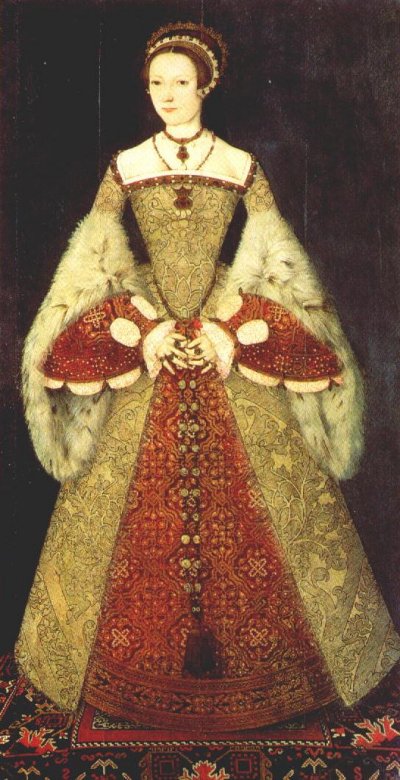
 Mary had been on her way from her Suffolk estates to visit her sick brother but forewarned she turned back and avoided capture by Robert Dudley and a force of armed men. Once she’d regained the safety of Framlingham Castle she declared herself queen and sent Thomas Hungate to London with a letter to present to the Privy Council to that effect. She fled deeper into East Anglia – to Kenninghall in Norfolk.
 Frances Grey nee Brandon is another ‘not quite Tudor princess.’ She was the elder daughter of Henry VIII’s sister Mary Tudor the Dowager Queen of France and her second husband Charles Brandon, Duke of Suffolk- based on modern rules she would not be defined as a princess but her nearness to the crown at a time when there was a shortage of Tudor heirs created tragedy for her three daughters.