The story of the Holland family begins with Robert de Holland from Upholland in Lancashire. He was born about 1283. He was a trusted part of Thomas of Lancaster’s household. He benefitted from being within the Lancaster affinity by acquiring land as well as a wife in the form of Maud de Zouche – a co-heiress.
He fought at Boroughbridge in 1322 but not on the side of the earl who was in rebellion against his cousin the king. This may well have been because Edward II was holding one of Robert’s daughters hostage at the time. However, the Lancaster faction were not quick to forgive the fact that the second earl was executed in Pontefract soon after the battle and that Robert, one of his most trusted men, had been a traitor to the earl’s cause.
Thomas of Lancaster was succeeded by his younger brother – Henry of Lancaster. Time passed. On 15 October 1328 Robert Holland, or Holand, was at Borehamwood. Unfortunately so were a number of Lancaster supporters. There was an argument. Robert was beheaded.
Thomas, Robert’s eldest son pictured at the start of this post in his garter robes, served Edward III. He was a man of no substantial wealth. His mother Maud had to borrow money so he could be outfitted as a knight. However, it would appear that Thomas had a great deal of charm, not to mention nerve and persistence. He wooed and won Edward III’s young cousin Joan of Kent. They married in a secret exchange of vows when she was eleven or twelve. He was more than ten years older than Joan. It would take another nine years, a bigamous marriage and a papal decree before he was allowed to live with his bride.
Thomas’s fortunes really changed when Joan’s brother died. He had no other heirs so Joan became the Countess of Kent in her own right (suo jure). Thomas effectively became an earl through the right of his wife. Thomas who had a proven military track record by this time now had the money and the position in society to fulfil a leading military role in the Hundred Years War. Thomas and Joan’s eldest son another Thomas became a baron after his father’s death but did not become the 2nd Holland Earl of Kent until Joan died in 1385.
 Thomas died in December 1360. The following year his widow married her cousin Edward, the Black Prince. The Holland children now had access to patronage with a very heavy clout. Thomas (Joan’s son) gained a wealthy and aristocratic bride from the FitzAlan family. More importantly it was the Hollands’ half-brother, Richard, who ascended the throne after Edward III died in 1377.
Thomas and John Holland were loyal to their half brother, Richard II, and benefited from their close ties – John even managed to get away with murder. The Holland family found themselves spouses from some of the wealthiest families in the country, had the ear and trust of the Crown and continued to thrive whilst Richard II was on the throne. The second earl’s son, another Thomas not only became the 3rd Earl of Kent but from 1397 the 1st Duke of Surrey. This was a reward for loyalty. Thomas had arrested his FitzAlan uncle on behalf of his royal uncle Richard II. Perhaps because he felt a bit guilty about it he the founded of Mount Grace Priory in Yorkshire the following year.
It is perhaps unsurprising that when Richard II was deposed by Henry of Bolingbroke – Richard’s first cousin and the Hollands’ first cousin once removed- that they found themselves being demoted. The dukedom had to be handed back. As a consequence Thomas Holland the 3rd earl of Kent became involved with the Epiphany Rising of 1400. He was executed. He had no children.

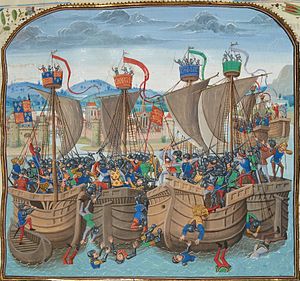
 Thomas’s uncle John (Joan’s second son) was executed at the same time. John Holland had married another wealthy royal cousin, Elizabeth of Lancaster (John of Gaunt’s daughter). This may have been because of the Black Prince’s patronage and it may have been because his mother Joan of Kent got on well with her cousin John of Gaunt. John became Earl of Huntingdon in 1388 and in 1397 became the Duke of Exeter. He was also involved in removing Richard II’s enemies. In John’s case not only had he arrested his uncle Richard FitzAlan (the 11th Earl of Arundel) he has gone to Calais to arrest Thomas of Woodstock, Richard’s youngest Royal uncle. Thomas had died whilst in Calais as pictured in Froissart – the story involves a mattress…
When Richard II fell from power John was stripped of his dukedom but was allowed to retain his earldom by his brother-in-law the new king Henry IV. This double relationship did not stop John from being involved in the Epiphany Rising of 1400 nor did it prevent his execution.
For the moment the fortunes of the Holland family looked bleak. It would continue to be dubious until 1415 when John Holland’s son, another John, would be able to regain the dukedom of Exeter from Henry V after the Battle of Agincourt. He would also continue the family tradition of marrying someone who was a cousin in a degree that required papal dispensation and which kept his family close to the line of succession!
Hicks, Michael. Whose who in Medieval History
P.S. A family tree will be forthcoming at some point soon.
 Alice of Norfolk, was born about 1324. She was the daughter of Thomas of Brotherton and Alice Hales. She was the youngest of their three children.
 It is perhaps not surprising then that Thomas used his youngest child as a political pawn and married her into the Montagu family in 1333. William Montagu had been raised alongside Edward III and had married into the extended royal family in the person of thirteen year old Joan of Kent. Unfortunately it had turned out to be a bigamous marriage. Joan having already married Thomas Holland before the knight went on crusade in Prussia. Eventually, after much wrangling, the pope told Joan to return to Thomas Holland.
 Eventually, in 1312, after the birth of his own heir, Edward II confirmed his half brother as Earl of Norfolk and Earl Marshal of England. He also appears in the legal record as being an executor of his mother’s will. We also have records of Thomas’s half sister Mary visiting him regularly when he was a child. Mary was a nun at Amesbury.
 The tabloids would have had a field day in 1361 when Edward, Prince of Wales – better known as the Black Prince married the love of his life. The people’s princess in this instance was his cousin, Joan of Kent.
 Eleanor de Clare was the eldest of Gilbert de Clare 7th Earl of Gloucester’s three daughters. She was also the eldest granddaughter of Edward I, her mother being Joan of Acre. You would think under those circumstances that her marriage would have been fairly auspicious. Unfortunately her royal grandfather owed a Marcher Lord 2,000 livres. Eleanor was what you might describe as “settlement of the debt” that Edward I owed to Hugh Despenser the Older. Her wedding to Hugh Despenser the Younger took place in 1306. It included a dowry that settled an annual income on Eleanor. She was thirteen years old. The Despensers were an old family but they were somewhat cash strapped. Eleanor gave their family added prestige, took them a step closer to court and there was also the promise of future patronage.
 The 7th Earl of Gloucester, Gilbert, the Red Earl, was born in 1243. He took part of the second Barons War in 1262 which saw the barons rise against King Henry III. He was one of Simon de Montfort’s supporters and took part in the Battle of Lewes. They were turbulent times and although de Montford effectively toppled the Crown it wasn’t long before there was a falling out amongst the barons. This resulted in Gilbert changing sides and fighting on the side of Prince Edward at the Battle of Kenilworth and the Battle of Evesham where de Montfort was killed.
 To leap is to make a sudden movement it can also mean to swiftly provide help or protection. Neither, if I am honest is very helpful in terms of my leaping lords for this post! So, there’s no help for it I shall have to cheat:
 Let us begin. The earl of Nottingham, Thomas de Mowbray, managed to eventually find his way back into Richard II’s good books by helping to get rid of another Lord Appellant. It is likely that Mowbray helped with the murder of the Duke of Gloucester in 1397 – he had a nasty accident in Calais. As a result of this Richard elevated him from being the Earl of Nottingham to the first Mowbray Duke of Norfolk – so we’ll count him as two lords for the time being given his key titles. It didn’t end well for de Mowbray though as he had an argument with Bolingbroke presumably about killing off co-conspirators. Bolingbroke reported de Mowbray’s comments to the king and there was another argument. They were due to fight a duel in Coventry to resolve the matter but Richard banished them both in 1398. De Mowbray was exiled for life. He died in Venice in 1399 of Plague.
 Henry of Bolingbroke initially got away with his involvement with the Lords Appellant after Richard regained power because of the importance of Henry’s father John of Gaunt. Bolingbroke can also be counted a second time because Richard made him the Duke of Hereford during the lull in proceedings. Upon the death of John of Gaunt Richard changed Henry ‘s sentence to life in exile and he kept John of Gaunt’s land for himself rather than allowing Henry the revenue. It was for this reason that Henry returned to England, ostensibly to reclaim the duchy of Lancaster which had been his father’s. From there it was one short step to becoming Henry IV.
 In 1378 Westminster Abbey had to be closed for several months after an unfortunate interlude. Murder had been done in the choir and John of Gaunt was implicated. It didn’t help his reputation as the abbey had to be reconsecrated.
 John of Gaunt was born in March 1340 whilst Edward III was on campaign in France trying to claim the French throne through his mother’s, Isabella of France, bloodline – someone hadn’t explained salic law to him. John was probably born in St Bavo Abbey in Ghent. In later years the rumour would arise that he was no true son of Edward’s but was instead a Ghentish butcher’s brat – no one ever paused to wonder how Philippa of Hainhault might have met this butcher given that queen’s aren’t prone to popping out to do the shopping for the evening meal.