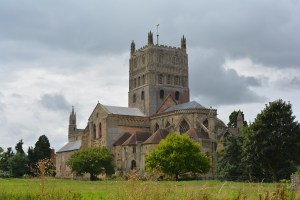
Monastic Houses of Derbyshire.

DSC_0287-9Yorkshire is knee deep in monastic houses from the great foundations such as Fountains and Rievaulx to the smaller but no less fascinating Kirklees Priory with its links to Robin Hood.  Part of the reason for the great number of monastic foundations in Yorkshire is the fact that the early monks wanted to live like the Desert Fathers – on their own in the wild. It was also excellent land for sheep once it had been cleared, although the monks of Jervaulx made their reputation as breeders of fine horses.  The Yorkshire Moors must have seemed very wild a thousand years ago.  Then there were the monastic patrons and benefactors.  So far so good – but what about Derbyshire surely it was no less wild and surely to goodness there were plenty of patrons eager to save their souls?  It’s not as if its a million miles from Yorkshire either (though clearly the traffic restrictions currently in operation on the M1 are doing a very good job of creating that impression).  In actual fact the large monasteries did have extensive links with Derbyshire but rather than establishing monastic houses they established granges – or farms. Roche Abbey had a number of granges in the White Peak.

The abbey that most immediately springs to mind is Calke Abbey which now bears no resemblance to an abbey and which is in the hands of the National Trust.  A bit of research revealed that it wasn’t an abbey, it was a priory in the hands of Augustinian Canons – so that’s me told.  The priory at Repton is its daughter house.  Now I’ve always known Repton for its links to Vikings so clearly I’m not doing very well thus far.

Gresley Priory became a parish church and Darley Priory – another Augustinian stronghold turned into an eighteenth century stately stack whilst its guest house became an inn rejoining in the name “Old Abbey Inn” just in case a passing historian should miss the obvious. Then there’s Dale Abbey in Deepdale. Then there’s Bradbourne Priory and Breadsall Priory.  Each and every one of these was run by the Augustinians.  As might be expected, Derby boasted more than one monastic foundation including the Augustinians.

The Benedictines were the first monks to settle in Post-Conquest England.  Their robes were black. The Cluniacs were aliens – all under the control of the mother house in France and the Augustinians were priests who went outside the precincts of their monastic houses to minister to their flocks. The later additions to the monastic fold were the twelfth century  Cistercians who looked to a life of poverty and hard work – which brings us back to the Cistercians of Rievaulx and Fountains.

Now, all I need to do is reach for my copy of Derbyshire King’s England by Arthur Mee and a road atlas and plan my route.

Calder Abbey – or a false start

DSCN3786-2In 1135 twelve monks and a newly minted abbot called Gerold left Furness Abbey to found a daughter house at Calder near Egremont.  The land had been donated by Ranulf Meschin but he doesn’t appear to have endowed the new abbey with an estate sufficient to thrive.  Even more unfortunately for the Savignac monks of the newly founded Calder Abbey, England was just about to erupt into civil war between King Stephen and Empress Matilda.

King Henry I had twenty-two children of whom twenty were illegitimate.  He had only one legitimate son and he drowned when the White Ship sank in 1120.  Henry made the leading barons swear to accept his daughter Matilda as their queen but they had their fingers crossed. As soon as Henry departed this life Matilda’s cousin Stephen of Blois snaffled the crown.  The next nineteen years when ‘Christ and his apostles slept’ were not a good time to be founding anything far less an abbey a stone’s throw from the Scottish border.  The Scots sensing that the English might be distracted took the opportunity to invade most of Cumberland and claim it for themselves.  This seems to have involved burning large chunks of it to the ground.

Within three years of its foundation, thanks to Scottish raids,  Calder Abbey was on its knees.  The twelve monks and their abbot set off back to Furness.  Now, this is where accounts differ.  In the first version of the story Gerold rather liked being an abbot and refused to stop being one even though he didn’t have an abbey anymore.  In the second version Furness Abbey had founded a daughter house (Calder Abbey)  to rid itself of a little band of trouble makers. It had no intention of letting them back in again even if the Scots had burned their home.

Whatever the truth, Gerold and his twelve footsore monks set off on their travels once more.  Their intent was to go to York and present their case to Archbishop Thurston.  However, on arrival at Thirsk they met the mother of Roger Mowbray who suggested a nice location at Hood where another relation of hers was busy being a hermit (perhaps she hadn’t spotted the fact that hermits like being on their own and that thirteen additions would rather ruin the solitude).

The monks settled down in their new Yorkshire home but as they hadn’t been made to feel very welcome by their brothers back in Cumberland they decided that they wanted to free themselves from the jurisdiction of Furness.  This happened in 1142 but not before Gerold had made a trip to the Savignac head office at Savigny to present his case.

Hood proved to be an unsuitable location for a monastery so in 1143 the brothers moved again, this time to Byland.  Unfortunately they failed to notice that Rievaulx Abbey was right on the doorstep.  The two abbeys were so close that they could hear each other’s bells which would not have been a problem had they been keeping to the same schedule but unfortunately they weren’t.  The refugees from Calder were forced to move for a third time and on this occasion the monastic community we know as Byland Abbey thrived.

The abbey at Furness and later the abbey at Calder continued to try to claim superiority over the monks of Byland despite the fact that Gerold had been released from his allegiance to Furness and that Calder Abbey hadn’t really existed until 1143 when Furness Abbey made a second attempt at building a daughter house on the land given to them by Ranulf Meschin.

(The picture is of Byland Abbey.  Calder Abbey is not currently open to the public.)


Shap Abbey and Robert Clifford


DSCN0997Shap Abbey was originally founded in about 1191 by Thomas who was the son of Gospatric at a place called Preston Patrick. For some reason that history does not provide the site was unsuitable for the White Canons who  came to dwell there. Perhaps the Kendale Valley wasn’t remote enough for them. In any event the Premonstratensians relocated in about 1200 to the remote and wild land beside the River Lowther at a place called “Hepp’ or ‘Heap’ so called because of a pile of nearby megaliths. Shap Abbey was duly dedicated to St. Mary Magdalene.

The Premonstratensians were founded by St Norbert in Germany.  The Premonstratensians lived frugal lives in isolated places following the example of the early desert fathers.  As regular canons they were all ordained priests who lived together in a monastic community.


During the thirteenth century, according to Butler & Given-Wilson, there were twenty canons there and, as with every other monastic community, Shap was dependent upon the generosity of its patrons and benefactors. For instance Shap manor was previously held by the Curwens of Workington and then subsequently by Shap Abbey.  Curwen records that Thomas de Workington gave to the canons land, pasture and the Rectory of Shap as well as the church of Bampton; Johanna de Veteripont gave them nine acres while other members of the de Veteripont family gave the vill of Reagill where they had a grange and chapel the Hospital of St. Nicholas near Appleby to maintain three lepers, also a parcel of land in Knock Shalcock.  Another benefactor was Robert Clifford, First Lord Clifford of Westmorland.   Summerson notes that Clifford, who was buried at Shap following his death at Bannockburn in 1314, had founded a chantry at Shap for his parents. Roger Clifford had died in 1282 in Wales whilst Isabella Vieuxpont – from whom Robert inherited many of his northern territories- died in 1291 and was buried at Shap (H Clifford, The House of Clifford (Andover, 1987), pp 51–2).  Shap was to become the burial place for many generations of the Clifford family including the Shepherd Lord (the 10th Lord Clifford) who died in 1523.

A chantry was usually a chapel within a church dedicated to a particular benefactor or benefactor’s family. It is where prayers and masses for the benefactors’ souls were said to help them get out of Purgatory faster than might otherwise be expected. There is no indication in the archeology, as it has currently been explored, as to the location of the Clifford Chantry. Equally there is no mention made of the chantry in the documents relating to the dissolution of the abbey. Having said that Keld Chapel which is thought to have been a separate chantry chapel belonging to Shap Abbey also goes unmentioned in the documents of the time.


John F Curwen, ‘Parishes (West Ward): St Michael, Shap’, in The Later Records Relating To North Westmorland Or the Barony of Appleby (Kendal, 1932), pp. 358-376 http://www.british-history.ac.uk/n-westmorland-records/vol8/pp358-376 [accessed 1 January 2015].

Roof Bosses

roof bossAs medieval builders became more confident they built their buildings higher and airier as though they were soaring heavenwards. This was a tricky thing to do architecturally speaking – the last thing that the average medieval bishop wanted was to be haranguing his congregation only to have the roof come crashing down round his ears.

The outcome was Gothic stonework called fan vaulting that reminds me of an avenue of elegant stone trees spreading out their branches to make a canopy.


My technical adviser (yes – that’s you Adam if you’re reading this) explained to me that you can create large spans that open up the space with fan vaulting.  Each rib acts like an arch, meaning that the weight which might otherwise be disastrous effectively adds strength to the structure.  Therefore you require fewer columns and can achieve taller buildings.  You could compare fan vaulting to an egg-shell, in the sense that it gains its strength in its unity, it is form-active, so therefore less bulk is required for it to be structurally stable. The first fan vault that is still standing in the world can be found in Gloucester Cathedral.


A boss, which is after all what this particular blog is about, is a block of stone or wood, found on ceilings, at the intersections of the ribs of a vault. The more ribs that there are in a ceiling, both structural and aesthetic, the more opportunity there was for medieval masons to produce intricately carved roof bosses.

In Tewkesbury Abbey there are approximately 250 roof bosses many of them telling the life of Christ. The cathedral boasting most bosses is Norwich. Tewkesbury Abbey

Bosses may be foliage filled, depict green men with their mouths sprouting foliage, have birds, beasts and fabulous creatures as well as depicting scenes from the Bible – in fact the images on roof bosses depend on the imagination of the men who carved them.   In the aftermath of York Minster’s terrible fire in 1984, the viewers of Blue Peter were asked to design some new roof bosses so one of them depicts Man landing on the moon.


Originally the bosses would have been painted but in the aftermath of the Reformation roof bosses often returned to the natural colours of wood and stone – some within reach of iconoclasts have lost their heads and hands. However, the majority of roof bosses are so high that the carvings remain in tact and there are often hints of the original paint as well.


Of course the downside of roof bosses is that you end up with a crick in the neck and lots of blurred photographs where your hands have shaken too much while you’ve been holding the camera at arm’s length – more photographic aerobic exercise.   However, some cathedrals provide a tilted mirror on wheels so that visitors don’t need to do themselves a mischief to see the ceiling in all its glory. Provided that there aren’t lots of grubby paw prints on the mirror (and I have been known to clean them off) it is much easier to take a picture of the reflection of the ceiling than of the ceiling itself.


This blog contains three images. The first shows a roof boss depicting an angel playing a musical instrument that has been removed from the ceiling of Tewkesbury Abbey – there are several dotted around the building.  The second image shows the ceiling of the nave in Tewkesbury. The ceiling has been restored to the way it would have looked before the Reformation.  Medieval congregations must have been filled with awe when they entered vast colour filled spaces like this one – I certainly was.  The final image – thanks to ‘he who is occasionally obeyed’- shows a boss in close-up in situ.

Tewkesbury angel


Cleeve Abbey

Cleeve Abbey TileCleeve Abbey was a Cistercian foundation.  Cistercians were initially an order of Benedictine monks who felt that the rule of St Benedict had slackened over time. A group of these reformers founded the abbey at Citeaux in 1098. They placed emphasis upon prayer, manual labour, austerity and poverty.


The Cistercians or White Monks, named after their undyed rough woolen habits came to England in 1132. They arrived from Clairvaux in order to establish a ‘daughter house’ to the abbey in Clairvaux.  The abbot and his twelve companions (the usual number for a new daughter house) journeyed north until they arrived at the River Rye.

Rievaulx Abbey would become one of the greatest abbeys in the country founding daughter houses of its own in England and Scotland.  Patrons of Rievaulx included kings of England and Scotland. Little wonder that they began with twelve choir monks but exceeded one hundred and fifty less than a century later. Much of this expansion was due to the influence one of Rievaulx’s abbots – a monk called Aelred who later became a saint.


Rievaulx’s own daughter houses can be found north and south of the border between England and Scotland. Melrose Abbey in Scotland was a daughter house, as were Warden Abbey in Bedfordshire, Revesby in Lincolnshire and Rufford Abbey in Nottinghamshire. A second abbey was founded in Scotland – Dundrennan.


Each of these abbeys in their own turn founded daughter houses; grand-daughter houses to Rievaulx. For example Melrose Abbey is the mother house of Hulm Cultram Abbey in Cumbria. In England, Revesby Abbey created a daughter house in Somerset – Cleeve Abbey to be precise – so you can take a blogger out of Yorkshire but you can’t take Yorkshire out of the blog for very long as I discovered this morning.


Having listened to the aftermath of Hurricane Bertha pass overhead in the night in the form of a heavy downpour and a thunderstorm we ventured coastwards to Cleeve Abbey in Washford with our fingers firmly crossed that we would avoid any rain.


The information that follows comes from the very informative display at the beginning of the tour and the ever helpful Victoria County History.


The 3rd Earl of Lincoln, William de Roumare,  was the founder of the monastery in the late twelfth century when abbey building was at its peak. His own grandfather had been one of the patrons who founded Revesby.

The abbey was known as Vallis Florida meaning ‘flowering valley’ – it still does have plenty of flowers.


The first abbot was called Ralph. He and twelve monks arrived from Revesby to found the only Cistercian abbey in Somerset. It was never wealthy but by 1300 there were twenty-eight monks. In the years that followed monks from this picturesque community toiled on the land, studied (rather than the usual cupboard of books, the brothers at Cleeve had an entire room of them) and a couple were even raised to the rank of papal chaplain.

And so things might have continued but Henry VIII was a man in need of a son. In Autumn 1535 Thomas Cromwell’s commissioners came knocking on the gatehouse door. The man of the moment was Dr John Tregonwell. He liked what he saw –even if it was only worth in the region of £155 a year- in fact he liked it so much that he wrote a politely worded note to Cromwell asking if he could rent it as he had a wife and children to support. Given that the monastery hadn’t even been dissolved his request seems to be ‘a bit previous’ as my step-son would say.


The plot thickened as there’s also a letter in existence dated 1537 written by Sir Thomas Arundell, the king’s receiver who was writing to ask what Cromwell intended with Cleeve as it was still operational and rumour said that King Henry VIII had ‘pardoned it.” He went on to ask for clarification and to comment that Cleeve contained “seventeen priests of honest life.”

It was to no avail. The abbey was required to submit. The abbot received a pension of 40 marks a year (about £9000 these days apparently). One of the monks – John Hooper- went on to become Bishop of Gloucester. He managed to irritate Queen Mary in 1555 and was burned as a heretic.


Tregonwell was not successful in his suit. Still, there were plenty of other abbeys for him to lay hands upon. He acquired Milton Abbas in 1540 and numerous other Dorset properties. According to his parliamentary biography there appears to have been some irregularity about the number of leases he handed over for the nunnery of St Giles at Flamstead which must have been resolved and not to his credit. He went on to become Chancellor of Wells Cathedral and later,  during the reign of Queen Mary, the MP for Scarborough.

As for Cleeve Abbey itself, it was granted in January 1538 to Robert Radcliffe, Earl of Sussex by way of a thank you present.

Radcliffe was a loyal servant to the Tudors. He was the privy councilor who suggested that Henry Fitzroy, Henry VIII’s illegitimate son with Bessie Blount, should be named heir to the crown ahead of the legitimate but female Mary. He was an active agent in promoting Henry’s divorce from Catherine of Aragon and later after the suppression of the minor monasteries he helped to put down the Pilgrimage of Grace (1536) in Lancashire.


The church of Cleeve Abbey was swiftly demolished but the cloister remains as do many lovely, if cracked thirteenth century floor tiles, which lay hidden beneath the soil for many centuries. The display in the abbey buildings includes tiles showing Richard the Lionheart and Saladin on horseback. The display also explains how the tiles were made.  Other tiles are heraldic and reflect the names of the abbey’s patrons including Richard of Cornwall who was the brother of  Henry III.  His tiles are the ones with the lion rampant on them.

Henry III was also a patron.  He gave the monks of Cleeve Abbey the right to any wrecks that arrived on Cleeve’s stretch of shoreline.
 

Muchelney Abbey

Tiles from Muchelney AbbeyMuchelney Abbey on the Somerset Levels was founded by the Saxon Kings of Wessex.  Unfortunately it is impossible to be precise about which one, as some of the charters granting land to Muchelney are medieval forgeries.  Evidence does suggest that King Ine of Wessex founded the abbey and then King Athelstan refounded it when he gave gifts to the abbey – in thanks for his victory over the Vikings at Brunanburgh or possibly as an ‘oops I’ve been a bit of a naughty boy’ offering in relation to his involvement in the murder of the Atheling Edwin in 933. The confusion about the abbey’s foundation may be because the area suffered under the Vikings.  After all, Muchelney is in the vicinity of the hovel where Alfred the Great burnt the cakes. Wedmore, where there was once a royal palace and where Alfred made a treaty with Guthrum is just up the road.


The ruins that remain today date from the twelfth century and reflect the Norman desire to found or support existing monastic houses.  There is also a very smart sixteenth century staircase in the abbot’s residence that must have looked a bit out of place when it became a farm house after the dissolution as well as some wonderful recumbent lions over the fireplace which date from a century earlier.


Muchelney is mentioned in the Domesday Book.  It turns up again some five hundred years later in Thomas Cromwell’s Valor Ecclesiasticus as being worth £447 with eight monks in addition to the abbot and prior. It had never been a large monastery – Glastonbury was too close for that to happen.


There were earlier visitations. The Victoria County History for Somerset mentions a visit in 1335 when the Bishop of Shrewsbury found the Benedictine monks sleeping in richly covered beds and going off for their meals on horseback rather than eating in the monastery itself. In addition the cloisters were being polluted with the presence of the laity – and not just men either. The Bishop also noted that the church was in a bad state of repair. The monastery was swiftly reformed by a new abbot but it didn’t spare the monks from a visit by the Black Death.


Cromwell’s commissioners also sent many letters about Muchelney.  The commissioner who arrived in January 1538 was Thomas Leigh (he made himself deeply unpopular during the first phase of the dissolution in Yorkshire.)   By 1538 Leigh had a handy assortment of damning phrases with which to write to his master. He described the abbot as being of “doubtful character” and the monks “unlernyd.” Unlearned or not the brethren at Muchelney could see which way the wind was blowing and swiftly surrendered the abbey into Leigh’s hands.

Henry VIII granted the abbey to his brother-in-law the Earl of Hertford.  The Earl, Edward Seymour whose sister Jane Seymour married the king two years earlier, went on to become Protector of England during his nephew Edward VI’s minority.

Seymour kept the abbot’s lodging turning it into a farm house which he let out to tenants. He used the rest of the monastery as a quarry.

When Seymour was executed for treason Muchelney returned to the Crown where it remained until 1614 when it was sold off by James I.

The church of Muchelney which stood next door to the abbey was not part of the abbey itself – so Seymour couldn’t strip the lead from the roof or take away its dressed stone!  However, the abbey had the living for the church. This meant that they could appoint the priest. An informative display also mentions the fact that the abbey was responsible for providing the vicar with bread and ale every day, meat twice a week, and eggs and fish on the other five days.


Victorian excavation of Mucheleny Abbey revealed medieval floor tiles belonging to the Lady Chapel. These were placed inside the church where they remain today as a reminder of how beautiful English abbeys must have once been.


The last abbot

Glastonbury AbbeyGlastonbury Abbey was the richest abbey in Somerset. Pilgrims came to see the graves of King Arthur and Guinevere and to hear the story of the Holy Grail, Joseph of Arimathea and the Glastonbury thorn. So, the Abbot of Glastonbury, Richard Whiting, didn’t initially have anything to fear when Cromwell started the process of dissolving the minor monasteries. Gradually the reformation gathered pace and the elderly abbot must have prayed for guidance.  In 1537 monks, implicated in the Pilgrimage of Grace, were executed – amongst their number the Abbots of Sawley, Jervaulx and of Fountains.

Two years later on 15 November 1539 the last abbot of Glastonbury Abbey, an old man in his seventies, followed his brothers when he lost his life on Tor Hill following two trials and having spent some time in the Tower of London.


Richard Whiting had been a young man when the Tudors came to power.  He’d been a student in Cambridge at the time of the Battle of Bosworth and was ordained at the beginning of the sixteenth century. Wolsey nominated him when the position of abbot fell vacant noting his upright character. John Leland, Whiting’s friend, described him as “truly upright”.

His life might have passed peacefully had it not been for Henry VIII’s desire for a son and his determination to divorce Catherine of Aragon. Unlike Sir Thomas More, Whiting signed the 1534 Act of Supremacy along with the monks of Glastonbury. The following year Cromwell sent his commissioners around every monastic house in the country. The Valor Ecclesiasticus was an inventory of monastic wealth as well as a monastic fault-finding tour. At Glastonbury the monks were kept upon the straight and narrow by their abbot – the commissioner Richard Layton found nothing to fault (he apologised to Cromwell for his error in a later letter.)


In 1539 the act was passed suppressing all the remaining monasteries in the country by then Glastonbury was the last remaining abbey in Somerset.  The National Archives houses a positive flurry of letters sent from the abbot and his supporters to Cromwell.  Ink, paper, fair words – none of them mattered a jot.  Cromwell had plans for Glastonbury.   The commissioners returned. They found a copy of the life of Thomas Becket and a book in support of Catherine of Aragon in the abbot’s quarters. It was enough to send him to the Tower.


While the elderly abbot languished in a dungeon, Cromwell’s men got to work. They uncovered financial irregularities and further evidence of Whiting’s treasonable opinions – which have conveniently been lost in the following centuries. Letters to Cromwell quoted in the Victoria County History of Somerset reported that three hundred pounds of cash was uncovered along with a gold chalice and parcels of plate which the “we think he ought to make his hand by this untruth to his King’s Majesty.” Their discovery would see the abbey’s treasurer share his abbot’s fate.

Whiting was tried in London, on evidence that was never made public, and found guilty. Then he was shipped back to Wells where he was tried for a second time in the Palace of the Bishop of Bath and Wells. His judges included men who had, in former times, written on his behalf to Cromwell. It was a show trial with a catalogue of people coming forward to testify against him. The abbot was not permitted to defend himself or question his accusers.


It was a show execution as well. The elderly man, nearly eighty by some reckoning, was forced to walk barefoot from Wells to Glastonbury – a distance of some seven miles. He was then tied to a hurdle and dragged through the town, by the gateway of his abbey and up onto the tor where a gibbet awaited him and two other of his brothers. They each faced a traitor’s death. Whiting’s head ended on a spike looking out over his own gateway.


The Battle of Tewkesbury

Tewkesbury AbbeyThe Battle of Barnet in April 1471 saw the defeat and death of the Earl of Warwick. A Lancastrian defeat was not the kind of news that Queen Margaret (of Anjou), wife of Henry VI, wished to hear when she came ashore with her son Prince Edward  at Weymouth on the same day.


Her only option was to meet with Jasper Tudor in Wales. The Yorkist king, Edward IV, needed to prevent this from happening. The two armies came face to face with one another on the 3rd of May 1471. Margaret managed to avoid Edward at Sodbury and was heading for Gloucester when the armies finally met. A battle would be fought the following day that would see Margaret and Henry’s only child, Prince Edward, killed.


The Lancastrians held the land to the south of the abbey. Edward used artillery and bowmen to attack the Lancastrians. The Lancastrian right wing came to the aid of its center and caught the Yorkists by surprise. Things could have gone very wrong for Edward had not his brother Richard, then Duke of Gloucester, met the attack. As it was the Lancastrians found themselves caught on marshy ground and 2,000 men died resulting in the name of ‘Bloody Meadow’ being attached to the area of battle where the Lancastrians fell.  The Duke of Somerset held John Wenlock (the  1st baron) responsible for the disaster as he’d commanded the centre of the Lancastrian army.  The Duke who’d commanded the right wing of Margaret’s forces was so incensed that he killed his compatriot on the field of battle. The army fled, many of its soldiers killed in the fields and hedgerows where the A38 runs today.  Other men sought sanctuary in the abbey.


However, Tewkesbury Abbey did not hold legal sanctuary status so the Yorkists forced their way into the abbey two days after the battle. They laid hold of the Lancastrians who sheltered there. The abbey church was so desecrated that it required purification the following month while the Lancastrians who survived the onslaught found themselves dragged into the market square where they were summarily beheaded. Amongst the executed were Edmund Beaufort, Duke of Somerset (Margaret Beaufort, mother of Henry VII was his niece) and his younger brother John. They were returned to the abbey for burial.

Prince Edward was also buried in the abbey.  The other Plantagenets to find a final resting place in the abbey were Isabella (wife of the Duke of Clarence and daughter of the Earl of Warwick) and the Duke of Clarence, Edward IV’s brother who was drowned in a butt of Malmsey.


As for Margaret of Anjou, she was captured on the 7th May. She remained a prisoner until 1475 when a ransom was paid for her release.

Click on the picture to open up a new window for a BBC page showing a Victorian interpretation of the Yorkists and Lancastrians in Tewkesbury Abbey.

William le Meschin

shiled ringRanulf le Meschin, Earl of Chester and his brother William le Meschin were the sons of Ranulf de Briquessart and Matilda. Meschin simply means ‘younger’ so Ranulf the Younger was used to identify the son from the father. William ended up with the same name because he was very much his brother’s man.

Ranulf was given much of Cumberland by William the Conqueror. Cumberland was then divided into eleven baronies in an attempt to control the region. The Cumbrians took to their Lakeland hills and fought a guerrilla war against their invaders.  This meant that the Normans could, initially at least, only secure the coastal and less mountainous regions.  Rosemary Sutcliffe’s excellent  book entitled The Shield Ring explores the history of the region and the role of Ranulf – she was not his greatest fan. There’s also a book entitled The Secret Valley which covers the same period and the battle of Rannerdale. The Scots took advantage of the ensuing difficulties  to extend their boundaries south.  It was no sinecure when Ranulf gave William the baronies of Copeland and Gilsland.  The latter meant he was responsible for guarding the northern approaches to Carlisle.  It proved a task too far.   He built a castle at Egremont but lost Gilsland. He was compensated for the loss of Gilsland by Henry I with land in Allerdale. He also acquired land through his wife Cecily de Rumilly, Lady of Skipton.


As William acquired land he also founded religious houses including St Bee’s Priory in 1120 which was a daughter house of St Mary’s in York. It was founded after the sinking of the White Ship that saw Henry I’s only legitimate son drown on a journey between Normandy and England. Richard, Earl of Chester -William’s cousin- died in the same disaster. The charter for St Bees prays for the souls of the drowned men.  In part he was demonstrating his religious belief and buying ‘time out’ from purgatory but he was also showing support for foundations who enjoyed the patronage of kings.   Thurstan, who was the Archbishop of York would have welcomed an alliance with a strong northern magnate such as le Meschin so perhaps it is not surprising that he came in person to bless St Bees.


In addition to giving land and funding buildings William went on the First Crusade and was at the Siege of Nicaea.


William: soldier, invader, crusader, castle builder, monastery endower- call him what you will,  died sometime between 1130 and 1135. He left a son called Ranulf but he died shortly after his father leaving the great estates that le Meschin had built to be divided between William’s three daughters.

A monk, a bishop and a heretic – Robert Ferrar

foxe289Robert Ferrar, a lad from Halifax, was an Augustinian Canon who showed sufficient talent to leave Yorkshire and go to Oxford University where he became a student at Merton University.  The Augustinians had a policy of each of their houses sending at least one monk to receive an education.

It was probably while he was at Oxford that he came under the influence of reformers  and the works of Tindale.  Certainly when Cardinal Wolsey investigated heresy in Oxford Ferrar was one of the men arrested and punished.  Wolsey forced the students who had been discovered with banned books to witness their destruction.  He was, however, allowed to complete his education.

Ferrar returned to Nostell Priory in 1533.  Three years later, Thomas Layton, one of Cromwell’s visitors arrived at the monastery to conduct its visitation.  The prior was very sick.  In fact, he died not long afterwards.  Ferrar was appointed prior probably because of his reforming sympathies.  When the monastery surrendered in 1539 he received a pension, eventually married and had three children.

Ferrar’s quiet family life intersected with his role in the Reformation Church of Edward VI.  He was appointed chaplain to Edward Seymour (the Lord Protector) and  then Archbishop Cranmer as well as Bishop of St David’s.  In this latter role he helped to reform the Welsh church.  It was this that brought him into conflict with his parishioners and resulted in him being imprisoned in London upon the fall of Seymour where he remained until Mary Tudor came to the throne.

Ferrar was in difficulties not only because he was a protestant but also because he was married.  Mary refused to recognise the legality of Ferrar’s marriage and he was deposed of his see.  He was tried for heresy by Archbishop Gardiner and found guilty.  He refused to recant.  He was sent from London to Carmarthen in February 1555 where he was placed on trial.  Eventually he was burned at the stake.  Foxe recounts the fortitude with which he met his end.  Double click on the image to go to Foxe’s account of Ferrar’s trial, imprisonment and death.