Monks, Money and Borgia woolly hats

DSCN3074The Austin Canons of Carlisle found that their church sometimes felt very overcrowded by ecclesiastic types in vestments with  diverse official roles and an eye on the coffers.

Henry I granted landed in Carlisle in 1102 for the foundation of a priory in Carlisle.  It was funded by four churches in Northumberland as well as the wealth of Walter the Priest who endowed the priory with all his lands when he entered holy orders.  Slowly other landowners began to make endowments and with the continued support of the king the Austin Canons continued to build their home.  It was completed by 1130.  They had three years in which to enjoy sole ownership of their new home.

The foundation of the bishopric within the priory church of St Mary in 1133 meant that the priory church  now became a cathedral.  The first Bishop of Carlisle, Adelulf had previously been the prior of Nostell Priory near Wakefield.  He tried to ensure that the revenues of the monks and the bishop were kept separate.  At a conclave in Drax he sent a messenger to ensure that  it was clearly understood that what the monks did was one thing but that what the bishop might do was entirely separate on account of the bishop having a role more like a parent within the ecclesiastic community.  Just to add a drop of confusion to the discussion – rather like adding an extra thread to a ball of wool that already has its share of tangles –  the Commons of Carlisle referred to the priory as the abbey but there was never an abbot appointed to be subordinate to the bishop.

This shared ownership presented something of a difficulty.  As the Victoria History of Cumberland edited by James Wilson explains:

The bishop’s supremacy over his cathedral church cannot be questioned. It has been already pointed out that the bishop and his chapter formed one ecclesiastical corporation and held the lands and spiritual possessions of the church of Carlisle in common. When a division of the property was made and the see became an institution in some measure separate from the priory, care was taken to define the relationship of the head of the diocese to the corporate body occupying the church which represented the unity of his diocese and contained the seat of his jurisdiction. There is little doubt that at the outset the appointment of the prior was in the patronage of the bishop, and perhaps of the king when the bishopric was void. When the terms of the arrangement for the separate endowment of the see were complete, this privilege seems to have been relinquished to the chapter in compensation for the redistribution of emoluments. At all events it was not until 1248 that the canons had the liberty of electing their own superior. On 25 November in that year, Pope Innocent IV. granted protection and confirmation of possessions to the prior and convent, and especially the chapelry of the church of Carlisle, with all offerings, tithes, and parish rights belonging to the said church, except the offering at Whitsuntide, all the land formerly belonging to Walter the priest, which King Henry gave and confirmed by his charter, and other possessions. The pope also granted to the canons the right of electing the prior and prohibited the bishop from disposing of their emoluments without their consent.

Clearly the monks had sound business heads on their ecclesiastical shoulders but they weren’t the only ones.  The bishop maintained some control over the Austin Canons.  He had a say in the selection of the sub-prior and cellarer, the two principal officers of the house. And things didn’t always go smoothly Prior Adam de Warthwyk received a stern lecture from Bishop Halton and later on Prior John de Kirkby was excommunicated by Bishop Ross which puts a whole new meaning on being sacked!  Some priors even resigned their posts and perhaps it’s not surprising since the bishop had the power to carry out a visitation. Given the canons’ church was the bishop’s cathedral it is easy to imagine some of the petty grievances and slights that resulted in the full weight of the Churches authority being bought down on the monks.  Prior Warthwyk was charged with negligence and remissness in the discipline of his house contrary to the statutes of the order.  His  household was much too expensive, he only consulted with Brothers Robert Karlile, William de Hautwysil, and William de Melburne, order was not preserved among the brethren, the business of the house was not transacted, and its goods were wasted beyond measure by his expensive entourage; the list- or rather rant- went on at some length.


Quite what the Bishop would have made of the canons being allowed to wear hats on account of the cold is a matter of historical speculation.  In 1258 Pope Alexander IV- the Borgia Pope- permitted the Canons of Carlisle to where caps in the choir on account of the northern cold. How this concern for monastic pates occurred is not a matter of the historical record but its nice to know that while Alexander was busy poisoning people, fighting wars, keeping bees and dallying with mistresses – though possibly not in that order- (yes- I’ve watched the series) that he had time to carry out his pastoral responsibilities for the Austin Canons of Carlisle.


As well as being the priory church and the cathedral, it also served as the parish church of St. Mary, Carlisle, from the date of its foundation.  Once again finances became an issue when the problem of endowing a dedicated vicar arose.  The citizens of Carlisle made a complaint that the sacrist of the priory, to whom the issues of the parish were committed, had neglected the cure of souls and that insufficient ministrations were supplied to the people.  The Bishop of Carlisle gave judgment in favour of the priory, because he said that the canons were able to serve the church through their own chaplains under the care and direction of the prior.  No one mentioned the fact that the bishop may have lost some of his revenue and powers had a third ecclesiastic been appointed to the aisles of St Mary’s.

The smallest cathedral in England was once larger than it is now but its choir and chapels must have echoed with the hiss of political intrigue and the sound of ruffled feathers – though of course at least the monks had warm heads.
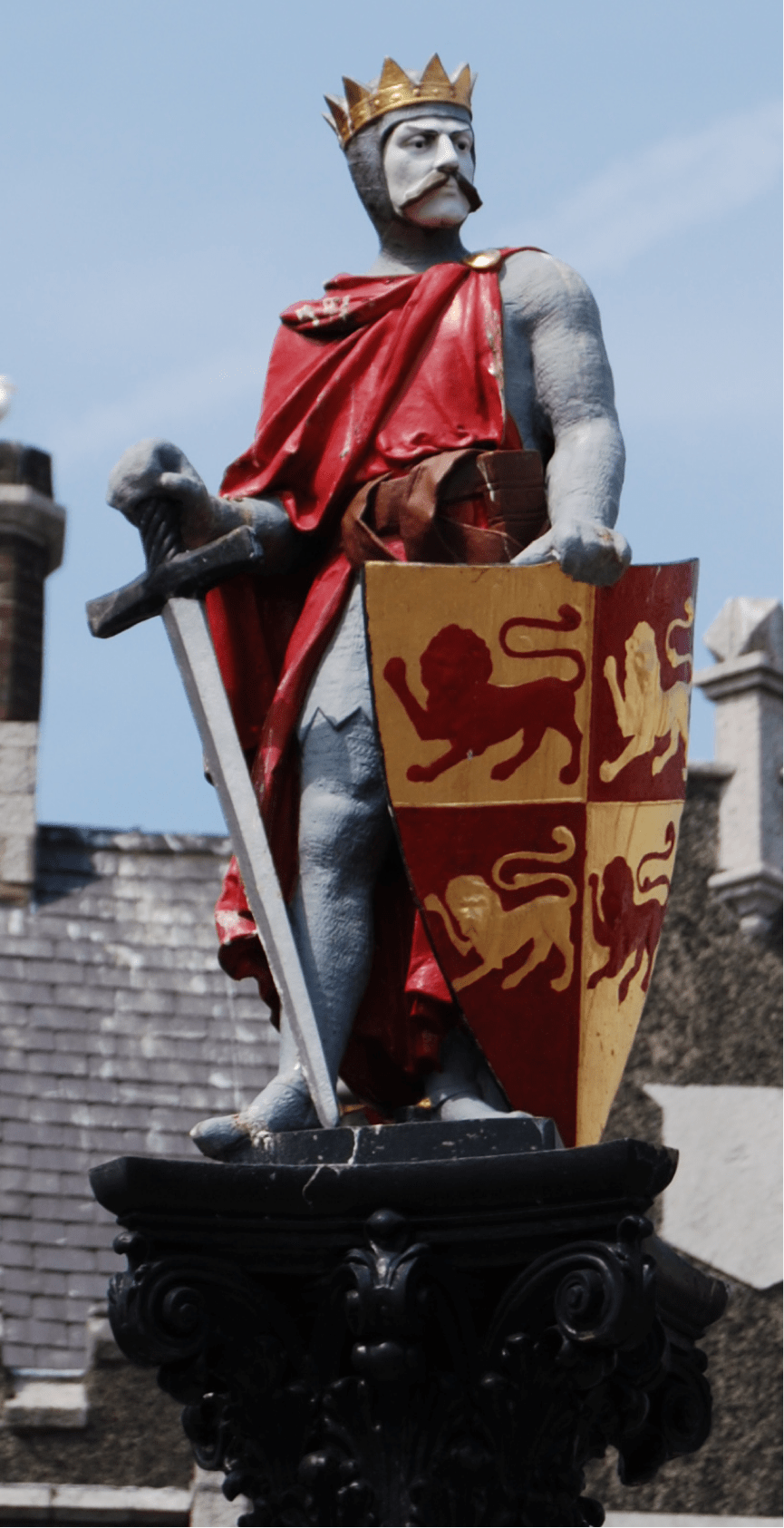
Dafydd ap Gruffydd

EdwardDafydd was the grandson of Llywelyn the Great.  He was also the first nobleman in Britain to be executed by being hanged, drawn and quartered for treason.

The story is a complicated one and begins with Llywelyn the Great.  Llywelyn married Joan, the natural daughter of King John.  They had one son who inherited his father’s kingdom.  He died without heirs so the kingdom was inherited by the heirs of Llywelyn’s other son Gruffydd who had been excluded from a share in the power because of his illegitimacy.  This had followed the English way of excluding all but the legitimate heirs.  Now though Gruffydd’s four sons all had an opportunity to make a bid for power.

In 1256 Llywelyn ap Gruffydd managed to wrest power from his brothers.  The early years of his reign were helped by the fact of the Baron’s War in England and the role of Simon de Montfort.  Dafydd formed an alliance with King Henry in 1263 and continued to fight against his brother alongside Edward I from 1274.

The alliance with King Edward served Dafydd well.  He married Lady Elizabeth Ferrers, the daughter of the Earl of Derby and widow of William Marshall (2nd Baron Marshall).  He gained land and prestige in England.  But then Dafydd thought better of his links with the English and returned to fight alongside his brother.  He attacked Hawarden Castle during Easter 1282.  Edward was unamused.

That same year Llywelyn was killed and Dafydd became the next Prince of Wales.  It probably wasn’t a very comfortable position as Edward was hot on Dafydd’s heels.  In fact he was captured once but managed to escape into the Snowdonian Mountains.  Finally he was cornered along with his younger brother Owain.  Also imprisoned were Dafydd’s wife, their seven daughters, two sons and one niece.

The Lanercost Chronicle takes up the story:

The King sent him forward to the Tower of London with wife and children….David’s children were condemned to perpetual imprisonment, but David himself was first drawn as a traitor, then hanged as a thief; thirdly, he was beheaded alive, and his entrails burnt as an incendiary and a homicide; fourthly his limbs were cut into four parts as the penalty of a rebel.


This all took place in Shrewsbury.  As for his wife and children.  Their fates are not completely known.  His wife is thought to be buried in the church at Caerwys.  One daughter, Gwladys, a child, was sent to the Gilbertine convent in Sixhills Lincolnshire where she spent the rest of her life along with her cousin.  Her brothers Llywelyn and Dafydd were imprisoned for the rest of their lives.  Llywelyn died in suspicious circumstances in 1287 in Bristol Castle.

The Lanercost Chronicle

DSC_0056Lanercost Priory was founded in 1169 by Robert de Vaux, son of the Lord of Gilsland, for Augustinian Canons.  As it turned out the priory wasn’t in the best location for quiet contemplation and production of religious texts sitting as it did in the shadow of Hadrian’s Wall on the border between England and Scotland.

The chronicle cover the years 1201 to 1346 and gives graphic accounts of some of the difficulties faced by a population living on the frontline of the first war of Scottish Independence.  Unsurprisingly it presents information from an English viewpoint.  The monks of Lanercost do not seem to have had a soft spot for any marauding Scots who passed their way.

The chronicle reference local events including a siege at Berwick and an eyewitness account of one of Carlisle’s sieges  certainly give it a local flavour as does an account of the visitation by the Bishop of Carlisle in 1281 and also one of Carlisle’s periodic fires.  It also covers events such as the Battle of Bannockburn and the execution of Sir Andrew de Harcla.  The chronicler agrees that Sir Andrew was a traitor to Edward III but follows up with the comment that the local population would have been grateful for the peace that de Harcla had worked towards at the cost of his life.

It seems probable that some of the chronicle was compiled in Carlisle while other entries were written in Berwick – there are first person eyewitness accounts to events located in these places.  This has given rise to a question about the authorship of the chronicles as has the manner in which the Franciscans are heralded at every opportunity as men of great spiritual worth. As the preface of the chronicle explains it seems unlikely that Augustinian Canons would extol the virtues of Mendicant Franciscans.  It is a puzzle exacerbated not simply by time and border warfare but also by the Dissolution of the Monasteries which saw the destruction of a tradition of monastic chronicles that dated from before the conquest.

The only thing that readers can be absolutely certain of was that the text translated from Latin into English by Sir Herbert Maxwell in 1913 used a manuscript that was known to be in the possession of Sir Henry Savile in 1596.


The Gilbertines of Ravenstonedale

ravenstonedale

St Oswald’s Church in Ravenstonedale is a gem in a beautiful setting.  The Georgian church seems hardly changed since the eighteenth century.  The Georgian three-decker pulpit  is certainly eye catching but there has been worship on this site since Saxon times and it was once home to the Gilbertines.

The Gilbertines, founded in 1131, are the only English order.  Their rule is based on the Cistercians with their life of poverty and work. What makes them even more unusual is the fact that the Gilbertines were a mixed order. One of their prime rules was the line from the Lord’s Prayer – ‘Lead us not into temptation’. Monks and nuns lived side by side in a mixed community.  The order originated in Sempringham in Lincolnshire under the strict rule of Gilbert.  Although the order was mixed, the nuns and monks were rigidly segregated.

By the time of the Reformation there were twenty-five Gilbertine houses in England – including one at Malton and Watton in Yorkshire as well as Ravenstonedale.  Interestingly a lower age limit was set before men and women could take full orders.  Lay brothers  professed at twenty-four while lay sisters were allowed to take orders when they reached twenty.  Of course, as with every religious order there is scandal – take the story of the pregnant nun of Watton for instance.  More of that in another post.  Incidentally, the Gilbertines of Ravenstondale had their roots in Watton.  The manor of Ravenstonedale was granted to them in about 1200.

Ravenstonedale was never independent of Watton but the canons would have had a fish pond and possibly some rabbit warrens for self-sufficiency.

On a tranquil summer’s evening in June these days, it’s possible to surprise the rabbits scampering about the Gilbertine ruins which were excavated in 1929.