
 Roche Abbey near Maltby was founded in 1147 by Richard de Bully of Tickhill and Richard Fitz Turgis. The valley where the monastery stands is narrow and split by the fast flowing Maltby Dyke- rather thoughtfully the patrons did not specify which side of the dyke the abbey would be built on which is why there are two funders because the valley was owned by both men with the dyke as the boundary of their lands.
Initially monks from Newminster in Northumbria settled the site on behalf of the so-called white monks, the Cistercians, who sought remote locations so that they could better adhere to the rule of St Benedict. Newminster was itself the daughter house of Fountains Abbey. Initially there would have been twelve monks and an abbot as well as a larger group of lay brothers. The numbers have a direct correlation to the number of apostles. The monastic population at Roche peaked in 1175 (ish) with fifty or so monks and twice as many lay brothers. Unfortunately the economic wellbeing of the monks dwindled the following century when their sheep flocks became contaminated with a murrain and this was followed up at the turn of the fourteenth century with the Black Death which carried off the monks and the lay brothers. In between times they had to contend with Scottish raiders during the reign of Edward II. By 1350 the monks had returned to virtually the same as they had been at their founding with only fifteen brothers. In 1380 we know that the abbot of Roche – a certain Hugh Bastard – was taxed 45 shillings by Pope Nicholas.
It would have to be said that the early monks must have felt they had chosen their spot well when one of them found a cross carved into the rocks near their new home – hence the name de rupa. The cross remained a source of holy inspiration and pilgrimage until the dissolution of the monasteries in 1536. Cromwell’s visitors to Roche noted the self-same cross under their list of superstitions.
Over time various other patrons bequeathed land or entitlement to the monks. John de Warenne, the Earl of Surrey – and holder of nearby Conisbrough Castle gave the monks the advowson of Hatfield church meaning that they had the right to appoint the incumbent and levy the appropriate ecclesiastical taxes in that location. Unusually for most monastic foundations Hatfield Church was Roche’s only ecclesiastical living.
However Roche did acquire other lands and gifts. Armethorp is described as “A knight’s fee held by the abbot of Roche (de Rupa)” in Inquistions Post Mortem of Edward III. They also held land at Hallaby in the West Riding, territory in Nottinghamshire and Linconshire, Rossington in East Sussex, Derbyshire, Lincoln and York. In Derbyshire the monks held granges at Oneash and Moneyash. Monks who had committed sins in Roche were sometimes sent to Derbyshire as part of their punishment. For a complete list of Roche’s lands and granges click here https://www.dhi.ac.uk/cistercians/roche/lands/appendix.php
Realistically not much more is known about Roche, possibly because Cromwell\s commissioners sold manuscripts and parchment by the cartload for kindling, until the Dissolution.
Cromwell’s visitors were the dreaded Thomas Layton and Legh. In addition to noting the cross carved in the rock they charged five monks with the usual kind of immoralities and carted another off to York Castle on charges of treason. He must have been allowed to return from York after the Pilgrimage of Grace because his signature is on the deed of surrender along with the rest of his bretheren. It was signed in the chapter-house on 23 June 1538. (fn. 9)
Come to think of it the sinning can’t have been that terrible because all the monks were in receipt of their pensions. The abbot was given £33 6s. 8d. a year. He wasl also allowed his books, the fourth part of the plate, the cattle and household stuff, a chalice and vestment and £30 in money at his departure. He may well have regretted having to say farewell to his house, his own personal cloister and his kitchen.
The sub-prior (Thomas Twell) received £6 14s. 8d. and the bursar (John Dodesworth), one of the monks charged with gross misconduct in the notoriouscomperta, £6. Eleven other monks who were priests received £5 each; and four novices 66s. 8d. each.
Michael Sherbrook, rector of nearby Wickersley recorded the suppression of Roche recalling the words of his father and uncle, “as the Visitors were entred within the gates, they called the Abbot and other officers of the House, and caused them to deliver up to them all their keys and took an inventory of all their goods both within doors and without; for all such beasts, horses, sheep, and such cattle as were abroad in pastures or grange places, the Visitors caused to be brought into their presence: and when they had done so, turned the Abbot with all his convent and household forth out of doors.”
He continues to describe the destruction of centuries of craftsmanship – the Roche Limestone being a prized form of masonry in many ecclesiastical buildings. “It would have pitied any heart to see what tearing up of lead there was, and plucking up of boards, and throwing down of the sparres: when the lead was torn off and cast down into the Church, and the tombs in the Church all broken… and all things of price either spoiled, caryed away, or defaced to the uttermost.”
Sherbrook notes that his father was sympathetic to the plight of the monks but like many other men still took part in the destruction. His response was an honest one. “Well, said I, then how came it to pass that you was so ready to destroy and spoil the, thing that you thought well of? What should I do? said he. Might I not as well as others have some profit of the spoil of the Abbey? for I did see all would away; and therefore I did as others did.”
Another source for Roche’s state in 1536 comes from the inventory taken by the commissioners. It included everything from crucifixes to carthorses.
By 1627 the land upon which Roche stood had passed into the hands of the ancestor of the Earls of Scarborough. By the eighteenth century the picturesque and ruined site was described by Horace Walpole as a “venerable chasm,” the fourth earl was so suitably impressed with this gem of information that he hired Capability Brown to make the place even more picturesque – this involved some further levelling of the stonework on the grounds that not all ruins are picturesque. Scarborough then built the so-called Banqueting Lodge so that he and his guests could admire the view whilst partaking of a fine dining experience and discussing suitably intellectual matters having been driven a mile and a half from the earl’s residence.
The remains of Roche, despite the remedial work of Lancelot Brown, adhere to the standard Cistercian plan beginning with the gatehouse to the west of the site.It was designed to impress visitors as they made their way down the valley to the abbey. The quarries from which the Roche Limestone come make for a rather splendid backdrop. The area between the gatehouse and the church has been levelled so that the earl of Scarborough and his guests could enjoy the view but this is the area that visitors would have been made welcome. Hospitality was an essential part of the monastic ethos. Visitors would have been able to access the church which dated from the abbey’s foundation but which was remodelled and extended during the wealthiest times of the abbey’s existence. Today the nave is an open vista punctuated by masonry stumps. There is no sign of the night stairs that would have allowed the monks to access the church from their dormitory other than a handily placed sign.
The grandest part of the ruins are the remnants of the three storey transepts. Each of the transepts contains two chapels of which rib vaulting and ruined piscinas remain as do the altar platforms. The presbytery between the precepts has been largely robbed away. As Lawrence explains the plans of Cistercian abbeys are standard and would have been inspected to ensure that there was no deviation. The buildings to the south side of the abbey church contained the library and the cloister. Buildings to the west of the cloister were for the lay brothers whilst on the other side of the cloister the library, chapter house and parlour could be found – the “engine” end of the abbey. The southern side of the cloister housed the choir monks. Like the lay brothers their refectory was on the ground floor with the dormitory running above it. Next to the refectory was a warming room with a hearth for the elderly and infirm to warm themselves. The latrines, hanging over the dyke, provided a ready made flush – quite what the abbot would have made of that is another matter as his own dwelling lay directly opposite the latrines on the other side of the dyke. He had his own house, cloister and hall in which to entertain important guests. There was also a second kitchen and bakehouse situated nearby.
Lawrence, C.H. (2000) Medieval Monasticism: Forms of Religious Life in Western Europe in the Middle Ages.
‘Houses of Cistercian monks: Roche’, in A History of the County of York: Volume 3, ed. William Page (London, 1974), pp. 153-156. British History Online http://www.british-history.ac.uk/vch/yorks/vol3/pp153-156 [accessed 22 June 2018].
J E E S Sharp and A E Stamp, ‘Inquisitions Post Mortem, Edward III, File 5’, in Calendar of Inquisitions Post Mortem: Volume 7, Edward III (London, 1909), pp. 41-56. British History Online http://www.british-history.ac.uk/inquis-post-mortem/vol7/pp41-56 [accessed 22 June 2018].
 Today’s post is about the family of one of the most notorious women in English History. Frances Howard, Countess of Somerset pleaded guilty in 1616 to murdering Sir Thomas Overbury in 1613 whilst he was a prisoner in The Tower.
 So who was Frances Howard? She was born on the 31 May 1590. She was the grand daughter of the 4th Duke of Norfolk by his second wife, Margaret Audley – it was how that grand mansion Audley End came into the hands of the Howard family. The fourth duke, Thomas Howard, was the man who aspired to marry Mary Queen of Scots in 1569 then managed to get himself caught up in the Ridolfi Plot of 1571. He was executed in 1572. As a traitor his lands and title were forfeit to the State but by that time the Tudors had become rather adept at removing wealth with one hand and returning it with the other in order to ensure that there weren’t too many grievances to be aired by rebellious subjects. The fact that the Howards were Elizabeth’s cousins should also be added to the scales.
 As it happens Audley End was not part of Elizabeth’s haul of booty when the 4th duke got the chop. The estates there and around Saffron Waldon were part of Margaret Audley’s dowry so when she died they had passed straight into the hands of her eldest son Thomas Howard (born 1561), who was Frances Howard’s father.
 Sir Henry Lee (1533–1611) was Queen Elizabeth I’s self-appointed champion. The family originated from Buckinghamshire although his mother was a Wyatt from Kent. As is usual with the Tudors, Lee was related somehow or other to some very important people including the queen herself as well as to William Cecil and to Robert Dudley. He was also man who served all the Tudors from the age of fourteen beginning with Henry VIII without being slung in the Tower for his pains.
 Perhaps Elizabeth wouldn’t have been so keen on lending money if she had realised that her new lady-in-waiting, Anne Vavasour, would one day lead her royal champion astray – she being at least thirty years his junior. In 1584 , three years after Anne disgraced herself by becoming pregnant by the earl of Oxford, Lee jousted against Anne’s brother Thomas. Anne would be described as Lee’s “dearest dear.” Lee clearly wasn’t too bothered by the feud that the Vavasour and Knyvet families were running agains the Earl of Oxford on account of Anne’s meteoric fall from grace. And, in all fairness, we don’t know when Anne and Lee began their relationship. It is only in 1590 that Anne Vavasour turns up in the Ditchley records but as Simpson explains the purchase of Ditchley in 1583 could be explained not only as a home located in reasonable proximity to an important official role (Steward of Woodstock) but also as a home for his lady-love. By 1585 Lee was living separately from his wife as identified through the will of Anne Paget’s mother. The 1592 Ditchley Portrait is usually regarded as Sir Henry Lee’s apology to Elizabeth for living with a married woman – not that she seems to have held it against him.
 Anne was born in about 1560 to 1653 – she was a girl remember- to a Yorkshire family. When she was somewhere between eighteen and twenty, she became one of Elizabeth I’s ladies-in-waiting. Her links with the Kynvet family through her mother were probably what landed her a plum job at court. Her sister would also serve the queen and cause almost as much scandal as Anne.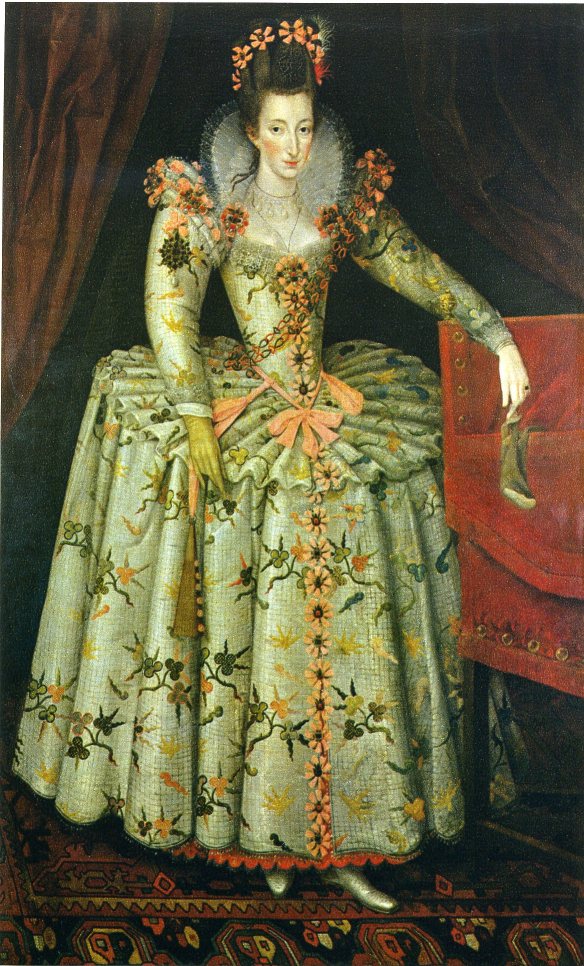


 Now, I know this isn’t necessarily going to be popular but Sir Francis Drake is one of my heroes. He has been since I was a child and I’m not about to change tack now. The problem with the global circumnavigator (the Golden Hind is smaller than some modern bath tubs) is that he was also a privateer – or put another way a pirate licensed by the queen for a spot of pirating which is apparently quite different from being a lawless thug who deserves to be strung up.
 David Cecil, William’s grandfather had turned up at Bosworth on the victorious side. he went on to become one of Henry VII’s newly formed yeomen of the guard. His son meanwhile settled down to the business of being a Lincolnshire gentleman with court connections.
 During the first ten years of Elizabeth I’s reign she took very little notice of the English Catholics who led their home shores to find sanctuary in Europe. Very sensibly she had no desire to create martyrs. There was also the lesson of her half-sister to consider. She had begun her reign on a wave of popularity which swiftly dissipated when she started burning people.
 Margaret’s son Ferdinando Stanley the 5th earl of Derby was much less lucky. Ferdinando became earl in 1593 after his father’s death. The following year the fifth earl died rather unexpectedly following a sudden and violent illness. At the time witchcraft was mentioned but poisoning was the more generally accepted reason – as this extract from Camden’s history reflects:
 History tends to decree that the Tudors had problems with heirs. In reality it must have felt to the heirs, on occasion, that they had problems with being Tudor. Henry VIII decreed the order of inheritance beginning with his own children. Not only did he specify the order of inheritance in his will but he ensured that it was enshrined in law with the third Act of Succession of 1544.
 William (pictured right) was specifically forbidden from joining the Earl of Essex on his campaign in Ireland as it was felt that he might take advantage of the opportunity to do a spot of networking. William, it would’ve to be said, appears to have done nothing to deserve royal suspicion – he was very much a member of the gentry concerning himself with his northern estates and keeping his head down – presumably he didn’t want to end up like his mother or brother. He appears to have been a scholarly type and if you like your conspiracy theories he is one of the contenders for the real Shakespeare based on the fact that George Fenner, a Jesuit, reported that William rather than being interested in politics and matters of religion spent his time “penning common plays” in his house near Chester.