Two men, two queens, one surname….and a girl.

Nicholas Throckmorton

Nicholas Throckmorton

Have you noticed the way that one name will repeat itself throughout a period of history.  The Norman period is littered with women called Matilda. Bizarrely the same is true, in the reign of Elizabeth I, of the name Throckmorton.  The two men are Nicholas and Francis Throckmorton; the two queens Elizabeth I of England and Mary Queen of Scots.

Nicholas Throckmorton was a Tudor courtier and loyal ambassador to Elizabeth as well as being Francis’s uncle.  Francis was a Catholic conspirator who plotted to assassinate Elizabeth and put Mary on the throne.


Nicholas Throckmorton was also Catherine Parr’s cousin so first met Elizabeth when both of them were in the Dowager Queen’s household.  Young Throckmorton navigated the rocky whirlpool of Tudor politics because of his Protestant sympathies and because he was able to become one of Edward VI’s advisors.  He went on to become and MP and undertreasurer at the mint which was at that time in the Tower of London.


He got to know the Tower much better during reign of Mary when his protestant ideas got him into trouble.  Eventually he went to France.


After Elizabeth’s accession his fortune’s changed once more and he found himself in France not this time as asylum seeker but as Elizabeth’s ambassador where he met Mary Queen of Scots.  It was he who helped arrange her journey back to Scotland after she’d been widowed.  In 1565 he was sent as ambassador to Scotland.  His task was to prevent Mary, by now a personal friend, from marrying Lord Darnley.  He was in Scotland once more when Mary was overthrown. He found himself in the predicament of irritating touchy Scottish lairds and annoying his famously tetchy queen.  It didn’t help that Elizabeth sent him one set of instructions while Cecil sent a different set of instructions.  He was probably relieved to return to England – where he leapt from the proverbial frying pan straight into the fire stoked by Mary Queen of Scots.

He became involved with the plan to marry Mary to the Duke of Norfolk in 1569.  This led to the Northern Earls Rebellion and to Throckmorton spending an uncomfortable few weeks in Windsor under arrest while Elizabeth fumed at Throckmorton’s stupidity.  He claimed that he thought that Elizabeth was in favour of the marriage.  He escaped trial and imprisonment but he wasn’t allowed any more key political roles and certainly wasn’t allowed anywhere near the Scottish queen.

On to the the second Throckmorton. In 1583 there was a plot to assassinate Elizabeth; at its heart a man called Throckmorton – Francis was Nicholas Throckmorton’s nephew.  He was also very Catholic.  Francis Throckmorton had been recruited by the Spanish to kill Elizabeth at the same time that Henry Duke of Guise invaded England (funded by the Spanish.)  It was the discovery of this plot that led to the Bond of Association which stated that it was sufficient to know of a plot to kill the queen or usurp the throne to be guilty of treason – as in, guilty by association.  Francis was tired and found guilty after making his confession which was gained by torture.  He was executed for treason.

Bess Raleigh nee Throckmorton

Bess Raleigh nee Throckmorton

…And the girl?  The girl is the other famous Tudor Throckmorton.  Bess Throckmorton was Nicholas Throckmorton’s daughter and Francis’s cousin but she is more usually remembered as the lady-in-waiting who fell in love with and married Sir Walter Raleigh much to Elizabeth’ s irritation.
A Little Bit of Luck

Luck of Edenhall

Luck of Edenhall

When I was a child we used to refer to a bird splattering the car window screen  with its guano as leaving ‘luck’.  As an adult responsible for washing my own car I fail to see what luck has to do with it.  However, back to matters in hand, the lucks of today’s post as rather prettier and infinitely more historic – although once again in some instances ‘luck’ seems to be missing from the equation.

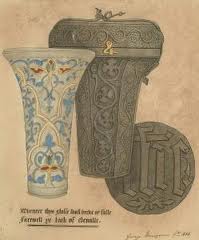
The first luck is the ‘Luck of Edenhall’ which used to be in possession of the Musgrave family of Edenhall. The ‘luck’ is a beautiful gilded and enamelled glass beaker (it looks like a vase to me but what do I know).  It was made in Syria so the chances are that it made its way home in the trunk of a Musgrave crusader.  Remarkably it survived the joys of reiver warfare, heavy handed drinkers and the washing up bowl.  Though to be fair it must always have been prized because when not in use it was kept in a leather container that had been made in the Fourteenth Century. The case bears the letters IHS suggesting that it was once used as a communion challice.

The luck was still in one piece at the beginning of the Eighteenth Century when the current owner decided it would be a good idea to drink the health of the entire family from the priceless heirloom.  Luck must indeed have been on the side of the Musgraves because it survived and went on to feature in a ballad.

Border ballads had been popularised by Sir Walter Scott and James Hogg at this time and “The Drinking Match” was a modern contrivance which featured the medieval glassware.

If this cup should break or fall,

Farewell the Luck of Edenhall.

From there it was one small step to the fairies – quite literally at the bottom of the garden – who were supposed to have given the luck to the Musgraves after water was drawn for them at a well.

The Musgraves aren’t the only family to have a ‘concrete’ luck that they need to guard against disaster.  The Lamb Family of Great Salkeld had a brass dish allegedly given by hobgoblins at a wedding feast.  A girl from the wedding family went to a nearby well to fetch water where she was accosted by a hungry hobgoblin – or gaggle of hungry hobgoblins depending on the account- who said that they would bless the bride and groom in exchange for food and drink.

Sir John Pennington was the Lord of Muncaster Castle during a portion of the Wars of the Roses.  In the aftermath of the Battle of Hexham (15 May 1464) King Henry VI was found wandering over the fell.  He was taken to Muncaster where Sir John and his wife cared for the broken monarch for the next nine days.  When he left the monarch – who could have done with a bit more luck himself- gave the family a glass cup telling them that they would prosper so long as it remained unbroken.  It is still on display in Muncaster Castle.

View across fells from Muncaster Castle

View across fells from Muncaster Castle

The final luck in this post brings us to the Luck of Workington.  Mary Queen of Scots fled across the Solway Firth in a fishing boat with sixteen companions.  When she arrived she had very few possessions and needed shelter.  Lord Herries, a Scottish Lowland laird who’d remained loyal to his queen sent a message to Sir Henry Curwen of Workington with whom he had a friendship.  Sir Henry sheltered Mary until she could be escorted to Carlisle Castle.  When she left she gave the family a small agate cup as a token of her gratitude.  It became known as the Workington Luck.

La Belle Ecossaise

 lady_janet_stewart_mediumLady Janet Fleming was Mary Queen of Scots governess – and her half-aunt.  She began life as Janet or Jenny Stewart, an illegitimate daughter of King James IV.  When she was about fifteen she was married to Malcolm, the third Lord Fleming who was ten years older than her.  They had eight children before he died at the Battle of Pinkie.

Lady Janet now found herself employed as the infant Mary’s governess and went with her to France.  The journey was difficult and when they arrived the French court took one look Mary’s Scottish entourage and decided that they were barbaric and unwashed with the exception of ‘the beautiful Scot.” – Janet Fleming.  Her daughter Mary Fleming, to be known in history as one of Mary Queen of Scots’ four Marys was packed off to a convent for education and polish while Janet remained with her royal charge.  It may be that she had already caught King Henri II’s attention.  Certainly, she’d made an impression on the Venetian ambassador who described her as “a very pretty little woman.” (The Venetian Ambassador was clearly a contender for patronising ambassador or the year).

Janet spoke only in scots, she didn’t know any french when she arrived in France.  However, clearly there was some effective communication with Henri II because she became pregnant and bore a son Henri de Valois-Angouleme.  She is recorded as believing that her role as mother of the king’s child had secured her position.  She hadn’t bargained with Catherine de Medici or Diane of Poitiers who as wife and mistress respectively clearly felt that they didn’t need the competition.  Janet was despatched back to Scotland in disgrace- the reason being that Mary had just acquired her own household and it was important that the future queen of France should have no scandal attached to her name (a pity that Mary didn’t recall that later in her life).

Little Henri remained in France and was later legitimised.  Janet found herself trapped in Scotland.  She died in 1562.

A monk, a bishop and a heretic – Robert Ferrar

foxe289Robert Ferrar, a lad from Halifax, was an Augustinian Canon who showed sufficient talent to leave Yorkshire and go to Oxford University where he became a student at Merton University.  The Augustinians had a policy of each of their houses sending at least one monk to receive an education.

It was probably while he was at Oxford that he came under the influence of reformers  and the works of Tindale.  Certainly when Cardinal Wolsey investigated heresy in Oxford Ferrar was one of the men arrested and punished.  Wolsey forced the students who had been discovered with banned books to witness their destruction.  He was, however, allowed to complete his education.

Ferrar returned to Nostell Priory in 1533.  Three years later, Thomas Layton, one of Cromwell’s visitors arrived at the monastery to conduct its visitation.  The prior was very sick.  In fact, he died not long afterwards.  Ferrar was appointed prior probably because of his reforming sympathies.  When the monastery surrendered in 1539 he received a pension, eventually married and had three children.

Ferrar’s quiet family life intersected with his role in the Reformation Church of Edward VI.  He was appointed chaplain to Edward Seymour (the Lord Protector) and  then Archbishop Cranmer as well as Bishop of St David’s.  In this latter role he helped to reform the Welsh church.  It was this that brought him into conflict with his parishioners and resulted in him being imprisoned in London upon the fall of Seymour where he remained until Mary Tudor came to the throne.

Ferrar was in difficulties not only because he was a protestant but also because he was married.  Mary refused to recognise the legality of Ferrar’s marriage and he was deposed of his see.  He was tried for heresy by Archbishop Gardiner and found guilty.  He refused to recant.  He was sent from London to Carmarthen in February 1555 where he was placed on trial.  Eventually he was burned at the stake.  Foxe recounts the fortitude with which he met his end.  Double click on the image to go to Foxe’s account of Ferrar’s trial, imprisonment and death.

Chaucer and the de la Poles.

chaucer3This is one of those surprising connection posts.  It also reflects the way in which society changed as a consequence of the Black Death and the decline of feudalism.  The descendent of an inn keeper became a Duke of Suffolk and was embroiled in the bloody aftermath of the Wars of the Roses.

The Chaucer family were upwardly mobile, of that there’s no doubt.  Geoffrey’s great-grandfather was a inn  in Ipswich, his grandfather was a shoemaker – not a humble cobbler- think wholesale shoe sales with entrepreneurial tendencies; he was also a vintner.  In addition, he had the good sense to marry a pepperer’s widow called Mary Heron which added a further very lucrative string to his bow.

Their son, Geoffrey’s father, John Chaucer was an established merchant and freeman of the City of London.  He was sufficiently wealthy for his aunt to attempt to kidnap him in order to marry his cousin when he arrived at a marriageable age.  The plot was foiled but it demonstrates how much the Chaucer family circumstances had changed in four generations.

As the Chaucers climbed the social rungs they became soldiers and served in royal households.  Geoffrey Chaucer was talented not only as a poet but also as a diplomat.  It helped that he was married to the sister of John of Gaunt’s mistress – Katherine Swynford – which is in itself a fairly unexpected connection but one of history’s more well-known links.

However it is in Geoffrey’s descendants that the really unexpected connection begins to take shape.  Geoffrey’s son Thomas- there are some suggestions that Thomas was in fact John of Gaunt’s son but there is no evidence to confirm this- had a daughter called Alice who married three times.  Her final husband was William de la Pole – who became the Duke of Suffolk.  They had one son – John who married Edward IV’s sister Elizabeth which turned the de la Poles into Plantagenets which was an excellent step up the social ladder in the world before the Wars of the Roses but was not so useful in the Tudor world.

Alice’s grandson John took part in the ill-fated  uprising against Henry VII  with Lambert Simnel.  He was killed.  His younger brother Edmund took on the family title but fled to Europe where he found protection at the court of the Hapsburgs. Unfortunately Philip the Handsome was shipwrecked on the English coast and Henry VII was able to have the troublesome Plantagenet returned to his care and a comfy room in the Tower of London.  In 1513 Henry VIII had Edmund executed.  The third de la Pole brother was called Richard who became a soldier of fortune and was killed at the Battle of Pavia – an event which Henry VIII celebrated.

But who would have thought that any of the three were related to Geoffrey Chaucer?


Sir Ralph Eure, a murder and a castle.

DSCN6689What more could anyone want – a knight, a murky sort of murder and a Yorkshire castle – Scarborough Castle to be precise.

Sir Ralph Eure or Evers came from an old Yorkshire family that had originally arrived with William the Conqueror.  His ancestors had been Sheriffs of Yorkshire as well as wardens of the marches. One of them died at the Battle of Towton.  Our Sir Ralph’s moment of history came during the reign of Henry VIII.  He had temporary charge of Scarborough Castle at the time of the Pilgrimage of Grace. As a result of his loyalty to the king he was made constable of the castle for life.  When the castle was besieged in 1536 he kept the gates firmly shut despite the fact that the king had failed to send him supplies for fear that they should fall into rebel hands.   Though this appointment was not without a whiff of scandal as Sir Ralph was accused very early in his tenancy of taking the lead off the towers and turrets for his own profit: some of the lead was exchanged for French wine. Despite his inability to read and write Sir Ralph overcame the accusations that he faced and was able to  pursue a claim to Sir Francis Bigod’s lands.


Sir Francis had been involved in the second part of the Pilgrimage of Grace which occurred against Robert Aske’s advice in January 1537 and which gave Henry the excuse he needed to execute all the leaders of the pilgrimage including Robert Aske.  Sir Francis paid with his life and Sir Ralph benefitted in April 1538 when was he appointed chief steward of Sir Francis Bigod’s lands in Lincolnshire and Yorkshire.  All straight forward so far.  Sir Ralph was on the winning side while Sir Francis gambled and lost.


Except, of course, there was more than the Pilgrimage of Grace between Sir Francis and Sir Ralph.  The year before the uprising a man named Davy Seignory was murdered by a group of 10 men from Settrington took place in Malton. Seignory was Eure’s servant.  The murderers rode to Scotland where they were safe but returned to England sometime later.  However, they remained outside the reach of the law because they stayed in the Bishopric of Durham – at this time the whole county was effectively a sanctuary.  Cromwell, apparently, tried to persuade Bigod that although the king could do nothing about this unfortunate situation that Bigod could and indeed should take matters into his own hands.  Bigod said that sanctuary was more important than the murder and that was that…well apart from the fact that one of the murderers was related to Thomas Cromwell and also the fact that Bigod was in debt at a time  and was in effect Cromwell’s man.  Let’s just say that the paperwork necessary to bring the murderers before the court in York was incorrectly completed.

Strangest of all, Sir Francis Bigod had written a treatise recommending the reform of the monastic system – he was a Protestant, a reformer and Cromwell’s man.  Yet somehow he ended up taking the side of the Pilgrims.  A  fact which enabled Sir Ralph to exact revenge, it would appear, for Sir Francis’s part the shadowy events surrounding his servant’s death.  A national event but also a question of neighbours vying for power and perhaps – and this is entirely supposition- a matter of personal dislike.  Sir Francis’s version of events and his letters can still be read in the National Archives while Sir Ralph did not have the skills to save his thoughts for posterity.

Sir Ralph’s lack of literacy didn’t stop him from becoming  in 1542,  on the Duke of Suffolk’s appointment, keeper of Redesdale and Tynedale.  He took part in many raids and was part of the Earl of Hertford’s ‘Rough Wooing’ in 1544.   His actions during this campaign won him the hatred of the Scots.  In addition to the usual pillaging of the border he managed to distinguish himself by burning Brumehous Tower- not unusual – but on this occasion the lady and her children were still inside.

Eure, a commander of the army, died at the battle of Ancrum Moor on 27 Feb. 1545, where the Earl of Angus ‘revenged the defacing of the limbs of his ancestors at Melrose upon Ralph Evers.’  The Earl of Arran is said to have wept when shown the body and said, according to Henry VIII’s state papers:

“God have mercy on him, for he was a fell cruel man and over cruel, which many a man and fatherless bairn might rue, and wellaway that ever such slaughter and bloodshedding should be amongst Christian men.”

Fortified Churches in Cumbria

DSC_0065There are officially three fortified churches in Cumbria.  Two of them lie on the Solway Firth and the third, the first picture in this post, lies in the Eden Valley at Great Salkeld a few miles north of Penrith.

St Cuthbert’s Church in Great Salkeld was a brief resting place for the body of St Cuthbert when the monks spent seven years wandering through the north in fear of the Danes.  These days it is more noticeable for its tower.  The thick walls, narrow doorway and staircase as well as the ironbound door indicate that it was a place of safe haven from marauding Scots.

At Newton Arlosh they say that the door is so narrow that the bride and groom have to decide who is leaving the church first.  The spouse who sees daylight first will be the one in charge of the partnership so the locals say…I couldn’t possibly comment.

The third church is at Burgh-By-Sands and it is probably the oldest of the fortified towers which is not surprising given that it lays so very close to Scotland.  Its stones once formed part of the Roman fort of Aballava; a Celtic carved head reminds visitors that people have lived here for thousands of years.  The church lay in the domain of one of the knights who killed Thomas Becket and in 1307 Edward I was laid here in state after dying on his way to war with the Scots.  The tower caused the Bishop of Carlisle some distress because when the villagers built it they managed to undermine the foundations of the church.  One thing is for sure the builders meant business.  The tower is heavily buttressed and several feet thick as well as the narrow entrance, the iron yet is still in place with its three great bolts and there is a huge slot in the masonry for a bar to be slid into place.  There are narrow windows through which arrows could be fired and there is evidence of archers having sharpened the tips of the arrows on the walls of the tower.  When gunpowder became more readily available someone cut a gun loop in the lower room and a height that would leave attackers facing kneecapping at best.  The tower is vaulted and there is a narrow spiral staircase just the same as in Great Salkeld.DSC_0128

Of course there are a number of other churches in the area where villages- and certainly the priest- sought sanctuary in time of trouble.  The tower on the church at Edenhall (another St Cuthbert’s and another resting location for the saint’s mortal remains) has a funny little tower that includes a ‘mini’ steeple.  It was built in the fourteenth century and was probably used in much the same way as the three fortified churches already described but unlike the towers at Newton Arlosh, Burgh by Sands and Great Salkeld the tower in Edenhall lacks the narrow doorway and the iron bound door.

Other strategies were devised elsewhere. In Corbridge the vicar came up with an alternative means of self-preservation.  There is a peel tower in the churchyard where the vicar could flee in the event of trouble and the wall around the churchyard is fairly stout too.  At Kirkby Stephen the church tower is a handy vantage point that enabled two Westmorland’s Pilgrimage of Grace ringleaders to evade capture by Henry VIII’s men and is also part of a more general defense strategy whereby the streets narrow so that the townsfolk could defend their property more easily against border reivers.

The Mad Priest of Kent

John-ball-rebel-1John Ball was an English priest and one of the leaders of the Peasants Revolt of 1381. The revolt started in Essex at Brentwood.  It was only when the revolt spread to Kent that John Ball became involved but he quickly, according to folk-lore and the chroniclers of the period, became one of the revolt’s leaders.  He was certainly one of the most eloquent representatives of the Peasants Revolt.

Ball probably began his career in St Mary’s Abbey, York where he was ordained as a priest.  He next appears in Colchester in 1366 when he was arrested for heretical preaching and forbidden from preaching.  John Ball was not deterred. He attacked the wealth of the church and preached for equality between social classes. In 1376, he was arrested by the new archbishop of Canterbury, Simon of Sudbury because he preached that people need not pay their tithes to unworthy priests.  Even more inflammatory he said that all property should be shared in common among all people.

He was in prison at the outbreak of the Peasants’ Revolt in June of 1381. He wrote many letters from prison to his supporters continuing to urge them to break free from social injustice. When the revolt reached Maidstone one of the first things that Wat Tyler did was to free Ball.

Ball gave a sermon at Blackheath saying “When Adam delved and Eve span, who was then the gentleman?”  The peasants were so inflamed by his words that they demanded the heads of King Richard II’s bad advisors— Richard returned to the Tower with the men who the commons wanted to kill and the next day the commons rampaged through London.

Ball survived the death of Wat Tyler, there is no further reference to him after the famous sermon speech at Blackheath “When Adam delved and Eve span – who then was then the gentleman?” He escaped London and went into hiding.  He got as far as Coventry where he was discovered, captured and dragged back to face the king.

He was hanged, drawn and quartered on July 15 1381 at St Albans after judgment by Richard II.  His head ended up on a spike on London Bridge.  In the city itself people began to rebuild their homes and their lives where they could.  Many Flemings and Lombards had been killed during the unrest and now the King and his council ordered Englishmen to leave London if there had not lived there for a year and a day.

It was said by chroniclers of the period that Ball was a supporter of Wycliff and the Lollards but it is thought that this was an attempt by the authorities to implicate them in the events of the revolt.

Monks, Money and Borgia woolly hats

DSCN3074The Austin Canons of Carlisle found that their church sometimes felt very overcrowded by ecclesiastic types in vestments with  diverse official roles and an eye on the coffers.

Henry I granted landed in Carlisle in 1102 for the foundation of a priory in Carlisle.  It was funded by four churches in Northumberland as well as the wealth of Walter the Priest who endowed the priory with all his lands when he entered holy orders.  Slowly other landowners began to make endowments and with the continued support of the king the Austin Canons continued to build their home.  It was completed by 1130.  They had three years in which to enjoy sole ownership of their new home.

The foundation of the bishopric within the priory church of St Mary in 1133 meant that the priory church  now became a cathedral.  The first Bishop of Carlisle, Adelulf had previously been the prior of Nostell Priory near Wakefield.  He tried to ensure that the revenues of the monks and the bishop were kept separate.  At a conclave in Drax he sent a messenger to ensure that  it was clearly understood that what the monks did was one thing but that what the bishop might do was entirely separate on account of the bishop having a role more like a parent within the ecclesiastic community.  Just to add a drop of confusion to the discussion – rather like adding an extra thread to a ball of wool that already has its share of tangles –  the Commons of Carlisle referred to the priory as the abbey but there was never an abbot appointed to be subordinate to the bishop.

This shared ownership presented something of a difficulty.  As the Victoria History of Cumberland edited by James Wilson explains:

The bishop’s supremacy over his cathedral church cannot be questioned. It has been already pointed out that the bishop and his chapter formed one ecclesiastical corporation and held the lands and spiritual possessions of the church of Carlisle in common. When a division of the property was made and the see became an institution in some measure separate from the priory, care was taken to define the relationship of the head of the diocese to the corporate body occupying the church which represented the unity of his diocese and contained the seat of his jurisdiction. There is little doubt that at the outset the appointment of the prior was in the patronage of the bishop, and perhaps of the king when the bishopric was void. When the terms of the arrangement for the separate endowment of the see were complete, this privilege seems to have been relinquished to the chapter in compensation for the redistribution of emoluments. At all events it was not until 1248 that the canons had the liberty of electing their own superior. On 25 November in that year, Pope Innocent IV. granted protection and confirmation of possessions to the prior and convent, and especially the chapelry of the church of Carlisle, with all offerings, tithes, and parish rights belonging to the said church, except the offering at Whitsuntide, all the land formerly belonging to Walter the priest, which King Henry gave and confirmed by his charter, and other possessions. The pope also granted to the canons the right of electing the prior and prohibited the bishop from disposing of their emoluments without their consent.

Clearly the monks had sound business heads on their ecclesiastical shoulders but they weren’t the only ones.  The bishop maintained some control over the Austin Canons.  He had a say in the selection of the sub-prior and cellarer, the two principal officers of the house. And things didn’t always go smoothly Prior Adam de Warthwyk received a stern lecture from Bishop Halton and later on Prior John de Kirkby was excommunicated by Bishop Ross which puts a whole new meaning on being sacked!  Some priors even resigned their posts and perhaps it’s not surprising since the bishop had the power to carry out a visitation. Given the canons’ church was the bishop’s cathedral it is easy to imagine some of the petty grievances and slights that resulted in the full weight of the Churches authority being bought down on the monks.  Prior Warthwyk was charged with negligence and remissness in the discipline of his house contrary to the statutes of the order.  His  household was much too expensive, he only consulted with Brothers Robert Karlile, William de Hautwysil, and William de Melburne, order was not preserved among the brethren, the business of the house was not transacted, and its goods were wasted beyond measure by his expensive entourage; the list- or rather rant- went on at some length.


Quite what the Bishop would have made of the canons being allowed to wear hats on account of the cold is a matter of historical speculation.  In 1258 Pope Alexander IV- the Borgia Pope- permitted the Canons of Carlisle to where caps in the choir on account of the northern cold. How this concern for monastic pates occurred is not a matter of the historical record but its nice to know that while Alexander was busy poisoning people, fighting wars, keeping bees and dallying with mistresses – though possibly not in that order- (yes- I’ve watched the series) that he had time to carry out his pastoral responsibilities for the Austin Canons of Carlisle.


As well as being the priory church and the cathedral, it also served as the parish church of St. Mary, Carlisle, from the date of its foundation.  Once again finances became an issue when the problem of endowing a dedicated vicar arose.  The citizens of Carlisle made a complaint that the sacrist of the priory, to whom the issues of the parish were committed, had neglected the cure of souls and that insufficient ministrations were supplied to the people.  The Bishop of Carlisle gave judgment in favour of the priory, because he said that the canons were able to serve the church through their own chaplains under the care and direction of the prior.  No one mentioned the fact that the bishop may have lost some of his revenue and powers had a third ecclesiastic been appointed to the aisles of St Mary’s.

The smallest cathedral in England was once larger than it is now but its choir and chapels must have echoed with the hiss of political intrigue and the sound of ruffled feathers – though of course at least the monks had warm heads.

Resurrection Men in Carlisle

st cuthThe story begins with the Liverpool coach on the 6th September 1823.  Sadly it overturned and badly injured a little boy.  His right leg was amputated at the knee.  The child died on the 1st November and was buried in the graveyard of St Cuthbert’s Church.

The body-snatchers Burke and Hare were up to no good in Edinburgh this time exhuming bodies and selling them to the medical world for dissection. Accounts of graves being robbed of their occupants featured in all the newspapers.  There was concern that a grave had been tampered with in Stanwix.  Before long suspicion focused on ‘two strangers’ who’d hired a room in Long Island.  The trail led to the offices of the Edinburgh Carriers where a stoutly corded box to be delivered to Lieutenant Todd in Edinburgh had already been dispatched. Suspicion excited, the box was stopped and opened at Hawick.  Inside were the bodies of three children.  Another, rather heavier box, had already been refused transportation.

Meanwhile on the 8th of December, another interment was about to occur in St Cuthbert’s.  The mourners may have been rather alarmed at what was discovered.  The body of a Botchergate Blacksmith wash discovered with cord tied around its feet.  He was carefully reburied and a search of the graveyard made.  The little boy, killed in the coach accident, was missing as was the body of a cotton spinner.


A twenty guinea reward was offered for the capture of the resurrection men but they disappeared as swiftly as they had arrived.  By 1828 body-snatching had reached such a pitch  that the Government of the day needed to legalize dissection.