Resurrection Men in Carlisle

st cuthThe story begins with the Liverpool coach on the 6th September 1823.  Sadly it overturned and badly injured a little boy.  His right leg was amputated at the knee.  The child died on the 1st November and was buried in the graveyard of St Cuthbert’s Church.

The body-snatchers Burke and Hare were up to no good in Edinburgh this time exhuming bodies and selling them to the medical world for dissection. Accounts of graves being robbed of their occupants featured in all the newspapers.  There was concern that a grave had been tampered with in Stanwix.  Before long suspicion focused on ‘two strangers’ who’d hired a room in Long Island.  The trail led to the offices of the Edinburgh Carriers where a stoutly corded box to be delivered to Lieutenant Todd in Edinburgh had already been dispatched. Suspicion excited, the box was stopped and opened at Hawick.  Inside were the bodies of three children.  Another, rather heavier box, had already been refused transportation.

Meanwhile on the 8th of December, another interment was about to occur in St Cuthbert’s.  The mourners may have been rather alarmed at what was discovered.  The body of a Botchergate Blacksmith wash discovered with cord tied around its feet.  He was carefully reburied and a search of the graveyard made.  The little boy, killed in the coach accident, was missing as was the body of a cotton spinner.


A twenty guinea reward was offered for the capture of the resurrection men but they disappeared as swiftly as they had arrived.  By 1828 body-snatching had reached such a pitch  that the Government of the day needed to legalize dissection.


St Cuthbert’s Church, Carlisle.

st cuthSt Cuthbert’s Church in Carlisle has had a chequered history.  These days its easy to miss tucked away as it is down a side lane between the House of Fraser and the Crown and Mitre.  St Cuthbert preached in Carlisle but it didn’t stop the Vikings destroying the church that stood on the spot.  It was William Rufus who ordered that the church should be rebuilt and it escaped the worst of the great fire of 1292 as well as the attentions of assorted besieging Scots.  In 1644 when the Parliamentarians closed the cathedral and the parish church of St Mary’s which lays inside the cathedral the mayor made St Cuthbert’s the city’s Civic Church.  It remains so to this day.

However, in 1777 it was decided that the church should be rebuilt, though the opening of the new church was delayed by a particularly bad storm in 1778 it took only two years to raise the money for the building and fitting out of the new church.   Nothing remains of the medieval church apart from some fragments of glass.  

The churchyard is an oasis of green in a city environment.  Headstones have been placed against the churchyard walls so there is no indication of the spot where executed felons and Jacobites were laid to rest.  There’s a further link to Carlisle’s troubled past as the last town besieged in England inside the church in the form of the royal coat of arms which were placed there in the aftermath of 1745 to remind the citizens of Carlisle where their loyalty lay.

  Back outside, the graveyard is the final resting place for members of the Royalist garrison who died during the siege of 1644. The guide-book also makes reference to a highwayman and if that weren’t lively enough in December 1823 the body snatchers came calling in Carlisle.  Graves were tampered with, two bodies went missing and one was discovered parcelled up ready for transportation.

Who would have thought there was so much history lurking in such a peaceful spot?

Princess Joan of Kent

Joan of Kent was the daughter of Prince Edmund of Woodstock, 1st Earl of Kent and his wife Margaret Wake; wife of the Black Prince and mother to King Richard II.  She is unusual in that on the death of her brother, the 3rd Earl of Kent and 4th Baron Wake, Joan inherited the titles in her own right.

She may well be named after her maternal grandmother who was Princess Joan, King John’s illegitimate daughter who married Llewelyn the Great of Gwynedd.  Just to add to the family tangle, Princess Joan was also cousin to Roger Mortimer, Earl of March.  And Roger Mortimer was the man who was Queen Isabella’s lover and the man responsible for the judicial execution of Joan of Kent’s father who had continued to be loyal to the deposed Edward II (Kent’s half brother).  Once the usurping Earl of March had been done away with and Edward III assumed control of the throne he arranged for Joan and her sister to come to court.  The two girls were raised alongside his own children.  So Joan grew up with the Black Prince.  Eventually Joan became Edward III’s ward.

Clearly Joan was an important member of the royal family.  Whoever won her hand in marriage would gain many points in the medieval power game.  Joan had other ideas.  She fell in love with Sir Thomas Holland.  She was twelve.  He was twenty-six. His grandmother was Ela Longespee whose grandfather was the Fist Earl of Salisbury and the illegitimate son of Henry II which puts a whole new meaning on the saying ‘keep it in the family.’  Suffice it to say Thomas Holland wasn’t someone of the make.  His ancestry was as illustrious as that of Joan.

The problem was that because the pair had run away to get married it wasn’t strictly legal though very romantic.  Joan, and indeed Thomas, required the king’s consent to get married.  Her guardians at the time wanted Joan to marry their son, Sir William Montague, who was the second Earl of Salisbury.  They didn’t see Joan’s marriage to Thomas as a problem.  They simply waited for him to leave the country to go on crusade and then forced Joan to marry their son. In 1341 Holland returned home and wasn’t terribly pleased to discover that his wife was married to another man.  Undeterred he set about winning fame in France in what was to become the Hundred Years War as a military commander and then set about regaining Joan.  Salisbury put up a fight but in the end Pope Clement VI annulled Joan’s marriage to Salisbury.

Joan’s firstborn son Thomas Holland who became the Earl of Kent was an ancestor of Katherine Parr which is definitely an unexpected connection – though given the medieval penchant for familial marriages it probably shouldn’t be quite such a surprise. Another son married one of John of Gaunt’s daughters. And yet another child was an ancestor of Lady Jane Grey.  Sir Thomas died in 1360 leaving Joan a rich widow.  She was eventually buried beside her first husband.

As well as being wealthy and well-connected with the royal family Joan was also one of the beauties of her age.  She was known as ‘the fair maid of Kent’. Many offers of marriage were made.  Joan turned them all down.  According to one version of events, one of the Black Prince’s men asked  Edward to intercede with Joan on his behalf.  Edward found himself falling in love with his childhood companion.  They were cousins within the degree prohibited by the church so before they could marry a papal dispensation was required.  On her marriage she became the first Princess of Wales.

When she became the Queen Mother her life continued to be the stuff of historical novels and mini-series.  She was so loved by the people of England that when she encountered Wat Tyler and his men at Blackheath they let her pass unharmed with an escort (you can’t help wondering who let such an important personage as the king’s mother meander into the path of revolting peasants?).  In any event the tale demonstrates that as well as being regarded in the light of national treasure she was also conventionally religious.  She was returning from pilgrimage to Canterbury when her path crossed with that of Wat Tyler.

Richard II – who do you think you are? Or meet the family.

tumblr_m94jocf45j1qeu6ilo1_500Richard II is one of those monarchs in history who is remembered for coming to a rather nasty end.  Incidentally he is also the first English monarch for whom we have a realistic portrait.

So who was the unfortunate king who lost his throne and starved to death in Pontefract Castle.  Richard’s grandparents were Edward III and Philippa of Hainhault.  His father was Prince Edward known as the Black Prince on account of the colour of his armour but only from the sixteenth century.  The prince died a year before his father of an illness that he’d contracted in Europe.  He is best remembered for his military importance at the Battle of Crecy and later on for capturing the french king.  He campaigned in Spain and made himself unpopular with the people of Aquitaine when he taxed them for his Spanish campaigns – for that and for the massacre of some 3000 inhabitants of a town that rose up in revolt against him.

Edward was married to Joan who was the daughter of the Earl of Kent.  He was the son of Edward I and Margaret of France.  So, he was the chap who supported his brother (Edward II) and was executed on the orders of Mortimer and Isabella – so not exactly a peaceful childhood.  As if that weren’t enough she’d been married before – twice.  Unfortunately the second marriage was bigamous and it took papal decree to sort the tangled matrimonial web out.  She produced five children before her legitimate husband Sir Thomas Holland died.  She then married the Black Prince and bore two sons.  The first child, a boy called Edward, died age six or seven.  Her second son, Richard, was born in 1367 in Gascony.  He succeeded his grandfather as king, the year after the Black Prince died.

Richard was a minor with lots of half-siblings on his mother’s side of the family and plenty of cousins and uncles on his father’s side of the family – the most notable one being John of Gaunt.  The stage was set for a familiar family saga of murder and mayhem.

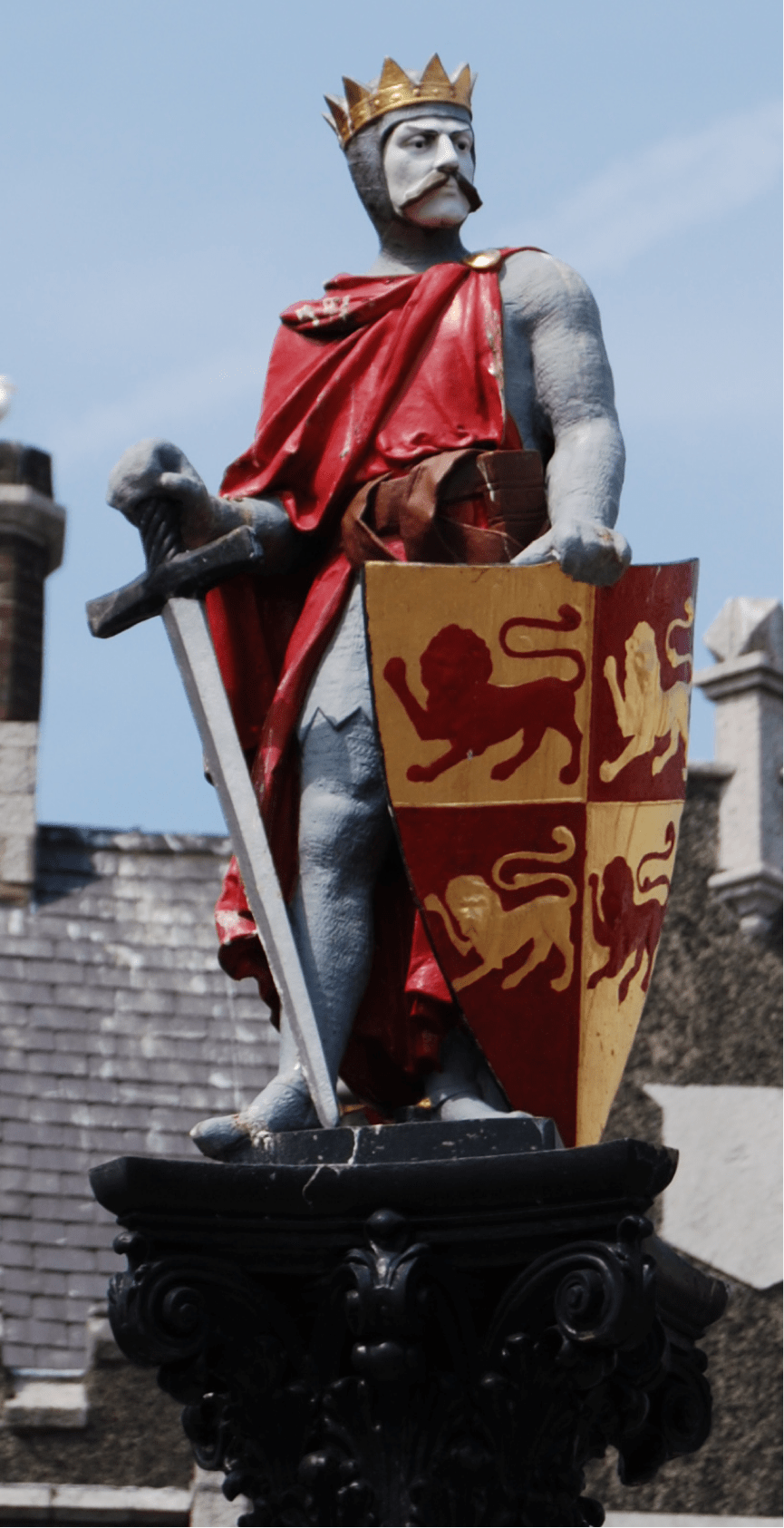
Dafydd ap Gruffydd

EdwardDafydd was the grandson of Llywelyn the Great.  He was also the first nobleman in Britain to be executed by being hanged, drawn and quartered for treason.

The story is a complicated one and begins with Llywelyn the Great.  Llywelyn married Joan, the natural daughter of King John.  They had one son who inherited his father’s kingdom.  He died without heirs so the kingdom was inherited by the heirs of Llywelyn’s other son Gruffydd who had been excluded from a share in the power because of his illegitimacy.  This had followed the English way of excluding all but the legitimate heirs.  Now though Gruffydd’s four sons all had an opportunity to make a bid for power.

In 1256 Llywelyn ap Gruffydd managed to wrest power from his brothers.  The early years of his reign were helped by the fact of the Baron’s War in England and the role of Simon de Montfort.  Dafydd formed an alliance with King Henry in 1263 and continued to fight against his brother alongside Edward I from 1274.

The alliance with King Edward served Dafydd well.  He married Lady Elizabeth Ferrers, the daughter of the Earl of Derby and widow of William Marshall (2nd Baron Marshall).  He gained land and prestige in England.  But then Dafydd thought better of his links with the English and returned to fight alongside his brother.  He attacked Hawarden Castle during Easter 1282.  Edward was unamused.

That same year Llywelyn was killed and Dafydd became the next Prince of Wales.  It probably wasn’t a very comfortable position as Edward was hot on Dafydd’s heels.  In fact he was captured once but managed to escape into the Snowdonian Mountains.  Finally he was cornered along with his younger brother Owain.  Also imprisoned were Dafydd’s wife, their seven daughters, two sons and one niece.

The Lanercost Chronicle takes up the story:

The King sent him forward to the Tower of London with wife and children….David’s children were condemned to perpetual imprisonment, but David himself was first drawn as a traitor, then hanged as a thief; thirdly, he was beheaded alive, and his entrails burnt as an incendiary and a homicide; fourthly his limbs were cut into four parts as the penalty of a rebel.


This all took place in Shrewsbury.  As for his wife and children.  Their fates are not completely known.  His wife is thought to be buried in the church at Caerwys.  One daughter, Gwladys, a child, was sent to the Gilbertine convent in Sixhills Lincolnshire where she spent the rest of her life along with her cousin.  Her brothers Llywelyn and Dafydd were imprisoned for the rest of their lives.  Llywelyn died in suspicious circumstances in 1287 in Bristol Castle.

Edwin’s Place

KSCN0001King Edwin’s kingdom stretched from Edinburgh – Edwin’s Town- to the River Trent.   This was the Kingdom of Northumbria He was accepted as the High King or Bretwalda.  Following his marriage to Ethelburga of Kent (daughter of Ethelbert) in AD 627 he became Britain’s second Christian king. Bede described Edwin  as more powerful than any earlier king and as time passed he extended his kingdom to the Isle of Man and Anglesey.

His invasion of North Wales resulted in Cadwallada of Wales and Penda of Mercia forming an alliance against him and invading his kingdom in 633.  He and two of his sons were killed at the Battle of Heathfield  which could be near Cuckney or alternatively at Hatfield near Doncaster – though it would be unlikely for the next part of the story to be true if this were the case.

Edwin’s comrades carried his body from the scene of the battle and buried it in the forest.  They carried his head back to St Peter’s in York., though another version has Cadwallada displaying Edwin’s head on the ramparts of York’s city walls following a veritable  Saxon-killing spree.  In either event the battle was bloody and decisive.


Eventually it was decided that Edwin’s body should be buried in Whitby Abbey where his niece St Hilda was abbess.  By that time people were calling him a saint.  The spot where his body had been buried was deemed a holy place and a wooden chapel built on the site.  This became known as the ‘place of Edwin’ or Edwinstowe.

Edwinstowe was part of the royal manor of  Mansfield in 1066.  Inevitably, given the Norman kings love of hunting the land around Mansfield and Edwinstowe became part of a royal forest.  The Domesday Book of 1086 records the church, a priest and four bordars – these were essentially slaves working the priest’s land.  Twenty years later there was even less land being cultivated.


In later times King John, who had a hunting lodge at Ollerton, paid a priest to live in a nearby chantry to say prayers for his soul and for the souls of the people he had wronged.

The local people probably felt they ought to have been included in the number as they were bound by the strict forest laws that protected the timber and the game of royal forests.   Those caught breaking the law were taken before the Forest Court or Eyre which was held every six or seven weeks.  More serious offences were tried at the Nottingham Eyre.

The Lanercost Chronicle

DSC_0056Lanercost Priory was founded in 1169 by Robert de Vaux, son of the Lord of Gilsland, for Augustinian Canons.  As it turned out the priory wasn’t in the best location for quiet contemplation and production of religious texts sitting as it did in the shadow of Hadrian’s Wall on the border between England and Scotland.

The chronicle cover the years 1201 to 1346 and gives graphic accounts of some of the difficulties faced by a population living on the frontline of the first war of Scottish Independence.  Unsurprisingly it presents information from an English viewpoint.  The monks of Lanercost do not seem to have had a soft spot for any marauding Scots who passed their way.

The chronicle reference local events including a siege at Berwick and an eyewitness account of one of Carlisle’s sieges  certainly give it a local flavour as does an account of the visitation by the Bishop of Carlisle in 1281 and also one of Carlisle’s periodic fires.  It also covers events such as the Battle of Bannockburn and the execution of Sir Andrew de Harcla.  The chronicler agrees that Sir Andrew was a traitor to Edward III but follows up with the comment that the local population would have been grateful for the peace that de Harcla had worked towards at the cost of his life.

It seems probable that some of the chronicle was compiled in Carlisle while other entries were written in Berwick – there are first person eyewitness accounts to events located in these places.  This has given rise to a question about the authorship of the chronicles as has the manner in which the Franciscans are heralded at every opportunity as men of great spiritual worth. As the preface of the chronicle explains it seems unlikely that Augustinian Canons would extol the virtues of Mendicant Franciscans.  It is a puzzle exacerbated not simply by time and border warfare but also by the Dissolution of the Monasteries which saw the destruction of a tradition of monastic chronicles that dated from before the conquest.

The only thing that readers can be absolutely certain of was that the text translated from Latin into English by Sir Herbert Maxwell in 1913 used a manuscript that was known to be in the possession of Sir Henry Savile in 1596.


A warrior-bishop who collected taxes.

precinctsJohn Halton, or de Halton, was an Augustinian Canon in Carlisle.  He was elected the ninth Bishop of Carlisle on 23 April 1292 making him bishop during the reigns of Edward I and then Edward II – and putting him on the front line for the First Scottish War of Independence.


As well as caring for the spiritual concerns of his flock- his Register of the incumbents of the diocese still exists- he was also a busy diplomat and entertainer of royalty. The Magna  Britannia records him entertaining the king at Rose Castle (the principle residence until recently of the Bishops of Carlisle) in 1306 from 28 August until 10 September.

He was sent to Scotland in 1294 by the king and was a papal tax collector in Scotland (which possibly didn’t enhance his popularity with the locals and may account for why the Scots burned Rose Castle down at the first available opportunity – though obviously that’s my own personal spin on events).  On a more factual level, he was Governor of Carlisle Castle at one point, so had custody of Scottish prisoners and hostages – little did he realise that five hundred years later there would be so many Scottish Jacobite captives in Carlisle that the cathedral would have to be used as a prison.


It was Halton together with the Archbishop of York who excommunicated Robert Bruce in 1305 after the killing of John Comyn  and in 1306 he absolved everyone of their offences against the King’s enemies in Scotland which must have pleased the English borderers no end as they could then steal and kill with neither fear of hellfire and damnation nor, at the very least, a long time in Purgatory.  For his pains he was involved in the Seige of Carlisle in 1314 when Edward Bruce attempted to take the city.  He fled the border for large chunks of time enjoying the peace and quiet of Lincolnshire.  He was one of the king’s representatives in the treaty signed between England and Scotland in 1320.


The following year he turned up at a meeting held by Thomas of Lancaster which was the first indication of the barons uprising against Edward II.  There’s no evidence that Halton was involved any further but trouble and the bishop seemed to have gone hand in hand.  He died in 1324 having lived through some turbulent times on the border.

Thomas Merks – the loyal bishop.

This is one of those posts without a picture.  I may track one down eventually.  Thomas Merks or Merke died in 1409.  He was Bishop of Carlisle for three years between 1397 and 1400.  His duties were not terribly onerous.  After all, Richard II could not really do without one of his principle advisors.  It was Merks who helped negotiate the King’s marriage to Anne of Bohemia.  The Westminster monk did much to make himself indispensable to Richard II.  He helped to negotiate the dowry of Isabella of Valois and he went with Richard to Ireland.  Some chronicles accused the bishop of enjoying evenings of carousing rather than prayer but these were Lancastrian chronicles and they had no love for the king’s bishop.

 In 1400 Merks found himself in the Tower.  He had remained loyal to his king even when Richard no longer had his throne.  Only one other bishop was deprived of his see by Henry Bolingbroke, Duke of Lancaster who took on the title King Henry IV.  Merks  stood up in court to defend his master and paid a significant price.  He ended his days deputising for the Bishop of Winchester.  The family had links to the area – Merks nephew is buried in a local church.

The Gilbertines of Ravenstonedale

ravenstonedale

St Oswald’s Church in Ravenstonedale is a gem in a beautiful setting.  The Georgian church seems hardly changed since the eighteenth century.  The Georgian three-decker pulpit  is certainly eye catching but there has been worship on this site since Saxon times and it was once home to the Gilbertines.

The Gilbertines, founded in 1131, are the only English order.  Their rule is based on the Cistercians with their life of poverty and work. What makes them even more unusual is the fact that the Gilbertines were a mixed order. One of their prime rules was the line from the Lord’s Prayer – ‘Lead us not into temptation’. Monks and nuns lived side by side in a mixed community.  The order originated in Sempringham in Lincolnshire under the strict rule of Gilbert.  Although the order was mixed, the nuns and monks were rigidly segregated.

By the time of the Reformation there were twenty-five Gilbertine houses in England – including one at Malton and Watton in Yorkshire as well as Ravenstonedale.  Interestingly a lower age limit was set before men and women could take full orders.  Lay brothers  professed at twenty-four while lay sisters were allowed to take orders when they reached twenty.  Of course, as with every religious order there is scandal – take the story of the pregnant nun of Watton for instance.  More of that in another post.  Incidentally, the Gilbertines of Ravenstondale had their roots in Watton.  The manor of Ravenstonedale was granted to them in about 1200.

Ravenstonedale was never independent of Watton but the canons would have had a fish pond and possibly some rabbit warrens for self-sufficiency.

On a tranquil summer’s evening in June these days, it’s possible to surprise the rabbits scampering about the Gilbertine ruins which were excavated in 1929.