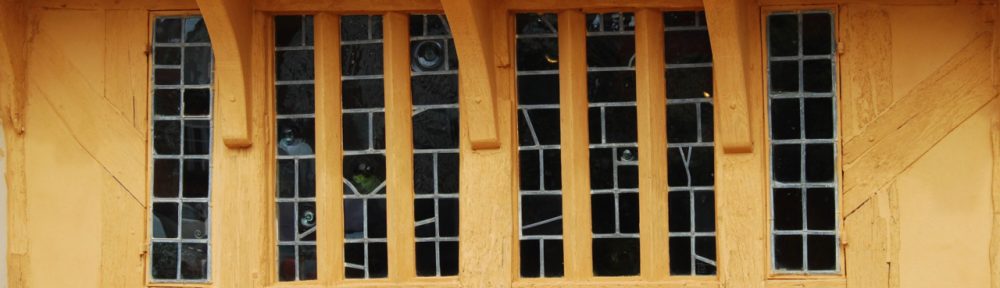
Croxden in Staffordshire was a Cistercian foundation. The Cistercians or “white monks” wanted to live a more austere life than their Benedictine or Cluniac brothers. This was symbolised by the undid wool habits that gave them their name.
Croxden Abbey was founded by Bertram de Verdun in 1176, Monks from Aunay in Normandy were sent to live in the new foundation. Initially the abbey began its life at Cotton but by 1179, the monks had moved to Croxden. The first abbey was built by 1254 but the precincts were expanded during the 13th and 14th centuries. The ground plan of the monastery at Croxden is modelled on Aunay.
When Croxden Abbey was dissolved in 1538 the property was leased to Francis Bassett, a member of the local gentry and rather conveniently a servant of Archbishop Crammer.
A road which dates from the 18th century runs diagonally across the site of the nave and the south transept.
The Augustinian Canons, “black canons” or Austin canons depending on your preference arrived in England during the Twelfth Century. They were all priests and rather than living in enclosed orders they sought to work within the community.
John was born at Twing just outside Bridlington in 1320. By the time he was twelve he had taken vows of chastity.
His education had begun locally but he went to Oxford from about 1336 to 1339. In 1340 he became a monk in Bridlington Priory. He gradually rose within the priory carrying out different roles: novice master, almsgiver, preacher and sub-prior. Then in 1346 he became a canon. Ten years later he was elected prior.
He served as prior for 17 years before dying October 10, 1379.
Pope Boniface IX canonised him in 1401 – which is unusual I don’t think that there are that many Augustinian saints, unless we include Thomas Becket who was a secular canon rather than a regular canon. Ie John followed the monastic rule. Essentially he miraculously saved fishermen from drowning and on another about to get into trouble for giving the priory bread away as alms to the poor he opened his bag to reveal stones for road mending. His saint’s day should you need to turn bread into stones is October 10th.
He can be found dressed in his Augustinian black cloak in the Beaufort Book of Hours which includes a prayer to him. The Beaufort Book of Hours is in The British Library.
There is another Yorkshire saint – St John of Beverley who gets mentioned by Henry V at Agincourt.
On the 20th March 1470 the Battle of Nibley Green brought the so-called Berkeley Feud to a head. It was to become the last private battle on English soil.
Edward IV was in the north of England at the time tying up the loose ends of unrest there. The Earl of Warwick, increasingly unhappy with his cousin, had rebelled in 1469 and imprisoned Edward in Warwick Castle. In September Edward was released and in 1470 following the Battle of Losecoat which had been fought on the 12th March the Earl of Warwick had fled England for France along with Edward’s brother, George Duke of Clarence.
Meanwhile Thomas Talbot, Viscount Lisle and William, Lord Berkeley took the opportunity to get on with a spot of feuding. Both men believed that they were entitled to the Berkeley estate as well as title and castle. Margaret, Countess of Shrewsbury born Beauchamp was the granddaughter of Thomas, Lord Berkeley who died in 1417 (this is a long story). She and her sister were his co-heiresses via their mother Elizabeth. However, Berkeley’s estates and title passed to his brother’s son James, though it should be added that this wasn’t without dispute. In fact Thomas had enfeoffed Berkeley Castle and his lands to several trustees prior to his death because the line of inheritance was uncertain.
James died in 1463 and his son William inherited the title and the estates.
It wasn’t a straight forward sort of transfer across the family branches because Margaret was married to the Earl of Warwick – so one of the most powerful families in the land. Margaret had imprisoned James’ wife, Isabel, in 1452 when she attempted to appeal James’ claim to a council of Henry VI. Isabel died whilst still in captivity. Its probably didn’t help matters much.
In 1468 Margaret died and her claim was taken up by her eighteen year old grandson Thomas Talbot.
In 1470 William Berkeley attempted to conclude matters by issuing a personal challenge to Thomas. The pair’s heralds agreed a time and a place. The result was the Battle of Nibley Green. William had a substantial force of men which outnumbered Thomas’s. Thomas Talbot and some one hundred and fifty other men died. it probably didn’t help that Thomas forgot to lower his visor in the heat of the moment.
Thomas’s manor at Wotton was then sacked.
Margaret had occupied Wotton which was part of the Berkeley estate so William Wotton regarded it as his anyway. Lord Berkeley in one of his legal petitions accuses the Countess of unjustly keeping possession of his manors of Wotton, Symondshall, Cowley, and some others; of plotting and corrupting his servants to get possession of Berkeley Castle, and finally of compassing his death by means of a hired assassin.
Margaret denied the charge of intended murder but held fast to her claim to the Castle and manors of Berkeley. She believed that as Thomas Berkeley’s granddaughter by a direct line of inheritance that her various attempts to gain possession were justified and she petitioned to have her rights restored to her. The first petition and reply were referred by the king, (Edward IV) to the Lord Chancellor, to whom the subsequent pleas and counter-pleas were addressed, and in these proceedings, varied by predatory incursions upon each others’ manors and frequent fights between their servants and tenants, five years had passed without any decision being pronounced when Thomas Talbot inherited the feud.
William Berkeley was a Yorkist and Edward IV needed his support so he suffered little punishment being made a viscount in 1481. In 1483 he became the Earl of Nottingham. Berkeley didn’t have any legitimate children so his brother Maurice inherited the estate by which time William had done a Lord Stanley at Bosworth i.e. sat and waited to see what the outcome was going to be before joining the battle. Even worse he’d sent men to Richard III and money to Henry Tudor.
“A Sketch of the History of Berkeley Its Castle, Church, and the Berkeley Family” by James Herbert Cooke, Land Steward to the Right Hon. Lord Fitzhardinge.
Wagner, John A. The Encyclopaedia of the Wars of the Roses
In 1586 the younger brother of Sir Edward Stafford, the English ambassador in Paris, went to see the secretary of the French ambassador, a man called Leonard des Tappes. Stafford had a plan. Des Tappes informed his master – Chateauneuf.
Stafford explained that the plan was to blow up the queen’s bed with the queen in it. Unfortunately the queen was afraid of the dark and never slept without one of her ladies in waiting. Stafford’s own mother Lady Dorothy Stafford served Elizabeth faithfully. Although the job title Mistress of the Robes hadn’t yet been created it was what Dorothy did.
Lady Dorothy Stafford
The ambassador pointed out that the risk of blowing up Lady Dorothy was quite great. Stafford said that in that case it would probably be best to stab Elizabeth or possibly poison her.
Stafford was very swiftly arrested and escorted to the Tower as was Des Tappes. The ambassador was questioned and eventually admitted that he knew about the plot. What he should have done was to reveal to the Privy Council, to Cecil, to Walsingham…to any one who would listen really…that there was a dastardly plot afoot. He hadn’t blabbed which wrong footed him and effectively put him out of the complicated Anglo-French game of spies and intrigue for a significant month of two. He was placed under house arrest and thus unable to get anywhere near Mary Queen of Scots who was being quietly entrapped by Walsingham (Babbington Plot)
Elizabeth’s guard was doubled and she became much more wary of Mary Queen of Scots which was exactly what Walsingham hoped to achieve.
And Stafford, described in documents as “a lewd, discontented person?” His mother was very distressed at the thought that he might try to blow either her or the queen up so it’s unlikely that Elizabeth was aware that it was a ruse. Certainly he was in Walsingham’s pay as indeed had Moody been at various times.
The Spanish Ambassador wrote to Philip II telling the story. Apparently Lady Dorothy and her older son were not on good terms with little brother William but that William had pretended to be a Catholic and told the French that he would place a barrel of gunpowder in the bedroom and er, well – kerboom!
And whilst we’re on the subject of Dorothy Stafford her grandmother was Margaret Pole the 8th Countess of Salisbury – yes – that one. The daughter of the Duke of Clarence (the one drowned in a vat of Malmsey) married off to a member of Margaret Beaufort’s extended family and eventually executed without trial by Henry VIII in 1541 making her grand daughter Dorothy Stafford doubly related to some degree to Elizabeth I.
Duke William of Aquitaine founded Cluny Abbey in 910. It was exempt for visitations from it’s local bishop answering, instead, directly to the Pope. Like all monastics the monks at Cluny followed the rule of St Benedict but it placed a new emphasis on the liturgy. Ceremony, prayer, mass and psalms became the focus of the day.
William the Conqueror wanted the Cluniacs in England but the first one was founded at Lewes by William de Warenne. Lewes was not an abbey, it was priory. All Cluniac houses remained dependent upon their mother house at Cluny for direction. Bermondsey followed and William Rufus who did not have a reputation for piety gave it rich endowments. In total there would be some 35 Cluniac foundations in medieval England.
Faversham was founded by King Stephen and his wife Matilda in 1147 when Stephen donated his manor as the location of a new abbey – to be called St Saviour’s. A group of monks from Bermondsey, under licence and with permission from the mother house at Cluny to build the new priory – or rather abbey. It was understood that the new foundation was to be as free and independent as Reading Abbey, another Cluniac foundation. Reading Abbey was founded by King Henry I and is where he is buried. This was to be the place where the House of Blois would be buried. Stephen, his wife and son Eustace were buried there.
Henry II confirmed the grants and charters that Stephen made and it was still a Cluniac foundation. It remained Cluniac in the reign of his grandson Henry III but it was independent and ultimately not so important as Reading Abbey, the House of Blois lasting precisely one generation. It’s status as an abbey was contrary to Cluniac identity. Thus in the reign of Henry III, although it was founded by Cluniacs Faversham became a Benedictine Abbey.
At the dissolution the bones of Stephen and his family were disinterred. Their empty graves were discovered during archeological survey in 1965 but it is thought that they might have been moved to St Mary’s Church rather than dumped in Faversham Creek
In Benedictine abbeys abbots were responsible for the running of an abbey and its material wellbeing as well as the spiritual health of the monks in their charge. They were lords of the manor, so important on a local political and social level as well as often being prominent figures in secular government. They were also patrons of art and architecture.
Abbots were selected from within the abbey. The result had to be confirmed by an ecclesiastical superior and, under the terms of many charters, by the patron. During the reign of William Rufus this was problem as he kept a number of posts vacant in order to draw the income from the land, based on the principle that when the land was vacant of its tenant ( a role fulfilled by the post of abbot) that the Crown, which was the owner, took the profit. And clearly elections were not always as straight forward as the basic description suggests. There were all sorts of internal and external political shenanigans that didn’t necessarily have a great deal to do with piety.
Originally the abbot filled the role of father figure but as time passed many abbots were taken to task for not eating in the refectory with the rest of the monks or living away from the cloister. As well as not having oversight of the monastic foundation which they were supposed to be running they were also effectively invisible in terms of the example they were supposed to be setting. And if they were present the example was not necessarily positive – one of the abbots of Selby was taken to task for being drunk most of the time and for womanising.
As the medieval period progressed abbots were celebrated not for their piety but for their administrative capacities and control of the finances. This in its turn led to some interesting, not to mention creative, accounting in terms of pasturing their sheep on common land or pocketing the proceeds for themselves rather than the chapter.
All who arrive as guests are to be welcomed like Christ, for he is going to say, ‘I was a stranger and you welcomed me. (Rule of Saint Benedict 53:1)
Monastic hospitality was of key importance during the medieval period for travellers, pilgrims and rulers. For the monastery it was an opportunity to fulfil its spiritual obligations, find out what was going on in the outside world and also to gain patronage. Reputation for hospitality was an important thing – abbots wished to be seen as generous to their guests.
Houses in York and London could find themselves swamped with guests – the Cluniac priory at Bermondsey being an excellent example of how its location just off the London-Dover road did it’s finances no good at all because it was such a popular stopping off place. In Reading the number of guests resulted in the abbey finding itself in debt. The result of this being that rich guests continued to be welcome but the poorer ones were turned away. Eventually a new hospice was built for poorer travellers outside the abbey gates.
It was also possible for guests to outstay their welcome. It was expected that visitors at larger houses would leave on the third day unless they were ill or travel was made difficult by bad weather. Visiting monks would be permitted to stay longer and of course it’s hard to tell a monarch or a bishop to go away.
The abbot would be expected to dine with guests and on those occasions he didn’t have to stick to the monastic diet – which didn’t help monastic reputation for clerical abuses. By the end of the twelfth century most abbots had their own lodgings and ate separately from the rest of the brethren. I have posted about the abbot’s lodge on a previous occasion: https://thehistoryjar.com/2015/07/28/the-abbots-lodging/
It was the responsibility of the guest master and the cellarer to accommodate and supply the guests. They would be housed according to their rank. Those with fourteen or more horses in their retinue would find themselves in the abbot’s house whilst those on foot would be provided with a space in the communal hall. Guests were provided with candles and given tours of the monastery where appropriate. There were restrictions of females entering monastic cloisters and on monks interacting with female guests. There were rules about when male visitors could enter different parts of the monastery as well so that the monastic day was not interrupted.
At Kirkstall near Leeds (A Cistercian foundation) there was a separate guesthouse and kitchens and even piped water, elsewhere the guest chambers were within the abbey precincts. Guest quarters would also have fires in them, unlike the monastery itself where a warming room was provided for use by elderly and infirm monks at given times of the year.
Burton, Janet. (1994) Monastic and Religious Orders in Britain 1000 – 1300, Cambridge, 1994
Kerr, Julie. Monastic Hospitality: The Benedictines in England, C.1070-c.1250 (Studies in the History of Medieval Religion)
According to existing records Elizabeth I was healthy and active child apart from teething problems as documented by Lady Margaret Bryan. However as she arrived at adolescence her health deteriorated and she began to experience a series of chronic ailments.
There were some very obvious additional stress factors to take into consideration – at six she’d gained her fifth step-mother, a cousin, Katherine Howard. Less than two years later Katherine was sent to the block.
In Katherine Parr Elizabeth found some sort of family life and stability, although on occasion wife number six’s head did not rest easy on her shoulders.
Not long after the death of her father, Thomas Seymour asked her to marry him. She was thirteen. Less that six weeks after Henry VIII’s death Thomas went on to marry Katherine Parr and Elizabeth found herself living in the same household as Seymour. It was not long before the thirty-eight year old began making in appropriate advances to the fourteen year old princess. Ultimately she was sent away from the household, Katherine died after giving birth to Seymour’s daughter and Seymour’s ambition became so great that he once again looked to a taking a Tudor bride. This resulted in his execution. Elizabeth now became ill and required the attended of Edward VI’s physicians.
When Mary Tudor became queen Elizabeth used her health – stomach ache in particular- to avoid attending mass. After Wyatt’s Rebellion in 1554 Elizabeth began to look ill – so much so that the French ambassador de Noailles reported that she was being poisoned. Mary’s doctors examined her and blamed her poor health on watery humours. And no wonder, Elizabeth spent the years between 1554 and 1558 dissembling. Just before Mary’s death Elizabeth became ill and complained of pain when moving. She also experienced painful swelling. One of the problems was that Mary and her advisors did not know whether she was really ill or not.
Elizabeth also experienced fainting fits, insomnia, debilitating headaches, nightmares and depression. There was much stress involved in the preparation to become Gloriana!
“The Medical Personnel of Elizabeth I (1558–1603).” The Royal Doctors, 1485-1714: Medical Personnel at the Tudor and Stuart Courts, by Elizabeth Lane Furdell, NED – New edition ed., Boydell & Brewer, Rochester, New York; Woodbridge, Suffolk, 2001, pp. 67–97. JSTOR, http://www.jstor.org/stable/10.7722/j.ctt14brw4d.7. Accessed 11 Jan. 2021.
Taylor-Smither, Larissa J. “Elizabeth I: A Psychological Profile.” The Sixteenth Century Journal, vol. 15, no. 1, 1984, pp. 47–72. JSTOR, http://www.jstor.org/stable/2540839. Accessed 11 Jan. 2021.
British Library – calendar page for January ‘Isabella Breviary’ (Add MS 18851)
This calendar was created for Isabella of Castile in the 1480s.
Remember medieval calendars are perpetual.
The Roman numerals or golden numbers on the left hand side of the page tells you when the new moon will appear and logically when 14 days later the full moon will appear. The numbers are from 1 to 19 and represent the metonic cycle.
Thus you need to know where you are in the 19 year cycle to work out which of the 19 numbers is the new moon fo 4th year you happen to find yourself in.
The metonic cycle basically works on the premise that across a period of 19 years there are approximately 235 lunar cycles after which the cycle will repeat itself on the same day ie the moon will be in the same place in the sky with the same stars. The cycle was discovered by the Ancient Greeks.
The golden number of any calendar year (Julian or Gregorian) can be worked out by dividing the year by 19. Now add 1 to the remainder, and that number is the golden number for the year.
So:
2021 divided by 19 = 106 remainder 7
7 + 1 = 8. So in 2021 the Roman number 8 will provide the day in the metonic cycle on which a new moon appears. Of course you’d need to know which days fell where within the cycle to do the calculation. Then it’s a question of counting on 14 days to calculate the full moon. This was important for working out when Easter would fall in any given year (the first full moon after the Spring equinox.) Across the metonic cycle Easter could only happen on 19 specific dates and if you knew where you were within the cycle you could calculate this.
2021 is the eighth year of the metonic cycle but applying the medieval perpetual calculator to work out the date of the new moon in 2021 won’t work because of the drift in the Julian calendar – when we changed to the Gregorian calendar we lost 10 days! The first new moon of 2021 falls at about 5.00am on January 13th and is apparently a wolf moon whereas the Golden Numeral method of calculation states that the new moon falls on the 6th…which is clearly not correct!
The calendar page for January often depicts Aquarius- usually a bloke pouring water from a downturned jug. There may sometimes be an image of Janus – the two-headed god after whom January is named looking towards the future and back towards the past.
The main agricultural/seasonal illustration is often a winter scene or someone warming themselves by the fire as above.
The British Library has a lot of useful information on medieval calendars.
I posted about Anne Vavasour a couple of years ago. She was one of Elizabeth I’s maid-of-hounour who became a mistess to Sir Henry Lee having previously had an affair with Edward de Vere. Sir Henry Lee was Elizabeth’s champion and master of armouries and Edward de Vere was the 17th Earl of Oxford. https://thehistoryjar.com/2018/06/12/anne-vavasour-scandal-bigamy-and-a-portrait/
Frances Vavasour (1568-1606) was Anne’s sister. She also came to court to serve as a maid of honour and wasn’t without her own share of scandal. In 1591 Robert Dudley, the illegitimate son of the Earl of Leicester, contracted to marry her – though the queen felt it wise for the couple to wait for a few years given the age of the groom. Despite his illegitimacy and lack of title he was a wealthy catch. His late father had left him many properties including Kennilworth Castle.
Somewhat bizarrely instead of marrying the young and handsome Robert Dudley Frances ran off with Sir Thomas Shirley (1564-1633.) The marriage was a secret one and whilst the marriage was still under wraps Shirley courted Frances Brooke, Lady Stourton. This was not a clever thing to have done as France’s brother-in-law was Robert Cecil. Frances was also the daughter of Lord Cobham.
Inevitably the secret wedding was uncovered and Elizabeth behaved in a familiar way i.e. banishing the couple from court. Thomas found himself imprisoned in the Marshalsea but was released in 1592. But there wasn’t any happy ever after for the couple.
The Shirley family fell upon hard times. Thomas’s father had been appointed Treasurer-At-War to the English army in the Netherlands. Unfortunately he borrowed the boney he should have been using for the Crown for his own ends – which went wrong. Essentially he ended up to his neck in debt. As an MP Shirley found a medium of sanctuary. A law was passed saying that MPS couldn’t be arrested for debt – only when they stopped being MPs could creditors take the matter further.
Thomas recognising that the family fortune was lost took up privateering (piracy licensed by the Crown.) This did not help matters very much as his father’s creditors continued to pursue him for payment. Nor did he help himself when he attacked a German ship taking goods to Holland.
Eventually he took himself off to the Levant where he was captured and help prisoner in Constantinople until a ransom was paid in December 1605. By the time he got home Frances was dead.