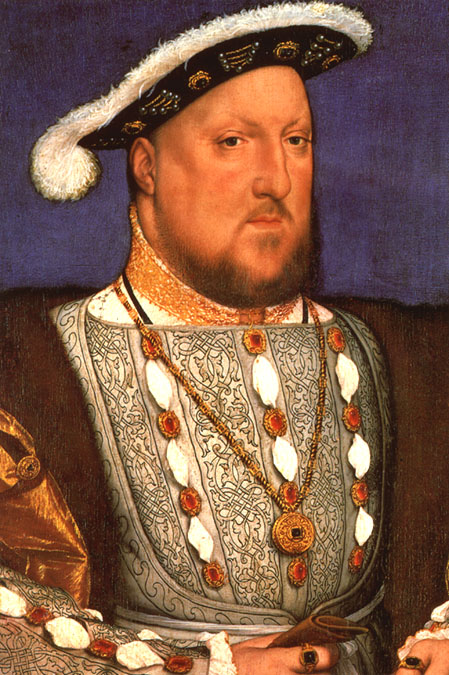
John Lambert – another of Henry VIII’s victims.

henryholbeinJohn Nicholson, or Lambert, was a Norfolk man who studied at Cambridge. He’d come to the attention of Katherine of Aragon and it was due to her nomination that he was elected fellow. However, he shifted away from the Catholicism of his birth and moved to Antwerp where he became acquainted with Tyndale.


He returned to London when it seemed that England was to have its own reformation when Anne Boleyn was in the ascendent. He taught Latin and Greek but unfortunately for him he got into a dispute  about a year after Anne’s execution when the official religious hue of the country was shifting back to its starting point. This argument was reported to the Duke of Norfolk. Norfolk accused Lambert of heresy and had him imprisoned.

During his imprisonment Lambert wrote a paper justifying his belief that Christ was not present in the bread and wine of the Eucharist which he presented to his accusers who promptly handed it over to Thomas Cranmer.

Lambert’s crime was to deny transubstantiation which at this point in the Church of England’s history made him a heretic. The Ten Articles left no room for manoeuvre in this matter. Cranmer tried him and found him guilty of heresy, which is ironic because Cranmer would himself deny transubstantiation as soon as he felt it safe to do so.

Lambert appealed his case directly to Henry VIII – perhaps he thought the monarch was a rational man with Protestant tendencies – after all he’d broken with Rome. Little did he realise that he was going to be at the heart of a show trial to demonstrate that having broken with Rome Henry intended to go no further down the road towards Protestantism. In fact even when the monasteries were being suppressed there were heresy trials and executions.  Henry didn’t have any truck with Lutherans or Zwinglians or any of the other protestant sects that were springing up across Europe. It wouldn’t be long in England and Wales before the Ten Articles shrunk into the Six Articles which were essentially catholic in view but with Henry in charge.


Henry summoned assorted bishops and theologians to Westminster rather fancying himself as a learned theologian himself – afterall he was the Defender of the Faith having launched his repost to Luther in 1521. He also arranged for an audience to gather on specially erected tiered seating.


Richard Sampson, Bishop of Chichester was the ringmaster for the day. He explained to the gathered courtiers and bishops that Lambert had appealed his case to Henry and that Henry was going to demonstrate that it was far from the case that he’d turned German in his religious sympathies. Sampson went on to say that whilst Henry had given the monks the big heave ho it was because they were an idle bunch who encouraged superstition. He also explained that in giving the Bible to the people in English it was to encourage them in their true understanding and away from the superstitious nonsense of the past – a humanist approach if you will.


Henry then exchanged words with the accused who had to explain about having two surnames which didn’t go down well with Hal but the king very graciously said that as Lambert was his subject he wanted him to have the opportunity of understanding the error of his ways and come back into the fold of the true faith even if he was an untrustworthy sort of bloke with two different names which was in Hal’s opinion just plain shifty.


Five hours later six  or so bishops including Cranmer and Gardiner  had disputed with Lambert who hadn’t budged an inch in his views during the entire time. Henry announced Lambert must die on account of the fact he didn’t patronise heretics. Cromwell recorded it as an occasion of Henry’s “inestimable majesty” when he wrote about the event  which suggests that the Vicar General might have thought that someone was reading his letters before they were delivered to their intended recipients.


As he burned on November 22 1538 at Smithfield, Lambert called out, “None but Christ.”

Those of you of a gentle disposition may wish to stop reading at this point.


Henry, allegedly, decreed that Lambert’s suffering should be extended as a warning to all other heretics so the poor man was lifted on pikestaffs from the flames as his legs burned.

Letters from Tudor England November 1535 – monasteries, marauding and a touch of treason

640px-Cromwell,Thomas(1EEssex)01Its that time of week again when I delve through Henry VIII’s letter and papers looking for the thoughts of Thomas Cromwell.

Dr Legh continued his periguination of Norfolk writing to Cromwell on November 19 1535, “there are many pretty houses here in Norfolk, both of monks and canons, which have only a prior and one with him.” He goes on to ask Cromwell what he should do about them.

Elsewhere in the southeast the next stage of the suppression was well under way. The Close Roll of that time reveals the “Surrender to the King of the Premonstratensian Abbey of St. Mary and St. Thomas the Martyr, Langdon, Kent, by Will. Dayer, abbot and the convent” on the 13th November. It notes that the surrender took place in the abbey’s chapter house. That same week the priory of St Mary and St Eanswith in Folkestone closed its doors. The following day the prior of St Mary’s in Dover surrendered along with eight other of his brethren. By the 16th of November Cromwell’s men were in Canterbury writing up their accounts. They informed Cromwell that the majority of the brothers of the suppressed houses were still in situ whilst they awaited new situations, that they’d confiscated the abbey seals so that no further business could be done and that they had checked the inventories of the suppressed houses. They commented rather touchingly of Folkestone. “It is a little house, well repaired, and the prior a good husband and beloved by his neighbours.”


It is easy to imagine that Cromwell was completely consumed by his job as Vicar General but a letter on the 15th of November from Sir William Parr reminds readers of Henry VIII’s letters and papers that Cromwell had oversight of everything. From Sir William we discover that Sir Thomas Clifford the captain of Berwick was “sore sick.” We also discover that Sir William had his eye on Clifford’s job because he asks Cromwell that if Clifford dies could he have the post because his “whole comfort rests upon it.” I can only hope that Sir William enclosed a large gratuity to help Cromwell remember Parr’s name. He might have done well to take note of another correspondent who sent a letter to Cromwell accompanied by a brace of fowl to ensure that Cromwell gave his attention to the annuity which his wife hadn’t received.


Sir William Parr’s letter does demonstrate that it was quite hard for Cromwell to escape the topic of monasteries because he continues his letter with a plea for  Pipwell Abbey in Northamptonshire. Parr offers a heartfelt testimonial to the godliness and hospitality of its inhabitants and asks that Cromwell should show them understanding.  Pipwell was near to Kettering and it had an income of less than £200 a year. The abbey was earmarked for suppression. Interestingly Sir William Parr, who would end up as the King’s brother-in-law, wrote once more to Cromwell offering to give the Vicar General £200 when it became clear that the lesser monasteries, Pipwell included, were to be suppressed. Ultimately, of course, it made no difference and Parr wrote a third time in 1538 asking about pensions for the abbot and the brothers and also that he should have the building and estate – this was duly granted. There are more letters in the archives from Parr because it rather looks as though folk helped themselves to fixtures and fittings that they shouldn’t have touched.


In addition to a spot of bother with Scottish reivers raiding the west march of England there were business matters in Calais to deal with, the ramblings of Lord Lisle and just to finish the week off Cromwell was also required to deal with an outbreak of treason. The vicar of Rye apparently didn’t take well to all those changes that were afoot in the 1530s, in particular the king becoming the Head of the Church of England. He had in his possession a booked called “Eckyus Enchiridyon…against the King’s being head of the Church.” If that wasn’t enough “when he stopped at the Black Friars here of London, friar Dr. Maydland said he would like to see the head of every maintainer of the New Learning upon a stake,—that of his principal among them,—and to see the King die a “vyolent and a shamefull” death; also “to see that myschevous hore the quene to be brent.” He knew by his science of necromancy that the New Learning should be suppressed, and the Old restored by the King’s enemies from beyond sea…” It’s always good to get a charge of witchcraft in with the treason – it makes for a nicely rounded case!


William Inold, the vicar of Rye, had already got away with offending the king once. In 1533 he had likened Henry VIII’s actions to those of King John when the medieval monarch had managed to incur papal wrath and get himself and the whole country excommunicated. Cromwell had Inold arrested on account of his seditious sermonizing but he was eventually released. The new treason laws of 1534 ensured the vicar didn’t escape a second time and the letter in the archives suggests that the evidence collected by Cromwell for the vicar’s second trial was guaranteed to ensure an unhappy end for Inold.


Henry VIII: November 1535, 11-20′, in Letters and Papers, Foreign and Domestic, Henry VIII, Volume 9, August-December 1535, ed. James Gairdner (London, 1886), pp. 271-288. British History Online http://www.british-history.ac.uk/letters-papers-hen8/vol9/pp271-288 [accessed 5 November 2016].

House of Cistercian monks: The abbey of Pipewell’, in A History of the County of Northampton: Volume 2, ed. R M Serjeantson and W R D Adkins (London, 1906), pp. 116-121. British History Online http://www.british-history.ac.uk/vch/northants/vol2/pp116-121 [accessed 11 November 2016].

King’s Mead Priory, Derby


DSC_0491The Benedictine nunnery of King’s Mead in Derby dedicated to the Virgin Mary was the only Benedictine foundation in Derbyshire and its inhabitants were initially under the spiritual and temporal guidance of the abbot of Darley Abbey – an Augustinian foundation.  History reveals that in the twelfth century there was a warden who acted as chaplain to the nuns as well as looking after the nuns’ business affairs. The nunnery grew its land holdings over the next hundred or so years so that it included three mills at Oddebrook. One of the reasons that this may have occurs was because Henry III gave the nuns twelve acres of land. Because the king had shown an interest it is possible that more donors followed suit in an effort to win favour. Equally donors such as Lancelin Fitzlancelin and his wife Avice who gave land and animals to the nunnery in 1230 or Henry de Doniston and his wife Eleanor could expect a shorter term in Pergatory after their deaths because the nuns would be expected to hold them in their prayers as a result of the land transaction.


By 1250 the nuns of King’s Mead and the abbot of Darley Dale were out of sorts with one another. It was decided that the nuns should go their own way and that the abbot of Darley Dale would cease interfering with their business. The land holdings of both organisations were perused and a division occurred.  The nuns were required to give some land to Darley Abbey but it was at this time that the church and living of St Werburgh in Derby along with other agricultural land was signed over to the nuns.

The pattern is similar to countless other monastic foundations across the country, so too are the difficulties that befell the nuns. Sadly they ended up so deeply in debt due to cattle morrain that by 1327 that they had to ask the king for protection as they were not able to offer hospitality to visitors to Derby. This raises an interesting question. Who exactly were the nuns petitioning? Edward II reigned from 1284 until 1327 but he was forced by his wife Isabella of France and her lover Roger Mortimer to hand over his crown to his son, Edward, in January 1327 before being whisked off to Berkeley Castle where he died on the 21st September 1327 (if history is to be believed) due to an unfortunate accident with a hot poker. The petition must therefore have been addressed to King Edward III but realistically it was Mortimer who was in charge at this point in proceedings.


Things looked as though they were improving with the appointment of a new prioress, Joan Touchet, and custodians who could make the books balance. However the priory was still struggling seven years later. Joan was still in charge in 1349 but she died that year. It was the year of the Black Death.


After this time the nunnery seems to have ticked along without cause for concern. A possible reason for this could well have been the charter from Henry IV granting the nuns payment of one hundred shillings every year from the town of Nottingham. Another reason could well have been the fact that it was Derbyshire’s only nunnery so it had the monopoly on educating the daughters of Derbyshire’s leading lights.


Things start to look uncertain for King’s Mead with the reign of Henry VI. The County History reveals the tale of the abbot of Burton demanding the back payment of twenty-one years rent. The prioress, a lady called Isabel de Stanley wasn’t having any of it:


Wenes these churles to overlede me or sue the law agayne me ? They shall not be so hardy but they shall avye upon their bodies and be nailed with arrowes; for I am a gentlewoman comen of the greatest of Lancashire and Cheshire; and that they shall know right well.


With hind sight, it may have been a bit of a foolish thing for the abbot of Burton to do though he can’t have known that Henry VI would end up murdered in the Tower or that the only Lancastrian claimant left standing would be the  step son of one Thomas Stanley. The name Stanley should be ringing bells by now! The prioress was related to Thomas Stanley who just so happened to be Margaret Beaufort’s husband and she of course just so happened to be Henry Tudor’s mother…


Not that being cosy with the Tudors was something that would serve future prioresses of King’s Mead very well. The Valor Ecclesiasticus of 1535, identifies Joan Curzon as prioress and gives the annual value of King’s Mead as £18 6s. 2d. and that the priory was in debt. The nuns of King’s Mead had already had a bit of a shock before the arrival of the visitors. The year before a fake visitor called James Billingford, who claimed to be the queen’s cousin arrived to inspect the barns. He was shown to be a fraud but it wasn’t long before Layton and Legh, Cromwell’s unfunny double act, arrived to poke into King’s Mead’s shady corners. They found nothing apart from a fragment of Thomas of Canterbury’s shirt which was venerated by the pregnant ladies of Derby. Interestingly, despite being the only nunnery in Derbyshire King’s Mead was not given a stay of execution. Perhaps the Prioress didn’t know that Cromwell was open to financial gifts or perhaps the sisters couldn’t afford to pay. In any event the nunnery was suppressed in 1536.


In 1541 the site fell into the ownership of the Fifth Earl of Shrewsbury and by the nineteenth century nothing remained apart from the name Nun Street.


Delving into Cromwell’s correspondence …again

640px-Cromwell,Thomas(1EEssex)01It’s that time of the week when I take the opportunity to ferret through Henry VIII’s 1535 papers in order to find out what Cromwell and his friends were up to during the coming week.  There’s no prizes for guessing that many of the notes were about monasteries and money.

It was becoming clear, thanks to the kinds of questions that Cromwell’s visitors had been asking across the south of England, that the king and Cromwell had plans for the Church’s belongings. As a consequence abbots and priors were beginning to dispose of their assets in an attempt to squirrel away a nest egg before the writing on the wall turned in to disconcerting fact.

Unfortunately for the brethren, and indeed sisters, they weren’t very good at fencing their goods or effecting swift or secret sales as is recorded on November 11 1535 by Thomas Legh and John Ap Rice in a letter to Cromwell. “At many places where we go they have sold lands and goods before we came, and prepared to go away and utterly relinquish their houses; as at a lewd nunnery hereby, called Crabhouse, where they sold lands to Mr. Conysbie, which we have sequestered and stayed the prioress from further alienation.”


Elsewhere there were all sorts of dodgy goings on in Llandaff which Adam Becansaw hints at but rather coyly doesn’t detail – perhaps Cromwell was of a gentle disposition after all and easily shocked. “We found the bishop and his archdeacon named Quarre guilty, not only of great ruin and decay in their mansions, but of other great faults.”


Meanwhile the Prior of Bokenham, who may or may not have been selling off the family silver, was attempting to bribe Cromwell to the tune of 26 shillings whilst trying to cosy up to the Vice Gerant with the news that some of the younger members of his priory were not ‘godly disposed,’ which, presumably, was music to Cromwell’s ears but not necessarily something which reflected terribly well upon the prior.


A rather predictable pattern is beginning to emerge – no doubt it will be continued over the next few weeks until the Pilgrimage of Grace flares up as the local populace of Lincolnshire fear that not only will their monastic houses be suppressed but that their local churches will be closed down. It will add a bit of variety into the equation when the Duke of Norfolk reaches for his quill and paper.

 
‘Henry VIII: November 1535, 6-10’, in Letters and Papers, Foreign and Domestic, Henry VIII, Volume 9, August-December 1535, ed. James Gairdner (London, 1886), pp. 262-271. British History Online http://www.british-history.ac.uk/letters-papers-hen8/vol9/pp262-271 [accessed 17 October 2016].
‘Henry VIII: November 1535, 11-20’, in Letters and Papers, Foreign and Domestic, Henry VIII, Volume 9, August-December 1535, ed. James Gairdner (London, 1886), pp. 271-288. British History Online http://www.british-history.ac.uk/letters-papers-hen8/vol9/pp271-288 [accessed 5 November 2016].


Croxden Abbey- Dissolution, William Cavendish and King John…

croxden-abbey-hero.jpgThe Cistercian abbey of Croxden, in the care of English Heritage, is in Staffordshire, one of approximately thirty religious houses across the county. Its story is similar to many other monasteries. It built its wealth on sheep in the twelfth century and then ran into debt as the political landscape of the countryside changed. By the late thirteenth century it was considerably poorer as a consequence of Edward I’s wars with Scotland and the loans it was forced to make to the warrior monarch. Murrain, plague and poor harvests didn’t help. It never recovered. It’s income in 1535 was given as £103 6s. 7d. which was substantially less than its early income and provided Cromwell with evidence, if he needed it, of the decline of the monasteries.

The Valor Ecclesiasticus reveals that money was paid out to seven laymen who fulfilled essential roles including stewards and bailiffs including the steward of Croxden, Ashbourne, and Caldon, the bailiff of Ashbourne and Caldon. The document for its suppression identifies its full estates of which several were in Derbyshire. Not that the division of land was always simple. Take Trusley, near Derby, for instance. Some of the land around the village belonged to the monks of Croxden whilst other parts belonged to some of Derby’s community of nuns.

By rights Croxden should have been suppressed in 1536 along with the rest of the smaller monasteries but the abbot paid a £100 and received a licence to continue. Two years later on the 17 September 1538 Dr Legh – an infamous abbey visitor and William Cavendish, equally well known at the time but less mentioned in this blog until now, received the surrender of the abbey. Along with the abbot, Thomas Chawner, who received a pension of £26 per annum there were twelve other monks. As with the other abbeys the building was stripped of everything valuable whilst the abbey’s water-mill, its lands and the rectory at Croxden were rented to Francis Bassett who just happened to work for the archbishop of Canterbury, Thomas Cranmer. The archbishop wrote to Cromwell on December 14 1538 asking him to “accomplish his suit.”

250px-William_Cavendish_c1547.jpgWilliam Cavendish had been a servant of Cardinal Wolsey.  He also seems to have been very efficient at taking the surrenders of abbeys.  According to Bess of Hardwick’s biographer, Mary Lovell, there was a point in 1538 where he was overseeing ten surrenders a week. He’d begun by auditing the abbey at St Albans and gone on to gain a job with the Court of Augmentations when it was set up in 1536 by Cromwell specifically to oversee the transfer of Church land to the Crown. He earned twenty pounds a year in addition to the ‘profits of office.’ As Lovell observes, the Cavendishs were not alone in making their fortunes from the reformation but Cavendish seems to have been rather good at it. As for William, these days he is more famous for his third wife – Bess of Hardwick, the foundation of Chatsworth House and his role as Mary Queen of Scot’s jailer.


The monks received their pensions and were required to sign for them. There is a receipt dated May 28 1541 for one Robert Clarke. Another of the monks, a man called John Stanley, became Vicar of Alton in 1546 until his death in 1569. We know this because along with three other men we have the records of his pensions in 1557-58.

A swift search on the Internet revealed the interesting fact that King John’s heart is rumoured to be buried in the grounds of Croxden Abbey whilst the rest of him was buried in Worcester (http://www.farmonthehill.co.uk/local-history.html accessed 4 November 2016 19:45). This information completely sidetracked me from monks being kicked out of their home by Henry VIII, Cromwell and Cavendish.  It sent me off down the side alley of Croxden’s relationship with King John.

Apparently John awarded the monks of Croxden an annuity of £5.00 each year from the Irish Exchequer in 1200. An English Heritage research report shed that much light on the assertion of John’s heart but what about something more academic than a legend? The Gentleman’s Magazine (volume 38) asserts that the descendants of Bertram de Verdun were buried there – so far so good, he was the founder after all and the same sentence references King John’s ticker. In fact Victorian tomes trip over themselves in their desire to identify Croxden as the last resting place of at least one bit of King John. The Antiquarian and Architectural Year Book for Staffordshire explains that John’s physician was also the abbot of Croxden – which would account for the grisly souvenir.  Another text dating from 1829 identifies the abbot as Ralph de Lincoln but misidentifies Croxden as being in Leicestershire. A book dating from 1844 references a British Museum text from the Cotton collection which looks at the Chronicle of William de Shepesheved who details the fact that John’s bowels were buried at Croxden. The whole thing is starting to sound decidedly offal.


Have I been there? No, not yet – but trust me when I say that I shall shortly be finding a reason for being in the vicinity and I shall be studying English Heritage’s interpretation boards with great interest.


Graham Brown, Barry Jones Croxden Abbey and Its Environs London: English Heritage

Lovell, Mary S. (2006) Bess of Hardwick:First Lady of Chatsw0rth. 

G C Baugh, W L Cowie, J C Dickinson, Duggan A P, A K B Evans, R H Evans, Una C Hannam, P Heath, D A Johnston, Hilda Johnstone, Ann J Kettle, J L Kirby, R Mansfield and A Saltman, ‘Houses of Cistercian monks: The abbey of Croxden’, in A History of the County of Stafford: Volume 3, ed. M W Greenslade and R B Pugh (London, 1970), pp. 226-230. British History Online http://www.british-history.ac.uk/vch/staffs/vol3/pp226-230 [accessed 13 October 2016].


‘Henry VIII: December 1538 11-15’, in Letters and Papers, Foreign and Domestic, Henry VIII, Volume 13 Part 2, August-December 1538, ed. James Gairdner (London, 1893), pp. 438-455. British History Online http://www.british-history.ac.uk/letters-papers-hen8/vol13/no2/pp438-455 [accessed 23 October 2016].


‘Henry VIII: May 1541, 26-31’, in Letters and Papers, Foreign and Domestic, Henry VIII, Volume 16, 1540-1541, ed. James Gairdner and R H Brodie (London, 1898), pp. 409-429. British History Online http://www.british-history.ac.uk/letters-papers-hen8/vol16/pp409-429 [accessed 18 October 2016].

Monastic fragments- the Jervaulx Screen

IMG_8232.jpgThe Cistercian monks at Jervaulx Abbey in Wensley Dale were renowned for their horse breeding. Their skill brought great wealth which was a tad tricky for a group of people who’d taken vows of poverty.

Jervaulx’s last abbot, Adam Sedbar, was a sensible man.  He did not wish to rebel against Henry VIII.  When news reached him that the so-called pilgrims of the Pilgrimage of Grace were heading in his direction in 1536 he fled the abbey and went into hiding on Witton Fell. He only came out of hiding when the pilgrims threatened to destroy the abbey – somewhat contrary to their avowed intention of restoring them. Sedbar eventually made his way to Castle Bolton and Lord Scrope where he took no further part in events.

Despite his best attempts to remain uninvolved it was too good an opportunity for Cromwell to miss. Sedbar was implicated in the Pilgrimage and found himself in the Tower of London on treason charges. His name can still be found carved into the masonry of his prison.  The main witness against him was Ninian Staveley, one of his own monks, who was up to his neck in rebellion.  He informed on his abbot in an attempt to save his own life. The abbey and the abbot were both erased in 1537; the abbey and its estates being passed to the crown through the attainder passed against Sedbar.

img_8217

img_8224These days Jervaulx is a picturesque ruin but there is one other remarkable survival to see in St Andrew’s Church, Aysgarth.  The rood screen, so the handy guide in the church tells me, is from the Ripon School of Carving.  In fact when I looked closer I recognised the elephant on the Jervaulx screen as an old friend from Ripon Cathedral. The screen, renovated by those pesky Victorians, is beautiful but it does rather question the Cistercian rule of austerity.  The screen must have been even more spectacular when it was first installed. There’s a frieze of foliage and animals running the length of the screen – that’s where the elephant can be found- as well as a dragon, a fox, a boar, an antelope, an eagle and a lion.  The message is clear if you’re a medieval church goer.  You’re being reminded of all those sins out there waiting to trip you up.  Apparently the antelope is a warning against drink and lustfulness on account of the fact that his horns are entangled in the foliage around him. Oddly enough I wouldn’t have known that unless I’d read it in the handy guide – clearly the medieval mind was much more switched on to visual symbolism.

img_8219

IMG_8237.JPGSymbolism was the least of Aysgarth’s worries. As Tudor England became more Protestant it became more dangerous for the parishioners to keep the Jervaulx screen and the original loft and statues which accompanied it.  In 1567 several churchwardens were required to do penance  for having hidden old papist relics.  The screen inevitably was badly damaged in the ensuing centuries.  It was once part of a much larger edifice.  The statues that belonged with it were burned.


But how did the screen get to Aysgarth?  The right to present the living of the church and take an income or advowson to give it it’s correct name belonged to Jervaulx up until the suppression of the monasteries.  One theory is that the monks seeing which way the wind was blowing transported the choir screen to the church in an attempt to save something of their abbey.  Perhaps the screen was the most beautiful thing they had in their monastery and they wished to preserve it – but that is speculation.  In the second version of the story the parishioners of Aysgarth purchased the screen upon Jervaulx’s suppression.  Either way a thing of great beauty from the days of  England’s monasteries survives tucked away in the Yorkshire dales.

img_8227

As for the rest of the monks, well their reputations as breeders of horses saw them provided with employment in Middleham Castle as well as in receipt of their monastic pensions.

Letters from monastic visitors

640px-Cromwell,Thomas(1EEssex)01The first week of November 1535 brought a flurry of letters to Thomas Cromwell’s door. His monastic visitors were in East Anglia and the South of the country at the time. The letters he received from his visitors, local gentry and from the clerics themselves are typical of the correspondence he received during the collection of information for the Valor Ecclesiaticus and the Comperta in 1535 and 1536.  Visits would continue until 1540 when the last monastery was suppressed – Cromwell would himself be executed the very same year – who says Henry VIII didn’t have a sense of irony?


Thomas Legh (Leigh) wrote of the priory at Fordham near Norwich on November 1 1535. He painted a bleak picture of the aged Gilbertine prior and a monk “at death’s door,” who “begged to be released from a bondage they could no longer endure.” As chance would have it Thomas Cromwell’s own confessor was a Gilbertine monk called Roger Holgate. He was the master of Sempringham. Perhaps it was for this reason that the Gilbertines were excluded from the act that dissolved the lesser monastic houses in 1536. Fordham eventually surrendered in 1538. The surrender document reveals three canons and the prior suggesting that the priory wasn’t in such a grim state as Legh’s letter of November 1st 1535 suggests not least because someone else had written to Cromwell that very same week asking about the disposal of the ‘goodly’ farmhouse at Fordham.


The monks of Chertsey were clearly not at death’s door at the beginning of November 1535. They were busy complaining about their abbot who seemed to be selling off the plate and the abbey’s woods. They had much in common with the monks of Worcester who had already been visited. They sent several letters to Cromwell making accusations, justifying themselves and making counter accusations in a ‘it was his fault’ sort of way.


It must have come as a pleasant surprise, depending upon your point of view, at the end of the week when Cromwell received a letter from the Benedictine Abbot of Athelney, Robert Hamblyn, asking to be allowed to leave the precincts of the abbey in order to do the abbey’s business. He notes that the visitor there, one Tregonell, found the abbey in good order. Athelney’s clean bill of health would not save it from dissolution. It finally surrendered on Feb 8 1539 despite the pleas of the abbot.


Grist to Cromwell’s mill of anticlerical justification for the closure of monastic houses was provided when John Ap Rice wrote of another Benedictine establishment. The Abbot of Bury St Edmunds met with very little approval on account of his dodgy financial practices and gambling habits. Apparently “he lay much forth in his granges” and spent money at dice and cards and in building; also that he did not preach and had converted farms into copyholds. “He seems addict also to superstitious ceremonies.”


The superstitions were related to the abbey’s relics which included “the coals that Saint Lawrence was toasted withal, the paring of St. Edmund’s nails, S. Thomas of Canterbury penknife and his boots and divers skulls for the headache, pieces of the Holy Cross able to make a whole cross of, other relics for rain.” I must admit a degree of curiosity regarding the inventory.  Ultimately all the relics would be sent to Cromwell – let’s hope that the “divers skulls for the headache” helped him as he worked late into the night accounting for all that monastic wealth.  And further more – were the relics to cause rain or to prevent it? Occasionally it could be wished that Mr Ap Rice was slightly more detailed in his written accounts to Cromwell.


As with the monks of Athelney Ap Rice left an injunction that they were not to leave their precinct and as with Athelney the abbot immediately wrote to Cromwell asking permission to go out and about on abbey business. He also saw fit to give Cromwell an annual pension of ten pounds that was later increased – whilst it didn’t save the abbey it certainly made the abbot’s life much easier in the long term with regards to his pension and associated perks.


Ap Rice also noted in his letter that he’d dismissed a number of monks at Bury who hadn’t reached their twenty-fourth birthday.  This confirms the rumours contained in Chapuys’ (the Imperial Ambassador) letters of that week which talk of rumours of youthful monks being dismissed from their monastic houses.

images

‘Houses of Gilbertine canons: Priory of Fordham’, in A History of the County of Cambridge and the Isle of Ely: Volume 2, ed. L F Salzman (London, 1948), pp. 256-258. British History Online http://www.british-history.ac.uk/vch/cambs/vol2/pp256-258 [accessed 30 October 2016].

‘Henry VIII: November 1535, 1-5’, in Letters and Papers, Foreign and Domestic, Henry VIII, Volume 9, August-December 1535, ed. James Gairdner (London, 1886), pp. 248-262. British History Online http://www.british-history.ac.uk/letters-papers-hen8/vol9/pp248-262 [accessed 12 September 2016].

Adam Becansaw’s letter to Cromwell

640px-Cromwell,Thomas(1EEssex)01I’ve been doing one of my favourite things, reading Henry VIII’s letters and papers.  In particular I look for the correspondence between Cromwell and the commissioners charged with visiting all the monastic houses in England and Wales during 1535/36. As Vicar-General Cromwell organised a national visitation of monastic houses.  It was the first and last time such a thing was done in England and Wales.

Today I was delighted to come across a rather wonderful letter of complaint from one of Cromwell’s abbey visitors who was clearly hard at work in Wales during the month of October 1535.

A priest, Adam Becansaw, working for Cromwell wrote from the diocese of St Asaph that one of his fellow visitors  Robert Ap Rice’s son Ellis Ap Robert (clearly following the Welsh method of naming) was not really being a terribly good example to the monks that he’d come to find fault with.  It turns out that he’d acquired a young woman in Coventry “whom he took from her mother,” and was also using the King’s commission in taverns to get freebies and better lodgings.  Becansaw, the letter writer, goes on to add that the letter should have been accompanied by sixty pounds worth of goods from the bishop of St Asaph but young Ap Robert’s behaviour had apparently given the locals courage to refuse payment.  The letter is dated the 14th October 1535.

Becansaw took a dim view of ‘concubines’ full stop – whether they belonged to the clerical classes or his fellow commissioners.  He’d already seen off the women of the priests and monks of Bangor.  In 1536 they wrote to Cromwell saying that Becansaw had been unreasonable in not allowing them to have any contact what so ever with women because whilst they agreed that perhaps they shouldn’t come into monastic private quarters that really and truly they were required to run the kitchens and provide hospitality to travellers. (Williams: 282).

Elsewhere in Wales,  Becansaw was concerned that the clergy and local gentry were doing very little to enforce the Act of Supremacy.  Or in other words, in places like Llandaff, it was business as usual despite what the king might say in London.

Rather more alarmingly when the visitors arrived at Vale Crucis the abbot, one Robert Salisbury, was arrested for highway robbery and forgery (which conjures a picture).  He was carted off to the Tower of London.  Further research on the ‘inter web’ reveals that Salisbury was known to have a bit of a dodgy reputation when he took on the job and several of the monks of Vale Crucis had relocated themselves to other abbeys as a consequence of his tenure so that there were only six monks in residence.

So at the end of this post I’m left with more questions than I’ve answered- what happened to Ellis Price or Robert depending on the name system you wish to follow?  What about his woman?  What happened to the abbot of Vale Crucis? Yes, its a cliff hanger – but I’m not totally sure I’m going to find all the answers any time soon.  It is however one of the reasons why I like delving around in primary sources.  You meet new and ‘interesting’ people on a regular basis.  Needless to say I was supposed to be looking for something else!

 
‘Henry VIII: October 1535, 11-20’, in Letters and Papers, Foreign and Domestic, Henry VIII, Volume 9, August-December 1535, ed. James Gairdner (London, 1886), pp. 195-218. British History Online http://www.british-history.ac.uk/letters-papers-hen8/vol9/pp195-218 [accessed 12 October 2016].

Williams, Glanmor. (1993) Reformation and Renewal in Wales 1415- 1642 (Oxford History of Wales vol III).


Reginald Pole – White Rose and Cardinal

reginald pole.jpgThe Pole family descended from Margaret, Countess of Salisbury (the daughter of the duke of Clarence who was allegedly executed in a vat of malmsey and Isobel Neville – elder daughter of the earl of Warwick a.k.a. The Kingmaker). She had four sons; Henry (Lord Montagu), Arthur, Reginald and Geoffrey.    There was also a daughter called Ursula. Had Richard III won the Battle of Bosworth and remained childless and Margaret’s brother the young earl of Warwick been deemed unfit to rule then his heirs would have been the Poles.


Young Reginald was born in about 1500.  He was educated by the Carthusians in Sheen and from there studied at the universities of Oxford and Padua and from there to Paris; all at the expense of his royal cousin King Henry VIII.  There is a note in Henry’s accounts describing him as “Mr Pole, the king’s scholar.”

In the summer of 1530 he became caught up in the King’s Great Matter.  In addition to using the Leviticus 20:21 and checking with Jewish communities in Europe as to their interpretation of the Old Testament in order to undermine Catherine of Aragon’s countering Deuteronomy argument, Henry also sent messengers  to the great university to elicit their opinions on the matter.  On May 1 Henry asked the University of Paris for an opinion and made Reginald his “dearest relative” the chief correspondent on the matter.

Reginald seems initially to have backed his cousin.  His letters record that Paris found in Henry’s favour but that the other faction were looking for a counter-opinion. (Bernard: 214).  By the end of the year, however, Reginald appears to have been having second thoughts. It was perhaps his concern over the divorce that led him to turn down Henry’s offer of the archbishopric of York following Wolsey’s demise.  Henry must have thought that Reginald would be in favour of the divorce to offer him the post.  He needed as many bishops on his side as possible. Henry offered the post to Reginald for a second time and saw him in person to discuss the matter.  Apparently the sight of Henry was enough to convince Pole that he couldn’t go agains this own heart on the matter.  He even sent a lengthy apology on the subject which no longer exists.  In it he warned of the dispute that might arise if Princess Mary was disinherited and reminded Henry of the Wars of the Roses – which was perhaps not an entirely sensible thing to do as it reminded Henry about who had the Plantagenet blood flowing through their veins and who might have been monarchs in other circumstances.


In January 1532 Pole went off to Europe to continue with his academic studies and to keep a low profile which he did until 1535 when Henry demanded that he wanted Reginald’s opinion on the subject of Henry’s supremacy, the divorce and the break with Rome.  Henry  helpfully sent him some books on the subject. By the time Henry had his answer Sir Thomas More and Bishop Fisher were dead as were the Carthusian monks of the Charter House in Sheen who’d taught him as a boy.  Reginald described Henry as a ‘wild beast’; being like a dirty barrel and incestuous (perhaps a reaction to the fact that Henry had an affair with Anne Boleyn’s sister Mary).  It was perhaps not a response designed to win friends and influence people nor was it a very private response as it was soon published all over Europe; later Reginald would claim that it was without his consent.

Henry politely suggested that Reginald return home for a face to face discussion.

By now Pope Paul III was in charge and he suggested that perhaps Reginald’s welcome would be rather too warm if he set foot on English shores.  It can’t have helped that the Imperial Ambassador, Chapuys, had suggested that perhaps Reginald might be able to marry the Princess Mary and take the crown from Henry in 1534. The small matter of Pole’s religious orders seems not to have worried the ambassador unduly (though Pole didn’t celebrate his first mass until Queen Mary was on the throne). Chapuys had already told the Pole family to keep Reginald in Europe rather than at home where he’d most likely have ended up in the Tower at the very least.

On 22nd of December 1536 Reginald was made a cardinal having made a name for himself in Rome where his humanist education leant itself to the reform of the Catholic Church from within.  To add insult to Henry VIII’s injury Reginald was made papal legate of England in February 1537.

Reginald’s actions reminded Henry that there was such a thing as a ‘white rose faction’.  The Pilgrimage of Grace in 1536 was ultimately used to round up Reginald’s mother and brothers following the Exeter Conspiracy.  It hadn’t helped Lord Montagu that he’d sent a letter to Reginald berating him for the contents of his book on the subject of Henry’s supremacy and the break from Rome. The poor man must have squirmed horribly when Thomas Cromwell turned up to visit him especially to read chunks of his brother’s rebuttal of Henry’s actions.  Even the Countess of Salisbury had written to Reginald demanding that he come home and face the music.  Both these letters had been seen by the King’s council before they were sent to Reginald (Seward: 295).  By 1539 Geoffrey was in the Tower and he in his turned implicated the rest of his family. He, his brother and his mother would be executed.

Reginald, in Europe, found himself facing assassination attempts that would continue throughout Henry’s life was increasingly disturbed by the extent to which the Church in England faced destruction.  Ultimately he sought the help of Francis I of France and also Catherine of Aragon’s nephew, Charles V, arguing that Henry was worse than the Turkish threat.  Charles chose not to invade England and Reginald’s name found its way onto a bill of attainder in 1539. Henry VIII had come to hate his Plantagenet cousin. For Englishmen who didn’t want to lose their catholicism he became an alternative to the Tudors.


It was only when Henry VIII’s daughter Mary took the throne after the brief reigns of her half brother Edward VI and the nine days queen Lady Jane Grey that Pole returned to England after a long career as a papal diplomat.  He’d even been suggested as pope.  Mary wrote to her cousin asking for spiritual guidance, his attainder was reversed and despite a lack of concord with Mary’s spouse Philip II of Spain he stepped foot on English soil once more at Dover in 1554.  The country was Catholic once more.  He sought now to heal the breach with Rome – notable amongst the victims of Mary’s determination to wipe Protestantism from English thoughts included the burning of Thomas Cranmer who Pole replaced as Archbishop of Canterbury.

Reginald Pole died on the 17th November 1558 on the same day as Queen Mary.  Their plan to return England and Wales to Catholicism bound to fail as Protestant Princess Elizabeth was now hailed Queen Elizabeth I.

The portrait of Pole pictured at the start of this post may be found at Hardwick Hall, a National Trust property, in Derbyshire.

Bernard, G.W. (2005) The King’s Reformation. New Haven and London: Yale University Press

Seward, Desmond. (2010)  The Last White Rose: The Secret Wars of the Tudors. London: Constable


Rochester Cathedral

DSC_0466.jpgIts that time of year again when my mind turns to teaching.  This term I’m back with Henry VIII and his wives and mistresses; the Norman Conquest and the English Reformation so that should keep me out of mischief for a while, though thankfully Henry’s love life is rather closely bound to the progress of the English Reformation.  Today though I’m sticking with cathedrals: Rochester Cathedral to be specific – it has links with all the courses I have just mentioned one way or another.

In the aftermath of the conquest Rochester found itself in the hands of Bishop Odo, William the Conqueror’s half-brother. Once Lanfranc of Bec was created Archbishop of Canterbury the territory around Rochester was wrested from Odo’s control and given to the newly appointed Bishop of Rochester, who at this stage we could think of as a kind of deputy to the Archbishop of Canterbury, not that the influence or power lasted very long.

Both the cathedral with its Benedictine abbey and the early castle at Rochester, an important crossing point for the Medway,  were the work of this bishop.  Bishop Gundulf was a Norman appointment well known to Archbishop Lanfranc.  Like Lanfranc, Gundulf was a monk at Bec before being summoned across the Channel to help reform the English Church along Norman lines.  Gundulf turned out to have been a bit of a builder having a hand in the building of the Tower of London as well as the castle and cathedral at Rochester. He began work on Rochester Cathedral in 1080 using imported stone from the quarries at Caen. By 1083 his workmen had started on the nave which still stands despite a fire in 1138 which saw the monks made homeless for a time. The crypt is also a good example of the Romanesque or Norman style of architecture.

DSC_0481

The problem for later Bishops was that the cathedral’s powerful neighbour in Canterbury owned more of the land around Rochester than Rochester did.   Not only was Rochester a cathedral being the seat of the bishop it was also an abbey.  Inevitably with the passage of time there were ructions between the needs of the more worldly bishops and the more inward looking monks and their prior especially when the bishop was not selected from one of their number.

The first instance of this occurred in 1124 when the monks, fearful of their position, did a spot of creative thinking and miraculously discovered some long lost saintly relics and Bishop Gundulf who was by then a saint was remembered in a new book, the contents of which did’t bother unduly with the actual facts. Whilst they were at it, the monks set about creating a dossier of charters and rights that resulted in the monks and the bishops barely being on speaking terms. Nor did it go down well in Canterbury.  Words like forgery were bandied around.

However, the death of Thomas Becket improved the relationship between the monks and the bishops of both Rochester and Canterbury primarily because the monks now discovered that they were on a booming pilgrim route – think of Rochester Abbey as offering a medieval ‘good night guarantee’.

Just when things couldn’t have been more eye-brow raising a pilgrim who’d managed to get all the way to Jerusalem and back without mishap was murdered in Rochester.  William of Perth arrived in 1201, got himself murdered by his servant and then performed a miracle by curing a woman who touched the body.  She was mad before but apparently became completely sane afterwards. William of Perth, a baker by trade, became an overnight success and a saint. The money that accrued from pilgrims flocking to William’s shrine paid for a new gothic east end to the cathedral.

DSC_0475

We’ll move on from King John who looted the cathedral in 1215.  Things went from bad to worse. In 1264 the cathedral and abbey fell victim to England’s civil war with soldiers stabling their horses in the cathedral.

The later monks didn’t seem to have the same inventive spirit of the earlier ones and by the end beginning of the thirteenth century the abbey was very badly in debt.  Fortunately Prior Hamo came along and gave the monks and the cathedral a badly needed injection of energy.  He launched a new period of building work in 1320.

There remains one more Bishop of Rochester who is impossible to ignore.  He was executed on Tower Hill in June 1535 for failing to accept the supremacy or the fact of his monarch’s new marriage.  His name was John Fisher. The monks at Rochester had all taken the oath of supremacy in 1534.

The following year Dr Layton arrived to visit the abbey as part of Thomas Cromwell’s Visitation of the Monasteries.  In 1539 the monks of Rochester Abbey were shown the door and then allowed to return as the dean and chapter of six canons of one of Henry VIII’s new cathedrals.


Cannon, Jon. (2007) Cathedral: The Greatest English Cathedrals. London: Constable

‘Houses of Benedictine monks: The cathedral priory of St Andrew, Rochester’, in A History of the County of Kent: Volume 2, ed. William Page (London, 1926), pp. 121-126. British History Online http://www.british-history.ac.uk/vch/kent/vol2/pp121-126 [accessed 17 August 2016].

Edward Hasted, ‘The city and liberty of Rochester: The priory and cathedral church’, in The History and Topographical Survey of the County of Kent: Volume 4(Canterbury, 1798), pp. 86-110. British History Online http://www.british-history.ac.uk/survey-kent/vol4/pp86-110 [accessed 16 August 2016].